

Read the first chapter
The whole of chapter one, free. About 7 min. Turn the pages with the arrows, your keyboard, or a swipe.
Chapter 1
Reclaiming Your Reality Baseline
When Your Memory Starts Asking Permission
What exactly happened - or what did you get trained to believe happened? After an argument, do you replay the conversation while brushing your teeth, driving to work, or lying awake at 2 a.m.? You remember the sharp comment. Then the denial. Then your own apology, even though you weren’t sure what you’d done.
Nadia, 34, an ER nurse and divorcee, knows this loop well. Her former husband could make a cutting remark, wait for her reaction, and then say she was “too sensitive.” If she brought it up later, he’d insist she had misunderstood. Nadia began keeping her questions to herself. She checked her texts repeatedly. She asked friends, “Did I make that bigger than it was?” before trusting her own memory.
Eventually, the problem wasn’t only what he said. It was that Nadia had started treating his version as the official record. She noticed herself doing the same thing at work after a tense exchange with a supervisor: “Maybe I heard it wrong.” That’s the pattern gaslighting leaves behind - an inner habit of putting your experience on trial. Do you recognise yourself in this?
The Question That Restores the Record
What if the goal isn’t to prove your memory is perfect, but to separate the facts from the distortion?
You don’t need a flawless recording of every conversation to rebuild trust in yourself. You need a clear way to sort the pieces. What happened is one piece. What you felt is another. What someone claimed about your reaction is a third. Gaslighting scrambles those pieces until your feeling is treated as evidence against you.
Before using the Reality Ledger Protocol, Nadia might write: “We argued because I overreacted. He said I was impossible. I probably pushed him too far.” Notice how quickly the facts disappear. “We argued” is vague. “I overreacted” is someone else’s judgment presented as truth. “I pushed him too far” is an assumption.
After using the protocol, her entry looked different: “At 7:40 p.m., I asked whether he had cancelled our appointment without telling me. He laughed and said I was obsessed. I felt embarrassed and angry. He then said the conversation proved I was unstable. The distortion was that asking a direct question was treated as evidence of instability.” That version doesn’t require Nadia to declare herself completely right. It gives her a trustworthy reference point.
This matters because emotional manipulation often attacks the map, not just the moment. If someone can convince you that your feelings are facts, your facts are feelings, and your questions are attacks, you lose your bearings. The Reality Ledger Protocol gives each part its proper place.
How the Distortion Takes Hold
The pattern usually moves faster than you realise:
1. When someone denies a clear event or reframes your question as an attack, your attention shifts from what happened to whether you’re allowed to mention it. 2. You feel confused, tense, ashamed, or suddenly responsible. Your body may tighten before your mind has words for the problem. 3. So you start investigating yourself instead of the interaction. You reread messages, soften your account, apologise, or ask the other person to explain your own experience. 4. Which leads to a weakened internal reference point. Their interpretation becomes the measuring stick, while your memory and feelings seem unreliable.
Here’s the alternative chain:
1. When someone denies an event or labels your reaction, pause before accepting their version. 2. You identify the three separate parts: what happened, what you felt, and what was distorted. 3. So you record observable details without arguing about motives. You write the words used, the timing, your response, and the claim made about you. 4. Which leads to a steadier internal reference point. You may still feel hurt or uncertain, but uncertainty no longer erases the facts.
The goal isn’t to win a courtroom case inside your head. It’s to stop handing the judge’s chair to the person who confused you.
Name the event, name the feeling, name the distortion - and keep them separate.
Check Your Internal Reference Point
Use these prompts with a specific recent interaction, not your whole relationship. Rate yourself honestly. There’s no prize for giving the “strong” answer.
1. From 1 to 10, how clearly can you describe what happened without adding the other person’s opinion of you? A low number suggests their interpretation has become tangled with the event. A higher number means you can describe observable details, even if you still feel emotional.
2. From 1 to 10, how quickly do you label your own reaction as the problem? A high number may show that you’ve absorbed the habit of treating anger, sadness, or confusion as proof you’re wrong. A lower number suggests you can notice a feeling without using it to convict yourself.
3. Yes or no: Can you name one exact sentence the other person used, rather than only describing their general attitude? “No” may mean the interaction left you flooded or that you’ve been trained to doubt your recall. “Yes” gives you a useful starting point for separating facts from conclusions.
4. From 1 to 10, how confident are you that you can identify what was distorted? A low score is not failure. It may mean the manipulation worked by blending a real event with a false explanation. A higher score means you can spot the leap - for example, “I asked a question” becoming “I’m controlling.”
For a quick interpretation, look for the lowest score. That’s your current pressure point. If your event score is low, focus on concrete details. If your reaction score is high, practise naming feelings without judging them. If your distortion score is low, look for the moment a description turned into a character attack.
Nadia’s first ratings were 4 for describing events, 8 for blaming her reaction, and 3 for spotting distortion. That told her where to begin. She didn’t need to solve every memory. She needed to slow down one interaction and put each piece back in its place.
The 15-Minute Reality Ledger
Create one clean record before your mind edits it for someone else.
1. Within 24 hours of a confusing interaction, set a 15-minute timer. Difficulty: Medium. On paper or in a private note, write three headings: What happened, What I felt, and What was distorted. Under the first heading, record only observable details: time, place, exact words you remember, and what happened next. Don’t explain motives yet.
2. Spend five minutes naming your response without judging it. Difficulty: Easy. Write two or three feeling words, plus what your body did. For example: “I felt cornered and embarrassed. My chest tightened. I stopped speaking.” Then write the claim made about your reaction: “I was told that being upset proved I was unstable.”
3. Finish by circling the distortion and writing a balanced correction. Difficulty: Hard. Nadia might write: “Distortion: my question was called an attack. Correction: asking for information is not automatically an attack.” Keep the correction modest and accurate. You’re not replacing one extreme story with another.
You’ll know it’s working when:
• You can describe the event without immediately apologising for having feelings. - You can say, “I felt afraid,” without adding, “so I must have been wrong.” - You can identify the exact point where a fact was turned into a judgment about your character.
If writing the full entry feels too difficult, use a one-minute version: “The fact was __. I felt. The distortion was __.” That small record still interrupts the old habit. The aim is not beautiful journaling. It’s keeping your reality from being overwritten while the interaction is still fresh.
Keep the ledger private if sharing it would put you at risk or invite more argument. This tool is for clarity, not for persuading someone committed to misunderstanding you.
What You Now Know
Your reality becomes more trustworthy when you stop forcing facts, feelings, and distortions to answer for one another.
• A confusing interaction can be mapped without proving every detail beyond doubt. - Your feelings are information about your experience, not evidence that you caused the problem. - A person’s label for your reaction is not the same thing as what happened. - The Reality Ledger Protocol rebuilds clarity by separating the event, your response, and the distortion.
Nadia still has moments when the old doubt returns. She still rereads a message sometimes. The difference is that she no longer treats doubt as a verdict. She can make a record, locate the distortion, and return to what she knows.
That is a practical kind of self-trust. Not loud certainty. Not pretending you never get confused. Just the ability to pause and ask, “What belongs to the event, what belongs to my feelings, and what was added to make me doubt myself?”
Once you can map the past more clearly, what new choices become possible in the present?
End of chapter one. 7 more chapters in the full book.
Swipe or use the arrows to turn the page


What's inside: 8 chapters
- 1. Reclaiming Your Reality Baseline
- 2. Unlearning the Gaslighting Script
- 3. Breaking the Self-Doubt Loop
- 4. Building Boundaries Without Guilt
- 5. Correcting Memory Distortion Fast
- 6. Responding With Calm, Not Reactivity
- 7. Rebuilding Trust in Yourself
- 8. Turning Recovery Into Purpose
About this book
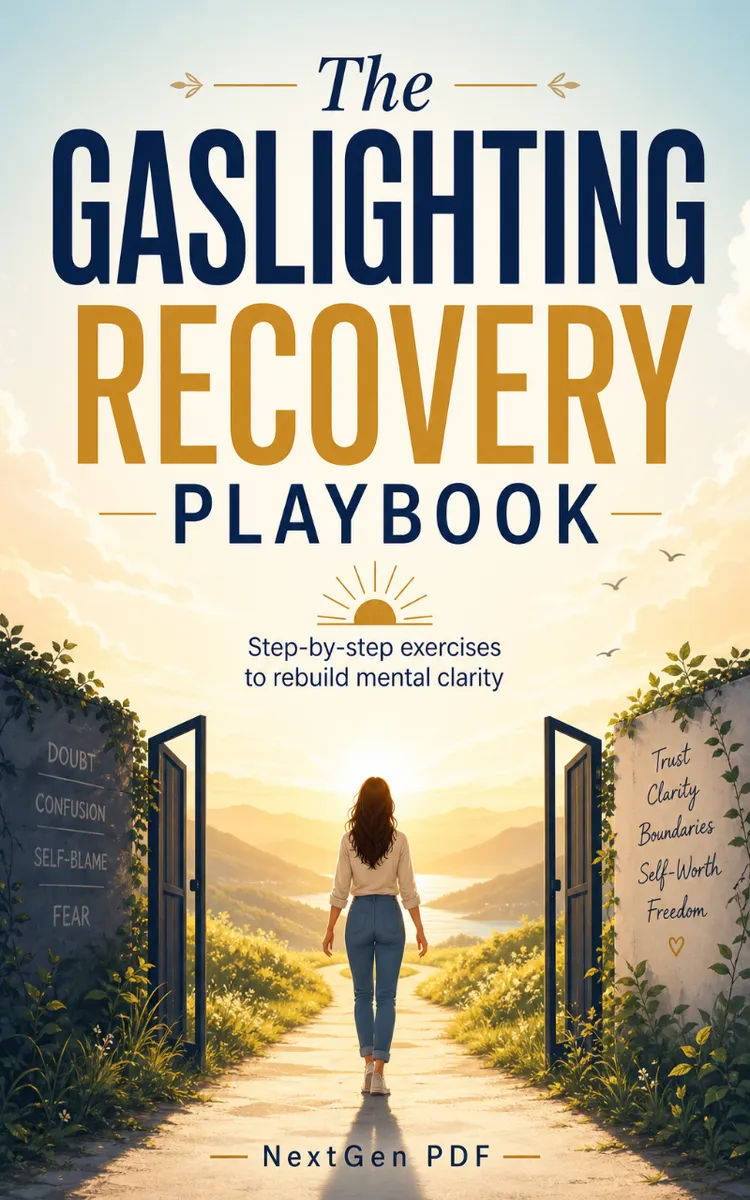
"The Gaslighting Recovery Playbook" is a self-help book by NextGen PDF with 8 chapters and approximately 12,389 words. Recovery from gaslighting using cognitive reframing exercises.
This book was created using Inkfluence AI, an AI-powered book generation platform that helps authors write, design, and publish complete books. It was made with the AI Self-Help Book Writer.
Frequently Asked Questions
What is "The Gaslighting Recovery Playbook" about?
Recovery from gaslighting using cognitive reframing exercises
How many chapters are in "The Gaslighting Recovery Playbook"?
The book contains 8 chapters and approximately 12,389 words. Topics covered include Reclaiming Your Reality Baseline, Unlearning the Gaslighting Script, Breaking the Self-Doubt Loop, Building Boundaries Without Guilt, and more.
Who wrote "The Gaslighting Recovery Playbook"?
This book was written by NextGen PDF and created using Inkfluence AI, an AI book generation platform that helps authors write, design, and publish books.
How can I create a similar self-help book?
You can create your own self-help book using Inkfluence AI. Describe your idea, choose your style, and the AI writes the full book for you. It's free to start.
Write your own self-help book with AI
Describe your idea and Inkfluence writes the whole thing. Free to start.
Start writingCreated with Inkfluence AI


