
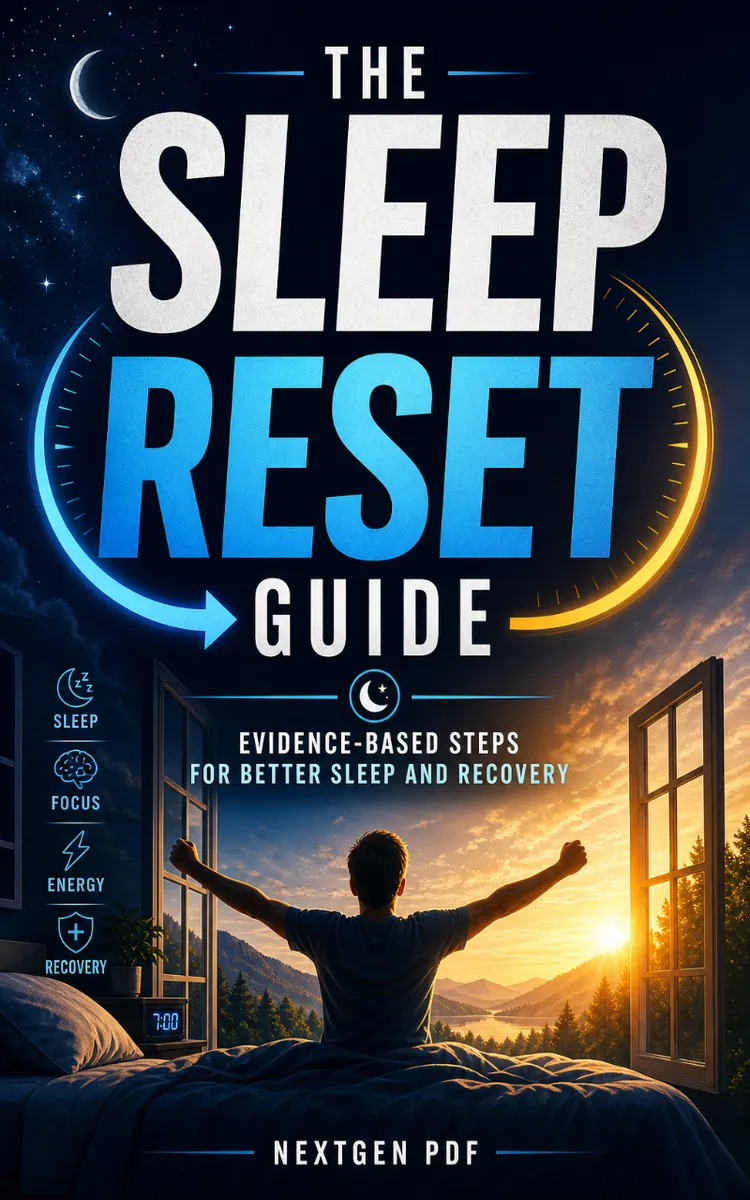

Read the first chapter
The whole of chapter one, free. About 9 min. Turn the pages with the arrows, your keyboard, or a swipe.
Chapter 1
Circadian Rhythm Reset Basics
Light Timing and Consistent Schedules: What This Reset Can Change
A single hour of light timing can swing your internal clock more than you’d think - often within a few days you’ll notice your body “starting to line up” with the bedtime and wake time you’re trying to keep. For many people, sleep doesn’t improve because they’re missing a secret trick; it improves because their body is getting the right signals at the right time, day after day. That’s the core idea behind this chapter: light timing plus consistent schedules helps your brain re-sync its daily rhythm, so falling asleep and staying asleep feel steadier.
You can expect a more reliable sleep window, fewer “my body won’t power down” nights, and a calmer rhythm to your day - especially for people whose sleep has drifted because of late screens, irregular wake times, or rotating work hours. This works best when you treat your schedule like a light-and-dark “steering wheel,” not a suggestion. Think: what you do with morning light, evening light, and your wake time is the reset lever.
Who this is for: If you’ve tried to “sleep earlier” but your bedtime keeps slipping, or you feel tired at the wrong times (wired-but-tired, wide awake at 2 a.m., sleepy during the wrong hours), this is for you. If your work schedule changes day to day, like it does for Nadia - an ICU nurse who rotates shifts - this is also for you.
Key benefits readers often notice: - Easier wind-down because your brain gets the “night” signal on schedule - Faster rhythm recovery after schedule drift - Less nighttime tossing because your internal clock gets pulled back toward your target sleep window
Takeaway prompt: Look at your last two weeks. What time did you actually wake up most days - close to your target, or drifting?
How Your Internal Clock Gets Re-Lined by Light (and Why It Sometimes Won’t)
Your sleep timing is driven by your circadian rhythm - your body’s built-in 24-hour timing system. The “clock” in your brain responds strongly to light, especially bright light in the morning and dim light in the evening. When those signals don’t match the schedule you want (for example, bright light late at night, or sleeping in on “off days”), your rhythm can shift forward or backward - so your body asks for sleep at the wrong time.
A helpful way to picture it: your brain uses light as a daily map. Morning light helps say, “It’s daytime - start the day.” Evening dimness helps say, “Night is coming - prepare for sleep.” When you shift those signals, you shift your clock.
Here are the most common reasons light timing and schedules get off track:
1. Irregular wake times (even by 60-90 minutes) 2. Bright light at the wrong time (late-night screens, overhead lighting, driving home in bright streetlights) 3. Not getting enough morning brightness (staying indoors, curtains closed) 4. Rotating schedules that force your body to switch “day mode” and “night mode” too often
Risk factors tend to be practical, not mysterious. If you already run on a later bedtime, if you’re exposed to bright light after dark, or if your job requires shift changes, your circadian rhythm has more chances to drift. Nadia, for instance, doesn’t just have a late bedtime problem - she has “body time” mismatches. Her ICU shifts can push her wake time around, and that means her brain receives inconsistent morning and evening light cues.
Two important terms to keep straight as you read: melatonin is a hormone your body releases more at night, and circadian phase is simply where your internal clock is “set” along the 24-hour day. Light - especially timing - affects both. Morning light tends to advance your circadian phase (pull it earlier), while evening light tends to delay it (push it later). That’s why the reset isn’t mainly about willpower. It’s about repeating the right cues until your body learns the pattern again.
Takeaway prompt: Ask yourself: do you get bright outdoor light within an hour of waking, or do you start the day in dim indoor light?
The Chrono-Lock Reset Model: A Clear Light + Schedule Protocol for Real Life
The Chrono-Lock Reset Model is simple on purpose: you lock your wake time to a target as much as possible, then you use light to “lock in” the rhythm. The goal isn’t perfection - it’s consistent daily cues that pull your internal clock toward your desired sleep window.
Step 1: Pick your “anchor wake time” (and protect it) Choose a wake time you can realistically keep on most days. In practice, many people do well with a difference of no more than 30 minutes between weekdays and weekends during the reset.
• If you’re currently waking at wildly different times, start by choosing the wake time you can keep most days, not the ideal one.
Nadia’s example (ICU rotating shifts): On days she can, she anchors to the wake time that lets her get morning light before work. On shift days where waking is forced earlier, she still protects the timing of her morning light window (details below) rather than trying to “make up” sleep by sleeping in after.
Step 2: Use morning light like a steering wheel (frequency + duration) Within 0-60 minutes after waking, aim for 10-20 minutes of outdoor bright light (overcast counts, but aim for brightness). If you can’t go outside, use a bright window and a bright room setup, but outdoor is usually stronger.
Do this every day during the reset, including weekends, as long as you’re using the anchor wake time.
If you want a progression: - Days 1-3: Start with 10 minutes - Days 4-7: Move toward 15-20 minutes if your schedule allows - Week 2: Keep it steady - don’t keep increasing forever
Why this matters: morning light helps shift your circadian phase toward your target bedtime. Consistency is what makes it “stick.”
Step 3: Dim your evening light to help night signals land In the last 60-90 minutes before your target sleep, reduce bright light. You don’t need “cave mode.” You do need fewer “daytime” signals.
A practical evening setup: - Lower overhead lights or switch to lamps - Use screen brightness lower than you normally would - Consider night mode or a warmer color setting on your device - If you must be in bright light (like driving home), be extra strict about keeping the next room environment dim once you’re home
Frequency guidance: do this nightly, every night you’re trying to reset.
Step 4: Protect your sleep window with schedule consistency (progression milestones) For the first 7-10 days, focus less on exact bedtime and more on keeping the rhythm cues consistent. Your body tends to respond in phases - some people notice improvements earlier, others need a full week.
Use these milestones: - By Day 3-5: You may notice you’re sleepier at a more predictable time (even if bedtime isn’t perfect yet) - By Day 7-10: Your wake time becomes easier to hold, and nighttime awakenings may feel less frequent - By Week 2: Your internal clock often feels “steadier,” meaning fewer late-night delays
If you’re shifting due to rotating shifts, your milestone still counts - but you’ll measure it against your anchored days. Nadia, for example, tracks whether she can fall asleep faster after her “reset evening” and whether her morning light routine remains doable.
Warning signs: when to get professional help Light and schedule changes are generally safe, but seek professional guidance if you notice any of the following during your reset: - You’re getting very little sleep for several nights in a row (for you) and feel increasingly wired or agitated - Mood changes that feel intense or out of character - Symptoms that keep returning regardless of consistent light timing (especially if you also have breathing issues during sleep or severe daytime impairment)
A quick boundary: if you’re already under licensed care for sleep or mental health, treat this as supportive routine - not a reason to stop or ignore your current plan.
Quick comparison: how “timing” vs “duration” plays out Here’s a simple way to tell whether you’re aiming at the right lever:
| What you’re changing | What you’ll usually notice | Best use in the Chrono-Lock Reset | |---|---|---| | Morning light timing (within 0-60 minutes after waking) | Earlier or steadier sleepiness | Do this daily | | Evening dimming (60-90 minutes before bed) | Less delayed bedtime, easier wind-down | Do this nightly | | Bedtime “chasing” (trying to force earlier bedtime only) | Mixed results, more frustration | Use lightly; prioritize wake anchor + light |
Takeaway prompt: Today, can you commit to one thing: outdoor morning light for 10 minutes within an hour of waking?
Common Mistakes That Keep Your Clock From Moving
Even when people understand “light matters,” they often apply it in a way that doesn’t actually move the clock. These are the mistakes that show up most often in real routines - especially with shift work.
Morning Light Only on Off Days Why it happens: Off days feel like “free time,” so people go outside then - but their internal clock shifts based on what happens most days, not what happens occasionally. If your morning routine is inconsistent, your brain keeps getting mixed signals.
What to do instead: Make morning light part of your daily cue, even on busy days. During the reset, aim for 10-20 minutes within 0-60 minutes after waking every day you can. If you can’t go outside, use the brightest available indoor setup and get as close to the window timing as possible.
Reflection prompt: What would it take to do morning light on your “hard days,” not just your “easy days”?
Too Much Evening Brightness After You’re Trying to Sleep Why it happens: People dim lights for bedtime, but then they keep normal brightness while scrolling, gaming, or working on a laptop. If the screen and room lighting stay bright in the last 60-90 minutes, your brain may delay melatonin release and keep you alert.
What to do instead: Pick a nightly cutoff for your “bright mode.” For example: after the last 60 minutes before bed, reduce overhead lighting and use night mode/warmer settings. If you can’t avoid bright light (like commuting), be strict about dimming once you arrive home.
Reflection prompt: What’s your most common “last bright thing” before sleep - one screen, one overhead light, one late show?
Changing Wake Time Every Day Without a Direction Why it happens: People try to “sleep when you can” and then wonder why the rhythm won’t settle. If wake times drift frequently, the clock can’t reliably lock onto your target sleep window.
What to do instead: Choose an anchor wake time and keep it within 30 minutes on most days. If you work rotating shifts, anchor as best you can on the days you have control, and keep your morning light timing tied to waking even on shift days.
Reflection prompt: Can you name your realistic anchor wake time for the next week - even if it’s not your dream wake time?
Your Next Move: Lock the Cue, Then Let Your Body Catch Up
When light timing and schedule consistency start working, it feels less like a battle and more like a rhythm you can steer. You’re not trying to “be tired” at a specific hour - you’re sending clear daily signals that make sleep come more naturally. Nadia’s day-to-day reality in the ICU won’t vanish, but her reset improves when her morning light and her evening dimming are treated like non-negotiable cues, not optional extras.
If you want one simple takeaway to carry into the rest of your reset plan, it’s this: your wake time anchors the calendar, and your light anchors the clock. Get those cues aligned for about a week, then adjust based on what your body actually does - faster sleepiness, fewer delays, steadier nights. That’s the momentum that turns “I’m trying” into “it’s working,” and it sets you up for the next step in using your schedule with even more precision.
End of chapter one. 7 more chapters in the full book.
Swipe or use the arrows to turn the page


What's inside: 8 chapters
- 1. Circadian Rhythm Reset Basics
- 2. Sleep Hygiene That Actually Works
- 3. CBT-I for Insomnia and Sleep Anxiety
- 4. Stimulus Control for Faster Bedtime
- 5. Sleep Pressure and Napping Rules
- 6. Exercise Timing for Better Sleep
- 7. Caffeine, Alcohol, and Nicotine Cutoffs
- 8. Sleep Apnea Screening and When to Seek Care
About this book
"The Sleep Reset Guide" is a health & wellness book by NextGen PDF with 8 chapters and approximately 15,906 words. Sleep improvement strategies and reset plan for restful nights.
This book was created using Inkfluence AI, an AI-powered book generation platform that helps authors write, design, and publish complete books. It was made with the AI Health Book Generator.
Frequently Asked Questions
What is "The Sleep Reset Guide" about?
Sleep improvement strategies and reset plan for restful nights
How many chapters are in "The Sleep Reset Guide"?
The book contains 8 chapters and approximately 15,906 words. Topics covered include Circadian Rhythm Reset Basics, Sleep Hygiene That Actually Works, CBT-I for Insomnia and Sleep Anxiety, Stimulus Control for Faster Bedtime, and more.
Who wrote "The Sleep Reset Guide"?
This book was written by NextGen PDF and created using Inkfluence AI, an AI book generation platform that helps authors write, design, and publish books.
How can I create a similar health & wellness book?
You can create your own health & wellness book using Inkfluence AI. Describe your idea, choose your style, and the AI writes the full book for you. It's free to start.
Write your own health & wellness book with AI
Describe your idea and Inkfluence writes the whole thing. Free to start.
Start writingCreated with Inkfluence AI


