

Read the first chapter
The whole of chapter one, free. About 7 min. Turn the pages with the arrows, your keyboard, or a swipe.
Chapter 1
Baking Soda pH Basics Explained
What Baking Soda Can - and Cannot - Change
Could a small amount of white powder change how your body handles acid, while leaving most of your body’s pH almost untouched? That question is the key to understanding baking soda. Sodium bicarbonate - the chemical name for baking soda - is not a universal “alkalizer.” Its effects depend on where it travels, how much is used, and what your body is already managing.
The useful outcome here is not a promise of curing disease or “detoxing” the body. It is a clearer way to judge realistic benefits: baking soda may temporarily neutralize acid in the stomach, and under certain conditions it may influence acid balance during intense physical effort. It does not safely reset your entire body’s pH, and more is not better.
Who this is for: adults curious about baking soda’s health and wellness uses who want practical, evidence-aware boundaries before trying it. The main benefits of learning these basics are simple:
• You can separate local acid relief from whole-body claims.
• You can understand why timing and dose matter.
• You can recognize when sodium or bicarbonate may be a poor fit.
• You can use the pH-Buffer Map to match a possible use with the body area, goal, and safety check involved.
Ask yourself: are you seeking temporary relief from stomach acid, support around strenuous exercise, or a general “alkaline” effect? Those are different questions. The first step is naming the real target rather than treating pH as one number for the whole body.
The pH-Buffer Map: Where the Effect Actually Happens
pH is a measure of acidity and alkalinity. A lower pH means more acidic; a higher pH means more alkaline. The scale is logarithmic, so a small numerical shift represents a meaningful change in acidity. But the body is not one open container. Your stomach, blood, urine, and muscles have different environments and different controls.
Baking soda works mainly as a buffer. A buffer helps resist a change in acidity by reacting with acids or bases. When sodium bicarbonate meets stomach acid, it can neutralize some of that acid and produce carbon dioxide and water. That reaction explains why an antacid effect may occur - and also why belching, bloating, or stomach pressure can follow.
The pH-Buffer Map keeps three questions together:
• Place: Where is the proposed effect - stomach, blood, urine, or working muscle?
• Purpose: Is the goal temporary acid neutralization, exercise support, or something else?
• Pressure point: What could make the approach risky, such as sodium intake, kidney function, heart conditions, medication use, or excessive dosing?
The stomach is the easiest place to understand. Its normal contents are strongly acidic because acid helps break down food and supports digestion. Baking soda can raise stomach pH for a short time by neutralizing acid. That does not mean it repairs the cause of recurring heartburn, and it does not make the entire body alkaline.
Blood pH is tightly controlled by the lungs and kidneys. Acid - base balance means keeping blood acidity within a narrow working range. If blood pH shifts substantially, the body treats that as a serious problem - not as a wellness opportunity. Drinking baking soda is therefore not a sensible way to “alkalize the blood.” In some medical settings, sodium bicarbonate is used under professional supervision, but that is different from casual self-treatment.
During very hard exercise, muscles produce more acidic byproducts as energy demand rises. Researchers have examined whether bicarbonate availability can help buffer some of that acidity and delay the feeling that limits repeated, high-intensity efforts. Results can vary by activity, person, and protocol. Stomach upset is common enough to matter, and a kitchen-spoon approach is not a reliable performance plan.
Urine is another area where pH can change, but urine pH is not a report card for the pH of your blood or tissues. Diet, hydration, kidney handling, and medications can all influence it. A strip showing a higher urine pH does not prove that baking soda improved whole-body health.
Sodium is the major risk factor many casual users miss. Baking soda contains sodium, so repeated or large amounts may add a meaningful sodium load. People with high blood pressure, heart failure, kidney disease, liver disease, fluid-retention problems, or sodium-restricted diets need professional guidance before using it internally. It can also interfere with how some medicines are absorbed or managed. Ask a pharmacist or clinician about spacing and suitability rather than guessing.
The practical takeaway is powerful: baking soda can change acidity where it contacts or enters the body, but the location determines the meaning. Use the pH-Buffer Map before you think about any dose.
A Safer Way to Test the Idea
Start by defining the target in one sentence: “I want short-term stomach-acid relief,” or “I am considering bicarbonate for a specific, intense training session.” If you cannot name the target, do not begin with an internal dose. A vague goal encourages vague use, and vague use is where timing, repetition, and sodium exposure can quietly grow.
For occasional stomach-acid symptoms, a labeled antacid product is easier to measure than loose baking soda. Follow that product’s directions exactly, including the maximum daily amount and duration. Do not use a kitchen spoon to estimate a dose. If symptoms occur more than twice a week, persist despite label-directed use, or keep returning for longer than two weeks, arrange a medical review rather than extending self-treatment.
If a clinician or pharmacist confirms that sodium bicarbonate is appropriate for you, keep a simple record for the first use: the exact product, measured amount, time, food taken with it, symptoms, and any other medicines used that day. Do not repeat it several times because the first attempt did not feel immediate. Baking soda reacts quickly with stomach acid, but more frequent use increases sodium and side-effect exposure.
For exercise, do not make a first trial before an important event. A qualified sports dietitian, clinician, or pharmacist can help assess whether the plan fits your health history and training goal. If professional guidance supports a trial, test it during a normal training session at least several days before competition, use a measured product, and stop if significant gastrointestinal symptoms occur. Progression should mean evaluating tolerance and usefulness - not automatically increasing the amount.
A quick comparison helps keep the boundaries clear:
Proposed goal
What baking soda may affect
Main limitation
Occasional stomach acidity
Acid in the stomach for a limited time
Does not treat every cause of recurring symptoms
“Alkalizing” the body
Usually not blood pH in a safe, meaningful way
Blood pH is tightly regulated
Intense exercise
May influence buffering during some efforts
Benefits vary; stomach upset and sodium matter
Raising urine pH
Urine acidity may change
This does not prove whole-body benefit
Stop and seek prompt professional advice for severe or persistent abdominal pain, repeated vomiting, black or bloody stools, chest pressure, trouble breathing, fainting, confusion, marked swelling, or a sudden change in urination. These signs need evaluation, not stronger home alkalizing efforts. If you have kidney, heart, liver, or blood-pressure concerns, or take prescription medicines, ask before internal use even when symptoms seem minor.
Your practical checkpoint is this: choose the body location, define the purpose, confirm the safety boundary, and measure rather than estimate. That sequence turns pH curiosity into responsible decision-making.
Errors That Distort the pH Picture
Mistake: Treating “alkaline” as a whole-body reset
Why it happens: Food labels, social posts, and urine-test results can make pH sound like a single wellness dial. A higher urine reading may then be mistaken for proof that the blood or muscles have been improved.
What to do instead: Return to the pH-Buffer Map. Name the location first. Baking soda may neutralize stomach acid, and it may affect buffering during selected intense efforts, but it does not safely override the lungs and kidneys that regulate blood pH. Use symptom improvement or a defined training outcome - not an at-home urine number - as the relevant question.
Mistake: Measuring baking soda by guesswork
Why it happens: Baking soda is inexpensive, familiar, and already found in the kitchen. That familiarity can make a heaped spoon seem harmless, especially when a small amount does not produce the hoped-for effect.
What to do instead: Use a product with clear directions and a proper measuring method. Follow the stated maximum and duration. Never “top up” quickly, and do not turn occasional use into a daily habit without professional advice. Remember that every internal amount also brings sodium.
Mistake: Ignoring the reason symptoms keep returning
Why it happens: Neutralizing acid can feel like an immediate solution, so recurring heartburn may be managed repeatedly without asking why it is happening.
What to do instead: Treat occasional relief and recurring symptoms as separate situations. Follow label directions for short-term use, but arrange a review when symptoms are frequent, persistent, worsening, or accompanied by warning signs. A pharmacist or clinician can also check interactions, kidney and heart considerations, and safer alternatives.
Baking soda’s chemistry is real, but chemistry is not the same as a blanket health claim. The strongest starting point is precision: identify the acid, identify the location, identify the purpose, and respect the body systems that already keep pH in range. Once those basics are clear, the broader benefits - and the limits - of baking soda become far easier to judge.
End of chapter one. 7 more chapters in the full book.
Swipe or use the arrows to turn the page


What's inside: 8 chapters
- 1. Baking Soda pH Basics Explained
- 2. Heartburn and Reflux Relief Protocol
- 3. Exercise Performance and Fatigue Buffering
- 4. Kidney Stone Prevention With Urine pH
- 5. Oral Health and Breath Support
- 6. Skin pH for Itch and Irritation
- 7. Baking Soda Foot Soak for Odor
- 8. Safety, Contraindications, and Lab Checks
About this book
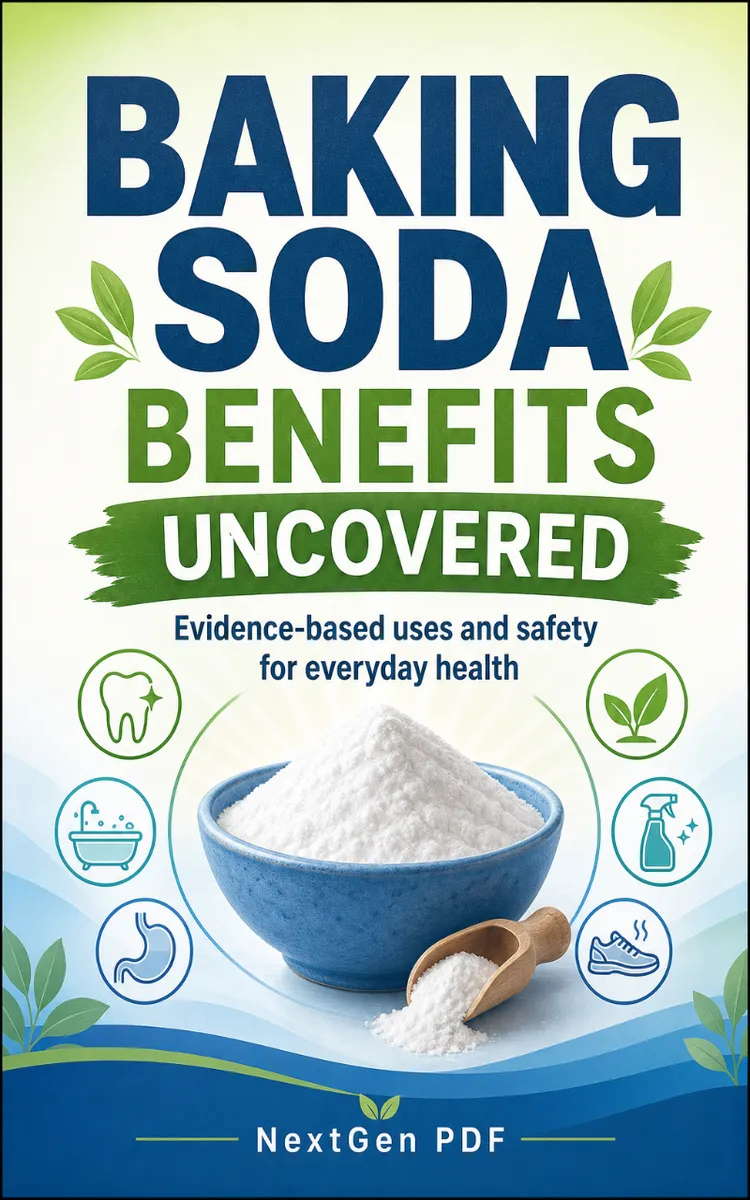
"Baking Soda Benefits Uncovered" is a health & wellness book by NextGen PDF with 8 chapters and approximately 12,568 words. Health and wellness uses of baking soda.
This book was created using Inkfluence AI, an AI-powered book generation platform that helps authors write, design, and publish complete books. It was made with the AI Health Book Generator.
Frequently Asked Questions
What is "Baking Soda Benefits Uncovered" about?
Health and wellness uses of baking soda
How many chapters are in "Baking Soda Benefits Uncovered"?
The book contains 8 chapters and approximately 12,568 words. Topics covered include Baking Soda pH Basics Explained, Heartburn and Reflux Relief Protocol, Exercise Performance and Fatigue Buffering, Kidney Stone Prevention With Urine pH, and more.
Who wrote "Baking Soda Benefits Uncovered"?
This book was written by NextGen PDF and created using Inkfluence AI, an AI book generation platform that helps authors write, design, and publish books.
How can I create a similar health & wellness book?
You can create your own health & wellness book using Inkfluence AI. Describe your idea, choose your style, and the AI writes the full book for you. It's free to start.
Write your own health & wellness book with AI
Describe your idea and Inkfluence writes the whole thing. Free to start.
Start writingCreated with Inkfluence AI


