

Read the first chapter
The whole of chapter one, free. About 10 min. Turn the pages with the arrows, your keyboard, or a swipe.
Chapter 1
How Do We Know What’s True?
About This Topic
A footprint in wet sand is an observation. Evidence begins when you ask whether the footprint really came from a person, check other clues, and test explanations against what you find. This chapter follows Questions 1-12 through that journey: observations, evidence, experiments, controls, models, predictions, and the uncertainty that keeps discovery honest.
Questions and Answers
Q1: What is the difference between an observation and evidence?
A: An observation is something you notice or measure. Evidence is an observation that helps support or challenge a possible explanation.
Suppose a plant near a window grows taller than a plant in a dark cupboard. “The plant is taller” is an observation. It becomes useful evidence for the idea that light affects growth only after you measure both plants carefully and consider other differences, such as water, soil, temperature, and age.
Evidence does not have to be dramatic. A thermometer reading, a photograph, a sound recording, or a repeated measurement can all count. The important question is whether the information connects clearly to the question being investigated.
Ask yourself:
• What exactly was observed?
• Was it measured accurately?
• Could another explanation fit the same observation?
Takeaway: Observations are the raw clues; evidence is a clue tested for how well it supports an explanation.
Related: See also Q2 about testing explanations | Q5 for why experiments need controls
Q2: How do scientists turn a question into something they can test?
A: Scientists turn a broad question into a specific claim that could be checked with observations or measurements.
For example, “How can plants grow better?” is too wide for one simple experiment. A testable version might be: “Do bean plants grow taller when they receive eight hours of light each day than when they receive four hours?”
A useful process is:
• Name what you will change, such as hours of light.
• Name what you will measure, such as plant height after fourteen days.
• Keep other important conditions similar, including water, soil, and pot size.
• Decide what result would support the claim.
The claim is often called a hypothesis, meaning a proposed explanation or prediction that can be tested. A hypothesis is not a lucky guess. It should connect to what is already known and make a clear prediction.
Takeaway: A strong scientific question points to a measurement and a fair test.
Related: See also Q3 about hypotheses | Q6 for repeated testing
Q3: Is a hypothesis just a guess?
A: No. A hypothesis is a testable explanation based on observations or existing knowledge, not a random guess.
If a metal spoon feels colder than a wooden spoon in the same room, you might hypothesize that metal transfers heat away from your hand faster than wood. That claim can be tested by measuring how quickly each material changes temperature.
A good hypothesis has three features:
• It explains something you noticed.
• It can be tested.
• It could turn out to be wrong.
That last feature matters. “Everything happens because of invisible magic” is not useful scientifically if no possible observation could challenge it. A scientific idea must take a risk by making a prediction.
Scientists may revise a hypothesis after new evidence appears. Changing an explanation is not failure. It is how ideas become more accurate.
Takeaway: A hypothesis earns trust by surviving careful tests, not by sounding certain.
Related: See also Q2 about testable questions | Q8 about predictions
Q4: What makes evidence trustworthy?
A: Trustworthy evidence is collected carefully, measured as accurately as possible, and checked against other explanations.
Imagine a digital sensor reports that a room is 5 degrees Celsius warmer after a heater is turned on. That result is more convincing if the sensor was working properly, the measurement was repeated, and the room was not also warmed by sunlight.
Scientists look for several qualities:
Quality
Why it matters
Accuracy
The measurement is close to the true value.
Repeatability
Similar tests produce similar results.
Fairness
The test does not secretly favor one outcome.
Relevance
The evidence actually bears on the question.
Transparency
Other people can understand how it was collected.
One measurement can be useful, but it may also be unusual. A pattern seen across many careful measurements is usually stronger.
Takeaway: Do not ask only, “What is the result?” Ask, “How was the result obtained?”
Related: See also Q5 about controls | Q7 about repeated results
Q5: Why do experiments need controls?
A: Experiments need controls so researchers can tell what caused a result.
Suppose you want to know whether a new fertilizer helps plants grow. You give the fertilizer to one group and nothing extra to another group. The second group is the control. If both groups receive the same water, light, soil, and temperature, then differences in growth can be compared more fairly.
Without a control, many causes can get mixed together. Perhaps the fertilized plants also received more sunlight. Perhaps they were planted in larger pots. Perhaps they were healthier from the beginning.
A control does not always mean “nothing happens.” In a medicine study, the control group might receive the usual treatment or a harmless placebo, a look-alike treatment with no active ingredient.
Takeaway: A control gives an experiment a comparison point, helping separate cause from coincidence.
Related: See also Q2 about fair tests | Q6 for repeating experiments
Q6: How can I tell whether an experiment was fair?
A: Check whether the experiment changed one main factor while keeping other important factors similar.
Use this quick test:
• What factor was changed?
• What result was measured?
• What conditions were kept the same?
• Was there a control group?
• Were enough trials performed?
For a paper-towel experiment, you might compare how much water different brands absorb. The paper towels should be the same size, the water volume should be measured, and the time allowed for absorption should be equal. Testing each brand once would be weak; testing each several times gives a better sense of the usual result.
Fair does not mean perfect. Real experiments have limits. A careful researcher names those limits instead of pretending they do not exist.
Takeaway: A fair experiment makes the comparison clear enough that the result has a reasonable chance of answering the question.
Related: See also Q5 about controls | Q7 about repeatability
Q7: Why do scientists repeat experiments?
A: Scientists repeat experiments to find out whether a result is a real pattern or a one-time accident.
A seed may sprout quickly because conditions happened to be ideal. A sensor may give one strange reading. A person may improve after a treatment because of natural recovery rather than the treatment itself. Repeating the test helps reveal whether the same result appears again.
Repeating can happen in two ways:
• The original team performs the test several times.
• A different team follows the method and checks whether it gets a similar result.
Repeats do not guarantee truth. A mistake can be copied, especially if the method is poor. That is why researchers also compare methods, inspect data, and encourage independent checking.
Takeaway: One result can raise an interesting possibility; repeated results make the possibility harder to dismiss.
Related: See also Q4 about trustworthy evidence | Q10 about uncertainty
Q8: What is a scientific model, and why use one?
A: A scientific model is a simplified representation of something complicated, used to explain how it works or explore what might happen.
A model can be a drawing, a physical object, a computer program, or a set of mathematical rules. A globe models Earth’s shape. A weather model uses data and equations to estimate future conditions. A diagram of blood flow can show how the heart, vessels, and lungs work together.
Every model leaves something out. A globe does not show every mountain, and a weather model cannot include every swirl of air in the atmosphere. The goal is not to copy reality perfectly. The goal is to keep the details that matter for a particular question.
A model is useful when its results match observations well enough to guide further testing. If it fails, researchers adjust it or replace it.
Takeaway: A model is a map of reality, not reality itself.
Related: See also Q9 about predictions | Q11 about changing scientific ideas
Q9: How do scientists make predictions?
A: Scientists make predictions by using evidence and models to state what they expect to happen under specific conditions.
A prediction might be: “If a metal expands when heated, then a measured metal rod should become slightly longer as its temperature rises.” The prediction is useful because it tells researchers what to measure.
Predictions can be made with different levels of confidence. A well-tested model may forecast the path of a spacecraft with great precision. A model of next month’s weather may be less certain because the atmosphere is extremely complicated and small changes can grow over time.
A prediction is not a promise. It is a claim that can be checked later. When observations disagree with it, scientists ask whether the model, the measurements, or the assumptions need closer examination.
Takeaway: A prediction turns an explanation toward the future and gives evidence a chance to answer back.
Related: See also Q8 about models | Q10 about uncertainty
Q10: Is uncertainty a sign that scientists do not know anything?
A: No. Uncertainty shows how much confidence a measurement or prediction deserves and what remains unknown.
If a scale reports a package as 2.00 kilograms, the true value may be slightly higher or lower because the scale has limits. Scientists might report the result as 2.00 kilograms with a small range around it. That range is an uncertainty estimate.
Uncertainty can come from:
• Limited or noisy measurements
• Changing conditions
• Incomplete data
• Limits in a model
• Random variation
A weather forecast saying there is a 70 percent chance of rain is not useless because it is not certain. It gives a better guide than pretending rain is guaranteed or impossible.
Good science makes uncertainty visible. That helps people decide what to do and shows where better measurements could improve knowledge.
Takeaway: Uncertainty is not the opposite of knowledge; it is a clear label on the edges of knowledge.
Related: See also Q9 about predictions | Q12 about reading scientific claims
Q11: What’s the difference between “scientists changed their minds” and “science was wrong”?
A: Scientists change their conclusions when stronger evidence shows that an earlier explanation was incomplete or mistaken.
For centuries, many people thought Earth was the center of the universe. Better observations and mathematical explanations eventually showed that Earth moves around the Sun. The earlier idea was not improved by defending it forever; it was replaced because it could not explain the evidence as well.
Science is not a list of permanent guesses. It is a process for comparing explanations. Some ideas remain reliable across many tests, while others are narrowed or replaced.
There is an important difference:
• Changing an idea because of new evidence is scientific progress.
• Changing an idea without evidence is simply changing an opinion.
When researchers update a model, they often keep the parts that still work. A newer explanation may explain more observations while preserving useful older results in familiar situations.
Takeaway: Good science is willing to improve its answers when reality provides better clues.
Related: See also Q8 about models | Q10 about uncertainty
Q12: How can I avoid being fooled by a scientific-sounding claim?
A: Ask how the claim was tested, what evidence supports it, and whether the conclusion goes beyond the evidence.
Use these questions:
• What exactly is being claimed?
• Is there measurable evidence?
• Was there a comparison or control?
• Were the results repeated?
• Could another explanation fit the same result?
• Does the source explain uncertainty and limits?
Be careful with phrases such as “proven completely,” “works every time,” or “scientists say” when no researchers, methods, or measurements are named. A dramatic graph can also mislead if its vertical scale starts above zero or if only successful results are shown.
This does not mean rejecting every surprising claim. Surprising ideas can be correct. It means giving them the same careful treatment as ordinary ideas: define the claim, inspect the evidence, and wait for independent checks when the stakes are high.
The practical habit is simple: pause before sharing. Look for the measurement, the comparison, the method, and the uncertainty.
Takeaway: Scientific thinking is not memorizing what to believe. It is learning how to check why a claim deserves belief.
Related: See also Q4 about trustworthy evidence | Q11 about changing ideas
Key takeaways from this chapter:
• Observations become evidence when they are measured, checked, and connected to a clear question.
• Controls and repeated tests help separate causes from coincidences.
• Models make complicated systems easier to study, while predictions test whether models work.
• Uncertainty marks the limits of what is known - and points toward the next discovery.
End of chapter one. 7 more chapters and about 19,817 words in the full book.
Swipe or use the arrows to turn the page


What's inside: 8 chapters
- 1. How Do We Know What’s True?
- 2. The Strange Rules of the Quantum World
- 3. Smart Machines and Artificial Intelligence
- 4. The Future of the Human Body
- 5. Earth’s Changing Climate and Living Systems
- 6. Could People Live Beyond Earth?
- 7. Searching the Universe for Life
- 8. Tomorrow’s Biggest Questions
About this book
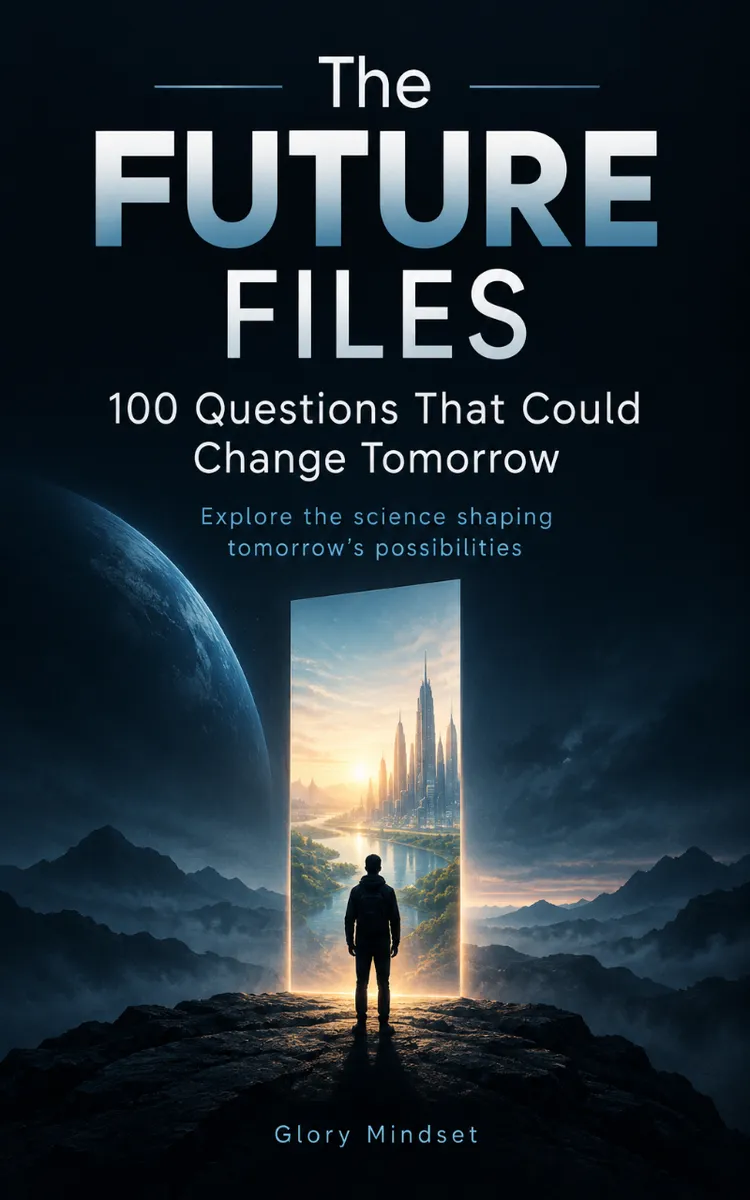
"The Future Files: 100 Questions That Could Change Tomorrow" is a q&a book by Glory Mindset with 8 chapters and approximately 19,817 words. Future science, quantum computing, space travel, biology, and life on Earth.
This book was created using Inkfluence AI, an AI-powered book generation platform that helps authors write, design, and publish complete books.
Frequently Asked Questions
What is "The Future Files: 100 Questions That Could Change Tomorrow" about?
Future science, quantum computing, space travel, biology, and life on Earth
How many chapters are in "The Future Files: 100 Questions That Could Change Tomorrow"?
The book contains 8 chapters and approximately 19,817 words. Topics covered include How Do We Know What’s True?, The Strange Rules of the Quantum World, Smart Machines and Artificial Intelligence, The Future of the Human Body, and more.
Who wrote "The Future Files: 100 Questions That Could Change Tomorrow"?
This book was written by Glory Mindset and created using Inkfluence AI, an AI book generation platform that helps authors write, design, and publish books.
Write your own q&a book with AI
Describe your idea and Inkfluence writes the whole thing. Free to start.
Start writingCreated with Inkfluence AI


