

Read the first chapter
The whole of chapter one, free. About 9 min. Turn the pages with the arrows, your keyboard, or a swipe.
Chapter 1
When the Machine Writes First
The Message That Arrived Before Its Author
In 2023, a New York lawyer submitted a brief containing invented legal cases after relying on ChatGPT for research. The machine had produced polished citations; the human had signed them. The failure was not that the software could write. It was that fluent writing made checking feel unnecessary.
Generative AI now drafts emails, apologies, customer replies, school announcements, performance reviews, and condolence messages. Its sentences often arrive clean, balanced, and complete before the person who requested them has decided exactly what they mean. That reversal is the subject here: not whether a machine can produce words, but what happens when the first version of a message comes from somewhere other than the person sending it.
A draft is never merely a collection of sentences. It carries facts, tone, relationships, timing, and responsibility. The Draft-to-Decision Loop follows the path from machine-generated language to human judgment, asking where editing changes a message from plausible text into an accountable act.
When a machine writes first, who is still responsible for what the words mean?
From Predictive Text to Public Voice
The machinery behind generative writing grew from an older idea: language can be modeled by predicting what comes next. Earlier systems offered autocomplete, corrected spelling, or selected a likely reply from a small menu. Modern language models work at a much larger scale. They generate text by calculating relationships among words and patterns learned from vast collections of writing.
That process can produce an email to a landlord, a note to a teacher, or a response to a dissatisfied customer in seconds. The model does not begin with personal experience or a private understanding of the relationship. It begins with patterns. If a request resembles thousands of professional messages, it can assemble a response that sounds professional. If the prompt asks for warmth, brevity, firmness, or apology, the system can alter the surface accordingly.
The result is useful precisely because everyday communication contains repeated forms. A scheduling message has familiar parts: the reason for writing, the proposed time, the request for confirmation. A customer-service reply often acknowledges inconvenience, explains the next step, and closes politely. Generative AI handles these patterns much as a skilled copy editor handles a standard letter - except that it can create a complete draft before anyone has supplied the details that make the message true.
That distinction matters. A machine may write, “I understand how frustrating this must be,” without understanding frustration. It may write, “We have reviewed your account,” even when no review has occurred. It may add a confident explanation because confident explanations are common in the material from which it learned.
The sentences can be grammatically sound and still be wrong in ways grammar cannot detect.
The Draft-to-Decision Loop
The first turn of the Draft-to-Decision Loop is not writing but intention. A person supplies a situation: decline an invitation, explain a delay, ask for a refund, tell an employee that a deadline was missed. The more general the request, the more room the system has to fill gaps. “Write a firm email about the problem” leaves unanswered what happened, what remedy is wanted, and how much of the relationship should be preserved.
The generated draft then creates an unusual psychological effect. Before AI, people commonly began with fragments, awkward openings, or a blank screen. Those rough beginnings exposed uncertainty. A machine draft conceals it beneath smooth prose. Once a complete message is visible, its structure can make the underlying decision seem settled.
Human editing is therefore not a cosmetic final pass. It is the point at which facts are tested, promises are owned, and tone is brought back into contact with the relationship. An editor may remove a sentence claiming that a refund has been processed, replace a vague apology with a precise acknowledgment, or reject a cheerful closing that would sound insulting after a serious mistake.
Consider a school administrator responding to a parent who reports repeated bullying. A generated reply might be courteous and reassuring, but it could also imply that the school has investigated, that support has been offered, or that the matter is under control. Those statements are not harmless decoration. They describe actions and create expectations. The administrator must decide what is known, what remains uncertain, and what the school is actually prepared to do.
A similar issue appears in small businesses. A plumber using AI to answer a complaint about a missed appointment may receive a polished message promising improved scheduling. If the business has not changed its scheduling system, the sentence is empty at best and misleading at worst. The machine has supplied a socially familiar solution; the owner must determine whether that solution exists outside the paragraph.
The loop moves from draft to decision when a person asks, in effect: Is this accurate? Is this what I mean? Is this appropriate for this relationship? Am I willing to be answerable for it?
The Strange Authority of Smooth Sentences
The counterintuitive finding is that better-sounding drafts can create greater risk than visibly clumsy ones. Awkward language invites correction. Fluent language often passes as evidence that the underlying thought is sound.
This changes the usual picture of editing. The human is not simply improving a machine’s style. The human is interrupting the authority that fluency seems to grant. A polished paragraph can hide an unsupported assumption, an invented detail, or a promise no one intended to make. The central danger is not that AI writes badly; it is that it can write convincingly before the facts have been examined.
That problem has a long technological history. Spell-checkers changed the appearance of errors without deciding whether a sentence was truthful. Email templates standardized routine communication without knowing whether a recipient needed a personal explanation. Generative AI combines those older conveniences with the ability to produce novel wording on demand. It does not merely complete a sentence; it proposes a version of the situation.
The proposal can influence the writer. If the draft sounds apologetic, the user may accept an apology. If it sounds firm, the user may become firmer. If it includes a reason that was never supplied, the reason may survive simply because it makes the message feel complete. The machine’s first draft becomes an uninvited participant in the decision.
Voice is affected in subtler ways. A person who normally writes plainly may send a message filled with formal phrases such as “I appreciate your patience and understanding.” A manager may sound more distant than intended. A parent may send a school email that is grammatically impressive but emotionally unlike them. The words are not necessarily incorrect, yet the mismatch can be felt by the reader.
Human editing restores more than personality. It restores location: who is speaking, from what position, to whom, and with what consequences. The sentence “I’m sorry this happened” does not carry the same meaning as “We regret any inconvenience.” The first places a person inside the event. The second can place an institution safely outside it.
A Lawyer, a Citation, and the Cost of Completion
The 2023 case involving lawyer Steven Schwartz made the problem visible because the setting was a courtroom, where invented authorities could be checked against legal records. Schwartz used ChatGPT while preparing a filing in a case involving an airline. The resulting document cited cases that did not exist and included fabricated quotations. The filing looked like legal writing, but its appearance did not guarantee its sources.
The episode was not simply a story about a careless user or a defective tool. It showed how generative systems respond to pressure for completion. When asked for legal research, the model generated the kind of material that belongs in legal research: case names, citations, quotations, and explanations. It produced the form of evidence without possessing the obligation to verify evidence.
That distinction is present in ordinary messages, though the consequences are usually less public. A tenant may ask AI to explain a lease clause and receive a confident interpretation. An employee may request a reply about workplace policy and be given language that implies rights or procedures that do not apply. A customer may receive a generated answer that sounds authoritative but was never checked against the company’s actual records.
The more personal the message, the more difficult the error can be to notice. A machine may confuse a date, misstate a family detail, or describe an event with a level of certainty the writer does not possess. In a condolence note, an inaccurate detail can wound. In a performance review, a vague machine-generated criticism can affect someone’s career while concealing who selected the judgment. In a medical message, a reassuring sentence can delay attention to a serious concern.
Editing adds accuracy by testing claims against the world. It adds voice by testing language against the relationship. It adds responsibility by forcing a person to recognize that sending is an act, not a formatting choice.
The Person Behind the Send Button
The most revealing setting may be the ordinary workplace inbox, where AI-written messages are becoming part of the daily texture of communication. A manager can ask for a performance conversation to be phrased “professionally and constructively.” The result may contain balanced language, careful transitions, and a list of concerns. Yet the employee still needs to know which examples are real, which expectations are changing, and whether the manager stands behind the assessment.
A generated review can make accountability harder to see because responsibility becomes distributed across prompt, software, template, and sender. The employee cannot meaningfully respond to an algorithmic tone. They respond to the manager who delivered it. That is why human editing cannot be reduced to removing obvious errors. It determines whether the message reflects an actual judgment or merely borrows the shape of one.
The same tension appears in family life. Parents use AI to draft messages to teachers, coaches, doctors, and relatives because the emotional labor of writing can be exhausting. A tool may help organize a difficult explanation, especially when the writer is angry or frightened. But the resulting calmness can also conceal urgency, and a carefully softened message may fail to communicate what the parent needs the recipient to understand.
Generative AI makes communication faster by shortening the distance between intention and finished prose. It may also lengthen the distance between a person and the consequences of their words. That is the central paradox of machine-first writing: the draft arrives more quickly, while the decision about what should be said can become easier to postpone.
A message remains human not because every word was typed by hand, but because someone examined its claims, recognized its audience, and accepted its consequences. The machine can supply language. It cannot occupy the social position from which the language matters.
Human writing has always been partly assembled from inherited phrases, borrowed forms, and conventions. Generative AI exposes that fact by making the assembly visible and nearly instantaneous. What seems original in a message may be a pattern; what seems personal may be a style setting. Yet the final meaning still depends on the living relationship between sender and reader.
A machine can write first. The unresolved question is whether the person who edits, approves, and sends the message has truly returned to the scene - or merely pressed send on a sentence that sounded ready.
End of chapter one. 24 more chapters and about 42,160 words in the full book.
Swipe or use the arrows to turn the page


What's inside: 25 chapters
- 1. When the Machine Writes First
- 2. The Tasks Algorithms Already Win
- 3. Why Automation Misses the Mess
- 4. The Job Is Not the Task
- 5. The New Shape of a Career
- 6. Learning Beside a Tireless Tutor
- 7. What Students Must Still Practice
- 8. The Interview After the Resume
- 9. The Creative Brief Nobody Can Automate
- 10. When Originality Becomes a Question
- 11. The Human Cost of Helpful Bots
- 12. Can Software Read the Room?
- 13. Who Answers for the Algorithm?
- 14. The Bias Hidden in the Data
- 15. Your Privacy Has a Price Tag
- 16. The Convenience Trap in Your Pocket
- 17. When Every Answer Sounds Certain
- 18. The Manager Behind the Dashboard
- 19. Who Gets the Productivity Dividend?
- 20. The Skills That Travel With You
- 21. Building an AI-Ready Workday
- 22. The Family Rules for Smart Machines
- 23. The Local Choices Behind Global AI
- 24. Planning for Several Possible Futures
- 25. Value Is a Choice We Make
About this book
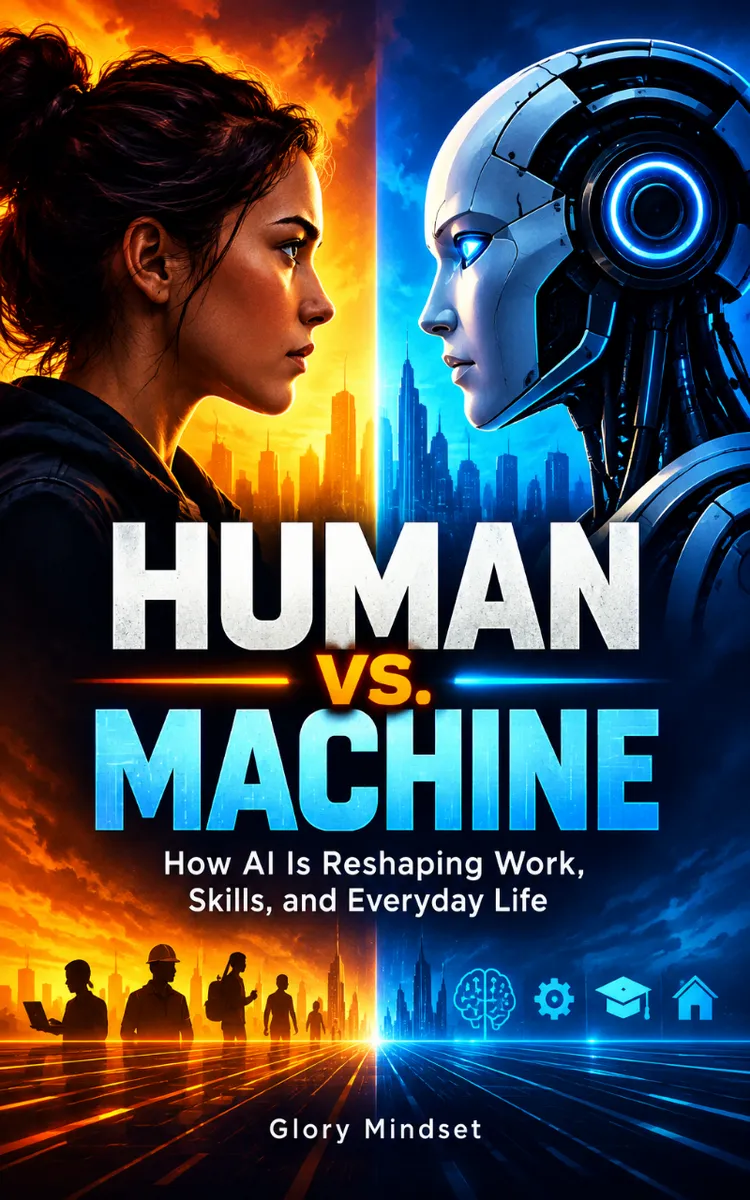
"Human Vs. Machine" is a curiosity book by Glory Mindset with 25 chapters and approximately 42,160 words. Artificial intelligence, automation, human value, and the future of work.
This book was created using Inkfluence AI, an AI-powered book generation platform that helps authors write, design, and publish complete books.
Frequently Asked Questions
What is "Human Vs. Machine" about?
Artificial intelligence, automation, human value, and the future of work
How many chapters are in "Human Vs. Machine"?
The book contains 25 chapters and approximately 42,160 words. Topics covered include When the Machine Writes First, The Tasks Algorithms Already Win, Why Automation Misses the Mess, The Job Is Not the Task, and more.
Who wrote "Human Vs. Machine"?
This book was written by Glory Mindset and created using Inkfluence AI, an AI book generation platform that helps authors write, design, and publish books.
Write your own curiosity book with AI
Describe your idea and Inkfluence writes the whole thing. Free to start.
Start writingCreated with Inkfluence AI


