

Read the first chapter
The whole of chapter one, free. About 9 min. Turn the pages with the arrows, your keyboard, or a swipe.
Chapter 1
A Childhood Without a Smartphone
The Phone Is No Longer the Center
A child asks a voice assistant what sound a whale makes, while a watch on the child’s wrist records movement and a sensor in the bedroom adjusts the temperature. No phone is being held, yet several forms of computing are already present. The most important change in childhood technology may be that children will use fewer screens precisely because technology will be everywhere.
For children born from 2025 to 2039, the familiar phone-centered model may be only one stage in a longer transition. Today, a smartphone is usually a visible object: it has a screen, a battery, an owner, and a clear boundary between online and offline time. The emerging alternative is less obvious. Information may arrive through speech, a wearable device, household systems, toys, vehicles, and school equipment without gathering around one glowing rectangle.
That difference matters because a phone makes technology easy to notice. Ambient technology can be harder to see, understand, or refuse. The question is not simply whether children will have screens, but whether they will grow up surrounded by systems that listen, measure, predict, and respond before anyone thinks of them as “using technology.”
If childhood moves beyond the phone, where will children learn to recognize when technology has entered the room?
From the Pocket Computer to the Invisible Assistant
The smartphone compressed several older technologies into one object. It became a telephone, camera, map, music player, television, library, game console, calendar, and social space. Its cultural power came partly from this concentration. A child looking at a phone is visibly engaged with a device, and adults can often identify the moment when the device becomes part of an activity.
That arrangement is historically unusual. Earlier generations encountered computing through separate machines: a family computer in a shared room, a television fixed in one place, a game console connected to a screen, or a telephone attached to a wall. Each device announced its purpose. The smartphone dissolved those boundaries and made computing portable.
The next shift may dissolve the phone’s central position as well. Voice assistants can answer questions without requiring a screen. Smart speakers can control lights, music, and household routines. Wearable devices can track movement, heart rate, sleep patterns, or location. Connected appliances can exchange information with one another. In these systems, the child does not always open an application. The environment responds as though computing were part of the furniture.
A useful distinction is between visible technology and ambient technology. Visible technology asks for attention: a child picks up a phone, looks at a display, and chooses what to do. Ambient technology works in the background, often activated by speech, motion, proximity, or a preset rule. It may reduce the time spent staring at a screen while increasing the amount of data produced about everyday life.
The home itself has become a testing ground for this change. A smart doorbell can identify movement near an entrance. A thermostat can learn household patterns. A voice assistant can recognize a request from across a room. None of these devices looks like a traditional classroom tool, but together they create an environment in which software is constantly interpreting human behavior.
Childhood in a Wearable World
Wearable technology changes the relationship between the body and the machine. A phone sits outside the body and is picked up when needed. A watch, ring, hearing device, or sensor-equipped piece of clothing remains close to the body, collecting information as movement unfolds.
For adults, wearable devices are already used to count steps, monitor exercise, provide directions, and receive messages. For children, the same category may be connected to safety, health, communication, or learning. A wearable could allow a parent to contact a child without giving the child a full smartphone. It could provide reminders through sound or vibration rather than a display. It could help record physical activity without requiring a child to carry a device in a pocket.
The apparent simplicity can be misleading. A device that does not show social media may still know where a child is, how often the child moves, when the child sleeps, or which routines repeat. The absence of a bright screen does not mean the absence of digital influence. It may simply move the influence into the body’s surroundings.
This creates a different kind of childhood boundary. With a phone, the question is often whether a child is looking at a screen. With a wearable, the question may be whether a child is being measured. A child might not experience a watch as a surveillance device, especially if it is presented as a way to stay connected or safe. Yet the device can turn ordinary actions into records that travel through software systems.
Voice technology introduces another complication. Speaking feels more natural than typing, especially for young children who are still learning to read and write. A child can ask a question, request a song, or control a device through ordinary language. That ease may support curiosity, but it also makes the boundary between conversation and command less clear.
A phone usually requires a deliberate gesture. Voice technology can be activated in the middle of family life. The child may speak to a machine while eating breakfast, playing with blocks, or walking through a room. The interaction is not necessarily more distracting, but it is more woven into the surrounding activity.
The Screenless Moment That Still Belongs to Technology
The surprising possibility is that less visible screen use may produce more continuous technological involvement. A child who spends fewer minutes holding a phone may still live in a home that hears requests, tracks locations, adjusts conditions, and recommends responses throughout the day.
This changes the usual argument about screen time. Screen time measures attention directed toward a display, but ambient systems can influence behavior without demanding visual attention. A voice assistant can shape which answer is heard. A wearable can turn movement into feedback. A smart home can make certain actions easier than others. The technology disappears from view while remaining active in the background.
The distinction matters because adults often judge technology by its most visible form. A phone in a child’s hand is easy to notice and discuss. A microphone in a speaker, a location service in a watch, or a learning system in a classroom may be less obvious. Children born from 2025 to 2039 may therefore need to understand not only how to operate devices, but also how devices operate around them.
There is an unexpected connection here to the history of architecture. Buildings have always guided behavior through doors, corridors, lighting, and furniture. Digital systems add a responsive layer to that guidance. A room can now react to presence, a school platform can alter the next lesson, and a wearable can prompt a change in behavior. The environment is no longer merely where childhood happens; it can become an active participant in it.
That does not make ambient technology automatically harmful or beneficial. A voice-controlled device may help a child who cannot yet read. A wearable may provide reassurance during a journey. A connected classroom may adjust material to a learner’s pace. The same systems can also encourage dependence, collect information without a child’s full understanding, or make ordinary decisions feel as though they require technological assistance.
The central issue is therefore not whether the phone disappears. It is whether children can tell when technology is helping, when it is guiding, and when it is quietly recording.
A Family, a Classroom, and the New Ordinary
A useful real-world setting is the modern connected home, where devices from different categories already coexist. A child may wake in a room regulated by a smart thermostat, hear a voice assistant announce the weather, carry a wearable that allows contact with a parent, and encounter a school system that adapts digital material to performance. Each tool may have a separate purpose. Together, they create a continuous chain between the child, the household, and remote software.
The chain is easy to miss because no single moment feels revolutionary. The thermostat is not a phone. The watch is not a classroom. The voice assistant is not a teacher. Yet each can shape the child’s experience of time, privacy, attention, and independence. The child learns that questions can be answered instantly, locations can be shared, and environments can respond to spoken requests.
Schools add another layer. A classroom once contained physical books, paper assignments, and shared equipment. Increasingly, it may also contain microphones, interactive displays, connected tablets, digital readers, and systems that record progress. A child’s learning activity can become visible to software in ways that were impossible when work remained in a notebook.
For educators, the challenge is not simply managing devices. It is recognizing that the device may no longer be the most important part of the system. A student can be affected by an algorithm without knowing its name, by a data record without seeing it, or by a recommendation without understanding how it was produced.
Parents face a similar change at home. A phone can be placed on a table, switched off, or left in another room. Ambient systems are more difficult to gather into one place because they are distributed through the house and attached to daily routines. The question of “screen-free time” may gradually become a question of which systems are active, what they collect, and who controls them.
The Beyond-the-Phone Lens
The Beyond-the-Phone Lens offers a way to observe this shift without treating every new device as either progress or danger. It asks readers to look across three features: where technology is located, how it communicates, and what it knows.
Location changes the relationship between child and device. A phone is carried; a speaker belongs to a room; a wearable belongs to the body; a connected classroom system belongs to an institution. Communication changes as well. Touch and text may give way to speech, vibration, automatic alerts, or responses that require no direct request. Knowledge is the third feature: what the system can infer from movement, voice, location, habits, or learning behavior.
Seen through this lens, a screenless childhood is not necessarily a less technological childhood. It may be a childhood in which technology becomes harder to separate from ordinary experience. The child may encounter fewer obvious sessions of “being online” while spending more time inside systems that are connected by default.
Human beings have always adapted to tools by allowing them to fade into the background. The handle becomes part of the door; the road becomes part of the journey. Digital technology is following the same pattern, but with one important difference: it can remember, compare, and predict. A room can now contain a memory of its occupants. A wearable can produce a record of the body. A classroom platform can preserve a history of mistakes and improvements.
For Generation Beta, the defining question may not be whether childhood is mediated by technology. Childhood has already been shaped by tools, from books and clocks to televisions and phones. The more precise question is whether children will be able to recognize the systems shaping them when those systems no longer look like devices.
The phone made technology personal by placing it in a pocket. Ambient and wearable systems may make it environmental by placing it in the room, on the body, and inside the routines of daily life. What disappears from view may not disappear from influence. It may become part of the background against which a child learns what is normal, private, and possible.
End of chapter one. 21 more chapters and about 35,449 words in the full book.
Swipe or use the arrows to turn the page


What's inside: 22 chapters
- 1. A Childhood Without a Smartphone
- 2. The Home That Notices Everything
- 3. When a Tutor Knows Your Pace
- 4. The Toy That Talks Back
- 5. Robots in the Nursery
- 6. What Wearables Tell Parents
- 7. The Data Trail Begins at Birth
- 8. Teaching Children to Guard Privacy
- 9. Screens, Sleep, and Growing Bodies
- 10. Can an App Read a Feeling?
- 11. The Human Skills Machines Miss
- 12. When Answers Arrive Too Easily
- 13. Raising a Child Who Can Verify
- 14. The Classroom After Personalization
- 15. Who Gets Left Out of Smart Learning?
- 16. Family Rules for Connected Devices
- 17. When Convenience Becomes Dependence
- 18. Deepfakes, Scams, and Child Safety
- 19. The Environmental Cost of Invisible Tech
- 20. Preparing for Jobs Not Yet Named
- 21. Three Possible Beta Childhoods
- 22. Keeping Childhood Bigger Than Technology
About this book
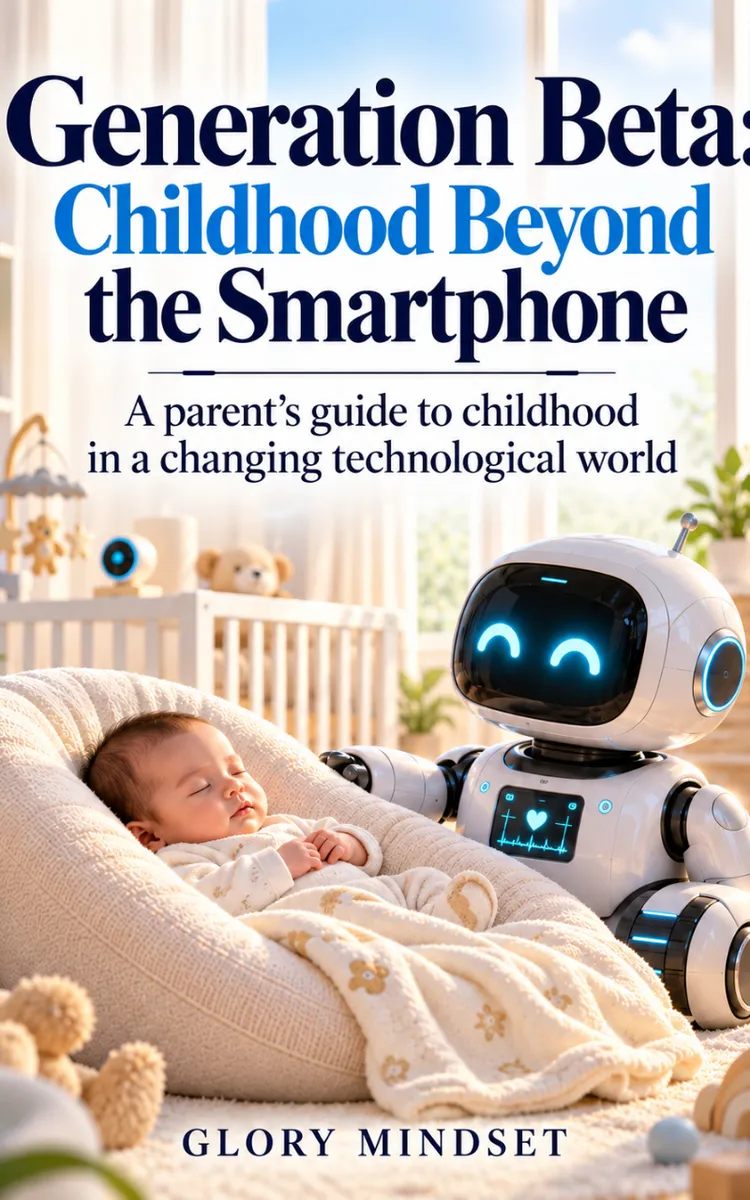
"Generation Beta:Childhood beyond the smartphone" is a curiosity book by Glory Mindset with 22 chapters and approximately 35,449 words. How emerging technologies may shape Generation Beta’s childhood, learning, privacy, and development.
This book was created using Inkfluence AI, an AI-powered book generation platform that helps authors write, design, and publish complete books.
Frequently Asked Questions
What is "Generation Beta:Childhood beyond the smartphone" about?
How emerging technologies may shape Generation Beta’s childhood, learning, privacy, and development
How many chapters are in "Generation Beta:Childhood beyond the smartphone"?
The book contains 22 chapters and approximately 35,449 words. Topics covered include A Childhood Without a Smartphone, The Home That Notices Everything, When a Tutor Knows Your Pace, The Toy That Talks Back, and more.
Who wrote "Generation Beta:Childhood beyond the smartphone"?
This book was written by Glory Mindset and created using Inkfluence AI, an AI book generation platform that helps authors write, design, and publish books.
Write your own curiosity book with AI
Describe your idea and Inkfluence writes the whole thing. Free to start.
Start writingCreated with Inkfluence AI


