

Read the first chapter
The whole of chapter one, free. About 7 min. Turn the pages with the arrows, your keyboard, or a swipe.
Chapter 1
The Robot in the Tide Pool
Mara Venn pressed the metal tip of her temperature probe into a shallow tide pool. A tiny green screen blinked in her hand.
“Fourteen degrees,” she whispered.
The Pacific breeze brushed her cheeks. Around her, the rocky shore shone with seawater. Limpets clung to the stone like little hats, and a purple sea star rested beneath a ledge. Each wave made a soft shushing sound as it slipped between the rocks.
Mara crouched closer. She liked tide pools because they were small enough to study and big enough to surprise her. A pool could hold tiny shrimp, snails, seaweed, and fish, all living together in a space no bigger than a bathtub.
She moved the probe to a second pool. This one read fourteen degrees too.
Then something gray flashed below the surface.
Mara leaned forward. A round machine was wedged between two rocks. One short arm stuck out of the water. Green seaweed curled around its side.
“A survey robot,” Mara said.
She knew the little machines from the coastal science station. They traveled through shallow water, taking pictures and measuring temperature, salt, and other signs of ocean health. This one had a blue stripe along its shell, but the stripe was scratched almost white.
Mara reached toward it.
The tide pool gave a quick, cold splash.
She pulled her hand back. The water had risen around her boots. A wave had poured into the pool, filling the narrow channels between the rocks.
The robot was not far away, but the stone path to it was wet and slippery. Mara tested one rock with her boot. Her sole slid a little.
She stepped back at once.
“Slowly,” she told herself. “The robot can wait.”
A gull called from a high shelf. Mara heard the small click of the probe in her hand. She took out her radio and called the shore station.
“Jonas, I found a survey robot in the north tide pool,” she said.
Static crackled. Then Jonas answered. “Is it moving?”
“No. It looks stranded.”
“I’ll bring the grab line.”
Mara looked at the robot again. Its small light was dark. A thin cable trailed from its side and disappeared beneath the water.
“Bring the repair case too,” she said. “It may be damaged.”
Jonas promised he would hurry, but the radio signal faded before Mara could hear the rest. The station was around the bend, hidden by a low cliff. Mara was alone for the moment.
She knelt on a dry patch and studied the pool. The tide was still coming in. The robot rested in a pocket between two rocks, where each new wave pushed it deeper.
Mara tried the long handle of her probe. She stretched it toward the robot and tapped its round shell.
The robot rocked.
For one happy second, Mara thought it might float free. Then its arm caught on a crack in the rock.
“Not that way,” she said.
She moved to the left, where the water looked calmer. A flat stone made a bridge across part of the pool. Mara placed one boot on it. The stone wobbled under her weight.
She stepped back again.
Her cheeks felt warm, though the wind was cool. She wanted to help the robot, but rushing could make the problem worse. A slipped boot might knock the machine deeper into the pool. It might also crack the probe or stir up the animals living among the rocks.
Mara took a breath and looked closely.
The robot’s cable was caught, but not tightly. Seaweed covered the hook at the end. If she could lift the cable, perhaps the robot would turn toward the shallow side.
She lowered the probe into the water and nudged the seaweed away. A tiny fish darted from beneath the robot and vanished under a shelf.
“Sorry,” Mara murmured. “I’m trying to give you room.”
The cable rose a little. Then a wave rushed into the pool. Water swirled around Mara’s boots, and the cable slipped from the probe.
The robot bumped against the rock with a soft clunk.
Mara froze.
The machine did not break, but its blue light flickered once and went dark again.
“That was my fault,” she said quietly.
She sat back on her heels. The pool smelled of salt and wet stone. A snail crawled across the rock beside her, carrying its shell as if it had all day.
Mara watched it move. The snail did not push hard against the stone. It found the edge, changed direction, and kept going.
She looked at the water again.
“I need a better way,” she said.
Jonas appeared above the pool a few minutes later. He carried a yellow case and a coiled grab line. His boots were covered in sand.
“You found it,” he said.
“It is stuck,” Mara replied. “And the tide is filling the pool.”
Jonas set down the case. “We can pull it.”
Mara shook her head. “The cable is caught. Pulling might tear it.”
Jonas peered over the edge. “Good catch.”
They waited for a wave to pass. Then Jonas held the grab line while Mara guided its soft loop toward the robot. The line brushed the water but missed.
“Again,” Jonas said.
Mara moved closer, keeping both knees on a dry rock. She slid the loop around the robot’s handle. This time it caught.
“Got it,” she said.
“Pull gently.”
Together they drew the robot toward the shallow edge. The machine scraped over the stone. Its shell made a rough sound, but the line held.
A larger wave rolled in. It filled the pool to Mara’s ankles and lifted the robot just enough for it to turn.
“Now,” Mara said.
Jonas pulled. Mara guided the cable away from the crack with the probe. The robot slid free and bumped softly against the pool’s edge.
They lifted it onto a dry rock.
For a moment, neither of them spoke. Water dripped from the robot’s round shell. One of its side panels hung open. Inside, a red wire curled like a loose thread.
Jonas opened the repair case. “The power light is weak, but the sensors may still work.”
Mara looked at the scratched blue stripe. “Can we turn it on?”
“Only for a short test.”
Jonas connected a small battery pack. The robot gave a gentle beep. Its blue light glowed.
Mara smiled. “Hello.”
The robot’s sensor arm unfolded. A tiny screen on its side showed the last readings it had saved.
Mara held her temperature probe beside it. “Let’s compare.”
Her probe read fourteen degrees.
The robot read sixteen.
Jonas checked the setting. “Both instruments are set correctly.”
Mara touched the water with two fingers. It felt chilly, but the number on the robot’s screen stayed the same.
“Could the robot be wrong?” she asked.
“It could,” Jonas said. “That is why we compare tools. But the robot took readings in more than one spot.”
He turned the screen so Mara could see. A line of numbers appeared. Sixteen. Sixteen and a half. Seventeen.
Mara frowned. “It got warmer as it went farther out.”
Jonas pointed to the small map beside the readings. “The map is damaged. Part of it is missing.”
The map showed the tide pool, the rocks, and a short path leading toward the open water. Beyond that, the screen was a blank gray patch.
Mara leaned close. A thin orange mark crossed the edge of the map.
“What is that?” she asked.
“Maybe the robot’s last route,” Jonas said. “It may have found warm water offshore before it stopped.”
Mara looked from the map to the shining sea. Beyond the rocks, waves rolled toward a wide stretch of blue. The water looked peaceful. It also seemed much bigger than it had a moment before.
“Could the warm reading be from a sunny rock?” she asked.
“Not if the sensor was underwater,” Jonas replied. “We need more readings before we know what it means.”
Mara nodded. The robot had given them an answer, but not a complete one. It had also given them a new question.
She picked up the damaged machine with both hands. It was heavier than she expected, cool and smooth beneath her fingers. The loose panel clicked against its shell.
“We should not send it back out yet,” she said.
“Agreed,” Jonas replied. “We can dry it, copy its data, and check the sensors.”
Mara glanced at the tide pool. The water had reached the dry rock where she had been sitting. A small green crab climbed out of the way and tucked itself beneath a ledge.
She and Jonas carried the robot above the waterline. Mara placed it on a folded cloth from the repair case. The robot’s blue light blinked twice, then rested.
Jonas studied the broken map. “The missing section points toward the outer water.”
Mara watched a wave spread silver across the rocks.
“So the tide pool was only the beginning,” she said.
“Yes,” Jonas said. “But we will not guess. We will measure.”
Mara held the temperature probe beside the robot. The two tools rested together, one simple and one clever, both waiting for careful questions.
She had come to the shore hoping to explore. Now she understood that exploring also meant slowing down, checking your tools, and listening when the ocean gave a small clue.
The wind carried the clean smell of salt. Behind them, the station lights glowed warmly through the windows. Jonas closed the repair case, and Mara tucked the probe into her pocket.
The stranded robot was safe, but its damaged map pointed offshore, where the next set of answers waited in the moving blue water.
Mara smiled at the wide sea. A mystery was easier to face when you had a friend, a careful plan, and the courage to look closely.
End of chapter one. 16 more chapters and about 29,642 words in the full book.
Swipe or use the arrows to turn the page

First Kids On Another World

A Second Chance At Life

The Future Files: 100 Questions That Could Change Tomorrow
What's inside: 17 chapters
- 1. The Robot in the Tide Pool
- 2. The Sensor Buoy Alarm
- 3. The Kelp Forest’s Missing Shade
- 4. The Seafloor Mapping Run
- 5. Choosing the Right Clue
- 6. The Storm-Tossed Buoy
- 7. Plastic on the Deep Camera
- 8. Down the Blue Ravine
- 9. The Warm Current Puzzle
- 10. The Map That Wasn’t Certain
- 11. The Harbor’s Plastic Surge
- 12. The Reef Nursery Test
- 13. When the Kelp Went Quiet
- 14. The Narrow Channel Crossing
- 15. The Living Reef Trial
- 16. Mara’s Science Fair Promise
- 17. The First New Buoy
About this book
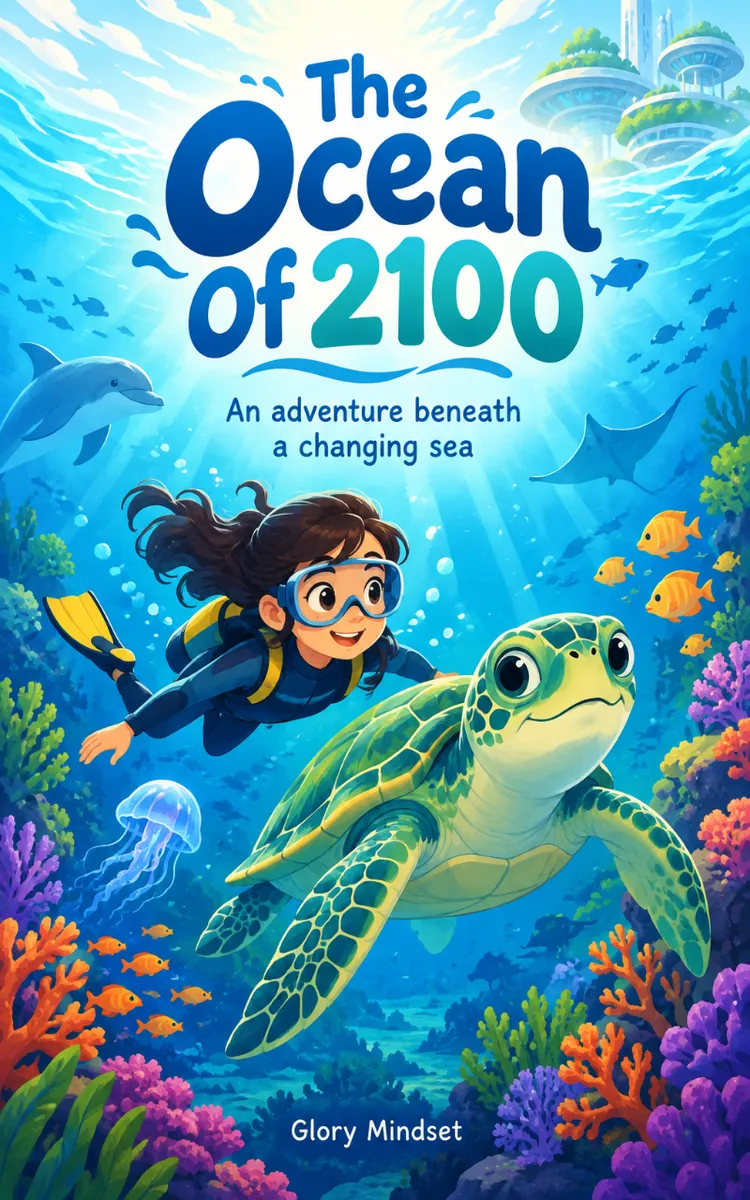
"The Ocean Of 2100" is a children's book by Glory Mindset with 17 chapters and approximately 29,642 words. Young explorers investigate ocean technology, climate change, and marine conservation.
This book was created using Inkfluence AI, an AI-powered book generation platform that helps authors write, design, and publish complete books. It was made with the AI Children's Book Creator.
Frequently Asked Questions
What is "The Ocean Of 2100" about?
Young explorers investigate ocean technology, climate change, and marine conservation
How many chapters are in "The Ocean Of 2100"?
The book contains 17 chapters and approximately 29,642 words. Topics covered include The Robot in the Tide Pool, The Sensor Buoy Alarm, The Kelp Forest’s Missing Shade, The Seafloor Mapping Run, and more.
Who wrote "The Ocean Of 2100"?
This book was written by Glory Mindset and created using Inkfluence AI, an AI book generation platform that helps authors write, design, and publish books.
How can I create a similar children's book?
You can create your own children's book using Inkfluence AI. Describe your idea, choose your style, and the AI writes the full book for you. It's free to start.
Write your own children's book with AI
Describe your idea and Inkfluence writes the whole thing. Free to start.
Start writingCreated with Inkfluence AI


