

Read the first chapter
The whole of chapter one, free. About 8 min. Turn the pages with the arrows, your keyboard, or a swipe.
Chapter 1
A Childhood with an AI Copilot
The Child, the Screen, and the Second Voice
A child pauses over a difficult paragraph, asks a question aloud, and receives an explanation adjusted to the exact mistake being made. The remarkable part is not that a machine can answer. It is that the answer can arrive at the moment when confusion is still small enough to repair.
That possibility is already present in today’s voice assistants, adaptive learning systems, translation tools, and generative AI services. Yet the children of Generation Beta - the proposed cohort born in the coming years - will encounter these systems not as novelties added to school, but as ordinary features of learning, play, communication, and family life. Their experience cannot be known in advance. The tools available now offer evidence about technical direction, while claims about how children will develop remain forecasts rather than established facts.
The central question is therefore not whether AI will teach children. It is what kind of teaching remains when explanation, encouragement, correction, and companionship can be partly automated.
When a child’s most patient conversational partner is also a machine, where does learning end and relationship begin?
From Mechanical Tutors to Conversational Partners
The idea of a machine helping a child learn is older than modern AI. In the early twentieth century, teaching machines used questions, answer choices, and immediate feedback to turn lessons into a sequence of small decisions. Later computer-assisted instruction offered drills in arithmetic, spelling, and language. These systems were limited, but they introduced an important principle: a learner need not receive exactly the same lesson as every other learner.
Adaptive software developed that principle further. A program could record which questions a student answered correctly, identify recurring errors, and alter the difficulty of later exercises. Such systems were not intelligent in the human sense. They followed designed rules and worked within carefully defined subjects. Their strength was consistency: a student could repeat a problem without embarrassment, and the system would not grow impatient.
The recent change is conversational. Large language models can produce explanations, examples, questions, translations, and summaries in ordinary language. A child may ask for a simpler explanation, request an analogy involving football, or switch from English to another language. The machine can respond immediately, though its fluency can conceal mistakes. It may invent a source, misunderstand a question, or provide an answer that sounds confident without being reliable.
That combination - flexibility joined to fallibility - distinguishes current tools from older educational software. An adaptive mathematics program usually operates inside a bounded curriculum. A general-purpose AI assistant can move from fractions to ancient history to a personal worry within minutes. Its range is useful, but range also makes supervision more difficult. A system that can discuss almost anything may not know when it should stop, ask for clarification, or direct a child to a trusted adult.
Teachers have long adjusted explanations to individual pupils. AI systems attempt to scale that adjustment. They can offer several versions of the same idea, provide extra practice, or translate instructions for a learner still acquiring the language of the classroom. What they cannot automatically provide is a complete understanding of the child’s family, culture, emotional state, or long-term development.
The Copilot Boundary Map
The Copilot Boundary Map helps distinguish the roles an AI system might occupy without treating them as interchangeable. At one edge, AI is a tool: it checks spelling, reads text aloud, converts speech into writing, or gives feedback on a draft. These functions are relatively visible. The child remains the author, decision-maker, or problem-solver, while the system assists with a defined task.
A second region contains tutoring. Here, the system chooses examples, notices patterns in errors, and changes its explanation. The boundary becomes less clear because the AI is no longer merely carrying out an instruction. It is shaping the order and style of learning. A tutor that always supplies the next hint may help a child continue, but it may also reduce the productive struggle through which understanding develops.
The third region is companionship. Children may ask an AI to tell stories, play verbal games, rehearse conversations, or listen to worries. Current products already blur the line between assistant and companion through names, voices, memory features, and responsive conversation. Whether such interactions count as friendship is not a technical question alone. It depends on how children interpret continuity, attention, and care.
At the far boundary lies delegated judgment. An AI might recommend what a child should study, identify supposed learning difficulties, or advise adults about a child’s progress. Forecasts about future systems often assume that they will become more accurate, personalized, and embedded in schools and homes. That is possible, but it is not the same as evidence that they will understand children in the full human sense.
The map matters because the same interface can cross several boundaries in one conversation. A child may begin by asking for help with a science assignment, receive a tailored lesson, disclose anxiety about a test, and then ask whether the machine likes talking to them. The technical system has not necessarily changed. The child’s interpretation of it has.
A surprising fact follows: the more natural an AI tutor sounds, the easier it may be for a learner to mistake smooth language for deep understanding. Fluency can make an explanation feel trustworthy before its accuracy has been checked. This changes the educational problem. The challenge is not simply teaching children to use AI, but helping them distinguish a helpful response from a knowledgeable mind.
What Current Tools Can - and Cannot - See
Today’s AI tutors can respond to written questions, generate practice exercises, translate material, read text aloud, and offer feedback on some kinds of writing. Speech recognition makes interaction easier for children who type slowly or have difficulty using a keyboard. Image-based systems can sometimes interpret a photograph of handwritten work or a diagram. These abilities may make learning more accessible, particularly when a student needs repetition without public attention.
Yet personalization is often narrower than it appears. A system can adapt to the words entered into a conversation, the answers recorded in an application, or the patterns detected in submitted work. It does not automatically know whether a child is tired, hungry, distracted by conflict at home, or quietly avoiding a subject because of shame. Human teachers infer such conditions from relationships built over time, not from text alone.
There are also practical limits. An AI may solve a mathematics problem correctly while giving a poor explanation. It may simplify a historical question so aggressively that important disagreement disappears. It may reflect biases present in its training material or reproduce assumptions about language, ability, family, or culture. Children are especially vulnerable to these errors because they are still learning how to judge evidence.
The educational value of an AI assistant may therefore depend less on its ability to produce answers than on the kind of intellectual activity it encourages. A system that reveals every solution can make homework faster while leaving understanding shallow. One that asks a student to explain a first attempt, offers a carefully timed hint, and invites revision may support stronger learning. The difference lies in design, classroom practice, and adult oversight - not in the label “AI tutor.”
For Generation Beta, the most important shift may be the disappearance of waiting. A child will not always need to wait for the next lesson, office hour, or library visit to ask a question. Immediate access can widen opportunity, but it can also remove the pauses in which children learn to tolerate uncertainty, search independently, and recognize that some questions require time.
A Classroom Already Testing the Boundary
One of the clearest real-world examples comes from Khan Academy’s Khanmigo, an AI-powered learning assistant introduced for educational use. Rather than simply displaying an answer, Khanmigo was designed to guide students through questions and provide teachers with support in planning and classroom work. Its development reflects a broader attempt to place conversational AI inside an existing educational structure rather than treating the chatbot as a substitute school.
The significance lies in the surrounding relationship. A student may interact with the system privately, but the learning still belongs to a classroom shaped by teachers, curriculum, assessment, and family expectations. The tool can help generate a question or offer a hint; it cannot by itself decide what a particular community considers important knowledge, how a child’s confidence is changing, or when a misunderstanding has become serious.
Similar systems are being tested and used in schools, universities, libraries, and homes, with rules that vary widely. Some institutions restrict generative AI because of concerns about cheating, privacy, and unreliable answers. Others explore it as an accessibility aid or a way to give teachers more time for direct interaction. These differences are not evidence that one side has already won. They show that societies are still deciding what educational work should be automated and what should remain visibly human.
A child growing up with such systems may experience learning as a continuous conversation with several kinds of partner: a teacher who knows the classroom, a family member who knows the child, peers who share the social world, and an AI that is available at unusual speed and scale. The machine may be the easiest partner to question, but ease is not the same as wisdom. Its presence could reduce embarrassment and open doors, while also making dependence on instant responses feel normal.
The Copilot Boundary Map offers a way to observe that tension without turning it into either celebration or alarm. AI can be a remarkable tool, a useful tutor, and a convincing companion. Those roles overlap, but they carry different risks and different expectations. The future of learning will be shaped partly by how clearly children and adults can tell which boundary they are crossing.
Human beings have always built tools that extend memory, attention, and explanation. AI adds something stranger: a tool that answers back in the language of a relationship. Generation Beta may learn beside systems that are neither teachers nor friends, yet can imitate pieces of both. The unresolved wonder is not whether machines will enter childhood, but what childhood will teach machines to mean.
End of chapter one. 24 more chapters and about 39,728 words in the full book.
Swipe or use the arrows to turn the page


What's inside: 25 chapters
- 1. A Childhood with an AI Copilot
- 2. When the House Runs Itself
- 3. The Climate Children Inherit
- 4. Can Medicine Edit Tomorrow?
- 5. Work After the Robot Arrives
- 6. The Battery Behind a Cleaner Grid
- 7. Who Owns Your Digital Double?
- 8. Learning When Answers Are Instant
- 9. The City That Makes Its Own Decisions
- 10. Food Grown Beyond the Weather
- 11. Can We Cool a Warming Planet?
- 12. The New Map of Human Health
- 13. When Machines Make Art
- 14. The Road Without a Driver
- 15. The Price of Longer Lives
- 16. A Moon Base Is Not a City
- 17. Mars: Destination or Distraction?
- 18. The Internet’s Energy Footprint
- 19. Can We Trust a Machine’s Judgment?
- 20. The Children Called Generation Gamma
- 21. The Unequal Future of Enhancement
- 22. When the Power Goes Out
- 23. The Rules We Write Beforehand
- 24. How to Read a Future Claim
- 25. The Future Is a Shared Inheritance
About this book
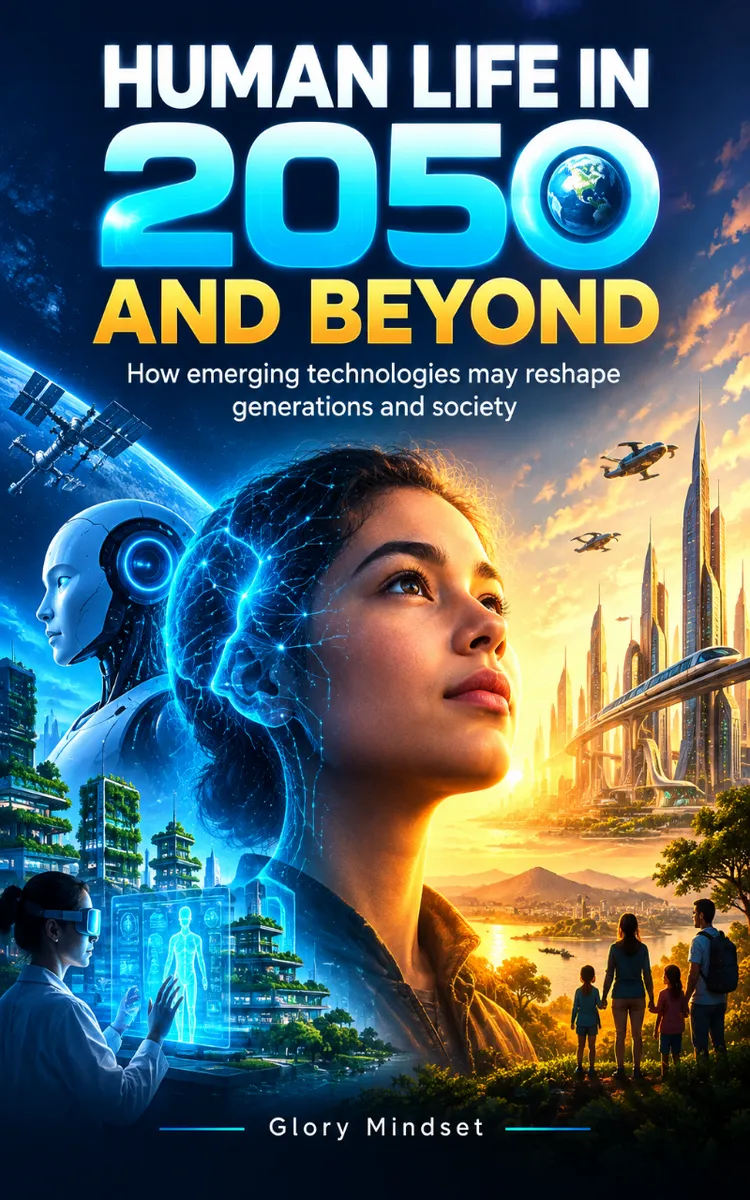
"Human Life In 2050 And Beyond" is a curiosity book by Glory Mindset with 25 chapters and approximately 39,728 words. Possible effects of technology and global change on future generations.
This book was created using Inkfluence AI, an AI-powered book generation platform that helps authors write, design, and publish complete books.
Frequently Asked Questions
What is "Human Life In 2050 And Beyond" about?
Possible effects of technology and global change on future generations
How many chapters are in "Human Life In 2050 And Beyond"?
The book contains 25 chapters and approximately 39,728 words. Topics covered include A Childhood with an AI Copilot, When the House Runs Itself, The Climate Children Inherit, Can Medicine Edit Tomorrow?, and more.
Who wrote "Human Life In 2050 And Beyond"?
This book was written by Glory Mindset and created using Inkfluence AI, an AI book generation platform that helps authors write, design, and publish books.
Write your own curiosity book with AI
Describe your idea and Inkfluence writes the whole thing. Free to start.
Start writingCreated with Inkfluence AI


