

Read the first chapter
The whole of chapter one, free. About 8 min. Turn the pages with the arrows, your keyboard, or a swipe.
Chapter 1
How Fungi Feed a Forest
Beneath the Familiar Trees
A walk through a forest looks like a collection of separate lives: oak, birch, pine, fern, moss. Below the leaf litter, however, many of those plants are joined by fungal threads so fine that a teaspoon of soil can contain kilometres of hyphae, The trees are not simply standing on the same ground; their roots may be participating in an underground exchange.
The partners responsible are mycorrhizal fungi, organisms that grow alongside or within plant roots. The plant supplies sugars made in its leaves. The fungus extends beyond the root into the soil, gathering water and minerals that roots alone would reach less efficiently. What appears above ground as a tree is only one part of a larger living arrangement,
The Root-to-Root Exchange Map follows that arrangement from one root to another: where the fungal threads begin, how they travel, what passes through them, and why the resulting network matters to a forest. It also complicates one of the most appealing images in modern ecology - the idea of trees quietly “talking” underground - by showing that cooperation in a forest is real, but neither simple nor sentimental.
If a tree’s roots are its hands in the soil, what is the forest doing with all those invisible connections?
The Partnership Begins at the Root
The relationship starts at a boundary that is easy to overlook. A young root grows through soil searching for water and dissolved nutrients. Nearby, a fungal filament called a hypha may encounter it. The hypha is microscopic, but it belongs to a vast branching system. When the fungus and plant form a partnership, the hyphae gather around or enter the root, creating a mycorrhiza, a word that combines the Greek terms for fungus and root.
The arrangement is an exchange rather than a one-way service. Through photosynthesis, a tree turns sunlight, carbon dioxide, and water into sugars. Some of those carbon-rich compounds move down into the roots and pass to the fungus. In return, the fungus explores soil pores too small or scattered for a root to use effectively. It can absorb phosphorus, nitrogen, and other minerals, along with water, and carry them back toward the plant.
The fungal partner is not merely an extension of the root in the mechanical sense. Its threads are narrower, more numerous, and able to move through spaces between soil particles. A root may encounter a patch of phosphorus only a short distance away but be unable to reach it with its thicker surface. A hypha can enter that patch, dissolve or absorb available nutrients, and transport them through the fungal network.
Most trees in temperate forests associate with ectomycorrhizal fungi. These fungi form a sheath around fine roots and grow between the root’s outer cells. Other plants, including many grasses and wildflowers, commonly associate with arbuscular mycorrhizal fungi, which enter root cells and form tiny tree-shaped structures where exchange occurs. The details differ, but the principle remains: plant carbon moves toward the fungus, while water and mineral nutrients move toward the plant.
A forest floor can therefore be read as a map of negotiations. Roots are the visible addresses; fungal hyphae are the connecting routes. Some routes end in the soil. Others meet the roots of neighboring plants, creating links that may join several individuals and sometimes several species.
Drawing the Root-to-Root Exchange Map
The Root-to-Root Exchange Map begins with a single plant but does not stop at its root system. A fungal colony can connect one tree to another when its hyphae grow from the roots of one host toward the roots of a second. At those contact points, substances may move through the fungal tissue, although the direction and amount depend on the species involved, the condition of the plants, the soil, and the surrounding network.
This is the physical basis for what researchers call a common mycorrhizal network. The phrase evokes infrastructure, a living system of branching pathways beneath the forest, Yet it is not a neutral pipe. Fungi choose where to grow, plants control some of the carbon they release, and chemical signals pass through a crowded environment in which roots, microbes, and minerals are continually interacting.
Water can move through fungal hyphae, especially when the fungus has access to moist soil beyond the immediate reach of a root. Nutrients may also be redistributed. A plant with abundant access to light can provide more carbon to its fungal partners, while a shaded plant may receive carbon or nutrients through shared fungal connections. These transfers are not necessarily acts of generosity. They may be exchanges shaped by fungal preferences, plant demand, and the balance of resources available at each point in the network.
The network’s structure also changes over time. A tree grows new fine roots, loses old ones, and alters the sugars it sends below ground as seasons change. Fungal colonies expand, contract, and encounter roots from plants that were not present when the first connection formed. After a disturbance such as fire, drought, or tree removal, some networks persist in the soil while others break apart.
One surprising fact is that a forest network may remain active even when the trees that first supported it have disappeared. Fungal tissue can survive on stored carbon or shift its relationships to other plants, depending on the fungus and conditions. The underground system is not a permanent memory bank, but neither is it erased whenever a tree falls.
From Soil Science to the Wood Wide Web
The public image of trees exchanging information through fungi developed from scientific work on mycorrhizal connections and plant signaling. Researchers have demonstrated that plants can respond to chemical cues released by neighboring plants, and that resources can move through shared fungal networks under some conditions. These findings helped make the phrase “wood wide web” memorable: a forest seemed to possess an underground communication system beneath its visible canopy.
The phrase is useful because it directs attention below ground, where most of the forest’s structure is hidden. It is also imperfect. Unlike a digital network, a mycorrhizal network has no central server, universal language, or guaranteed delivery. A fungal pathway may carry carbon, nitrogen, water, or chemical information, but the movement is influenced by living membranes and changing biological relationships rather than by a fixed protocol.
That distinction matters when considering claims about trees “talking.” Plants do not use speech, but they do release chemicals, alter their physiology, and respond to signals from roots, fungi, herbivores, and the atmosphere. Through a common fungal network, a damaged plant may affect the chemistry or behavior of connected plants. Whether that response benefits a neighbor, benefits the fungus, or simply reflects competition is a question that must be tested in each system.
The same network can connect allies and competitors. A fungus may link a mature tree to a seedling, but it may also connect trees whose roots compete for water and light. The network does not abolish competition; it places competition and exchange in the same underground space.
The Counterintuitive Forest
A counterintuitive finding is that a tree may receive resources through a fungal network without the exchange being a simple gift from a larger tree, In many cases, the fungus is the active broker, taking carbon from one host and trading nutrients or carbon among several hosts according to its own growth and survival.
This reframes the forest network. The fungus is not passive wiring between generous trees. It is a living participant with its own demands, and the plants are partners whose interests overlap without being identical. A seedling connected to an older tree may gain access to water or carbon, but the connection exists within a three-way relationship shaped by the fungus.
That change in perspective makes the network less like a hidden charity system and more like an ecological marketplace. The word “marketplace” should not suggest money or conscious bargaining. It points instead to exchange, choice, scarcity, and uneven advantage. A fungus may favor a host that supplies more carbon. A plant may invest more heavily in a fungal partner when phosphorus is scarce. Conditions alter the terms.
This is why the strongest account of forest cooperation is also a careful one. Support can occur without intention, and interdependence does not require harmony. The forest’s stability emerges from countless relationships that may be mutually useful, temporarily balanced, or quietly exploitative.
A Forest Seen Through Suzanne Simard’s Work
The human story most associated with the wood wide web belongs to Suzanne Simard, a forest ecologist whose work in British Columbia helped bring common mycorrhizal networks to public attention. In the forests of western Canada, Simard studied trees such as Douglas fir and paper birch, examining how carbon moved between plants connected by ectomycorrhizal fungi.
Her research used carefully controlled experiments in which trees were enclosed or exposed to forms of carbon that could be traced as they moved through the system. The point was not to watch a glowing underground internet, but to identify whether carbon passed between plants and under what conditions. The results contributed to a growing body of evidence that trees linked by fungi can exchange carbon and that the direction of movement may change with light, season, and plant condition.
The setting matters. A Douglas fir rising above a forest floor is not an isolated production unit. Its roots occupy soil shared with birch, shrubs, fungi, bacteria, and decaying wood. When sunlight changes through the canopy, so can the balance of carbon available to each plant. A young tree in shade may have a different relationship with the fungal network from a mature tree in full light.
Simard’s work also gave language to a pattern that foresters had long encountered without fully seeing its underground causes: the health of a forest depends on relationships that cross the boundaries of individual trees. A seedling’s prospects are influenced not only by its own leaves and roots, but by the living soil around it and the fungal partners already established there.
The image of the forest as a community is therefore grounded in physical exchange. Roots touch soil; fungi connect roots; carbon, water, and minerals move through the network. What appears to be a stand of separate trees is partly a shared system whose boundaries are difficult to draw.
A forest does not become a single organism, and its fungi do not make every tree an ally. Yet the underground map reveals a world in which survival is often distributed rather than self-contained. The tree above ground is an individual; the life supporting it is more difficult to isolate. Beneath the quiet surface, every root connection raises the same unresolved question: how much of a forest belongs to one tree, and how much belongs to the relationships between them?
End of chapter one. 7 more chapters in the full book.
Swipe or use the arrows to turn the page


What's inside: 8 chapters
- 1. How Fungi Feed a Forest
- 2. What Trees Send Through Roots
- 3. The Sapling That Gets Help
- 4. How Fungi Choose Their Partners
- 5. Warnings Before the Attack
- 6. When a Forest Network Breaks
- 7. Testing the Wood Wide Web
- 8. What Forests Teach About Community
About this book
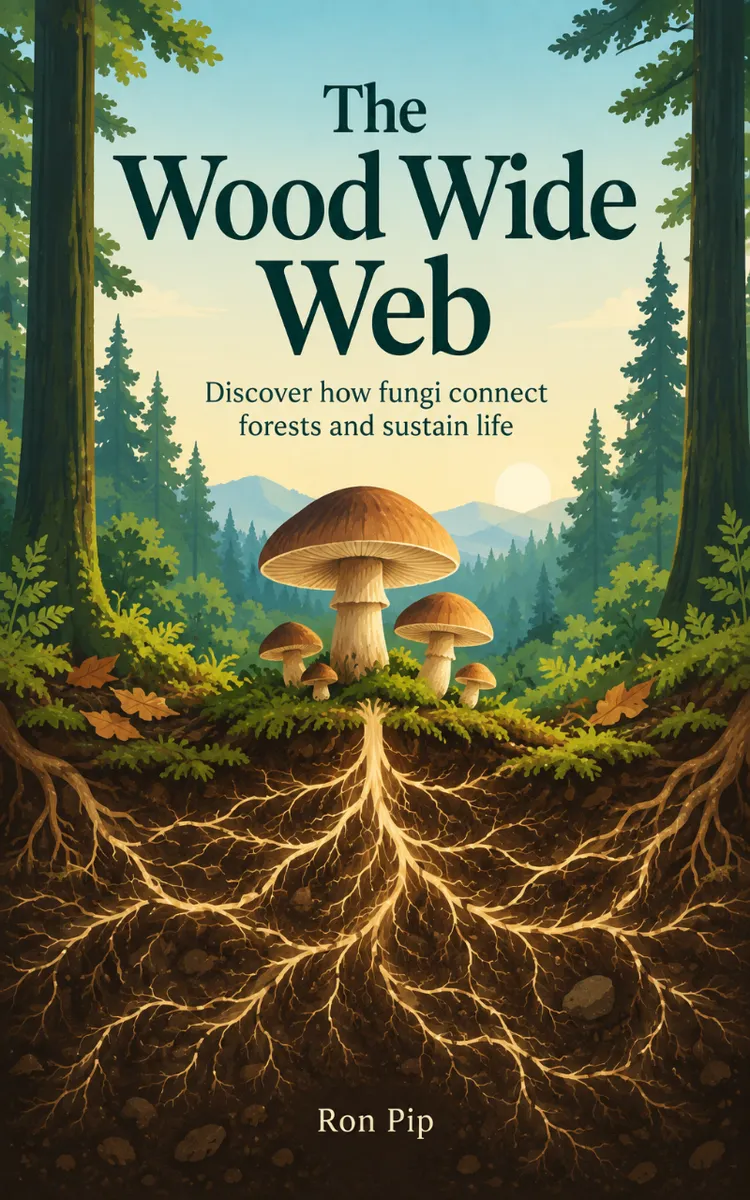
"The Wood Wide Web" is a curiosity book by Ron Pip with 8 chapters and approximately 13,097 words. Mycorrhizal networks, plant communication, and forest interconnectedness.
This book was created using Inkfluence AI, an AI-powered book generation platform that helps authors write, design, and publish complete books.
Frequently Asked Questions
What is "The Wood Wide Web" about?
Mycorrhizal networks, plant communication, and forest interconnectedness
How many chapters are in "The Wood Wide Web"?
The book contains 8 chapters and approximately 13,097 words. Topics covered include How Fungi Feed a Forest, What Trees Send Through Roots, The Sapling That Gets Help, How Fungi Choose Their Partners, and more.
Who wrote "The Wood Wide Web"?
This book was written by Ron Pip and created using Inkfluence AI, an AI book generation platform that helps authors write, design, and publish books.
Write your own curiosity book with AI
Describe your idea and Inkfluence writes the whole thing. Free to start.
Start writingCreated with Inkfluence AI


