
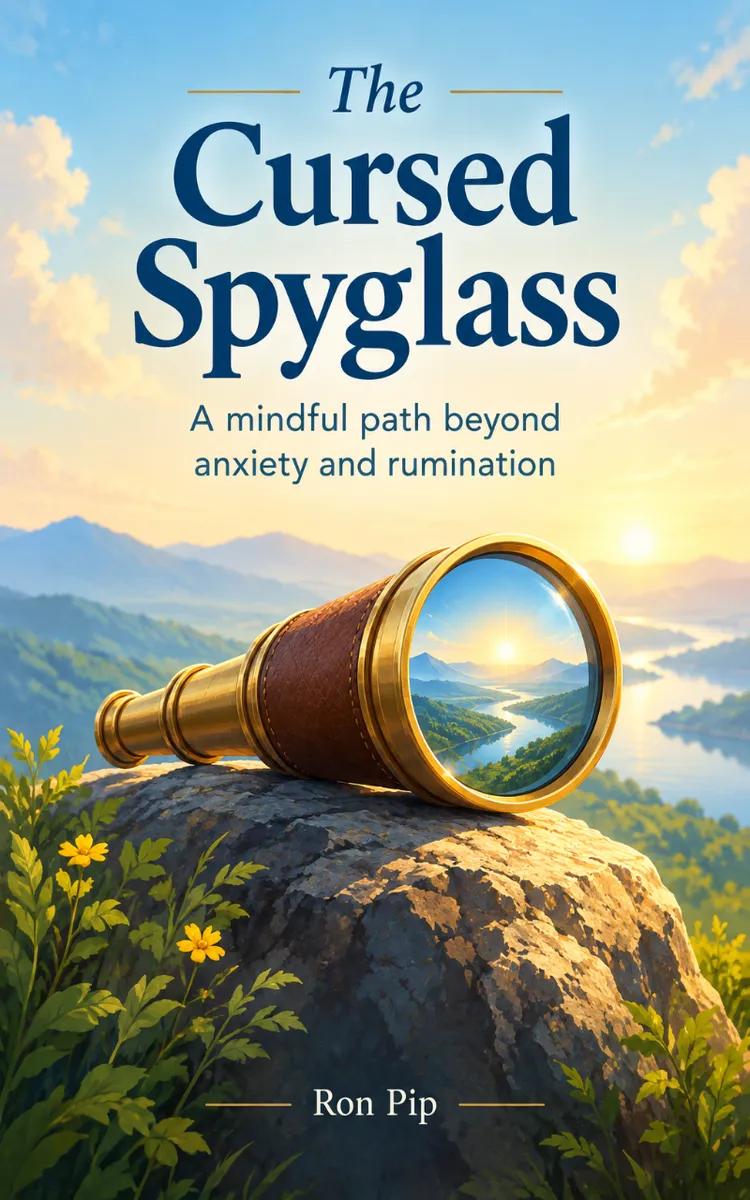

Read the first chapter
The whole of chapter one, free. About 7 min. Turn the pages with the arrows, your keyboard, or a swipe.
Chapter 1
Recognizing the Spyglass Curse
The Fork in the Road
At 8:17 on a Tuesday morning, Lena stood outside the shop with her key in her hand. The new supplier was waiting for her answer. One choice would save money but risk a late delivery. The other cost more and felt safer. A van hissed past. Somewhere behind her, the coffee machine clicked off.
But Lena wasn’t really standing outside the shop. She was back in last winter, hearing the customer who had called her “careless” after a delayed order. Then she was three weeks ahead, watching the new supplier fail, picturing angry messages, unpaid bills, and the awful silence after a mistake. The key remained still in her hand. The morning moved without her.
A root curled beneath her boot. She stepped over it at the last second, looked down, and noticed a small envelope near the door. It held a refund check she’d forgotten to deposit.
The spyglass showed dragons in the distance, while the rearview replayed old wounds, and neither showed the ground where her next step waited.
Three Ways Attention Gets Stolen
The Midnight Replay. Marcus lies awake remembering a joke he made at a work dinner six months ago. Nobody laughed. He tells himself they must still be thinking about it. Each replay feels like an attempt to solve the embarrassment, but the scene never changes. Morning arrives, and he’s exhausted before the day begins.
The Forecasting Storm. Priya owns a small gym. When two members cancel, her mind races toward an empty building, unpaid rent, and the end of the business. She’s standing at the front desk, yet she’s already grieving a future that hasn’t happened. She misses the member asking about a new class because she’s busy fighting tomorrow.
The Borrowed Moment. Devon sits with his daughter while she builds a tower from wooden blocks. He keeps checking his phone, then thinking about the mistake he made on a job earlier that day. The tower falls. His daughter laughs and starts again. Devon notices only after the best part has passed.
What all these have in common
• Their attention leaves the room and travels backward or forward.
• The mind promises that more thinking will create safety or repair.
• The present moment keeps offering information, connection, and choices.
• The cost is paid in tiredness, missed details, and moments that can’t be recovered.
The problem isn’t that Marcus remembers, Priya plans, or Devon cares about work. Memory and planning are useful tools. The trouble begins when the tool takes the driver’s seat. A memory becomes a courtroom. A prediction becomes a warning siren. Soon, the mind treats a thought as if it were a place you’re physically standing in.
That’s why this pattern can feel so convincing. Rumination wears the clothing of problem-solving. Anticipatory anxiety pretends to be preparation. Both say, “Keep looking. One more review might protect you.” Yet the past is a ghost and the future is a shadow. They can influence you, but neither can receive your next action. Only this moment can.
The Three-Lens Awareness Map
Attention gets trapped because the mind is trying to protect you with old equipment. It scans for danger, searches for unfinished business, and rehearses possible pain. Once it finds a regret or threat, it narrows around it. The rest of the room fades. Your body may be at the sink, in the truck, or beside someone you love, while your awareness is pacing through another year.
The Three-Lens Awareness Map gives you a way to notice which direction your attention has taken. The first lens is Rearview: What past scene, mistake, or conversation is being replayed? The second is Spyglass: What future disaster, judgment, or loss is being projected? The third is Ground: What is actually happening through your senses, and what small choice is available now? You don’t use the map to argue with your thoughts. You use it to stop confusing a thought with the whole landscape.
You may need this map when:
• You repeat one old mistake without reaching a new understanding.
• You rehearse a future conversation while the real conversation is still days away.
• You notice tension in your body only after hours of mental wandering.
• You finish time with someone and realize you were physically present but emotionally elsewhere.
A thought can visit the present without becoming the place where you live.
Try the map today in a plain, ordinary moment. When you catch yourself replaying or forecasting, name the lens quietly: “Rearview,” or “Spyglass.” Then turn toward Ground. Feel both feet. Name three things you can see. Notice one sound. Ask, “What is required in the next ten minutes?” Not the next year. Not the rest of your life. Ten minutes.
This works because attention follows a direction before it follows an argument. You don’t have to win a debate with fear. You only have to notice where the spyglass is pointed and lower it long enough to see the step beneath you.
Questions for the Honest Mirror
• What past moment does your mind keep replaying as if a better review could change the ending?
Name the scene plainly. “I sent the wrong invoice,” is more useful than “I always ruin things.” Notice what the replay seems to promise: control, punishment, repair, or protection.
• What future event are you treating as certain even though it hasn’t happened?
Write the prediction in one sentence. Then write what is actually known today. For example: “The customer will leave” may become “The customer hasn’t replied, and I can send one clear follow-up.”
• What has your attention cost you recently?
Be specific. Maybe you missed part of your child’s story, avoided a phone call, made an error at work, or carried yesterday’s shame into bed. The point isn’t to blame yourself. It’s to see the bill the wandering mind has been quietly leaving behind.
• When you move from Rearview or Spyglass to Ground, what do you notice first?
It might be a tight jaw, a cold cup of coffee, traffic noise, or someone waiting for an answer. These details are not distractions from life. They are life, arriving without fanfare.
• What is one present-moment action that would be honest, useful, and small?
Send the message. Put the tool away. Apologize without adding a speech. Drink water and return to the task. A small action doesn’t solve the whole future, but it gives your attention somewhere real to stand.
The Seven-Day Grounding Walk
Challenge name: Seven Days on the Ground
For one week, practice catching your attention before it disappears into regret or prediction. Keep a note on your phone titled “Spyglass Check.” Each entry should take less than two minutes. The goal isn’t to stop thoughts. It’s to stop abandoning the moment without noticing.
Difficulty level: Gentle, but emotionally revealing.
• Day 1 - Notice the lens. Record three moments when you catch yourself in Rearview or Spyglass. Don’t fix anything yet. Just label the direction.
• Day 2 - Add the body. For each label, write one physical sign: tight shoulders, restless hands, shallow breathing, heavy chest, or clenched teeth.
• Day 3 - Find the ground. Name three visible things, two sounds, and one physical sensation. Let the room become real again.
• Day 4 - Separate fact from forecast. Write one sentence about what you know and one about what your mind predicts. Keep them apart.
• Day 5 - Choose ten minutes. Ask, “What matters in the next ten minutes?” Do that one thing before returning to the larger concern.
• Day 6 - Give someone your full attention. Put your phone away for one conversation, even if it lasts only five minutes. Notice what you would have missed.
• Day 7 - Review the cost and the return. Look back at your notes. Write what rumination or anxiety took from you, and what returning to Ground gave back.
Celebrate when...
• You label a mental loop before it carries you away.
• You distinguish a known fact from a frightening prediction.
• You complete one small present-moment action instead of rehearsing endlessly.
• Someone - or something ordinary, like a meal, task, or patch of sunlight - gets your undivided attention.
The challenge is not a test of perfect calm. Some days, the spyglass will feel glued to your hand. That still counts as practice. Awareness often arrives first as irritation: “I’ve been gone for twenty minutes.” Let that discovery be a doorway, not another reason to attack yourself.
Put Down the Spyglass
The past is a ghost and the future is a shadow; your power begins where your feet are.
• You saw how regret can turn memory into a courtroom.
• You saw how anticipatory anxiety can turn possibility into certainty.
• You used the Three-Lens Awareness Map to identify Rearview, Spyglass, and Ground.
• You practiced returning through the body, the senses, and one small action.
The next time you catch yourself walking through an old scene or a frightening future, don’t demand that your mind become silent. Notice the lens. Feel the ground. Look for the unopened envelope, the waiting person, the next honest step.
Life won’t stop presenting dragons. But you don’t have to miss the path while studying them.
End of chapter one. 7 more chapters in the full book.
Swipe or use the arrows to turn the page


What's inside: 8 chapters
- 1. Recognizing the Spyglass Curse
- 2. Untangling Rumination from Reflection
- 3. Facing Future Dragons with Uncertainty
- 4. Grounding Attention in Your Senses
- 5. Making Room for Anxious Feelings
- 6. Choosing One Present-Moment Action
- 7. Finding the Gold Beneath Your Feet
- 8. Returning After the Mind Wanders
About this book
"The Cursed Spyglass" is a self-help book by Ron Pip with 8 chapters and approximately 11,394 words. Mindfulness, rumination, anticipatory anxiety, and present-moment awareness.
This book was created using Inkfluence AI, an AI-powered book generation platform that helps authors write, design, and publish complete books. It was made with the AI Self-Help Book Writer.
Frequently Asked Questions
What is "The Cursed Spyglass" about?
Mindfulness, rumination, anticipatory anxiety, and present-moment awareness
How many chapters are in "The Cursed Spyglass"?
The book contains 8 chapters and approximately 11,394 words. Topics covered include Recognizing the Spyglass Curse, Untangling Rumination from Reflection, Facing Future Dragons with Uncertainty, Grounding Attention in Your Senses, and more.
Who wrote "The Cursed Spyglass"?
This book was written by Ron Pip and created using Inkfluence AI, an AI book generation platform that helps authors write, design, and publish books.
How can I create a similar self-help book?
You can create your own self-help book using Inkfluence AI. Describe your idea, choose your style, and the AI writes the full book for you. It's free to start.
Write your own self-help book with AI
Describe your idea and Inkfluence writes the whole thing. Free to start.
Start writingCreated with Inkfluence AI


