
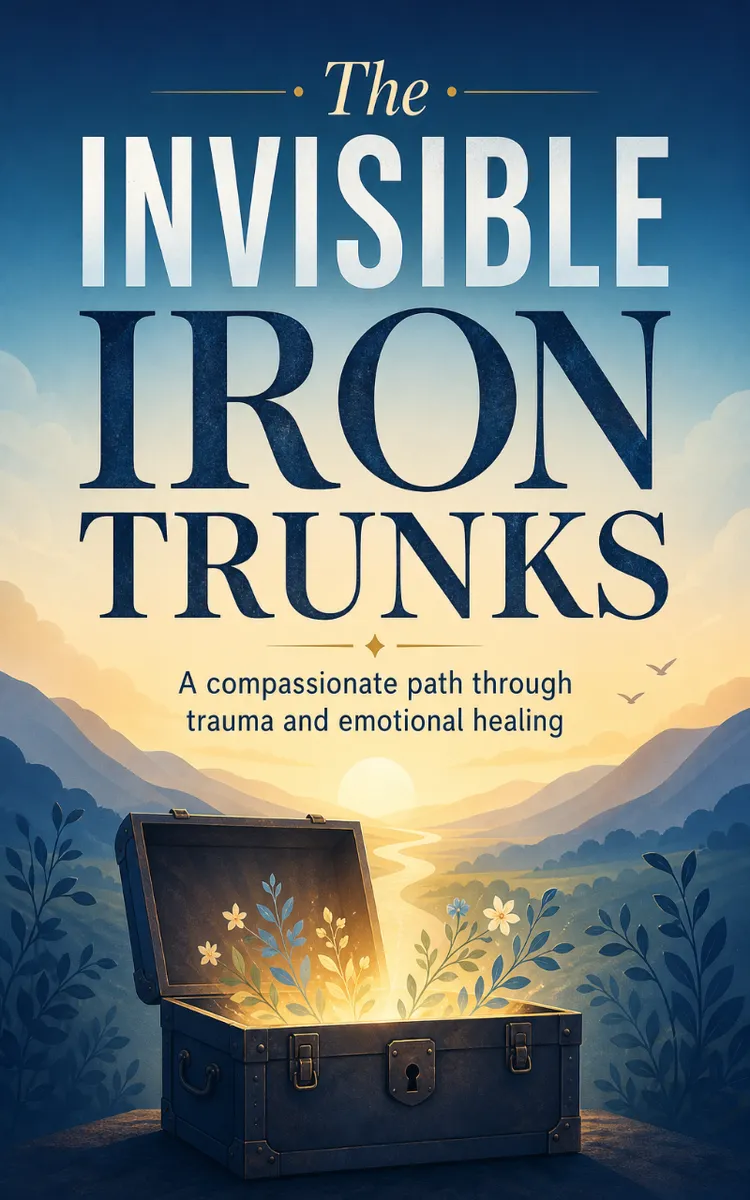

Read the first chapter
The whole of chapter one, free. About 8 min. Turn the pages with the arrows, your keyboard, or a swipe.
Chapter 1
Recognizing the Trunks You Drag
The Moment the Trunk Pulls Back
Mara stood in the hardware store aisle with a replacement lock in her hand. Her phone showed three missed calls from her brother, each one asking the same simple question: Can we talk about what happened? Her thumb hovered over the message, then clenched and pulled back. Then her chest tightened, her jaw hardened, and she typed, “Not doing this,” before sliding the phone into her pocket.
Nothing dangerous was happening. No one was shouting. The fluorescent lights hummed above her, and a man nearby compared two brands of screws. Still, Mara felt the old alarm rise through her body. She left the lock on the shelf and walked out without buying anything.
For years, she had told herself she was cold, dramatic, and impossible to reach, especially when relatives phoned about family matters. She had never called it what it was: a survival strategy still guarding a door that had been locked long ago.
The Trunks Behind Ordinary Reactions
The Fast Apologizer - Len
Len apologized before he even knew what he had done. If his partner looked tired, he said sorry. If a coworker sighed, he offered to fix something. His shoulders stayed slightly raised, as if an invisible hand might grab him for causing trouble.
As a child, Len learned that peace depended on reading the room quickly. His constant apologizing wasn’t proof that he was weak. It was an old attempt to stay safe.
The Disappearing Act - Priya
Priya received a promising job offer and immediately found reasons to reject it. The commute was inconvenient. The timing was bad. The team might be difficult. Each reason sounded sensible on its own, but underneath them lived a familiar fear: if she became visible, someone would eventually criticize her.
Her avoidance had once protected her from humiliation. Now it quietly kept her life small.
The Locked Door - Mara
Mara ended conversations the moment emotion entered the room. She called it having boundaries, but sometimes the boundary appeared before anyone had crossed it. A question about the past felt like an accusation. A request for honesty felt like a trap.
Her distance made sense when closeness had once meant being hurt. It simply no longer fit every room she entered.
What all these have in common
• Their present reactions began as attempts to prevent an older kind of pain.
• Their bodies responded before their thinking minds could assess the moment.
• Each person mistook protection for personality.
• The invisible trunk was still being dragged, even when the original danger was gone.
A survival strategy is not a character flaw. It’s a clever response that stayed on duty too long. The problem isn’t that Len learned to apologize, Priya learned to disappear, or Mara learned to shut the door. The problem is that their bodies kept treating ordinary moments as emergencies.
This is how unresolved experiences shape choices. They often show up as bodily alerts rather than tidy stories or named memories. Sometimes they appear as a clenched stomach before sending an email, a sudden urge to quit, a need to control every detail, or a voice that says, Don’t need anyone. Don’t expect anything. Don’t make a mistake.
The Invisible Trunk Inventory lets you notice the pattern, without turning observation into self-attack. You’re not putting your whole life on trial. You’re observing what happens when the trunk gets tugged.
When Protection Starts Looking Like Personality
The nervous system is built to notice danger before the conscious mind has finished forming a sentence. If an earlier experience taught you that conflict leads to abandonment, your body may react to a mild disagreement as if love itself is about to disappear. If mistakes once brought ridicule, a small correction can feel like exposure under a harsh white light.
That reaction can shape your self-image. You may begin saying, “I’m just bad with confrontation,” when the deeper truth is, “My body learned that confrontation was dangerous.” You may call yourself lazy because you freeze at important tasks. You may call yourself needy because reassurance settles an old alarm. These labels sound personal, but they often describe adaptations.
The shift begins when you separate who you are from what you learned to do to survive. That separation creates room. In that room, you can ask whether the trunk belongs in your hands today, or whether you’re still carrying it because nobody told your younger self the danger had passed.
You may need the Invisible Trunk Inventory when:
• Your reaction feels bigger than the event. A delayed text sends you into panic, or a small critique makes you want to disappear.
• You repeat choices you don’t actually want. You keep choosing unavailable people, familiar chaos, or roles where you never have to be seen.
• Your self-description sounds like a sentence. “I’m too much.” “I’m impossible.” “I can’t trust anyone.” “I always ruin things.”
• Your body answers before your mind does. Your throat closes, stomach drops, fists tighten, or breath becomes shallow before you understand why.
What you call a flaw may be an old protection asking whether it is finally safe to rest.
Opening the Inventory Without Forcing the Lock
Take a notebook and draw three columns. Name them Trigger, Protection, and Present Choice. This is your Invisible Trunk Inventory. Use one recent moment, not your entire childhood. We’re looking for a thread, not trying to excavate the desert in one afternoon.
• What happened, exactly, before your reaction changed?
Write the observable facts. “My manager asked me to revise the proposal” is clearer than “My manager attacked my work.” Precision helps you notice the difference between the present event and the meaning your trunk attached to it.
• What did your body do first?
Name the physical details: heat in your face, pressure in your chest, numb hands, a locked jaw, a sudden need to leave. If Len were answering, he might write, “My stomach dropped and I started drafting an apology before I knew what I was sorry for.”
• What protection appeared?
Did you appease, withdraw, over-explain, control, attack, numb out, or become perfect? Priya might write, “I found three practical reasons to reject the offer, but underneath them I wanted to avoid being judged.”
• What did you believe the reaction said about you?
Finish the sentence: “If I don’t protect myself this way, then…” Perhaps the answer is, “I’ll be rejected,” “I’ll be trapped,” or “People will see I’m not capable.” This is often where an old self-image steps out of the trunk.
• What is one present-day choice that includes protection without surrendering control to it?
You might wait ten minutes before replying, ask for clarification, or say, “I want to talk, but I need a short break first.” The goal isn’t to become fearless. It’s to let the adult you make one decision alongside the frightened part.
If reflection brings up intense distress, stop and return to the room around you. Press your feet into the floor. Name five things you see. Trauma processing should not be a punishment or a solo endurance test. Support from a qualified therapist can help when the lock feels too heavy to handle alone.
The Seven-Day Trunk Check
Challenge name: Seven Days of Noticing the Pull
Difficulty level: Gentle, with moments of honest discomfort.
For seven days, don’t try to eliminate your reactions. Track them. The purpose is to catch the moment when an old survival strategy disguises itself as “just who I am.”
• Day 1 - Choose one trunk.
Pick one repeating pattern: apologizing, withdrawing, overworking, controlling, freezing, or seeking constant reassurance. Write one sentence about what it protects you from feeling.
• Day 2 - Map the body signal.
When the pattern appears, pause for thirty seconds. Record where you feel it physically and rate its intensity from 0 to 10. No fixing. Just witnessing.
• Day 3 - Name the trigger.
Write what happened immediately before the response. Keep it concrete. “They didn’t answer for four hours” is more useful than “People always abandon me.”
• Day 4 - Find the old rule.
Complete: “When this happens, I assume…” Notice the rule beneath the reaction, such as “I must keep everyone happy” or “If I’m seen, I’ll be rejected.”
• Day 5 - Offer the younger part a sentence.
Place a hand where you feel tension and say quietly, “You’re trying to protect me. I’m here now.” This isn’t pretending everything is fine. It’s ending the habit of meeting pain with more contempt.
• Day 6 - Make one small different choice.
Delay the apology. Stay in the conversation for two more minutes. Accept the invitation without inventing a reason to decline. Choose a step that is challenging but not overwhelming.
• Day 7 - Review the evidence.
Look back and write what the strategy prevented, what it cost, and what you learned about the present moment. Notice whether the danger was current, remembered, or uncertain.
Celebrate when...
• You identify a body signal before the reaction takes over.
• You describe a survival strategy without calling yourself broken.
• You make one choice based on present information rather than old fear.
• You respond to yourself with curiosity instead of punishment.
The victory here may look very ordinary. You might still feel anxious, send the imperfect message, and remain in the room. That counts. The trunk may still be heavy, but you’ve stopped pretending the weight is your identity.
Setting Down the Weight, One Handle at a Time
The core lesson: Your survival strategies may explain your patterns, but they do not have to decide your future.
• Unresolved experiences can shape reactions, choices, and self-image long after the original danger has passed.
• The body often reveals the trunk first through tension, urgency, numbness, or the impulse to flee.
• Separating protection from personality softens shame and creates room for choice.
• The Invisible Trunk Inventory turns vague self-judgment into specific, compassionate observation.
You don’t have to break every lock today. Start by noticing which trunk pulls hardest when life becomes uncertain. Beneath that weight may be a younger part still waiting for someone to listen - not to shame it, not to drag it farther, but to finally sit beside it in the dust.
End of chapter one. 7 more chapters in the full book.
Swipe or use the arrows to turn the page


What's inside: 8 chapters
- 1. Recognizing the Trunks You Drag
- 2. Releasing Shame About Survival
- 3. Finding Safety in Your Body
- 4. Naming Emotions Without Flooding
- 5. Listening to the Frozen Child
- 6. Setting Boundaries Without Guilt
- 7. Returning to the Present After Triggers
- 8. Living Beyond the Unlocked Trunk
About this book
"The Invisible Iron Trunks" is a self-help book by Ron Pip with 8 chapters and approximately 12,054 words. Trauma processing, repressed emotions, somatic awareness, and inner-child healing.
This book was created using Inkfluence AI, an AI-powered book generation platform that helps authors write, design, and publish complete books. It was made with the AI Self-Help Book Writer.
Frequently Asked Questions
What is "The Invisible Iron Trunks" about?
Trauma processing, repressed emotions, somatic awareness, and inner-child healing
How many chapters are in "The Invisible Iron Trunks"?
The book contains 8 chapters and approximately 12,054 words. Topics covered include Recognizing the Trunks You Drag, Releasing Shame About Survival, Finding Safety in Your Body, Naming Emotions Without Flooding, and more.
Who wrote "The Invisible Iron Trunks"?
This book was written by Ron Pip and created using Inkfluence AI, an AI book generation platform that helps authors write, design, and publish books.
How can I create a similar self-help book?
You can create your own self-help book using Inkfluence AI. Describe your idea, choose your style, and the AI writes the full book for you. It's free to start.
Write your own self-help book with AI
Describe your idea and Inkfluence writes the whole thing. Free to start.
Start writingCreated with Inkfluence AI


