
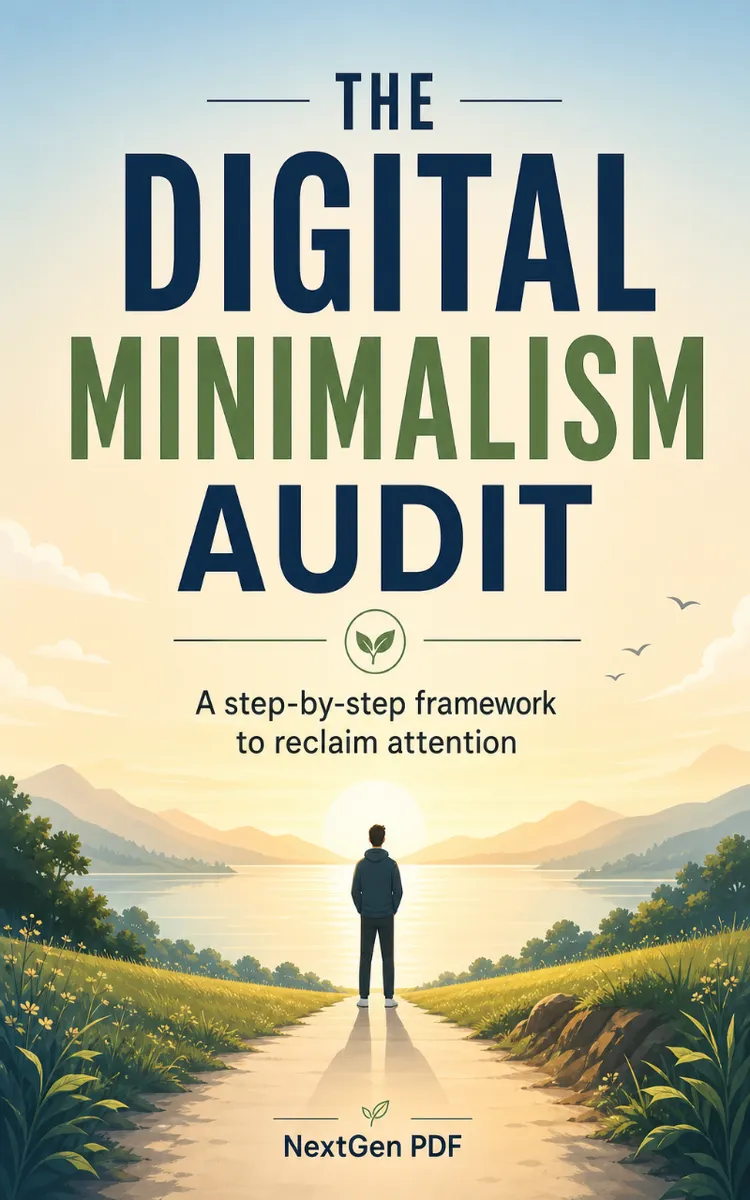
The Digital Minimalism Audit
Created with Inkfluence AI
Reducing digital distractions and optimizing attention habits
Table of Contents
- 1. Mapping Your Attention Leaks
- 2. Choosing a Notification Diet
- 3. Designing Focus Blocks That Stick
- 4. Replacing Doomscrolling With Rituals
- 5. Setting Boundaries Without Losing Trust
- 6. Building Identity-First Digital Habits
- 7. Auditing Communication Channels Weekly
- 8. Protecting Purpose Through Resilience
Preview: Mapping Your Attention Leaks
A short excerpt from “Mapping Your Attention Leaks”. The full book contains 8 chapters and 12,092 words.
The Moment Your Attention Slips
How many times do you unlock your phone without knowing what you meant to check?
You’re halfway through answering an email when a notification appears. You tap it, glance at a message, and notice a calendar reminder. That takes you to a meeting note, then a search, then a short video someone sent you. Ten minutes later, your original email is still open. Your coffee is cold. You’re annoyed, but not quite sure at whom.
The same thing happens in smaller cracks. You reach for your phone while waiting for a file to load. You check a work chat during dinner. You open your laptop to pay one bill and end up clearing three inboxes before remembering the bill. Nina, a 34-year-old customer success manager, noticed she was checking her phone every time a customer email made her slightly uneasy. The check felt practical. The real pattern was different: discomfort triggered the check, and the check gave her a quick escape.
That’s what an attention leak often looks like. Not a dramatic collapse. A tiny, repeated detour that quietly takes your focus, patience, and confidence with it. Do you recognise this pattern in yourself?
The Question Behind the Check
What if the problem isn’t that you use your phone too much, but that you use it at the exact moments you most need to stay with yourself?
That question changes what you look for. Instead of counting every minute on a screen, you start noticing the handoff: the moment a task, feeling, place, or person sends you toward a digital escape. The app matters, but the context matters just as much. Instagram during a relaxed lunch isn’t the same as Instagram opened after a difficult client call. One may be chosen. The other may be automatic.
Nina’s first instinct was to delete the social apps from her phone. She lasted two days, then moved the same checking habit to news, shopping, and work chat. Her Attention Leak Map showed the real pattern: customer complaints led to email refreshes; email refreshes led to chat; chat led to checking her phone; checking her phone made the complaint feel even harder to face. The app was only the doorway.
Before the audit, Nina described herself as “bad at focus.” After mapping seven days, she wrote a more useful sentence: “I leave difficult work when I feel uncertain.” That gave her something she could work with. She began placing her phone in a drawer during customer-response blocks and writing the next physical action on a sticky note: “Draft the first two sentences.” Her attention didn’t become perfect. It became easier to return.
The difference is important. A label makes you feel stuck. A map shows you where the road bends.
How an Attention Leak Builds
Use this chain to catch one of your own recurring loops. Choose a real example from the last three days, not an idealised version of yourself.
1. When you receive a notification, hit a difficult section of work, or feel a flicker of boredom...
2. You feel tension, uncertainty, restlessness, or the need for a quick reward.
3. So you open the easiest available app, usually without deciding to do it.
4. Which leads to a short burst of stimulation, followed by lost time and a harder return to the task.
Nina’s loop looked like this: a customer email arrived with an unclear request. She felt exposed and unsure. So she refreshed her inbox and opened team chat. That led to five minutes of reading, a delayed reply, and more anxiety about the email she was avoiding.
Now build the alternative chain:
1. When the same trigger appears...
2. You name the feeling and pause for ten seconds.
3. So you write the smallest next action, such as “highlight the customer’s actual question.”
4. Which leads to a deliberate choice: continue for five minutes, or take a planned break away from the screen.
The goal isn’t to remove every urge. It’s to insert one moment of choice between the trigger and the tap.
You don’t need perfect attention; you need a visible map of where it leaves.
Rate the Leaks, Not Your Character
Use the past seven days as your reference point. Answer quickly and honestly. The first answer is usually more useful than the impressive one.
1. On a scale of 1-10, how often do you open an app without knowing what you intended to do?
A low score suggests your app use is mostly deliberate. A high score points to automatic openings worth recording by context, not just by app.
2. Yes or no: Do notifications interrupt you during tasks that require concentration?
“Yes” reveals an external leak in your environment. “No” doesn’t mean you’re clear; you may still be switching because of internal cues such as boredom or uncertainty.
3. On a scale of 1-10, how often do you check a device when a task becomes emotionally uncomfortable?
A high score suggests the leak is serving as relief. The useful question isn’t “Which app should I delete?” but “Which feelings send me looking?”
4....
About this book
"The Digital Minimalism Audit" is a self-help book by NextGen PDF with 8 chapters and approximately 12,092 words. Reducing digital distractions and optimizing attention habits.
This book was created using Inkfluence AI, an AI-powered book generation platform that helps authors write, design, and publish complete books. It was made with the AI Self-Help Book Writer.
Frequently Asked Questions
What is "The Digital Minimalism Audit" about?
Reducing digital distractions and optimizing attention habits
How many chapters are in "The Digital Minimalism Audit"?
The book contains 8 chapters and approximately 12,092 words. Topics covered include Mapping Your Attention Leaks, Choosing a Notification Diet, Designing Focus Blocks That Stick, Replacing Doomscrolling With Rituals, and more.
Who wrote "The Digital Minimalism Audit"?
This book was written by NextGen PDF and created using Inkfluence AI, an AI book generation platform that helps authors write, design, and publish books.
How can I create a similar self-help book?
You can create your own self-help book using Inkfluence AI. Describe your idea, choose your style, and the AI writes the full book for you. It's free to start.
Write your own self-help book with AI
Describe your idea and Inkfluence writes the whole thing. Free to start.
Start writingCreated with Inkfluence AI


