

Read the first chapter
The whole of chapter one, free. About 6 min. Turn the pages with the arrows, your keyboard, or a swipe.
Chapter 1
Choose Enough Over Endless More
The Evening That Exposed the Real Problem
At 8:47 on a Tuesday night, a small-business owner shut her laptop, opened it again, and checked her sales dashboard “one last time.” Her dinner had gone cold, and an unanswered message waited from a friend sat unanswered. She’d planned to read for twenty minutes, but the day had quietly claimed that time too.
Nothing was technically wrong. The bills were paid. Work was moving. Her calendar looked impressive. Yet she felt strangely absent from her own life. The next morning, she added another task to her list, hoping a more productive day would finally create the feeling she was missing.
You may know this pattern. You finish one job and immediately scan for the next. You buy a new planner, tweak your mornings, or promise to wake earlier You say you want more time with your partner, more energy for exercise, or a slower cup of coffee. Then an urgent message, a fresh target, or someone else’s definition of success takes the wheel.
By Friday, your routine has become a conveyor belt. You’re moving, but you’re not sure where it’s carrying you. The frustrating part is that you may be doing many things “right” while still feeling that your days don’t belong to you. Do you recognise this in yourself?
The Question Behind the Question
What if the life you’re trying to improve is already asking you to stop adding and start choosing?
That question can feel uncomfortable because “more” is easy to measure. More income. More customers. More completed tasks. More time squeezed from the morning. Satisfaction is quieter. It may look like closing the shop at a reasonable hour, having enough patience left for your child, or finishing the day without replaying every unfinished task.
A satisfying life isn’t identical for everyone. For one person, it might mean steady work, a calm home, and two evenings each week protected from business decisions. For another, it might mean building a company aggressively for a season while keeping Sunday morning untouched. The point isn’t to copy someone else’s balance. It’s to name your own standard before your calendar names it for you.
That’s where the Enoughness Compass comes in. It names four directions: energy, connection, responsibilities, and respecting your limits Use it to judge a routine by the life it creates, not by how full it looks.
Before using the compass, the business owner above measured a good day by output. Afterward, she chose three signs of “enough”: the most important work completed, dinner without a screen, and lights out before her energy collapsed. She still worked hard. She simply stopped treating every available hour as an invitation.
How More Quietly Takes Over
The drift usually happens in a predictable order:
• When you see an unfinished task, a competitor’s achievement, or a new opportunity...
• You feel behind, even when you’ve already done meaningful work.
• So you add another task, extend the workday, or sacrifice the activity you said mattered.
• Which leads to less energy, thinner relationships, and a stronger belief that you need to do even more.
The alternative chain begins with a personal definition of enough:
• When you notice an unfinished task or tempting opportunity...
• You check it against your Enoughness Compass.
• So you choose whether it supports your responsibilities, connection, energy, or limits.
• Which leads to a routine that protects satisfaction instead of constantly postponing it.
This isn’t an excuse to avoid necessary effort. It’s a way to stop confusing effort with worth. A full day can be valuable, and a spacious day can be valuable too.
A satisfying life begins when your routine answers to your values, not your anxiety.
Your Enoughness Compass Check-In
Take a quiet moment with these questions. Rate yourself honestly; nobody sees the score unless you choose to share it.
• From 1 to 10, how clearly can you describe what “a good ordinary day” looks like for you?
A low score suggests you’ve been borrowing your definition from customers, coworkers, social media, or family expectations. A high score means your routine has a personal target beyond getting through the day.
• Yes or no: Does your current schedule protect at least one activity that matters even when work becomes demanding?
“No” may reveal that your priorities are treated as leftovers. “Yes” shows that your routine has a boundary strong enough to survive a busy week.
• From 1 to 10, how often do you stop feeling satisfied with what you’ve done
A low score can point to a moving finish line. A high score doesn’t mean every task is complete; it means you can recognise a worthwhile stopping point.
• From 1 to 10, how much of your daily effort supports the life you actually want?
A low score may reveal activity without direction. A high score suggests your choices are connected to a personal standard rather than borrowed urgency.
Here’s a simple reading of your answers. If most scores are 1 to 4, don’t overhaul your life; start by defining one ordinary day you’d respect. Scores from 5 to 7 suggest you know what matters but haven’t protected it consistently. Scores from 8 to 10 show a strong foundation, though even a clear compass needs regular checking when circumstances change.
The One-Day Enoughness Challenge
Draw your personal Enoughness Compass
• Name your standard at breakfast.
Write four short answers in a notebook: “I have energy when...,” “I feel connected when...,” “My responsibilities are cared for when...,” and “I respect my limits when...” Keep each answer under ten words.
Expected difficulty: Easy.
• Use the compass at your first decision point.
When you face a choice today - another work task, a message, an errand, or rest - ask which direction it serves. If it serves none, delay or decline it. If it serves one, decide whether that direction truly needs attention today.
Expected difficulty: Medium.
• Close the day with a three-line review.
Before bed, write one choice that supported your definition of enough, one moment when “more” pulled at you, and one boundary you’ll repeat tomorrow. Don’t turn this into an essay. Three honest lines are enough.
Expected difficulty: Medium.
You’ll know it’s working when...
• You can name why a task belongs in your day instead of doing it automatically.
• You stop one activity without feeling you’ve failed.
• You notice a small satisfying moment - an unhurried meal, a present conversation, or a clear end to work.
The challenge isn’t designed to make you feel perfectly balanced after one day. It’s designed to give your choices a reference point. Without one, every request can sound important. With one, you can begin separating what matters from what merely makes noise.
Enough Is a Direction, Not a Finish Line
Enough doesn’t mean settling; it means deciding what your effort is for.
• A satisfying life needs a personal definition, not a borrowed scoreboard.
• The Enoughness Compass connects daily choices to energy, connection, responsibility, and limits.
• A routine becomes more useful when it includes a stopping point.
• Small protected choices can change the emotional shape of an entire day.
You’ll still have crowded weeks. You’ll still change your mind. A new child, a health concern, a business season, or a financial goal may shift what enough means for a while. That’s not failure. A compass isn’t a cage; it helps you adjust without losing your direction.
Tonight, notice one moment when you could chase more but choose what matters instead. Let that choice be modest. Close the laptop. Eat the warm meal. Take the walk. Call the person you’ve been meaning to call.
Then ask yourself: If enough is the standard, what should the first hour of tomorrow make room for?
End of chapter one. 7 more chapters and about 11,774 words in the full book.
Swipe or use the arrows to turn the page


What's inside: 8 chapters
- 1. Choose Enough Over Endless More
- 2. Design Days Around Your Values
- 3. Build Habits That Survive Real Life
- 4. Shape Mornings Without Rushing
- 5. Protect Attention with Clear Boundaries
- 6. Make Space for Everyday Joy
- 7. Recover Quickly When Plans Break
- 8. Let Purpose Guide Your Weekly Rhythm
About this book
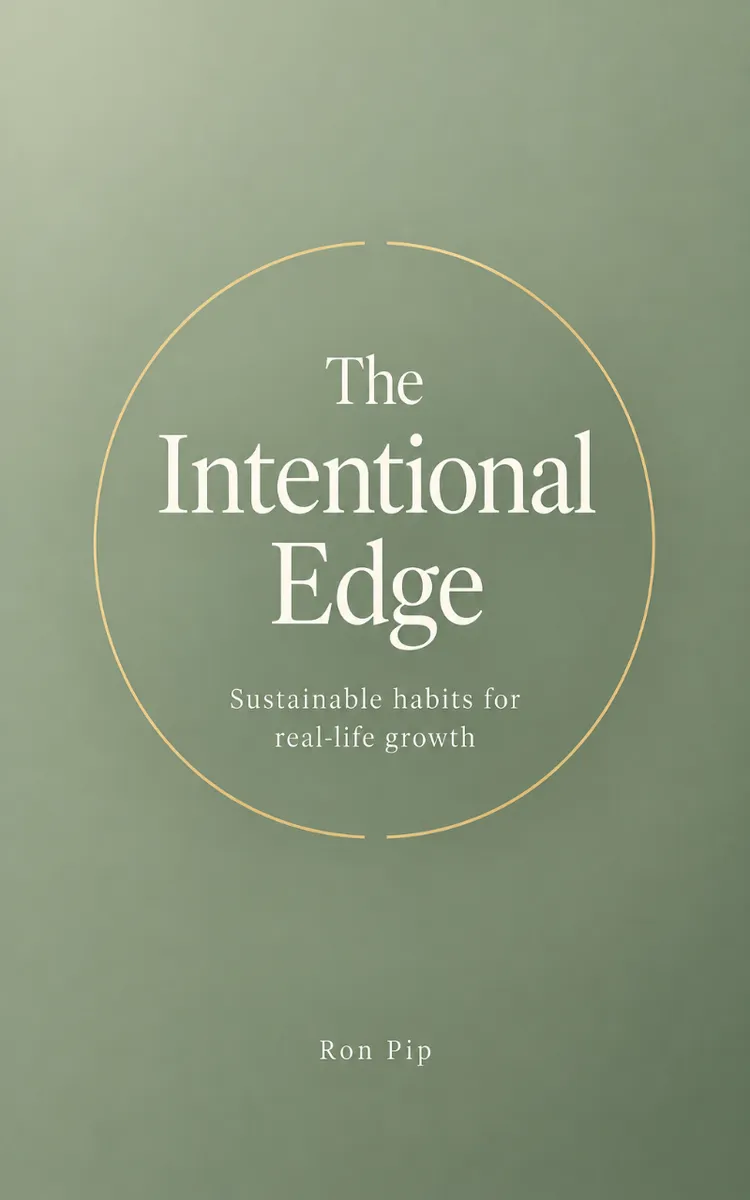
"The Intentional Edge" is a self-help book by Ron Pip with 8 chapters and approximately 11,774 words. Building sustainable daily routines for happiness and life satisfaction.
This book was created using Inkfluence AI, an AI-powered book generation platform that helps authors write, design, and publish complete books. It was made with the AI Self-Help Book Writer.
Frequently Asked Questions
What is "The Intentional Edge" about?
Building sustainable daily routines for happiness and life satisfaction
How many chapters are in "The Intentional Edge"?
The book contains 8 chapters and approximately 11,774 words. Topics covered include Choose Enough Over Endless More, Design Days Around Your Values, Build Habits That Survive Real Life, Shape Mornings Without Rushing, and more.
Who wrote "The Intentional Edge"?
This book was written by Ron Pip and created using Inkfluence AI, an AI book generation platform that helps authors write, design, and publish books.
How can I create a similar self-help book?
You can create your own self-help book using Inkfluence AI. Describe your idea, choose your style, and the AI writes the full book for you. It's free to start.
Write your own self-help book with AI
Describe your idea and Inkfluence writes the whole thing. Free to start.
Start writingCreated with Inkfluence AI


