
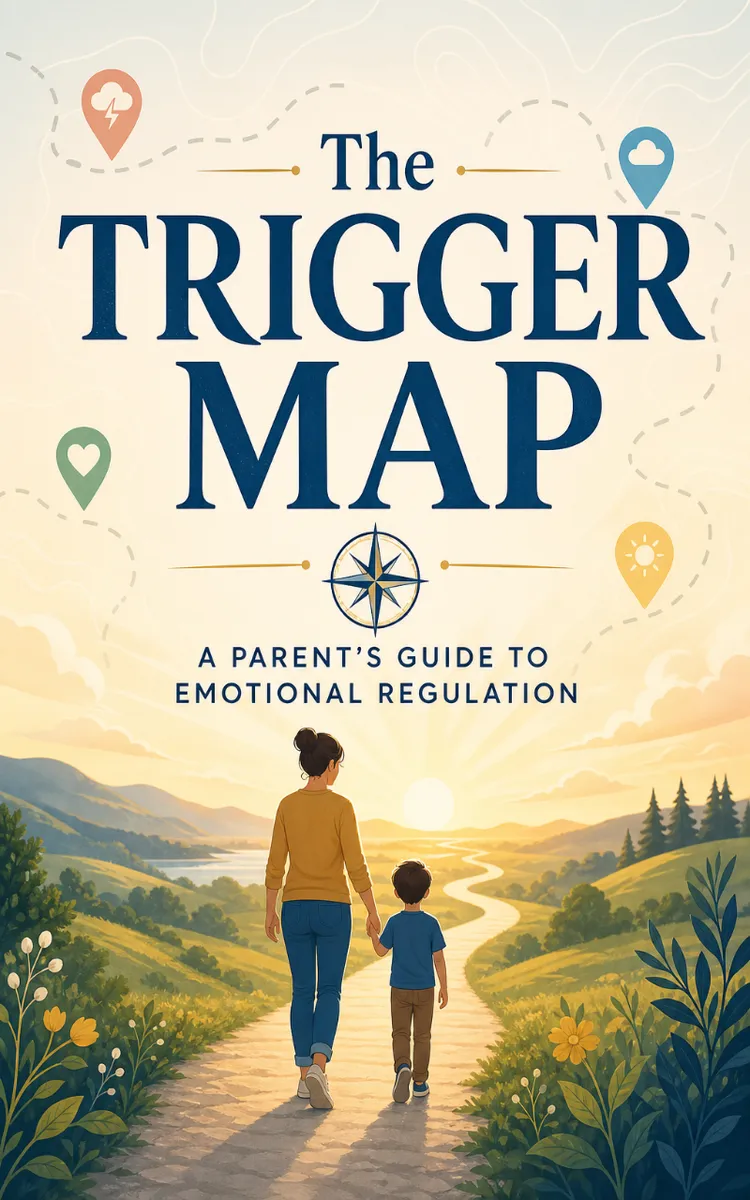

Read the first chapter
The whole of chapter one, free. About 8 min. Turn the pages with the arrows, your keyboard, or a swipe.
Chapter 1
Mapping Your Body’s Early Alarms
The Moment Your Body Snaps the Volume Up (Before You Even Notice)
Last winter, Tanya - ER nurse and mom of two - had that familiar “uh-oh” feeling before she’d even opened the fridge. Her kids were bickering in the kitchen, the kind of noise that usually makes her jump in and fix it. This time, she didn’t. She felt it first: a tight, hot band under her ribs, like someone had cinched her from the inside. Her shoulders rose without permission. Her jaw clicked. And right as she was about to speak sharply, she caught herself thinking, I’m not angry… I’m revving.
That pause saved her from the version of the scene she usually regretted. Instead of jumping straight to “Stop it right now,” she backed up half a step and did one small nervous-system check. The bickering was still happening. But her body wasn’t in full emergency mode yet - and that changed the words that came next.
So here’s the question that matters most when you’re trying to parent with more control: How do you notice your reaction before it hijacks your mouth?
The EARLY Alarm Scan: Spot Physical Sensations That Predict Your Reaction
Old Belief: If I’m reacting badly, it’s because I’m a bad parent (or my child is being “too much”). New Reality: Your reaction starts in your body first - long before your brain builds a reason for it.
That shift matters because it takes the blame off your character and puts it where it belongs: in your nervous system. When you can feel the early signals, you’re no longer stuck waiting for “proof” that you’re about to snap. You get a heads-up. Tanya didn’t stop the kids’ noise. She stopped the trajectory - the moment her body started steering.
Here’s a concrete example from Tanya’s real-life pattern. When her oldest refused to get dressed, Tanya’s mind would usually race straight to logic: They’re being difficult. They’re not listening. I shouldn’t have to ask twice. But the “snap” wasn’t born in the thought. It was already in the body: heat in her face, a quick tightening in her stomach, and a sharp urge to correct. Once she learned to treat those sensations like an alarm bell - not a verdict - she could choose a calmer first sentence. Not a perfect one. Just a better one.
And the beauty of this is that you don’t need a new personality. You need a new noticing skill.
Why Physical Alarms Matter More Than the Story in Your Head
Your body is quick. Your thoughts are faster than feelings, but the nervous system is the fastest part of the whole setup. Before your brain says, This is unfair, your body might already be doing, Danger. Tighten up. Get control.
That’s why the EARLY Alarm Scan is about sensations, not judgments. You’re not trying to “fix” anything yet. You’re gathering information. The whole goal is to catch the moment your system starts moving toward fight, flight, or freeze - so you can step in while you still have options.
When you rely only on the story in your head, you usually discover the problem after the fact. Like, Why did I yell? or Why did I shut down? But by then, your body has already spent energy and your words are already out the door. Physical sensations give you earlier data. They’re like the dashboard lights that come on before the car actually breaks down.
Signs This Pattern Is Running Your Life
1. Your body “jumps” first, and your thoughts show up as explanations after. You’ll notice heat, tightness, buzzing energy, or a heavy drop in your chest - and only then the mind builds a reason. 2. You feel compelled to talk faster, correct faster, or control faster. Not because you want to - because your system is trying to regain safety through action. 3. You get stuck in the same kind of moment repeatedly. The child’s behavior might vary, but the sensation pattern feels familiar (same tight band, same throat catch, same clenched jaw). 4. After the moment, you’re left replaying your words like they came from someone else. That “where did that come from?” feeling is often your nervous system taking the wheel.
A bold one-sentence summary
Your best self-control tool is noticing the alarm in your body before your brain turns it into a script.
The EARLY Alarm Scan: A Repeatable Nervous-System Check You Can Do Daily
This is the part you can actually practice - no special equipment, no fancy breathing classes, no waiting for a “perfect calm moment.”
The EARLY Alarm Scan is a quick scan for physical signals that show your system is shifting. You’ll do it in real time, but you’ll also use it daily so you get familiar with your own patterns (because your body has a “language,” and it’s yours).
Here’s the scan Tanya used as she built her awareness:
• Stop for 10-20 seconds. Not a big pause. Just enough to interrupt automatic mode. - Find one sensation that’s loudest right now. Don’t hunt. Don’t judge. Just notice. - Name it without fixing it. Example: “Tight stomach.” “Hot face.” “Clenched jaw.” “Buzzing in my chest.” - Check the direction: is it moving you toward push (fight), escape (flight), or shut down (freeze)? - Choose one tiny next step that matches your body’s needs, not the child’s behavior.
If you want one simple measurement to anchor it, use this: What’s your sensation intensity from 0 to 10 right now? That number isn’t for performance. It’s for clarity. You’re teaching yourself, I can track my state like I’d track a temperature.
Daily practice matters because the alarm signals aren’t always dramatic. Sometimes they’re subtle - like a slight throat tightness or a hollow ache behind the ribs. The more you scan when you’re calm-ish, the easier it is to catch the shift when stress hits.
Try These Questions So You Can Map Your Own Early Alarms
Answering these won’t make you “better” overnight. It’ll make you more accurate - about you. That accuracy is what creates change.
1. What physical sensations show up right before I react (even a little)? Think: throat, jaw, chest, stomach, shoulders, hands. If you can’t name it yet, start with what you feel in the moment: “tight,” “hot,” “heavy,” “buzzing,” “numb,” “fast.”
2. When I notice the sensation, what story does my brain start writing? Example: They’re ignoring me. This is ridiculous. I have to fix it. Your honest answer helps you see the difference between “facts” and “fuel.”
3. Do I tend to push, escape, or shut down when the alarm hits? Push looks like quick correction and raised volume. Escape looks like withdrawal, silence, or leaving the room. Shut down can look like blankness, numbness, or going quiet without connection.
4. What’s my earliest stage of escalation - what happens first, second, third? Write it like a mini sequence: “tight stomach → jaw clenches → I speak sharply.” Even if it’s messy, you’re building a map.
5. What happens if I pause for 15 seconds right when I first feel it? You’re not asking if it “fixes everything.” You’re asking whether you can soften your first word, your tone, or your next move.
7 Days to Catch Your Body’s Early Alarms (Before You Act)
Challenge Title: The EARLY Alarm Scan Week
• Day 1: Pick one common trigger moment (morning getting ready, bedtime battles, homework time). Do a 10-20 second scan before you enter that space. Rate the sensation intensity 0-10. - Day 2: During that trigger moment, scan the second you feel any shift. Name the sensation out loud in your head (no fixing). Rate again. - Day 3: Choose one “alarm sensation” and track it only. When it appears, note: push / escape / shut down. - Day 4: Do one 15-second pause before speaking when the sensation hits. Then choose one sentence you can live with (even if it’s short). - Day 5: After the moment, jot two lines: “I felt _ at about /10.” “My first reaction was ___.” - Day 6: Scan once during a calmer moment too (dishwashing, folding laundry, driving). Practice catching the baseline sensation so stress feels different. - Day 7: Review your notes. Look for the pattern: What sensation shows up first? What direction does it push you toward?
Expected difficulty rating: Medium (because it asks you to notice yourself in real time, and that can feel weird at first)
You’ll know it’s working when… - You can identify at least one physical sensation that reliably shows up before you react. - Your “snap moment” becomes less of a mystery - more of a pattern you can predict. - Even one time, you catch the alarm and choose a different first sentence.
Key Takeaway: Your Body Is Your First Message - Learn to Read It
By the end of the week, you’re not just trying to parent better. You’re training a skill: noticing your nervous system’s early warning signals. That’s the foundation for everything else in The Trigger Map, because once you can spot the alarm in the body, you can start choosing what comes next instead of letting your reaction write the script.
Your reaction doesn’t start in your mouth - it starts in your body, and you can learn to catch it early.
• You’re mapping physical sensations that show your nervous system is shifting before you act. - The EARLY Alarm Scan is a short, repeatable check: notice → name → rate → direction. - Daily practice makes subtle alarms easier to catch when stress spikes. - Once you track your sensations, your “snap” stops feeling random and starts feeling predictable.
Next, we’ll take that map one step further - turning your early body signals into clearer understanding of what your mind does with them, so you can interrupt the story before it turns into behavior.
End of chapter one. 7 more chapters in the full book.
Swipe or use the arrows to turn the page


What's inside: 8 chapters
- 1. Mapping Your Body’s Early Alarms
- 2. Naming Triggers Without Blame
- 3. Rewriting the Stories Behind Your Reactivity
- 4. Building Boundaries Without Guilt
- 5. Using the Pause That Actually Works
- 6. Communicating Needs Through Trigger Language
- 7. Recovering After Ruptures With Self-Trust
- 8. Integrating Your Trigger Map for Resilience
About this book
"The Trigger Map" is a self-help book by NextGen PDF with 8 chapters and approximately 13,717 words. Identifying parents' emotional triggers using nervous-system regulation.
This book was created using Inkfluence AI, an AI-powered book generation platform that helps authors write, design, and publish complete books. It was made with the AI Self-Help Book Writer.
Frequently Asked Questions
What is "The Trigger Map" about?
Identifying parents' emotional triggers using nervous-system regulation
How many chapters are in "The Trigger Map"?
The book contains 8 chapters and approximately 13,717 words. Topics covered include Mapping Your Body’s Early Alarms, Naming Triggers Without Blame, Rewriting the Stories Behind Your Reactivity, Building Boundaries Without Guilt, and more.
Who wrote "The Trigger Map"?
This book was written by NextGen PDF and created using Inkfluence AI, an AI book generation platform that helps authors write, design, and publish books.
How can I create a similar self-help book?
You can create your own self-help book using Inkfluence AI. Describe your idea, choose your style, and the AI writes the full book for you. It's free to start.
Write your own self-help book with AI
Describe your idea and Inkfluence writes the whole thing. Free to start.
Start writingCreated with Inkfluence AI


