

Read the first chapter
The whole of chapter one, free. About 11 min. Turn the pages with the arrows, your keyboard, or a swipe.
Chapter 1
When the House Goes Quiet
Chapter 1
When the House Goes Quiet
Understanding the Fundamentals of The Empty Nester’s Next-Chapter Devotional
The dishwasher clicks off. No one is asking for the keys. No backpack hits the floor. A house that was once full of motion can suddenly feel full of echo.
That change is not imaginary, and it is not small.
For many empty nesters, this season brings a strange mix of gratitude and grief. You may be proud of your children and still feel unsettled. You may love the Lord and still feel emotionally off-center. You may even have more time than you used to have, yet less clarity than you expected. That tension does not make you ungrateful. It makes you human.
This book begins here because the first spiritual task of the empty nest is not reinvention but honest return.
Before you figure out new routines, new goals, or even new ways to serve, you need a truer place to stand. When the house goes quiet, the first faithful move is not to prove your usefulness again but to bring your grief, fatigue, and questions to Christ. Your assignment may have changed, but your identity in Him has not.
Honest Grief Is Not Weak Faith
One of the hardest parts of this season is how easy it is to minimize your own loss. After all, no one has died. Your children may be doing well. Life may even look “successful” from the outside. So you tell yourself to be thankful and move on.
But good change can still hurt.
Sometimes what you miss is obvious: the people, the noise, the activity, the daily rhythm of family life. Sometimes what you miss is harder to name: the sense of being needed, the structure that organized your days, the version of yourself that knew exactly what to do next.
Scripture does not ask you to deny any of that.
Psalm 34:18 says, in the ESV, “The LORD is near to the brokenhearted and saves the crushed in spirit.” Notice what the verse does not say. It does not say God draws near only after you recover. It does not say He saves the people who have already put themselves back together. He comes near to the brokenhearted.
That matters, because denial can look spiritual when it is really fear in church clothes. Denial lets you keep moving. It lets you stay productive. It lets you avoid the vulnerable sentence: Something in me is grieving.
But a locked heart cannot receive comfort.
This is one of the fundamentals of a next-chapter devotional life: honesty does not break faith. Honesty is part of faith. When you tell God the truth about your sadness, your confusion, your resentment, or your fatigue, you are not pushing Him away. You are bringing your real self into His presence.
And that is where healing starts.
The Cultural Script Gets This Season Wrong
The wider culture usually offers two shallow answers to a quiet life stage.
The first answer is reinvention. Travel more. Buy more. Stay distracted. Build a new version of yourself fast enough that you never have to sit still long enough to ask what this season is exposing.
The second answer is usefulness. Stay busy. Stay relevant. Keep proving your value. Fill the open space before it starts asking uncomfortable questions.
Neither activity nor fresh purpose is wrong. Structure can help. New assignments can be gifts. Service still matters. The problem begins when those things become cover.
Our culture tends to measure worth by visible output. If fewer people need something from you today, it can feel like you somehow became less significant. In that kind of world, a quieter calendar can feel like a smaller self.
That is bad math.
And Christians are not immune to it. In some church cultures, busyness wears a halo. You can hide from grief behind volunteering. You can avoid deeper questions by staying “useful.” You can keep serving long after your soul has gone thin.
But Scripture never teaches that your value comes from your visible demand. In Christ, you are not loved because you are efficient. You are not secure because you are needed. You are not spiritually mature because you can carry a crushing load without complaint.
Your assignment changed. Your belonging did not.
That is why this season can feel so exposing. The quiet is not only changing your schedule. It is confronting the story you have believed about who you are.
Jesus Does Not Treat Quiet as Punishment
For many empty nesters, the quiet feels less like peace and more like a spotlight. The house may be still while your thoughts are anything but still. Questions get louder. Regrets surface. Small tensions in your marriage become easier to notice. Spiritual dryness becomes harder to disguise.
That is often when punishment language creeps in.
I should be handling this better. Maybe I’m losing momentum. Maybe God is showing me that my useful years are behind me. Maybe if I were stronger, this season wouldn’t feel so heavy.
Jesus speaks directly into that kind of burden.
In Matthew 11, He is addressing weary people, not polished people. He says, “Come to me, all who labor and are heavy laden, and I will give you rest. Take my yoke upon you, and learn from me, for I am gentle and lowly in heart, and you will find rest for your souls. For my yoke is easy, and my burden is light” (Matthew 11:28–30, ESV).
That invitation is deeper than stress relief. It is an identity correction.
Jesus does not say, “Come back when you have adjusted.” He does not say, “Come once you stop feeling sad.” He does not say, “Come after you’ve built a better plan.”
He says, Come to me.
Rest, then, is not a reward for high performers. It is a gift for those who are burdened. And in an empty nest season, that matters more than you may realize. Because the quiet is not proof that God has stepped away, it may be the place where He is teaching you to stop confusing activity with intimacy.
Stillness often reveals what noise concealed.
If parenting demands, ministry schedules, or household urgency kept deeper questions beneath the surface, the quiet may bring them up. That can feel unsettling. It can also be merciful. God is not exposing you to shame you. He may be uncovering what needs to be brought into the light so it can finally be healed.
Learn to Pray the Truth
When life changes, prayer can get strangely difficult. Some people become wordy with God because they are trying to manage their anxiety. Others go nearly silent because they do not know how to say what is true.
Scripture gives us a healthier pattern: lament, trust, and confession.
Lament says, This hurts. Trust says, God is still God here. Confession says, I have leaned on something smaller than Christ.
Lament is not unbelief. It is grief turned toward God. The Psalms are full of people who asked hard questions without walking away. They told the truth and kept praying.
Trust is not denial. It is the decision to place your weight on God’s character even when your emotions are unsettled. You do not have to feel bright to be faithful. You do have to keep turning toward the Lord.
Confession is often where this season gets uncomfortable in a good way. Not every empty nester is guilty of some hidden, dramatic rebellion. But many sincere believers discover that they built more of their identity on competence, usefulness, or being needed than they realized. The quiet uncovers it.
That is not a verdict. It is an invitation.
First John 1:9 says, “If we confess our sins, he is faithful and just to forgive us our sins and to cleanse us from all unrighteousness” (ESV). Confession is not self-punishment. It is agreement with God. It is laying down the false supports you were using and receiving grace where pride once stood.
Maybe your confession sounds like this:
• Lord, I have been using busyness to avoid grief.
• Lord, I have treated usefulness like proof of worth.
• Lord, I have expected my old role to give me what only You can give.
• Lord, I have been tired, but I have also been unwilling to slow down.
Those are not the prayers of people being rejected. Those are the prayers of people being restored.
Build a Rhythm Small Enough to Keep
If you are weary, this is not the time for a heroic devotional plan you cannot sustain. You do not need spiritual theater. You need a rhythm you can keep on tired mornings and tender evenings.
Small is not shallow when it is sincere.
A steady next-chapter practice can be simple:
1. Read a short passage slowly
Choose a few verses, not five chapters. Read until one phrase stands out. Ask, What does this show me about God’s heart toward weary people?
2. Tell God the truth
Do not polish your language. Pray one honest sentence about what is real today: grief, fear, numbness, frustration, even relief. Bring the actual thing.
3. Name one burden you are carrying
Ask, What am I holding as if it defines me? Let the answer be concrete: control, regret, loneliness, Pressure to stay useful, fear about the future.
4. Take one faithful step
Not a dramatic vow. One step. A short walk without your phone. Ten quiet minutes before the day takes over. A needed apology. A conversation with your spouse. Turning off the noise and sitting with the Lord instead of outrunning your thoughts.
This kind of rhythm matters because burnout and grief both distort judgment. They whisper that if you cannot do something big, you are doing nothing. That is not how spiritual formation works. God often rebuilds people through steady, ordinary return.
If you are married, this can also become a small point of reconnection. At some point in the day, each of you can offer one honest sentence: This is what felt heavy today. No fixing. No speech. Just truth in the same room.
That, too, is a form of grace.
The First Decision of This Next Chapter
Every major life change eventually presents a fork in the road.
You can treat the quiet like an enemy and spend your energy numbing it, filling it, or outrunning it.
Or you can bring the quiet to God and let Him tell you what it is uncovering.
The first path often looks productive at first. You stay active. You remain respectable. You avoid awkward vulnerability. But over time, unspoken grief hardens. Irritability grows. Spiritual life becomes mechanical. Marriage can become functional but distant. The soul gets crowded while pretending everything is under control.
The second path is slower, but truer. It asks for honesty. It asks for surrender. It asks you to stop treating stillness as a threat and begin treating it as a place where Christ meets the tired.
That path does not remove sorrow overnight. It does something better: it relocates sorrow. Instead of carrying it alone, you carry it into the presence of Jesus.
This is the first decision of the next chapter: Will you use the quiet to hide, or will you use it to pray?
Your First Practice: Quiet Isn’t the Enemy
Here is a simple first entry for this season.
Read Psalm 34:18 and Matthew 11:28–30 slowly. Read them once for understanding, then once again as an invitation.
Now resist the urge to rush ahead.
Ask yourself: What part of this season have I been calling “fine” that is actually grief? Maybe it is the silence at dinner. Maybe it is the shift in your marriage. Maybe it is the loss of clear purpose. Maybe it is the fear that your most needed years are over.
Then write one sentence:
God, in this quiet, I am grieving ________.
Do not edit it. Do not defend it. Do not turn it into a lesson yet. Just tell the truth.
After that, write a second sentence:
Jesus, this burden has felt heavy because ________.
That question often uncovers more than sadness. It reveals where identity has gotten tangled. You may realize you are grieving not only your children’s absence, but also the loss of feeling central, capable, or clearly assigned.
Then pray:
Lord Jesus, You are near to the brokenhearted, and You invite the weary to come. Meet me in this quieter season. Help me stop treating stillness like punishment. Teach me how to bring You what is true, rather than hiding behind what looks strong. Re-anchor my identity in You. Amen.
For the next 24 hours, choose one ten-minute appointment with God. Protect it. No scrolling. No multitasking. Read, pray honestly, and sit still long enough to notice what rises in your heart.
If you are married, consider sharing one line with your spouse: What I miss most in this season is ________. Let that be enough for one day. You are not trying to solve everything. You are practicing truthful presence.
Grace for the Quiet
If you remember only one thing from this chapter, remember this: God does not require denial to meet you.
He welcomes honest grief. He receives weary people. He is not confused by your tears, your numbness, your questions, or your mixed emotions. The quiet does not have to become a sentence about your worth. In Christ, it can become a place where you learn to pray again.
And that matters, because before purpose becomes visible, it is often received as presence. Before the next assignment becomes clear, the heart has to be steadied. Before you can live the next chapter well, you have to stop asking the old chapter to tell you who you are.
The first spiritual task of the empty nest is not reinvention but honest return.
Start there. Start small. Start truthfully.
Christ is already meeting people there.
DIG DEEPER
Reflection Questions
• What loss in this season have I been naming only through busyness instead of words?
• Where have I quietly equated usefulness with worth?
• What makes the quiet feel threatening to me right now?
• What ten-minute daily rhythm could I realistically practice this week?
Supporting Passages
• Psalm 34:18
• Matthew 11:28–30
• Psalm 42:1–11
• John 15:4–5
Next Step: For the next three days, keep the same ten-minute appointment with God and begin with this line: Lord, here is the truth I’m bringing You today.
End of chapter one. 5 more chapters in the full book.
Swipe or use the arrows to turn the page

Christian Faith Healing And The Power Of Miracles

The Overthinker’s 90-Day Prayer Journal

The Erased Name
What's inside: 6 chapters
- 1. When the House Goes Quiet
- 2. Getting Started with The Empty Nester's Next-Chapter Devotional
- 3. Essential Skills for The Empty Nester’s Next-Chapter Devotional
- 4. Building Your Next-Chapter Devotional Practice
- 5. Overcoming the Silence
- 6. The Neurobiology of the Quiet Room
About this book
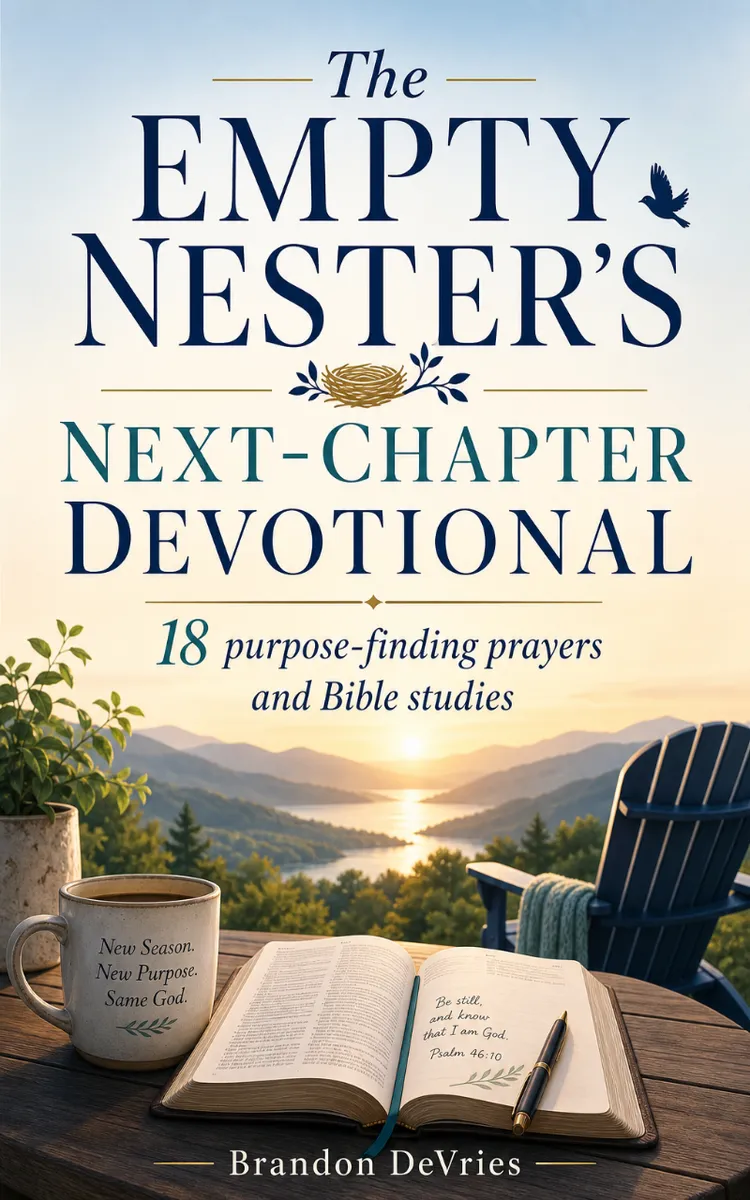
"The Empty Nester's Next-Chapter Devotional" is a religious devotional book by Brandon DeVries with 6 chapters and approximately 22,617 words. Christian devotional prayers and Bible studies for empty nesters.
This book was created using Inkfluence AI, an AI-powered book generation platform that helps authors write, design, and publish complete books.
Frequently Asked Questions
What is "The Empty Nester's Next-Chapter Devotional" about?
Christian devotional prayers and Bible studies for empty nesters
How many chapters are in "The Empty Nester's Next-Chapter Devotional"?
The book contains 6 chapters and approximately 22,617 words. Topics covered include When the House Goes Quiet, Getting Started with The Empty Nester's Next-Chapter Devotional, Essential Skills for The Empty Nester’s Next-Chapter Devotional, Building Your Next-Chapter Devotional Practice, and more.
Who wrote "The Empty Nester's Next-Chapter Devotional"?
This book was written by Brandon DeVries and created using Inkfluence AI, an AI book generation platform that helps authors write, design, and publish books.
Write your own religious devotional book with AI
Describe your idea and Inkfluence writes the whole thing. Free to start.
Start writingCreated with Inkfluence AI


