

Read the first chapter
The whole of chapter one, free. About 10 min. Turn the pages with the arrows, your keyboard, or a swipe.
Chapter 1
Chapter 1: The Scraped Name Dr. Mara Elan had learned to distrust silence.
Chapter 1: The Scraped Name
Dr. Mara Elan had learned to distrust silence.
In the conservation lab, silence never meant peace. It meant vacuum pumps humming behind walls. It meant filtered air moving through vents. It meant the quiet impatience of solvents drying and adhesives setting. It meant time passing in microns.
She stood beneath a bank of lights that made the room feel like a surgical theater. The fragment in front of her sat on a neutral board under a thin protective film. It was small, smaller than the palm of her hand, and yet it had rearranged her morning with the ruthless efficiency of a summons.
The email had arrived at 04:12, from an address that did not exist when she tried to trace it. The subject line was blunt.
AUTHENTICATION REQUEST. PRIVATE. IMMEDIATE.
No institutional affiliation. No letterhead. No grant code. No polite introduction. Just three attachments, a set of photographs taken at oblique angles, and a single sentence.
You will recognize the line. We will pay for certainty.
Mara had deleted the message twice before printing it. Deleting did not remove it from her mind. The photographs had done their work. They had shown a torn edge of parchment, brown with age, ink faded to the color of old blood. The script looked Herodian. The spacing looked Qumranic. And the line, the line had been a wound.
בני אלהים.
Sons of God.
Mara had stared at her office wall afterward, not because the phrase was unknown, but because the placement implied a specific battle in textual criticism that had never stopped being political.
Deuteronomy 32:8.
Most modern Hebrew Bibles, following the Masoretic Text, read something like: “When the Most High gave the nations their inheritance… he set the boundaries of the peoples according to the number of the sons of Israel.”
בני ישראל.
Sons of Israel.
But older witnesses, including the Septuagint, and the Dead Sea Scrolls in at least one key fragment, read differently.
בני אלהים, or a close equivalent, sometimes vocalized conceptually as “sons of God,” sometimes smoothed in Greek as “angels of God.”
The implication was not a minor footnote. It was a worldview. It was a map of the cosmos.
And maps always threatened someone.
At 07:30 she had arrived at the lab before the interns. At 07:45 she had called the museum director, careful with her words. She had not mentioned money. She had said only, “A private party is requesting authentication. The text is sensitive. I want a controlled environment.”
At 08:10 she had received a delivery.
Not through the museum loading bay. Not through the normal chain. A man in a gray coat had met her at a service door on the west side, where cameras angled away because they were meant to watch the street, not the shadows.
He had handed her a sealed case and said, “Sign nothing.”
Then he had walked away before she could ask his name.
Now the case sat on her bench, open, its foam cut to cradle the fragment like a relic. The smell had hit her first, faint but unmistakable.
Myrrh.
“Someone staged this,” she murmured, though nobody was in the room yet.
She pulled on gloves, nitrile over cotton. She leaned in and examined the edges. The fragment had the brittle curl of age, but that could be manufactured with heat and careful drying. Ink could be forged. Provenance could be invented.
But the fragment’s damage pattern spoke a language she trusted more than any seller’s story. The tears were irregular. The salt crystals embedded in the fibers, visible under magnification, suggested long exposure to an environment like the Judean Desert caves. The collagen sheen in the parchment had that exhausted look that centuries inflicted.
She exhaled slowly and reached for the multispectral imaging rig.
If someone wanted her to “recognize the line,” then she would read all of it, not just the bait.
She positioned the fragment under the camera, calibrated the wavelengths, and began the scan.
On the screen, the letters sharpened as if waking. Mara felt the familiar pull, the moment when dead ink became a voice again.
The line was part of a poetic section, parallelism tight, phrasing elevated. She saw the phrase “בְּהַנְחֵל עֶלְיוֹן גּוֹיִם” forming, “When Elyon apportioned the nations.” Elyon, “Most High,” a title that carried ancient resonance, not merely a synonym. In Ugaritic texts, in the wider ancient Near Eastern milieu, high gods had titles, and titles had histories.
She zoomed further. The next phrase emerged.
“בְּהַפְרִידוֹ בְּנֵי אָדָם,” “when he separated the sons of man.”
Her pulse quickened, not from excitement, but from recognition. This was the Song. This was the contested verse. She held her breath as the scan deepened into the fiber.
Then she saw it.
A scraped area, a deliberate abrasion across a cluster of letters. Someone had taken a blade, or a pumice stone, and tried to erase a word. The scrape was old, not modern. The damage had patina. It had lived with the parchment.
Mara’s throat tightened. “You were corrected,” she whispered to the fragment.
She toggled the wavelength, moving into the band that often revealed erased ink. The screen flickered. The scraped zone darkened, then something ghosted into view.
Not fully. Not yet. But enough to show strokes that did not belong to random wear.
Hebrew letters, partial, like bones under sand.
She adjusted contrast. The letters sharpened.
And in that moment, Mara felt the floor drop away from the ordinary world.
The erased word was not “Israel.” It was not “God.” It was a title, a Name-form, something that looked like it had been considered too precise, too personal.
She stared until her eyes watered.
“Not possible,” she said aloud.
Footsteps sounded in the hall. She snapped her gaze to the door as if caught doing something indecent.
The lab door opened, and her assistant, Yael, stepped in carrying coffee. Yael’s hair was still damp from a morning shower. Her badge swung as she walked.
“You are early,” Yael said, then noticed Mara’s face. “What happened?”
Mara did not answer immediately. She pointed at the screen. “Look.”
Yael set the coffee down carefully, as if sound might disrupt the pixels. She leaned in, and her brow furrowed with the effort of a non-specialist trying to read a specialist’s terror.
“I see Deuteronomy,” Yael said slowly. “Song of Moses?”
Mara nodded. “Verse eight.”
Yael’s eyes widened. “That one.”
“That one,” Mara echoed.
Yael swallowed. “Is it real?”
“I do not know yet,” Mara said, and forced herself to keep her voice level. “But it is sophisticated. If it is forged, it was forged by someone who understands why this verse matters.”
Yael pointed to the scraped section. “Why is it scraped?”
Mara zoomed in. She felt her mind splitting into two tracks, the scholar and the woman. The scholar catalogued strokes, ductus, ink flow. The woman remembered warning lectures and quiet conversations in academic corridors, how some topics created enemies you never saw.
“Because someone did not want this word read,” Mara said.
Yael looked up from the screen to Mara’s eyes. “What word?”
Mara hesitated. Saying it aloud felt like stepping across a line.
She chose a safer explanation first, the breadcrumb that a careful teacher offered before the cliff.
“In the Masoretic Text,” Mara said, “the nations are divided according to the number of the sons of Israel. In the older witnesses, the nations are divided according to the number of the sons of God. It implies a divine council framework.”
Yael nodded, tense. “Heiser. Psalm 82. The whole divine council conversation.”
“Yes,” Mara said. “And Qumran’s version supports the older reading, at least in one key fragment, 4QDeutj, which has been published, debated, and weaponized in popular discourse.”
Yael’s eyes returned to the scraped area. “So what is this, another witness?”
Mara’s fingers hovered over the keyboard. She pulled up an enhanced layer.
“That is the problem,” Mara said. “This is not just another witness to בני אלהים. Someone scraped a different term, something more specific.”
Yael leaned closer. “Can you read it?”
Mara’s mouth dried. “Not fully yet. But I can see enough to know it is a Name-form. It looks like… a title attached to El, or a divine epithet.”
Yael straightened, sudden fear flickering in her expression. “Why would they erase that?”
Mara answered with the simplest truth she had.
“Because names have power,” Mara said. “Even when you do not believe in power, the people who believe will act like it is real.”
Yael’s phone buzzed. She glanced at it, then looked back at Mara. “You should call security. This is private delivery. No paperwork. No chain-of-custody.”
Mara nodded without looking away from the screen. “I will.”
She did not move to call. Her eyes stayed on the resurrected strokes.
The erased word resolved further as the algorithm stitched wavelengths into a composite.
Mara felt her heart beat against the ribs as if it wanted out.
The letters formed, not perfectly, but unmistakably enough for a trained reader to risk a reconstruction.
They were not spelling Israel.
They were not spelling Elohim.
They were spelling an epithet that belonged in older strata of Semitic religion, an epithet that, inside Deuteronomy, would imply not just allotment, but jurisdiction.
She whispered the consonants under her breath, careful not to finish them. In Hebrew scholarship, one learned humility. You did not invent readings lightly. But she had seen too much ink to pretend it was nothing.
“Yael,” Mara said, and her voice sounded wrong to her own ears. “Lock the lab.”
Yael stared. “Mara, what did you see?”
Mara finally turned away from the screen and looked at her assistant directly.
“I saw intent,” she said. “And I saw that whoever delivered this expects me to complete what the scribe tried to erase.”
Yael moved quickly to the door and turned the lock. The click sounded too loud.
Mara reached for her phone, but before she could dial, the museum’s internal line rang on the desk.
It rang once, then again, sharp in the lab’s controlled quiet.
Yael looked at the phone as if it were a snake.
Mara picked it up. “Elan.”
A man’s voice answered, calm, professional, and unfamiliar. “Dr. Elan, you have something that does not belong to you.”
Mara’s grip tightened. “Who is this?”
“You have been asked to authenticate,” the voice said. “Authenticate. Then stop.”
Mara felt a cold line of sweat form under her glove. “I do not take instructions from anonymous callers.”
The voice paused, and in that pause Mara heard something like amusement.
“You will,” the man said. “Because you already read the line. And now you are part of it.”
Mara’s mind flashed to the courier, though she had not yet heard of him. It flashed to roads at night, to desert silence, to the kind of people who spoke as if history were theirs to manage.
“What do you want?” she demanded.
The man’s voice lowered, intimate, as if he were standing beside her bench.
“I want you to remember,” he said, “that some names were scraped for a reason.”
The line went dead.
Mara stared at the receiver for a full second, then set it down with controlled care. Yael’s eyes were wide.
Mara returned to the screen, to the scraped area where a forbidden title had begun to rise from the parchment.
She zoomed in one more increment.
And beneath the scraped fibers, a final stroke resolved, enough to complete the shape of the last letter.
Mara felt the air leave her lungs.
Because the erased title was not merely ancient.
It was accusatory.
And it suggested that the Song of Moses had once carried not just a theology of Israel’s election, but a judicial indictment against the other gods, an indictment with a proper name attached.
Mara whispered, “Psalm eighty-two,” and tasted the words like ash.
Yael’s voice shook. “What?”
Mara did not answer. She saved the image files twice, to two separate encrypted drives, then disconnected the lab network cable with a sharp yank.
The screen still glowed with the scraped Name.
On the bench, the fragment lay silent, but Mara could feel it pulling her forward, as if scholarship were a rope around her ribs.
Outside the lab, in the museum’s clean corridors, footsteps moved past without urgency. The world continued its ordinary pace.
Mara knew, with a clarity that made her hands steady, that the ordinary world had just ended for her.
Because someone had delivered a piece of the Song of Moses like a bomb.
And it was beginning to sing.
Threshold Hook (end of Chapter 1): The erased divine title reappeared enough for a reconstruction, and Mara realized the fragment was not merely a textual variant, it was a targeted, curated provocation, and someone had called to warn her not to speak the Name.
End of chapter one. 19 more chapters in the full book.
Swipe or use the arrows to turn the page

Christian Faith Healing And The Power Of Miracles

The Overthinker’s 90-Day Prayer Journal

The Empty Nester's Next-Chapter Devotional
What's inside: 20 chapters
- 1. Chapter 1: The Scraped Name Dr. Mara Elan had learned to distrust silence.
- 2. Chapter 2: The Fragment on the Bench
- 3. Chapter 3: "Sons of God” Before Deuteronomy
- 4. Chapter 4: Scribal Correction as Theology
- 5. Chapter 5: The Hand Behind the Verse
- 6. Chapter 6: Psalm 82 as Courtroom Theology
- 7. Chapter 7: Second Temple Trajectories
- 8. Chapter 8: When Greek Smooths Hebrew
- 9. Chapter 9: Why the Masoretic Reading Won
- 10. Chapter 10: Reconstruction With Restraint
- 11. Chapter 11: Modern Editions, Footnotes, and Public Claims
- 12. Chapter 12: Ethics, Access, and Publication
- 13. Chapter 13: Epilogue, The Next Fragment Will Not Save You
- 14. Chapter 14: Appendix A
- 15. Chapter 14: Appendix B, Annotated Research Pathways
- 16. Chapter 14: Appendix C
- 17. Chapter 14: Appendix D, Corridor in Practice
- 18. Chapter 15: Appendix E
- 19. Chapter 15: Appendix F
- 20. Closing Thoughts: The Witnesses Will Outlive the Headline
About this book
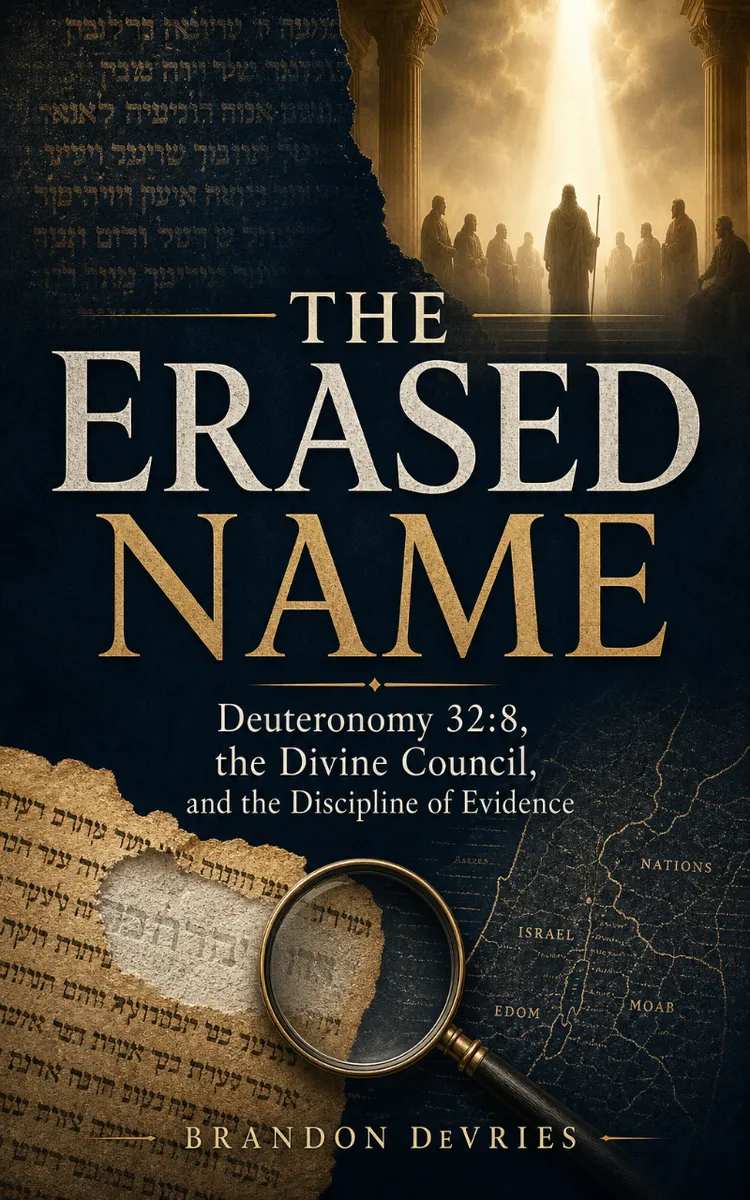
"The Erased Name" is a general book by Brandon DeVries with 20 chapters and approximately 44,657 words. It covers key insights and practical takeaways on the topic.
This book was created using Inkfluence AI, an AI-powered book generation platform that helps authors write, design, and publish complete books.
Frequently Asked Questions
What is "The Erased Name" about?
"The Erased Name" is a general book by Brandon DeVries covering key insights and practical takeaways on the topic.
How many chapters are in "The Erased Name"?
The book contains 20 chapters and approximately 44,657 words. Topics covered include Chapter 1: The Scraped Name Dr. Mara Elan had learned to distrust silence., Chapter 2: The Fragment on the Bench, Chapter 3: "Sons of God” Before Deuteronomy, Chapter 4: Scribal Correction as Theology, and more.
Who wrote "The Erased Name"?
This book was written by Brandon DeVries and created using Inkfluence AI, an AI book generation platform that helps authors write, design, and publish books.
Write your own book with AI
Describe your idea and Inkfluence writes the whole thing. Free to start.
Start writingCreated with Inkfluence AI


