
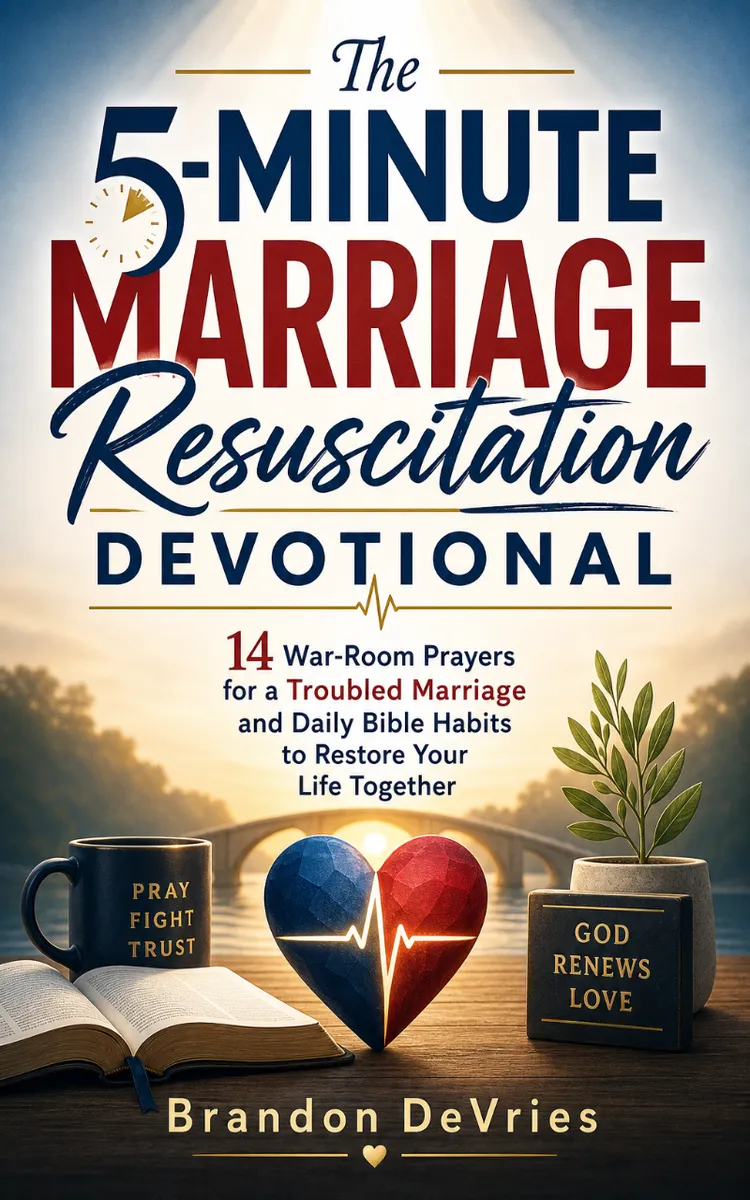

Read the first chapter
The whole of chapter one, free. About 10 min. Turn the pages with the arrows, your keyboard, or a swipe.
Chapter 1
When You Are Too Tired to Pretend
Set the context: why this matters and what you’ll do next
You know the weight before you open your mouth - the tightness in your chest that shows itself in a clipped tone, a sigh, or the way you stare at your hands instead of answering. Spiritual and emotional exhaustion in marriage doesn’t always look dramatic. It often looks like keeping a seat filled at the dinner table while your heart leaves the room. That slow hollowing out steals energy for conversation, erodes trust, and makes even small acts of love feel like chores. You’re not failing because you feel this; you’re human. This chapter names that exhaustion and gives clear, doable steps that help you stop pretending and start repairing - beginning with honest prayer and five-minute Bible habits you can actually keep.
The problem this fixes is specific: you’re worn down and performing faith rather than living it. Performative religion - praying phrases you don’t mean, attending services without bringing your real self to God, or hiding pain behind smiles - keeps you stuck. Resuscitation begins with honesty: telling God the truth, allowing Scripture to meet that truth, and practicing tiny spiritual disciplines that rebuild connection and courage. After reading this chapter, you’ll have two targeted war-room prayers (short, focused prayers you can return to) and two five-minute Bible habits tied directly to those prayers. These aren’t lofty routines; they’re small, steady acts that root you back in God’s presence and make room to honestly engage with your spouse. You’ve got this - one honest breath, one short prayer, one five-minute habit at a time.
Teach the core concept and technique with clear steps and examples
The core idea here is simple: replace performance with honest, repeated spiritual acts that are small enough to do even when you’re exhausted. Why this works: small, consistent practices lower the activation energy for spiritual life. They build muscle - honesty muscle, listening muscle, trust muscle - without asking you to be someone you’re not. When you tell God the raw truth, you remove the energy drain of pretending. When you read one short Bible passage with a single question in mind, your heart learns to let Scripture speak directly to a real need.
Apply the technique in three parts: (1) honest confession to God, (2) a focused war-room prayer you can say in under a minute, and (3) a five-minute Bible habit that puts Scripture next to your real pain. Together they make a tiny daily loop: confess, pray the war-room line, read Scripture with a single practical prompt. Over time those minutes accumulate into real change.
Follow these concrete steps each morning or at a consistent time you can keep:
• Stop and name the feeling for 30 seconds.
• Say out loud or whisper one sentence: “I’m tired of pretending,” or “I don’t have words but I’m here.” Naming anchors your honesty and wakes your body to the truth.
• Speak the war-room prayer (under 60 seconds).
• Use the specific prayers below. A short, repeatable line makes it easy to come back to God even when your voice feels raw.
• Do the five-minute Bible habit tied to that prayer.
• Read one short verse or a two-sentence chunk, ask one practical question, and write one sentence in a notebook or phone note about what you sense God saying. That single line connects Scripture to your present need.
For example, if tonight you’re so depleted you can’t imagine talking about feelings, you’ll follow the loop: name the feeling, pray War-Room Prayer 1, and do the five-minute Bible habit that focuses Scripture on your silence. The expected immediate outcome is a small easing of the internal pressure and a tiny, honest acknowledgment you can return to. Do these steps daily and you’ll find your inner life recalibrating: honesty replaces pretending, and that honesty becomes the soil where your marriage can begin to heal.
Walk through a realistic scenario applying this knowledge
You come home after a 12-hour shift, your spouse looks at you, and you feel a familiar hot surge - wanting to avoid the conversation because the emotional cost feels too high. Use these steps in order; they take five minutes or less and won’t require explaining yourself to anyone.
• Name it (30 seconds).
• Sit on the edge of the sofa. Breathe slowly three times. Say aloud: “I’m too tired to pretend I’m fine. I have no words.” Expected result: a tiny drop in adrenaline because you stopped performing for the moment.
• War-Room Prayer 1 (40 seconds).
• Pray: “Lord, I don’t have words. Hold my heart and speak through the silence.” Expected result: you feel permission to be quiet and let God be your voice for now.
• Five-minute Bible habit for Prayer 1 (3 minutes).
• Open a Bible app or small pocket Bible to Psalm 62:1-2 (or another short verse you prefer). Read the two verses slowly.
• Ask one question: “What part of this verse meets my tiredness?” Write one sentence: “I can rest because God is my true refuge right now.” Expected result: a single truthful sentence that shifts your posture from performance to rest.
• Short follow-up action (remaining 1-2 minutes).
• Send your spouse a short, honest line: “I’m spent tonight and don’t have words to talk about this well. Can we pause and reconnect tomorrow at 7 p.m.?” Expected result: you avoid a defensive interaction, keep lines open, and schedule a time to engage when you have more bandwidth.
Quick checklist:
• Pause and name the feeling (30 seconds).
• Pray War-Room Prayer 1 (under 1 minute).
• Read a two-verse passage and write one sentence (3 minutes).
• Send a brief honest text or schedule a time to talk (under 1 minute).
You can use the same loop for the second prayer later in the day if your home feels heavy. The goal is not to fix everything in one evening but to stop pretending and make small, trustworthy moves toward honesty. You’ll see the immediate outcome: less internal pressure, clearer boundaries, and a simple bridge back to conversation when you’re ready.
Common mistakes and edge cases - what to watch for and how to fix it
Mistake: Turning the prayer into performance
Turning your brief war-room prayer into a performance looks like polishing it - saying it perfectly, adding details to sound spiritual, or using prayer as a shield to avoid actual honesty.
Do this: Say the prayer in one breath, exactly as written or in your own simple words, then do the five-minute Bible habit. The goal is honest contact with God, not showmanship. Keep a phone note with the prayer so you can repeat it without thinking.
Not this:
Do not lengthen the prayer to avoid speaking your true feeling to your spouse later. Saying more to impress God or others defeats the purpose.
Mistake: Skipping the Bible habit because you “don’t have time”
You may convince yourself the five-minute habit is optional. Skipping it removes the corrective Scripture element that reorients your heart away from merely complaining and toward receiving God’s presence.
Do this: Commit to the full loop for seven consecutive mornings or evenings. Set a timer for five minutes and honor the timer. Small consistency beats occasional intensity.
Not this:
Do not treat the Bible habit as optional or decorative. Without Scripture, you risk staying stuck in emotion without the perspective that steadies you.
Mistake: Using honesty as an excuse to withdraw permanently
Honesty doesn’t mean you stop engaging with your spouse indefinitely. “I’m too tired” can become a permanent shutdown if you don’t pair honest pauses with future commitments to reconnect.
Do this: When you use the prayer and habit to acknowledge overwhelm, always add a concrete follow-up: a time to talk, a short check-in the next day, or a simple household action (cook a shared meal Monday, sit together for 10 minutes after dinner). These small commitments prove your honesty is an opening, not an abandonment.
Not this:
Do not use daily honesty as a way to avoid repair work. If you repeatedly say you’re too tired and never schedule a reconnection, your spouse will read that as a lack of willingness, not a need for rest.
Mistake: Confusing surrender with passivity
Surrender here means letting God see the real you, not becoming passive about the marriage. Some people believe surrender means doing nothing and waiting for God to fix everything.
Do this: Pair surrender with one practical next step each week - an honest conversation, a short counseling intake, or a clear household task shared between you. Surrender frees you from pretending so you can act from a clearer place.
Not this:
Do not equate surrender with giving up. Surrender without action is simply resigned inactivity and will deepen the exhaustion.
War-Room Prayer 1: For the spouse who has no words left
Lord, I have no words. Hold my heart when I cannot speak. Fill the silence with your presence so I can stop pretending and rest in your care.
Why this prayer works: It gives God control of the silence and frees you from the pressure to perform. Saying “I have no words” out loud names your limit - and naming limits moves energy from defending to receiving. Use this when your throat tightens and conversation would only add strain. Repeat it while taking three slow breaths and then follow with the five-minute habit below. You don’t need to fix anything in that moment; this prayer gives you permission to be real.
Five-minute Bible habit tied to Prayer 1
• Open to one short Psalm verse (e.g., Psalm 62:1 or Psalm 46:10). Read slowly once.
• Ask the single question: “Where do I need to rest right now?” Write one sentence - no more - about what rest looks like for you tonight (for example: “Rest tonight means I ask for help with dishes and plan to talk at 7 p.m.”).
• Close by repeating War-Room Prayer 1 once.
This habit’s expected outcome is immediate: a practical decision that relieves pressure, plus a short scripture anchor that quiets performance. You’ll feel less alone in your silence and gain a one-sentence plan you can act on tomorrow. You’ve got this - small practices like this rebuild honest living.
War-Room Prayer 2: For the spouse whose home feels emotionally heavy and disconnected
Lord, the air in my home feels heavy. Lift this weight from us and teach me one small thing I can do to bring light back today.
Why this prayer works: It turns general despair into a specific request for relief and action. When the home feels like a thick cloud, asking God for one small thing slices that cloud into something manageable. It’s practical and spiritual at once - inviting God’s presence and your hands to work.
Five-minute Bible habit tied to Prayer 2
• Read one verse about light or peace (for example, John 14:27 or Psalm 119:105). Read slowly.
• Ask, “What is one small, concrete thing I can do in the next 24 hours to reduce the heaviness?” Write it down (e.g., “I will clear the table and put on a soft playlist for 20 minutes.”).
• Commit to that single action and pray War-Room Prayer 2 again.
This habit makes emotional atmosphere a practical problem you can influence. The expected outcome: a small, observable shift in mood - a cleared counter, a warm light, a ten-minute conversation - that shows you can affect your home’s tone without grand gestures.
Reflective invitation: surrender, humility, and hope without pretending
You don’t have to erase the pain to be faithful. Surrender here looks like telling God the truth about your tiredness and then doing one small, responsible thing that proves you’re present. Humility doesn’t mean erasing your needs; it means naming them to God and to your spouse without acting small. Hope isn’t pretending the hurt is gone; it’s holding to the conviction that honest, repeated short actions - prayer, Scripture, one concrete step - change the weather in a home.
When you practice these prayers and five-minute habits, you create a rhythm: honesty, Scripture, small action. That rhythm counters the pattern of performance that has been quietly draining you. Expect small shifts first: a calmer evening, a scheduled talk, a cleared table, a one-sentence note in your phone that reminds you where you actually are. These are not dramatic miracles every time, but they are reliable signs of resuscitation taking hold.
Close your eyes, speak one of these prayers out loud, and give yourself the simple work ahead - five minutes, a verse, and one sentence. You don’t need to be whole before you begin; you only need to be honest. You’ve started the work of breathing again.
Keep this honest practice with you as you move into the next chapter, where we’ll build on these five-minute foundations and introduce tools for listening and speaking the truth to each other in ways that heal rather than harm. You’re not alone - one honest breath and one small step will carry you forward.
End of chapter one. 4 more chapters in the full book.
Swipe or use the arrows to turn the page

Christian Faith Healing And The Power Of Miracles

The Overthinker’s 90-Day Prayer Journal

The Empty Nester's Next-Chapter Devotional
What's inside: 5 chapters
- 1. When You Are Too Tired to Pretend
- 2. Praying Instead of Pushing
- 3. Surrendering Control, Keeping Wisdom
- 4. Grace for Wounds That Keep Reopening
- 5. Small Habits, Steady Hope
About this book
"The 5-Minute Marriage Resuscitation Devotional" is a general book by Brandon DeVries with 5 chapters and approximately 8,629 words. It covers key insights and practical takeaways on the topic.
This book was created using Inkfluence AI, an AI-powered book generation platform that helps authors write, design, and publish complete books.
Frequently Asked Questions
What is "The 5-Minute Marriage Resuscitation Devotional" about?
"The 5-Minute Marriage Resuscitation Devotional" is a general book by Brandon DeVries covering key insights and practical takeaways on the topic.
How many chapters are in "The 5-Minute Marriage Resuscitation Devotional"?
The book contains 5 chapters and approximately 8,629 words. Topics covered include When You Are Too Tired to Pretend, Praying Instead of Pushing, Surrendering Control, Keeping Wisdom, Grace for Wounds That Keep Reopening, and more.
Who wrote "The 5-Minute Marriage Resuscitation Devotional"?
This book was written by Brandon DeVries and created using Inkfluence AI, an AI book generation platform that helps authors write, design, and publish books.
Write your own book with AI
Describe your idea and Inkfluence writes the whole thing. Free to start.
Start writingCreated with Inkfluence AI


