

Read the first chapter
The whole of chapter one, free. About 12 min. Turn the pages with the arrows, your keyboard, or a swipe.
Chapter 1
What Exactly is Christian Faith Healing?
CHAPTER 1 — What Exactly Is Christian Faith Healing?
“Is anyone among you sick? Let them call the elders of the church to pray over them and anoint them with oil in the name of the Lord.” — James 5:14 (and immediately the questions begin—what does that sentence mean, in practice, without turning desperate people into experiments?)
The Scene Nobody Warns You About
It is rarely the spectacle that forces the question.
Not the stage lights. Not the praise-band swell timed to a climactic “In Jesus’ name.” Not the line of wheelchairs positioned where the camera can see them. Most believers will live their entire lives without standing in one of those televised aisles.
The question comes in quieter places—places that smell like antiseptic, or old carpet, or cold coffee.
A hospital room at 2:13 a.m. when the monitors keep time like a metronome. A kitchen table where pill bottles sit beside an open Bible like two competing gospels. A church foyer where a woman whispers, “They found a mass,” and everyone suddenly forgets how to speak.
And then, because Christians are Christians, someone says it. Sometimes gently. Sometimes like a dare.
“Have you tried praying for healing?”
You have. Of course you have.
But you also have something else: memory.
You remember prayers that seemed to split the sky—and the body still failed. You remember a testimony you believed with your whole chest… until you discovered the diagnosis was wrong, or the story grew with every retelling, or the “healed” person quietly died six months later, and nobody mentioned it again. You remember the way certain ministries speak about sickness the way prosecutors speak about criminals: Somebody is guilty; we just have to find the unbelief.
Then you open your Bible—because if there is an answer, it must be there—and you find yourself halted not by a verse, but by punctuation.
You’re reading Mark’s Gospel, running at Mark’s pace, and you reach the promise that has launched a thousand healing sermons:
“And these signs will accompany those who believe…” ( Mark 16:17–18 )
Demons driven out. New tongues. Serpents handled. Poison survived. Hands laid on the sick—and they recover.
And then your eyes fall to the brackets. The footnote. The editorial warning that feels like a trapdoor under your confidence:
“Some of the earliest manuscripts do not include Mark 16:9–20.”
In some Bibles, the loudest “healing passage” is also the passage with the loudest question mark.
And now you are standing before a dilemma that has injured real people—sometimes physically, often spiritually:
• If God heals, why do some prayers end in funerals?
• If faith is the key, why do the faithful still suffer?
• If miracles are real, why do “miracle cultures” so often produce manipulation?
• And if Scripture itself has textual complexities, how do we build a healing practice that is biblical, credible, and spiritually safe?
Chapter 1 has one job: to name the problem clearly—without flinching—and to show you there is a path through it that does not require gullibility or cynicism.
Because both extremes leave people bleeding.
Why “Faith Healing” Is One of the Most Dangerous Phrases in the Church
The phrase faith healing sounds straightforward—until you listen closely to how people use it.
In everyday speech, faith healing can mean any of the following:
• A private prayer whispered over a child’s fever.
• An altar call where the sick are asked to “step out.”
• An anointing service led by elders, as in James 5.
• A pilgrimage mentality—shrines, relics, sacred sites, “contact cloths.”
• A charismatic performance culture where healing becomes proof of spiritual rank.
• A pressure-cooker environment where doubt is treated as treason, and doctors are treated as compromises.
Those are not minor variations. Those are different religions wearing the same vocabulary.
And confusion has consequences. When people don’t know what Christian faith healing is, they tend to do one of two things:
• They demand a miracle as a guaranteed outcome. When it doesn’t happen, faith collapses into shame, rage, or accusation—usually aimed at the sufferer first.
• They dismiss miracles as myth or manipulation. When pain comes, prayer becomes a polite ritual, the New Testament becomes a museum, and suffering becomes a private exile.
So we start where careful readers have always started:
Define the terms. Guard the vulnerable. Anchor everything in the text.
What the Bible Actually Means by “Healing” (It’s Bigger Than Symptom Relief)
Modern people tend to define healing narrowly: the removal of symptoms, the restoration of normal function.
Scripture can include that—but Scripture is rarely that small.
1) The Hebrew world: רָפָא (rapha’) — to heal, restore, make whole
One of the primary Hebrew verbs for healing is רָפָא (rapha’). You see it in places where God is not merely a technician fixing a body, but a covenant Lord restoring what has been fractured.
When God reveals Himself to Israel as healer, the name is not a slogan—it’s an identity claim:
• YHWH Ropheka — “the LORD your healer” ( Exodus 15:26 )
This is not merely about getting pain to stop. It is about God’s authority to restore, to repair, to re-knit life that has been torn.
2) The Greek world: ἰάομαι (iaomai) and θεραπεύω (therapeuō)
In the New Testament, healing language often uses:
• ἰάομαι (iaomai) — “to heal / to be made well”
• θεραπεύω (therapeuō) — “to heal” but also “to care for / to serve” (It’s the root behind our word “therapy,” and that matters: biblical healing is not allergic to care, process, or means.)
And then there’s a word that startles modern readers because it refuses to keep body and soul in separate rooms:
• σῴζω (sōzō) — “to save,” and in some contexts, “to heal/make whole”
The Bible’s imagination is integrated. Sometimes what we call “healing” is not merely physical restoration, but rescue—deliverance—wholeness.
3) Healing in Scripture is often tied to shalom
Biblically, peace is not merely a matter of calm feelings. Shalom is wholeness: life ordered under God, restored where it was broken.
So when we say Christian faith healing, we cannot mean “a Christian-flavored attempt to force the body into compliance.”
We mean something more disciplined—and more reverent.
A Clean, Biblical Definition (Without Hype)
Here is the definition we will use throughout this book:
Christian faith healing is the practice of asking the living God—through Christ, by the Spirit—to intervene in a person’s physical, emotional, and spiritual condition in a way consistent with God’s character, God’s Word, and God’s wise purposes.
That intervention can look like:
• Immediate restoration (the kind that makes skeptics quiet).
• Gradual recovery over time.
• Provision of wisdom, treatment, and timing.
• Strength and endurance when symptoms remain.
• Peace that does not make sense given the circumstances.
• Deliverance from oppression that is more than psychological.
• And, finally—and this is the line modern triumphalism hates—ultimate healing on the far side of death, in resurrection.
That last category is not an escape clause. It is New Testament realism. The same Scriptures that record miracles also record martyrdom. The church that heals in Acts is also the church that buries Stephen.
If your definition of healing cannot survive the existence of Christian graves, it is not a Christian definition. It is a sales pitch.
The Stakes: What This Conversation Costs When We Get It Wrong
This is not a theoretical debate. Illness forces the question onto everyone eventually, because bodies are not permanent and pain does not ask permission.
When Christian faith healing is handled irresponsibly, four predictable disasters follow.
1) The sick get exploited
Desperation is profitable. That is why predatory “healing ministries” exist.
When people are drowning, they will grab any rope—even one woven from lies.
This is why Scripture consistently ties spiritual power to moral scrutiny. In the New Testament, power is never permission to devour the weak. Shepherds are judged by how they treat sheep, not by how many crowds they draw.
2) The suffering get blamed
Few wounds are as cruel as being told your cancer is proof you didn’t believe hard enough.
Jesus never treated sufferers like criminals.
In John 9, when the disciples see a man blind from birth, they ask the question humans love because it makes pain feel controllable:
“Who sinned, this man or his parents…?”
Jesus refuses their simplistic math. He does not turn the blind man into a morality play. He moves toward him.
Any “healing theology” that begins by interrogating sufferers as suspects is already out of step with Christ.
3) Medical care gets treated like betrayal
Some Christians are taught—explicitly or subtly—that using doctors means you didn’t really trust God.
But Scripture does not require that false choice.
• Luke is explicitly called “the beloved physician” ( Colossians 4:14 ).
• The Good Samaritan uses oil and wine as first-century treatment ( Luke 10:34 ).
• Paul advises Timothy with practical care for a physical issue ( 1 Timothy 5:23 ).
The Bible is not embarrassed by means. It is not threatened by wisdom. It does not treat medicine as a rival deity.
The more biblical position is this:
God can heal with no means, with ordinary means, or with extraordinary means. And the presence of means does not diminish the presence of God.
4) Faith becomes fragile—and then collapses
When people are promised guaranteed miracles and don’t receive them, many don’t merely feel disappointed. They feel spiritually deceived.
The result is often not “a small doubt,” but a catastrophic rupture:
“If God didn’t do what they said He must do, is any of it real?”
A responsible approach to faith healing must be biblical enough to sustain hope and honest enough to survive disappointment.
Three Counterfeits That Masquerade as “Faith”
To define Christian faith healing, we also have to name what it is not because the church has learned—often the hard way—that many things can wear Christian vocabulary and still be spiritually unsafe.
Counterfeit #1: Faith as a mechanism (God as a vending machine)
This is the belief that if you place sufficient faith, say the right words, and perform the correct ritual, God must grant healing.
It sounds spiritual. It is actually a superstition with Bible verses taped on it.
Biblical faith is not control. It is trust.
Counterfeit #2: Faith as denial (reality treated as an enemy)
This counterfeit refuses to name the illness, refuses to seek help, refuses diagnostics, refuses lament—because acknowledging pain feels like empowering it.
But Scripture contains entire books where saints tell the truth about suffering before God (Job, many Psalms). If honest speech were unbelief, large portions of the Bible would be sin.
Christian faith does not require you to lie about reality. It requires you to refuse reality the right to be ultimate.
Counterfeit #3: Faith as performance (healing as proof of spiritual rank)
This counterfeit turns the sick into props and turns healing into a status marker.
It creates a culture where people fake improvement because they can’t bear the shame of being “the one God didn’t choose to heal today.”
And the tragedy is that even when real healings occur in that environment, the fruit can still be rotten—because the culture trains people to chase power rather than Christ.
So What Is the Christian Practice?
Christian faith healing, at its best, is not a rally. It is not a brand. It is not a personality.
It is a church practice rooted in Jesus and governed by Scripture.
It is what happens when:
• a believer tells the truth about suffering,
• a community refuses to abandon them,
• leaders pray without theatrics,
• oil is used without superstition,
• medical care is honored without being idolized,
• and the outcome—whatever it is—is interpreted under the lordship of Christ rather than under the tyranny of shame.
And crucially: it is practiced with accountability, because the moment you start claiming miracles, you enter a world where multiple realities can overlap:
• testimonies can be true,
• psychosomatic effects can be real,
• misdiagnoses can occur,
• exaggeration is common,
• fraud exists,
• spiritual warfare is not imaginary,
• and God’s sovereignty is not negotiable.
A mature Christian cannot afford to pretend only one of those categories exists.
The Problem, Stated Plainly
Here is the core problem this book is solving:
Most Christians want to pray for healing, but they don’t know how to do it in a way that is both biblically bold and spiritually safe.
They are tired of extremes:
• the extreme that promises guaranteed miracles and blames sufferers,
• and the extreme that refuses expectancy and treats the New Testament like ancient propaganda.
This book insists there is a third way:
disciplined, Scripture-governed, Christ-centered prayer for healing—expectant without hype, honest without cynicism.
Why the Manuscripts Matter (And Why They Don’t Destroy the Case)
We need to return, briefly, to the bracketed verses that startled you—because they’re not a distraction. They are a warning flare.
The longer ending of Mark (Mark 16:9–20) is one of the most famous textual questions in the New Testament because some of our earliest and most important Greek witnesses do not include it, whereas later manuscripts do. That does not mean Christians invented miracles. It means the history of transmission is complex—and serious readers must build theology carefully.
Here’s the practical takeaway for our purposes:
If you build your entire healing practice on one disputed paragraph, you are building on a narrow foundation.
But the Christian case for praying for healing does not rise or fall on that one passage. Healing is everywhere in the Gospels. It is present in Acts. It is instructed in James. It is framed with sobriety in Paul’s letters. It is placed under God’s sovereignty in the whole canon.
So the brackets do not cancel healing.
They cancel careless proof-texting.
And that is a mercy—because careless proof-texting is how the vulnerable get hurt.
What This Book Will Do (And What It Will Not Pretend to Do)
This book will not do two things:
• It will not promise you a formula that forces God’s hand. If someone sells you guaranteed outcomes, they are selling you something other than biblical Christianity.
• It will not ask you to abandon medical care. Prayer is not recklessness. Faith is not denial. If you are facing serious symptoms, seek appropriate medical attention.
What this book will do is give you a clear, repeatable, Scripture-governed framework for approaching healing prayer—personally and in community—so you can pray with clarity rather than confusion, and with courage rather than hype.
And it will train you to evaluate claims of healing with maturity: not cynically, not naïvely, but wisely.
The Threshold Hook: The Question You Can’t Avoid Anymore
If faith healing is not superstition, not denial, and not performance—then what does it look like in the hands of Jesus?
Not the myth of Jesus. Not the sentimental Jesus. The Jesus of the text.
• When He heals, what does He say?
• When He refuses, why?
• When He asks about faith, what does He mean—and when does He heal without mentioning it at all?
• When crowds try to turn Him into a miracle machine, how does He respond?
• And what patterns emerge that can govern our practice today?
That is where we go next.
Chapter 2 will follow the healing ministry of Jesus as a set of textual case files—scenes, words, and patterns—so we can build expectation without illusion and compassion without manipulation.
End of chapter one. 8 more chapters in the full book.
Swipe or use the arrows to turn the page


What's inside: 9 chapters
- 1. What Exactly is Christian Faith Healing?
- 2. How Does Jesus Heal?
- 3. Examples of Jesus Healing in the New Testament
- 4. Other Examples Of Healing In The Bible By Apostles
- 5. Our Role As A Child Of God
- 6. Why Faith Is Very Important
- 7. The Duration Of Healing And The Role Of Natural Medicine
- 8. Even When Healing Doesn't Come
- 9. Why We Must Always Turn To God In All Things
About this book
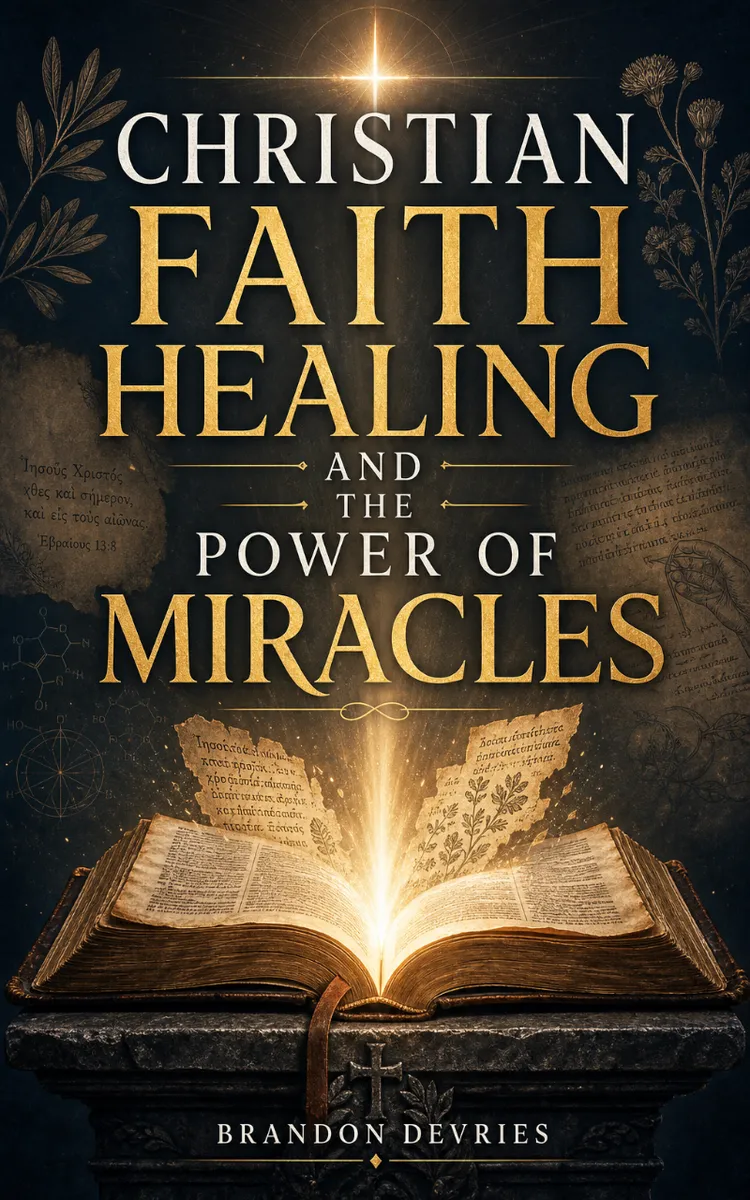
"Christian Faith Healing And The Power Of Miracles" is a general book by Brandon DeVries with 9 chapters and approximately 21,775 words. It covers key insights and practical takeaways on the topic.
This book was created using Inkfluence AI, an AI-powered book generation platform that helps authors write, design, and publish complete books.
Frequently Asked Questions
What is "Christian Faith Healing And The Power Of Miracles" about?
"Christian Faith Healing And The Power Of Miracles" is a general book by Brandon DeVries covering key insights and practical takeaways on the topic.
How many chapters are in "Christian Faith Healing And The Power Of Miracles"?
The book contains 9 chapters and approximately 21,775 words. Topics covered include What Exactly is Christian Faith Healing?, How Does Jesus Heal?, Examples of Jesus Healing in the New Testament, Other Examples Of Healing In The Bible By Apostles, and more.
Who wrote "Christian Faith Healing And The Power Of Miracles"?
This book was written by Brandon DeVries and created using Inkfluence AI, an AI book generation platform that helps authors write, design, and publish books.
Write your own book with AI
Describe your idea and Inkfluence writes the whole thing. Free to start.
Start writingCreated with Inkfluence AI


