
Read the first chapter
The whole of chapter one, free. About 8 min. Turn the pages with the arrows, your keyboard, or a swipe.
Chapter 1
Why Prayer Feels Like an Answer
The Answer That Arrives From Inside
On 27 February 2020, during a public prayer service in an empty church in Rome, Pope Francis walked alone through rain-soaked streets to pray before an icon associated with protection from plague. The square was silent, but the act was not private in the ordinary sense: millions watched through screens, each person receiving the same image and attaching a different need to it.
Prayer can feel like an answer before anything in the outside world has changed. A person kneels with fear, speaks words learned from childhood, and rises with a steadier pulse, a clearer decision, or a sense that someone has heard. That experience is real as an experience, even when its meaning is not shared by the person praying, the people nearby, or the institution that supplied the prayer.
The Inner Witness Lens begins with that private certainty. It asks what happens when an inner event - relief, coincidence, a vivid image, an unexpected recovery - is treated as evidence of an external power. It also asks how societies turn those personal interpretations into shared rules, authorized rituals, and systems of obedience.
When an answer is felt inside the self, what makes it seem to have come from somewhere else?
The Private Evidence of Prayer
Prayer is often described as communication with a divine listener, but its immediate evidence is usually bodily. The shoulders loosen. Breathing slows. Attention narrows. A person may stop rehearsing every possible disaster and begin sorting the problem into words. The sensation of being heard can appear before any answer has been identified.
That does not make prayer fraudulent or trivial. It places prayer among the many human practices that alter attention through repetition, rhythm, posture, and language. Chanting, kneeling, bowing, and reciting familiar phrases give the mind a narrow track to follow. A distress that was shapeless becomes a sentence: “Help my child.” “Forgive me.” “Show me what to do.” The sentence does not merely describe the feeling. It organizes it.
The same words can therefore produce different experiences. A Muslim saying the opening chapter of the Qur’an in daily prayer may be affirming submission, seeking guidance, or moving through a familiar structure that marks the day. A Catholic reciting the Lord’s Prayer may be asking for provision, forgiveness, and protection, while also repeating words shared by generations. A Buddhist using a mantra may not be addressing a creator at all, but cultivating concentration or compassion. The sound can be identical across a congregation while the private event behind it is not.
This is where the Inner Witness Lens becomes useful. It treats the praying person’s inner response as testimony, but not as a neutral recording device. The mind is not a window through which reality arrives unchanged. It is an interpreter, drawing connections among memory, expectation, sensation, and circumstance. When prayer brings relief, the relief is undeniable. What remains uncertain is the source assigned to it.
A useful comparison is the courtroom witness who is completely sincere and still mistaken about what was seen. Sincerity establishes that the witness experienced something. It does not settle the larger explanation. Religious experience often works in this narrow gap between certainty about the feeling and uncertainty about its cause.
How Ritual Gives Feeling a Public Shape
Private prayer existed long before large religious institutions, but organized religion gave private experience a common vocabulary. Ancient Mesopotamian city-states maintained temples where priests interpreted omens, managed offerings, and acted as intermediaries between communities and gods. In ancient Egypt, correct ritual was tied to the maintenance of cosmic order. In the Roman world, public religious acts were woven into civic life, military loyalty, and the authority of the state.
The point was not simply that rulers cynically invented belief. Religious systems were more durable than a simple deception model suggests. Priests, rulers, and ordinary people could all regard the sacred order as real. Yet once a private interpretation was placed inside an institution, it acquired consequences beyond the person who felt it. The institution could decide which prayers were proper, which rituals were effective, and which explanations counted as legitimate.
A villager’s prayer for rain might begin as an intimate plea. In an organized system, it could become a procession led by clergy, a calendar observance, a public display of humility, and a reminder that communal well-being depended on correct relations with the sacred. The weather remained outside anyone’s control. The interpretation of the weather, however, could be guided by those authorized to speak for the gods.
The transformation from private feeling to public order often depended on small acts of repetition. Bells marked the hour. Fasts marked the body. Shared words synchronized strangers. The congregation did not need to feel the same thing for the ritual to work socially. It needed to perform the same action and recognize the same authority.
A surprising fact is that disagreement about prayer can strengthen a religious institution rather than weaken it. When one person experiences prayer as conversation and another as discipline, both may still accept the same sacred vocabulary and the same authority over its correct use. Difference at the level of feeling can coexist with uniformity at the level of practice.
That matters because control does not require identical inner lives. It requires enough shared structure to make behavior predictable. A person may pray for comfort, another for a miracle, and a third from fear of punishment. If all three attend at the appointed time, contribute to the institution, and accept its interpretation of moral duty, their different private meanings can support one public system.
The Brain’s Search for Agency
Human beings are unusually quick to detect agency. A rustle in the grass may be wind, an animal, or nothing at all, but treating it as a possible agent has obvious survival value. The cost of investigating an empty field is usually smaller than the cost of ignoring a predator. That bias does not disappear in a church, mosque, synagogue, temple, or bedroom. It can shape how people interpret events that follow prayer.
A coincidence becomes especially persuasive when it arrives after an emotionally intense request. Someone prays for a phone call and receives one. Someone asks for strength and finds an unexpected reserve of patience. Someone fears a diagnosis, prays through the night, and receives reassuring news in the morning. The event may have an ordinary explanation, but its timing gives it narrative force.
Memory then edits the record. Prayers followed by meaningful events remain vivid; prayers followed by nothing often fade into the background. This is not a defect peculiar to religious people. It is a general feature of human attention. We remember outcomes that seem to confirm a story and overlook the many occasions on which the story made no visible difference.
Prayer can also change behavior in ways that make the hoped-for outcome more likely. A person who prays for reconciliation may become calmer and less defensive during a conversation. Someone praying for courage may finally make a medical appointment or leave an unsafe situation. If the result is good, the person may reasonably credit prayer, the changed behavior, or both. The private experience does not separate those causes neatly.
The counterintuitive connection is this: prayer can feel answered partly because it changes the person who asks, even when the person experiences the change as evidence that another being responded. The inward shift is genuine, but its interpretation moves outward. What begins as altered attention becomes a message from God.
This reframing changes the question. Instead of asking only whether prayer “works,” we can ask what kind of work it performs before any supernatural claim is tested. It can regulate emotion, focus attention, preserve identity, and coordinate a group. Those functions help explain why belief can remain firm even when different prayers produce different outcomes.
One Prayer, Many Authorities
The most revealing examples appear during crisis, when private meanings collide with public claims. During the COVID-19 pandemic, people prayed for healing, protection, scientific guidance, economic survival, and the dead. The word “protection” could mean divine intervention, adherence to public-health rules, or the emotional shelter of belonging to a congregation. A single service could contain all three meanings without resolving their differences.
Pope Francis’s 2020 visit to the church of San Marcello al Corso became a concentrated image of this problem. He prayed before a crucifix traditionally associated with ending the plague in Rome in 1522. For some viewers, the event was an appeal for supernatural mercy. For others, it was a symbolic act of solidarity during isolation. Still others saw a powerful religious leader using an old ritual language to address a modern public emergency.
The object was the same. The prayer was public. The meanings were not.
That distinction is easy to miss because institutions speak as though a shared ritual guarantees a shared belief. It does not. A congregation may repeat a creed while privately holding different pictures of God, different expectations about intervention, and different reasons for remaining. One person stays because prayer feels like a conversation. Another stays because the ritual preserves family memory. A third stays because the congregation provides food, childcare, friendship, or a moral vocabulary that makes suffering intelligible.
Religious authority often operates in the space between these motives. It does not need to manufacture every feeling. It can name feelings, rank them, and decide what they signify. Relief may be called grace. Doubt may be called temptation. A failed prayer may be explained as insufficient faith, divine timing, hidden wisdom, or a test. Each explanation protects the larger system from being judged by a single outcome.
The private believer is therefore not simply controlled from outside. The institution supplies categories through which the believer interprets the inside. A sensation that might otherwise be called calm becomes “the peace of God.” A coincidence becomes providence. Persistent uncertainty becomes a spiritual trial. The experience remains personal, but its meaning has been socially prepared.
The Witness and the Mystery
The Inner Witness Lens does not require dismissing prayer as illusion. It asks for a more careful separation between what a person knows directly and what a person concludes from it. The person knows that fear eased, that words mattered, that a decision became possible, or that a coincidence felt charged with meaning. The claim that a divine agent caused those changes belongs to a second level of interpretation.
That second level can be intimate and socially powerful at once. It may comfort a grieving person, bind a family together, justify a leader, or make obedience feel like virtue rather than submission. The same prayer can therefore be a refuge for one person and an instrument of authority for another, without changing its words.
Human beings do not merely seek answers; they seek explanations that make their inner lives legible. Prayer offers an especially durable explanation because it joins sensation to relationship: someone heard, someone answered, someone is watching. Perhaps the deepest mystery is not why people believe their prayers matter, but why the boundary between an answer found within and an answer received from beyond can feel so thin.
End of chapter one. 39 more chapters and about 65,241 words in the full book.
Swipe or use the arrows to turn the page


What's inside: 40 chapters
- 1. Why Prayer Feels Like an Answer
- 2. The God Who Looks Like Us
- 3. When Coincidence Becomes a Sign
- 4. The Comfort of an Unseen Witness
- 5. Why Doubt Feels Dangerous
- 6. Ritual Turns Belief into Habit
- 7. The Crowd Makes Faith Feel True
- 8. Sacred Stories Choose the Winners
- 9. Who Gets to Speak for God?
- 10. The Price of Belonging
- 11. Hell as a Tool of Compliance
- 12. Purity Rules Mark the Outsider
- 13. Confession Makes Private Life Legible
- 14. Obedience Disguised as Humility
- 15. Gender Written into the Sacred
- 16. Marriage as a Religious Institution
- 17. Children Inherit the Unquestioned
- 18. The Calendar Governs the Crowd
- 19. Giving Turns Wealth into Allegiance
- 20. Charity Can Build Dependence
- 21. When Kings Borrow Heaven’s Authority
- 22. The State Learns Religious Language
- 23. Conquest Carried a Mission
- 24. The Heretic Defines the Boundary
- 25. Censorship Protects the Sacred
- 26. Miracles Make Authority Visible
- 27. Prophecy Keeps Fear in Motion
- 28. The Charismatic Leader’s Exception
- 29. Scandal Tests Institutional Loyalty
- 30. Why Religious Movements Splinter
- 31. Conversion Rewrites a Life Story
- 32. Leaving Faith Has a Social Cost
- 33. Secular Institutions Inherit Sacred Habits
- 34. The Market Sells Belonging
- 35. Algorithms Find the Faithful
- 36. Pluralism Exposes Belief’s Contingency
- 37. Can Faith Resist Its Own Machinery?
- 38. What Evidence Can Actually Show
- 39. Meaning Without a Master
- 40. The Machinery Is Made by Us
About this book
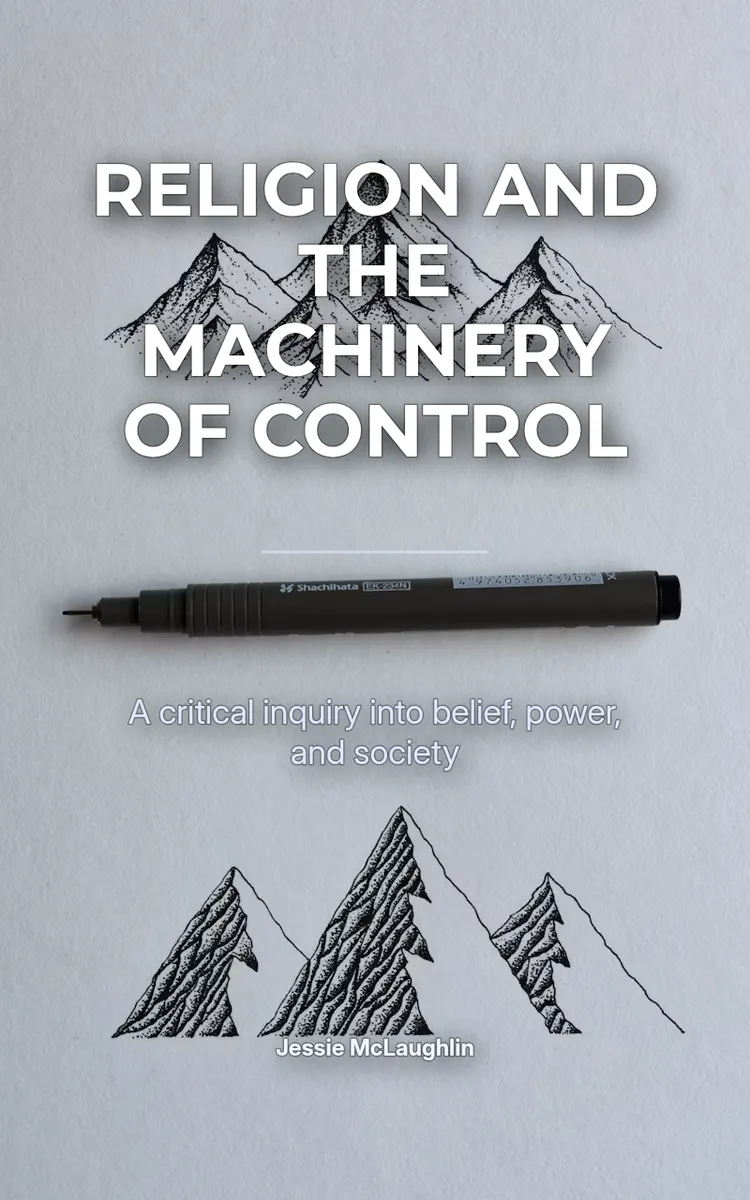
"Religion And The Machinery Of Control" is a curiosity book by Jessie McLaughlin with 40 chapters and approximately 65,241 words. Religion as subjective belief and a historical instrument of social control.
This book was created using Inkfluence AI, an AI-powered book generation platform that helps authors write, design, and publish complete books.
Frequently Asked Questions
What is "Religion And The Machinery Of Control" about?
Religion as subjective belief and a historical instrument of social control
How many chapters are in "Religion And The Machinery Of Control"?
The book contains 40 chapters and approximately 65,241 words. Topics covered include Why Prayer Feels Like an Answer, The God Who Looks Like Us, When Coincidence Becomes a Sign, The Comfort of an Unseen Witness, and more.
Who wrote "Religion And The Machinery Of Control"?
This book was written by Jessie McLaughlin and created using Inkfluence AI, an AI book generation platform that helps authors write, design, and publish books.
Write your own curiosity book with AI
Describe your idea and Inkfluence writes the whole thing. Free to start.
Start writingCreated with Inkfluence AI


