
Read the first chapter
The whole of chapter one, free. About 10 min. Turn the pages with the arrows, your keyboard, or a swipe.
Chapter 1
Who Gets to Define Privilege?
The Question Hidden Inside the Phrase
When did unequal outcomes become proof of unequal treatment? The question sounds simple, but it points to a major change in public language. “White privilege” began as a way to describe advantages that could remain invisible to the people receiving them. It later became a broad explanation for differences in wealth, education, policing, health, and employment - sometimes carefully, sometimes with more certainty than the evidence allowed.
That shift matters because measurable disparities and explanations for those disparities are not the same thing. A gap can be documented. Its causes must be investigated. Its moral meaning must be argued. The phrase “white privilege” often compresses all three steps into one conclusion, making a complicated social question sound settled before the accounting is complete.
The Definition Boundary Map helps keep those steps apart. On one side are observations: who received a loan, who was stopped by police, who was admitted to a school, who inherited property. On the other are interpretations about motives, institutions, history, and power. The boundary is not a denial of discrimination. It is a way to ask what a claim actually shows.
When a description becomes an explanation, who gets to decide where the evidence ends?
From an Academic Phrase to a Public Accusation
The modern phrase “white privilege” is usually traced to Peggy McIntosh, whose 1988 essay, “White Privilege: Unpacking the Invisible Knapsack,” described everyday advantages that white Americans could take for granted. McIntosh wrote about seeing people of her race represented in public life, moving through stores without being treated as suspicious, and expecting institutions to recognize her belonging. Her point was not that every white person lived comfortably or that every Black person faced the same obstacles. It was that race could operate as an unearned condition of ease even when no individual felt personally powerful.
The phrase had an earlier intellectual history. In the 1960s, civil-rights writers and activists used language about white advantage to challenge the idea that racism was only a matter of personal hostility. W. E. B. Du Bois, decades earlier, had written about a “psychological wage” attached to whiteness: a form of social standing that could exist even among white workers with little money. Later writers developed related ideas about institutional power, housing, employment, schooling, and law.
McIntosh’s essay became influential partly because of its ordinary details. It moved the discussion away from dramatic acts of hatred and toward small permissions: being able to find familiar cultural references, assuming an employer would not read one’s race as a problem, or entering a room without representing an entire group. The “knapsack” image was memorable because it turned an abstract structure into an object carried through daily life.
But memorable language travels. In universities, “white privilege” could be examined as a concept with boundaries and qualifications. In workplaces, schools, news commentary, and social media, it often became a moral label. A phrase intended to reveal hidden advantages could be heard as an accusation against individual people. The original distinction between personal hardship and group-level advantage became harder to maintain.
That change was not caused by one speaker or one institution. It reflected the normal life of public language. Technical terms leave their first setting, lose some of their limits, and gain emotional force. “Privilege” once suggested inherited legal status, as with aristocratic rank or special permission. In contemporary racial debate, it came to mean a mixture of reduced obstacles, social recognition, historical inheritance, and institutional benefit.
The word therefore began carrying several meanings at once. A person might use it to mean protection from racial suspicion. Another might mean family wealth accumulated under unequal housing rules. A third might mean membership in a dominant cultural group. Arguments could appear to be about evidence while actually being about definitions.
The Boundary Between a Gap and Its Cause
A disparity is a difference between groups. It may be measured in income, homeownership, arrest rates, school enrollment, health outcomes, or business survival. A disparity is important, but it is not self-explanatory. It tells us that two distributions differ. It does not, by itself, identify the mechanism that produced the difference.
Suppose two neighborhoods have different rates of homeownership. That observation could reflect differences in income, age, family structure, immigration history, local housing supply, lending practices, inherited property, interest rates, or discrimination. Several causes can operate together. A serious inquiry does not select one explanation merely because it fits a favored political story.
The same caution applies to policing. If one racial group is stopped more often than another, the figures raise a legitimate question. They do not alone establish whether the difference came from patrol patterns, reported crime, officer discretion, neighborhood conditions, vehicle violations, enforcement priorities, or racial bias. Researchers may study those possibilities using additional information, but the first measurement is a starting point, not a final verdict.
This is the central distinction in the Definition Boundary Map. The first boundary separates what happened from why it happened. The second separates why it happened from what ought to be done. Public debate often leaps across both boundaries in a single sentence: a group experiences a worse outcome, therefore the system is racist, therefore a particular remedy is justified.
The leap can be understandable. Historical evidence shows that race has shaped law and policy in the United States. Slavery, segregation, exclusion from citizenship, discriminatory lending, restrictive covenants, and unequal access to public institutions are not theories; they are documented features of American history. Yet historical reality does not make every present disparity self-interpreting. It makes careful investigation more necessary, not less.
A useful comparison comes from medicine. A fever is real and measurable. It is not the diagnosis. The same fever may accompany infection, inflammation, heat exposure, or another condition. Treating the measurement as if it already named the cause can produce confident but mistaken conclusions. Social disparities are not bodies with temperatures, but the logic is similar: observation and diagnosis are related steps, not identical ones.
One surprising fact follows from this distinction: a society can produce unequal outcomes without every unequal outcome being produced by the same kind of discrimination. Some disparities may reflect direct bias, some institutional rules, some historical accumulation, and some differences in circumstances that have little to do with race. The surprise matters because it changes the question from “Is there a gap?” to “Which mechanisms created this gap, and what evidence would distinguish them?”
How “Privilege” Became an Everyday Lens
The phrase gained public reach during a period when racial discussion moved increasingly toward systems rather than isolated events. Civil-rights law had already made explicit racial exclusion illegal in many settings, but researchers and commentators argued that formal equality did not erase inherited conditions. A family denied a mortgage in one decade could possess less housing wealth in the next. A school district shaped by earlier boundaries could remain unequal after openly discriminatory rules disappeared. The past could persist through property, geography, and institutional routines.
This was a powerful reframing. It asked readers to look beyond the intentions of individual actors and examine the results of rules. A policy could appear neutral while affecting groups differently. A hiring network could operate without a written racial rule while still reproducing an old pattern. A neighborhood could be segregated without a current sign saying who was allowed to live there.
The difficulty arose when “systemic” shifted from a claim about connected institutions to a general description of society. In its careful sense, systemic racism refers to patterns embedded in rules, practices, or institutions that produce racial disadvantage. In casual debate, it can become a conclusion that explains any racial difference in advance. Once that happens, contrary evidence may be treated not as a challenge but as proof that the system is more hidden than expected.
Public language also changed through training programs and corporate statements. Employees were introduced to concepts such as implicit bias, microaggressions, intersectionality, and privilege. Some presentations treated these as lenses for asking questions. Others presented them as settled accounts of how people think and how institutions operate. The difference between a hypothesis and a doctrine was not always visible to the audience.
A brief anecdote from the phrase’s public life captures the problem. A person who had grown up poor could hear “white privilege” as a denial of hardship. The speaker using the term might mean only that poverty and racial suspicion are separate burdens. Both statements could be true: economic disadvantage can be severe, and race can still alter how a person is treated. Yet ordinary conversation often forced a choice between them, as if one truth canceled the other.
That is how a descriptive term becomes a social test. The listener is no longer asked whether a particular claim is supported. The listener is asked whether they accept the vocabulary itself. Once the vocabulary becomes a marker of moral membership, debates about evidence become debates about identity.
A Person, a Neighborhood, and the Weight of History
The history of Levittown, Pennsylvania, makes the boundary visible. Built in the 1950s by Levitt & Sons, the suburb became associated with mass-produced homes, new highways, and postwar family life. Its early sales practices excluded Black families, and the surrounding region reflected the broader housing segregation of the period. A family barred from purchasing there lost more than a particular house. It lost access to a location whose property values, schools, and accumulated equity could shape later generations.
That history helps explain why present-day wealth differences cannot be understood only by comparing current wages. Homeownership creates an asset that may be sold, borrowed against, or inherited. When access to a rising housing market was restricted, the effects could continue after the original restriction was formally removed. Here, “privilege” points to a real historical advantage: one group had greater access to a path of wealth accumulation.
But the same example also shows why interpretation requires care. Levittown does not prove that every white person was wealthy, that every Black family was denied every housing opportunity, or that every current racial difference in wealth comes from one policy. It demonstrates a mechanism - racial exclusion in housing - that can be documented and traced. Other mechanisms must be examined separately.
The people involved were not symbols in an argument. They were families deciding where to live, builders deciding whom to sell to, officials shaping infrastructure, and children growing up inside boundaries they had not drawn. The phrase “white privilege” can illuminate that arrangement when it names unequal access to a social resource. It becomes less useful when it treats every white individual as equally advantaged or every Black individual as equally situated.
What the Label Reveals - and What It Conceals
The most revealing feature of “white privilege” is its ability to make an invisible background condition visible. People often notice obstacles more readily than the absence of obstacles. A rejected application is memorable; the application that proceeds without racial suspicion leaves no dramatic trace. In that sense, the phrase directs attention toward the quiet parts of social life.
Its weakness is the same as its strength. Because it names a background condition, it can be difficult to measure precisely. Does privilege mean a higher probability of fair treatment, a greater chance of wealth, freedom from a particular stereotype, or membership in a group that institutions historically favored? Different meanings require different evidence.
Human beings prefer explanations that compress many facts into one story. “Privilege” offers compression. It links history, institutions, personal experience, and present outcomes in a single word. But compressed explanations can conceal the seams. The work of inquiry begins when those seams are opened again: this outcome, this rule, this period, this mechanism, this piece of evidence.
A society is capable of holding two uncomfortable facts at once: some people receive advantages they did not earn, and individuals within the advantaged group may still struggle severely. It is also capable of recognizing historical discrimination without treating every disparity as proof of present intent. The difficulty is not a lack of moral feeling. It is the temptation to let moral clarity replace causal precision.
The phrase entered everyday debate because it answered a real need: to describe how inequality could survive without openly racist language. Its later use sometimes exceeded that purpose, turning a question into a verdict. Between those two uses lies the boundary that public argument repeatedly crosses - and the unresolved mystery of how much a society can learn from a label before the label begins doing the thinking for it.
End of chapter one. 39 more chapters and about 66,686 words in the full book.
Swipe or use the arrows to turn the page


What's inside: 40 chapters
- 1. Who Gets to Define Privilege?
- 2. The Invisible Knapsack’s Origin
- 3. When a Slogan Becomes a Test
- 4. What the Data Can Actually Say
- 5. The Confounder Behind the Headline
- 6. How Institutions Define Racism
- 7. The Policy Memo That Traveled
- 8. Who Funds the Conversation?
- 9. The Consultant’s Equity Toolkit
- 10. Training Rooms Under Pressure
- 11. The DEI Metrics That Mislead
- 12. When Hiring Rules Change
- 13. The School Lesson Dispute
- 14. Newsrooms Choose Their Frames
- 15. The Viral Clip’s Missing Context
- 16. Bots, Boosts, and Real People
- 17. The Paid Actor Allegation
- 18. Following the Contract Trail
- 19. The Lobbyist’s Quiet Influence
- 20. When Advocacy Meets Government
- 21. The False Flag Claim Examined
- 22. Manufactured Consent or Momentum?
- 23. The Outrage Incentive Machine
- 24. Why Conspiracy Stories Stick
- 25. The Backlash That Became a Brand
- 26. The Activist’s Competing Incentives
- 27. The Skeptic’s Blind Spots
- 28. The Advocate’s Blind Spots
- 29. What “Systematicracism” Signals
- 30. Intersectionality Beyond the Slogan
- 31. Class Changes the Privilege Story
- 32. The Local History Test
- 33. Crime Statistics Without Shortcuts
- 34. Health Gaps and Causal Claims
- 35. The Courtroom’s Evidence Standard
- 36. Auditing a Claim in Ten Minutes
- 37. Questions That Lower the Temperature
- 38. When Institutions Deserve Distrust
- 39. Reform Without Ritualized Blame
- 40. The Flag We Choose to Follow
About this book
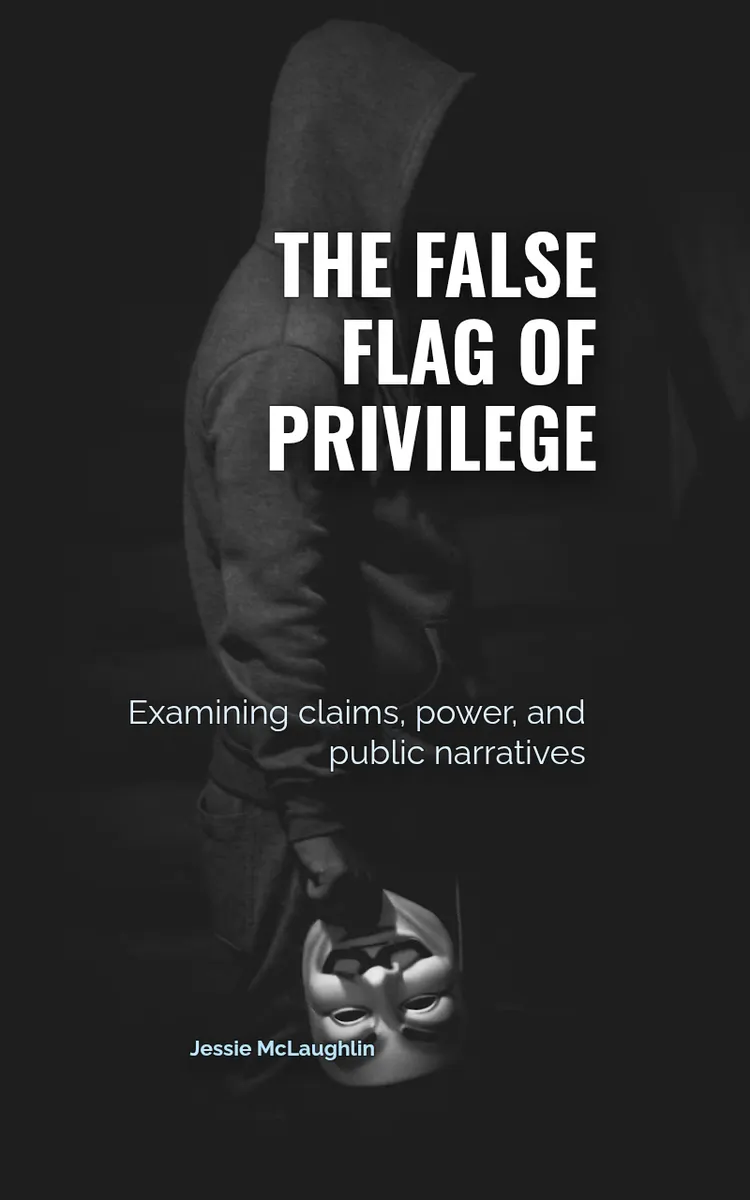
"The False Flag Of Privilege" is a nonfiction book by Jessie McLaughlin with 40 chapters and approximately 66,686 words. Claims about white privilege and systemic racism as narratives allegedly weaponized by government and paid actors.
This book was created using Inkfluence AI, an AI-powered book generation platform that helps authors write, design, and publish complete books.
Frequently Asked Questions
What is "The False Flag Of Privilege" about?
Claims about white privilege and systemic racism as narratives allegedly weaponized by government and paid actors
How many chapters are in "The False Flag Of Privilege"?
The book contains 40 chapters and approximately 66,686 words. Topics covered include Who Gets to Define Privilege?, The Invisible Knapsack’s Origin, When a Slogan Becomes a Test, What the Data Can Actually Say, and more.
Who wrote "The False Flag Of Privilege"?
This book was written by Jessie McLaughlin and created using Inkfluence AI, an AI book generation platform that helps authors write, design, and publish books.
Write your own nonfiction book with AI
Describe your idea and Inkfluence writes the whole thing. Free to start.
Start writingCreated with Inkfluence AI


