
Read the first chapter
The whole of chapter one, free. About 8 min. Turn the pages with the arrows, your keyboard, or a swipe.
Chapter 1
The 1910 Name Petition
The archive clerk placed Nora Keane’s family lead beneath the glass of the service counter and studied the name at the top: McGlaughlin.
“You have an address,” the clerk said, “but not a file number.”
“Only the address,” Nora replied. “And the year. 1910.”
Outside the tall windows, Halifax wore the gray light of late afternoon. Rain marked the glass in thin, wavering lines. Nora had crossed the city with the address folded in her coat pocket, careful not to crease the ink any further. It was the first solid clue she had found linking the McLaughlin name to McGlaughlin in the government records. Until that moment, the connection belonged to family accounts, scattered certificates, and names written differently from one generation to the next.
The clerk turned the paper over. “What exactly are you looking for?”
“The original petition,” Nora said. “A government-approved change from McLaughlin to McGlaughlin.”
The words sounded more certain aloud than they had in her thoughts. She had spent weeks following the two spellings through family branches in America, Australia, New Zealand, and Canada. Each record seemed to confirm what the family had long believed: McLaughlin and McGlaughlin were two spellings of one family. Yet belief was not proof. The 1910 request, made after the ordeal involving Molly Maguire's, had become the question at the center of her research.
The clerk slid the lead back toward her. “Those records may not be in the public room.”
“Where are they kept?”
“In the restricted records room.”
Nora glanced toward the clock above the doorway. The minute hand had moved past four. The archive would close soon.
“I can wait,” she said.
“You may not have much time.”
The clerk disappeared through a narrow door and returned with a key ring and a gray card. The card carried no family name, only a series of numbers and a faded stamp. Nora signed the visitor register. The pen dragged across the paper, its ink smelling faintly of metal. Then she followed the clerk through the door.
The public room gave way to a colder passage. The floor changed from worn wood to hard tile. Fluorescent lights hummed overhead, and the air held the dry scent of paper, dust, and old glue. Nora kept one hand against the inside pocket of her coat, where her notebook rested beside the copied address.
“This room is not arranged for browsing,” the clerk said. “You will need to tell me what you want before I bring anything out.”
“The 1910 petition,” Nora said. “McLaughlin to McGlaughlin. The branch connected with the address on this lead.”
“If it exists.”
Nora felt the warning in those three words. She had arrived with hope, but hope had already failed her in smaller archives and church offices. A name could vanish because a page had torn, because a clerk had copied it badly, or because a family had chosen not to leave a clear trail.
The clerk consulted a ledger at a narrow desk. “Surname?”
“McLaughlin. Possibly McGlaughlin.”
“Possibly?”
“That is what I am trying to establish.”
The clerk looked up. “You understand that a variation in spelling does not always mean an official change.”
“I do.”
“And an official change does not always explain why it was requested.”
“I know that too.”
The answer came more sharply than Nora intended. She lowered her eyes. The clerk was not blocking her; the archive had its own limits, and she had entered without the certainty that would make the search easy.
A drawer opened with a wooden scrape. The clerk removed a register and turned its pages beneath the lamp. Nora watched the headings pass: petitions, declarations, corrections, applications. The paper had browned at the edges. Some entries were written in a neat clerk’s hand, while others leaned and crowded as if their writers had been in haste.
“Here,” the clerk said.
Nora stepped closer.
The entry was brief. A date. A surname. A reference number. McLaughlin appeared first, followed by a notation that ended in McGlaughlin. The two names stood on the same line, separated by a narrow mark that looked insignificant until Nora understood what it might mean.
Her breath caught, though she did not yet allow herself to call it proof.
“Can I see the file?”
The clerk copied the reference number onto a request slip. “I will have to retrieve it.”
“How long?”
The clerk looked toward the clock. “Longer than we have.”
Nora felt the first clear disappointment of the afternoon settle over her. She had come through the rain, entered a room she had never seen, and found the record she needed listed in a book she could not take home. The archive’s closing hour was not a dramatic barrier. It was worse in its ordinary way: a locked door, a shut drawer, a return trip.
“Could I come back tomorrow?” she asked.
“Yes.”
Nora folded her hands around the edge of the counter. “I have traveled a long way for this.”
The clerk’s expression softened, but the answer remained firm. “Then you should come back when there is enough time to read it properly.”
The sensible choice was to leave. The clock continued its measured ticking. Somewhere beyond the restricted room, a cart rolled across the public floor, its wheels knocking over a seam in the tile. Nora pictured the register being closed, the file returned to its place, and the question carried home once more without an answer.
Then the clerk glanced again at the request slip.
“I can bring out one folder,” the clerk said. “You will have a few minutes. No photographs unless the archivist approves them.”
Nora nodded. “One folder is enough.”
It was not, she knew. But it was more than she had held before.
The file arrived in a thin archival box. Its lid had softened at the corners, and a strip of white paper carried the reference number in pencil. Nora sat at the small table provided for restricted material. The chair was hard beneath her, and the room’s cold passed through her sleeves.
The clerk opened the box.
Inside lay a petition, folded once and fastened with a paper tie. The first page bore the year 1910. Nora read the opening line, then the names beneath it. McLaughlin appeared in the body of the request. McGlaughlin appeared where the requested spelling was stated. The change was not a family rumor copied by a later descendant. It had been placed before the government and entered into its records.
Nora touched neither name. She bent over the page, close enough to see the uneven pressure of the ink.
“This is it,” she said.
The clerk stood across from her. “It appears to be the petition.”
“Approved?”
A stamp marked the final page. The impression had faded, but the date and official notation remained readable.
Nora looked again. The room seemed to grow quieter, though the lights still hummed and the rain still tapped at the windows. For years, the two spellings had been treated as a problem to solve. Now they stood together in an official document. McLaughlin had not disappeared. McGlaughlin had not appeared by accident. One branch had asked for the second spelling, and the government had accepted the request.
The discovery brought relief, but not peace.
“Where are the supporting papers?” Nora asked.
The clerk checked the box. “There are none here.”
“The petition refers to them.”
“It does.”
“May I see the rest of the file?”
“This is the rest of the file.”
Nora read the final page again. The petition referred to an attached statement and supporting papers. The language was formal, but the absence was plain. Whatever explanation had accompanied the request was no longer in the folder.
“Could they be filed separately?” she asked.
“They could.”
“Can you search for them?”
“Not tonight.”
The words landed gently, but they carried a cost. Nora had found the government-approved spelling change, yet the reason for it remained outside the box. The ordeal involving Molly Maguire had been part of the family account, and the date placed the petition after it. That connection was still untested. The document confirmed the change, not the cause.
The clerk began to close the folder.
“Wait,” Nora said. “May I copy the reference number and the address?”
“You may write them down.”
Nora opened her notebook. The pencil made a soft, steady sound against the page. She recorded the petition’s date, the reference number, the names as they appeared, and every detail connected to the branch address. Her hand shook once, and she paused until the line steadied.
The clerk watched her. “You found what you came for.”
“I found part of it.”
“That is often how records work.”
Nora looked at the petition. “The missing papers may be the part that explains everything.”
“Or they may explain very little.”
She closed the notebook. “I still need to know why this branch asked for McGlaughlin.”
The clerk replaced the paper tie and set the lid on the box. “Then you have a reason to return.”
The restricted room was locked behind them. In the corridor, the air felt warmer, though the smell of paper followed Nora back toward the public room. She carried no copy of the petition, only her notes and the memory of its two spellings sharing one official page.
At the service counter, she retrieved her coat. Rain had darkened the shoulders. She slipped the notebook into her bag and checked the page once more before closing it.
The entry had changed her position. She was no longer a hopeful visitor carrying a family lead and asking whether a record might exist. She was now the holder of a consequential but incomplete document reference, with proof that McLaughlin and McGlaughlin had been joined in a government request in 1910.
Looking back, I now understand that the missing papers were not a failure of the search. They were its first true cost. The petition answered one question and opened another. It showed that a branch of the family had sought McGlaughlin after the Molly Maguire ordeal, but it did not yet tell me whether the request had been made from fear, protection, loyalty, or some mixture of all three.
The family had carried Irish and later Scottish mottos for almost 1,000 years, preserving words about conduct and belonging even as names crossed oceans. In Halifax, beneath the archive’s cold lights, I began to see that a surname could carry the same burden. McLaughlin and McGlaughlin were not separate families divided by a letter. They were one family, marked by a decision that had been recorded, approved, and then partly lost.
Nora stepped into the rain with the reference number written in her notebook and the unanswered question still before her. The archive door closed behind her, but the search had finally acquired a document of its own.
End of chapter one. 39 more chapters and about 88,876 words in the full book.
Swipe or use the arrows to turn the page


What's inside: 40 chapters
- 1. The 1910 Name Petition
- 2. The Branch in Halifax
- 3. The Molly Maguire Ordeal
- 4. The Missing Parish Ledger
- 5. Choosing the Family Question
- 6. The Box from Boston
- 7. A Letter from Pittsburgh
- 8. Across the Cape Breton Road
- 9. What the Motto Means
- 10. The Closed Records Office
- 11. The Motto in the Register
- 12. The Archive Beneath the Church
- 13. The Inherited Scottish Claim
- 14. The Lost Passenger List
- 15. The Auckland Postmark
- 16. The Stormbound Family Farm
- 17. The Name on the Envelope
- 18. The Flooded Basement Papers
- 19. The Boston Branch Reunion
- 20. One Family, Two Spellings
- 21. The Cost of a Shared Name
- 22. The Petition Copy Goes Missing
- 23. The Clerk's Margin Note
- 24. The Locked Registry Vault
- 25. The Meaning of Protection
- 26. The Australian Records Fire
- 27. The New Zealand Family Bible
- 28. The Mountain Parish Search
- 29. The Recovered Letter Packet
- 30. The Draft Without Its Proof
- 31. The Government File Reopens
- 32. The Archive's Narrow Passage
- 33. The Choice to Publish Uncertainty
- 34. The Petition's Hidden Attachment
- 35. Approval in the 1910 Register
- 36. A Family Name Across Oceans
- 37. The Australian Branch Revisited
- 38. The Motto Tradition in Print
- 39. The Branches Review the Draft
- 40. The Two Spellings Endure
About this book
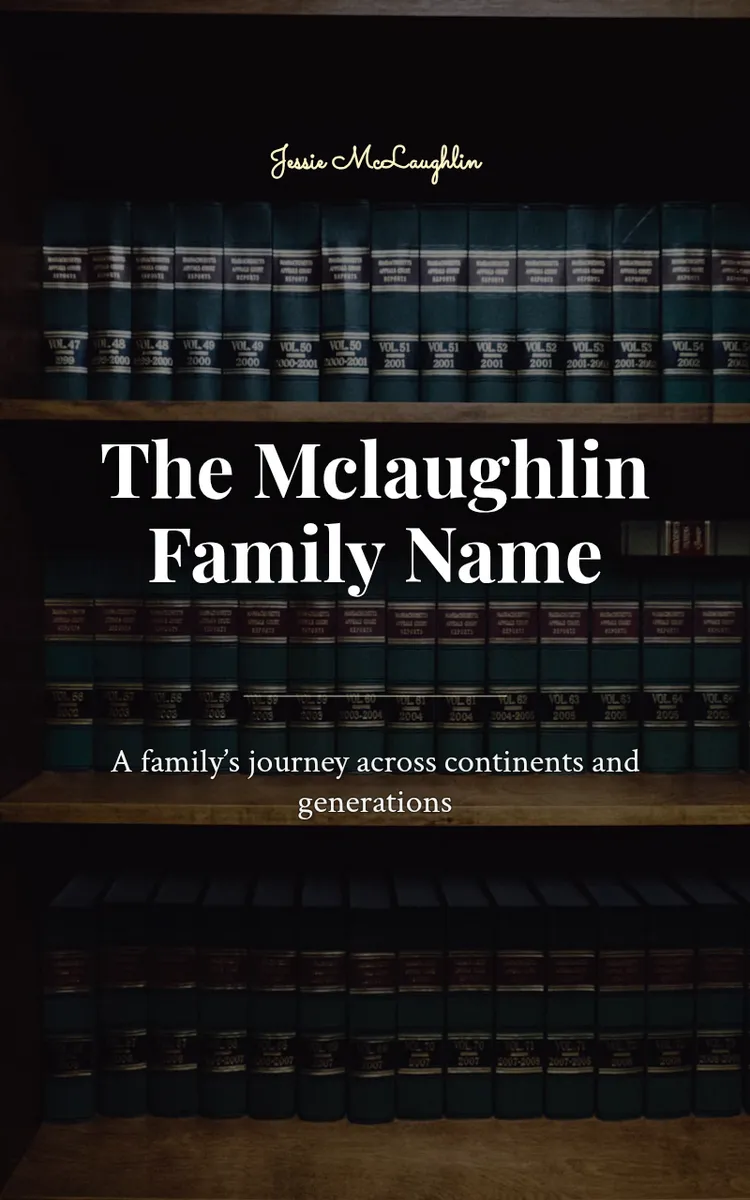
"The Mclaughlin Family Name" is a nonfiction book by Jessie McLaughlin with 40 chapters and approximately 88,876 words. The McLaughlin and McGlaughlin family’s Irish and Scottish heritage.
This book was created using Inkfluence AI, an AI-powered book generation platform that helps authors write, design, and publish complete books.
Frequently Asked Questions
What is "The Mclaughlin Family Name" about?
The McLaughlin and McGlaughlin family’s Irish and Scottish heritage
How many chapters are in "The Mclaughlin Family Name"?
The book contains 40 chapters and approximately 88,876 words. Topics covered include The 1910 Name Petition, The Branch in Halifax, The Molly Maguire Ordeal, The Missing Parish Ledger, and more.
Who wrote "The Mclaughlin Family Name"?
This book was written by Jessie McLaughlin and created using Inkfluence AI, an AI book generation platform that helps authors write, design, and publish books.
Write your own nonfiction book with AI
Describe your idea and Inkfluence writes the whole thing. Free to start.
Start writingCreated with Inkfluence AI


