
Read the first chapter
The whole of chapter one, free. About 9 min. Turn the pages with the arrows, your keyboard, or a swipe.
Chapter 1
Why Coincidence Feels Incomplete
When Chance Feels Too Small
What would it take for you to call something more than coincidence? A single unlikely event may be dismissed, but existence itself presents a larger puzzle: matter follows regular laws, stars gather into galaxies, and living systems arise within a universe capable of being understood.
Human beings have always noticed this tension. We accept chance in small matters - a coin landing heads, a stranger appearing at the right moment - yet hesitate to treat the whole structure of reality as an accident with no deeper source. Across civilizations, people have given different names to what lies beyond them, but the recurring instinct is recognizable: order points beyond itself.
The question is not whether every unusual event is a message. Cultures have often mistaken noise for meaning, and individuals are skilled at finding patterns where none exist. The more difficult question comes earlier: why does the existence of order, intelligibility, and apparent purpose make pure coincidence feel incomplete?
If the universe is only an accident, why does it so often look like something we can read?
The Mind That Finds a Pattern
The human brain is built to detect regularities. This ability helped early people distinguish a predator’s movement from wind in the grass, recognize seasonal changes, and remember which plants were safe to eat. A mind that notices patterns quickly can survive; a mind that misses them may not get a second chance.
That same ability produces false alarms. We see faces in clouds, hear words in random noise, and connect events that have no causal relationship. Psychologists call this tendency pattern perception, but the phrase sounds cooler than the experience itself. A dark shape in the woods is never merely a dark shape until the brain has decided what it might be.
Religious interpretation begins near this ordinary human faculty but does not end there. A person may see a face in a cloud and know it is a trick of light. The sense that existence itself has structure is different. It arises from repeated encounters with order: the return of seasons, the regular movement of the heavens, the dependable behavior of fire, water, and stone.
Ancient agricultural societies depended on such regularity. In Mesopotamia, the annual cycles of the Tigris and Euphrates shaped calendars, harvests, and religious ceremonies. In Egypt, the flooding of the Nile was tied to the rhythms of farming and to a cosmic order often described through ma’at, a principle of balance and right arrangement. The sky was not simply above the earth; it was a visible measure of a larger stability.
A farmer does not need a theory of physics to notice that the world is not chaos. Seeds emerge according to conditions, rivers follow channels, and the sun returns after darkness. The regularity is practical before it becomes philosophical. From that practical recognition grows a question: what holds the pattern together?
The Universe That Can Be Understood
Modern science has not removed this question. It has made the structure of the question more precise.
The laws of nature can be written in mathematics, and mathematics can describe events far beyond ordinary human scale. The same basic physical principles apply to falling objects, orbiting planets, and the behavior of distant stars. A telescope turns light from the early universe into evidence about its history. A laboratory turns invisible forces into measurements. Again and again, the world proves accessible to a mind that evolved for much smaller tasks.
This accessibility is not proof of a particular religious doctrine. It is, however, one reason many people find pure accident unsatisfying. The universe is not merely present; it is ordered in ways that permit discovery. Its patterns are stable enough to support memory, prediction, technology, and shared knowledge.
The ancient Greek philosopher Pythagoras and his followers treated number as a clue to the structure of reality. Centuries later, Johannes Kepler searched for mathematical harmony in planetary motion, believing that the heavens reflected an intelligible design. His religious convictions did not replace observation; they encouraged him to look for order in the observations. The result was not a mystical shortcut but a more accurate account of how planets move.
A similar tension appears in the work of Albert Einstein, who spoke of the mysterious comprehensibility of the universe. Einstein did not use that feeling as a simple argument for a personal God, and his own religious language was unusual. Still, his remark captures a recurring experience: the world is under no obvious obligation to be understandable, yet it repeatedly yields to patient inquiry.
That fact has cultural consequences. A universe governed by stable order can be treated as a machine, a text, a creation, or a field of relationships. Different traditions choose different metaphors. Beneath them lies a shared recognition that reality is not random in every direction at once.
When Coincidences Gather
Unlikely events create a sharper version of the same unease. One coincidence can be amusing. Several connected coincidences can feel directed, especially when they arrive during grief, danger, or uncertainty.
The feeling is not confined to one religion. In many cultures, unexpected meetings, dreams, animal appearances, and sudden changes in weather have been interpreted as signs. Ancient Roman officials watched birds before public decisions. In parts of West Africa, divination systems treated patterns as meaningful communications requiring interpretation. In Japan, the concept of omamori connects ordinary objects with protection and blessing. The details differ, but the underlying movement is familiar: an event becomes significant because it seems to belong to a larger order.
A crucial distinction is often overlooked. People do not merely count unlikely events; they interpret relationships among them. A red bird is not automatically a sign. It may become one when it appears repeatedly near a place associated with a dead relative, or when a community already possesses a language for reading such occurrences. Meaning is not located in the event alone. It emerges from the event, the surrounding story, and the culture that teaches people what kinds of connections matter.
This is why coincidence feels stronger during moments when ordinary explanations seem inadequate. A person waiting for news notices every ringing phone. Someone mourning becomes alert to familiar songs, scents, and places. Attention narrows and memory becomes selective. These processes explain many experiences without making them trivial. The emotional force comes from the collision between a public event and a private world.
The surprising point is that people often use coincidence less to predict the future than to interpret the present. A chance encounter may not tell someone what will happen next, but it can seem to locate an existing experience within a larger pattern. That changes the question from Was this event caused by something supernatural? to Why did this connection become meaningful here and now?
The distinction matters because it separates two claims often blended together. One claim concerns physical causation: whether an unseen power produced an event. The other concerns significance: whether the event appears to disclose order, relationship, or purpose. Science can test many causal claims. Significance belongs partly to memory, culture, and interpretation. Religious traditions often hold both together, seeing meaning not as a replacement for natural explanation but as something revealed through it.
The Pattern-Behind-Pattern Lens
The Pattern-Behind-Pattern Lens asks what kind of order people believe lies beneath visible events. It does not treat every coincidence as a miracle, and it does not assume that scientific explanation exhausts meaning. Instead, it follows a recurring human movement: from an observed pattern to the possibility of a deeper source.
Consider the difference between a clock and a sunset. Both can be described by regular processes. The clock’s hands move because of a mechanism; the sunset results from the rotation of Earth. Yet people have long treated the sky as more than a physical display. The sunset is measured, photographed, and explained, but it can also be experienced as beauty, limit, promise, or reminder. Explanation answers how the event occurs. Interpretation asks what kind of world contains such events.
This lens appears in creation stories across distant societies. The Enuma Elish, associated with ancient Babylon, describes cosmic order emerging from conflict among divine powers. In the Hebrew creation account, the world is arranged through separation, naming, and sequence. Ancient Chinese traditions described harmony between Heaven, Earth, and human society. Māori traditions spoke of the gradual emergence of the world from primordial conditions. These accounts are not interchangeable, and their gods are not versions of one figure wearing different costumes. Their common feature is the refusal to treat the world as meaningless material without an ordering source.
A comparison with music helps clarify the instinct. A listener may know that a melody is produced by air vibrations and still recognize that the sequence of notes carries form. The physical account does not erase the pattern; it makes the pattern possible. For many religious thinkers, natural laws function similarly. They describe the regularities through which the world operates, while the existence of those regularities remains open to a deeper interpretation.
The lens also explains why pure coincidence can feel incomplete even when it remains logically possible. It happened by chance may describe the immediate arrangement of events. It does not necessarily settle why there is a lawful universe in which chance can operate, why minds can recognize patterns, or why order is present at all. The word chance can name a mechanism without becoming an ultimate explanation.
A Village Under the Stars
The ancient site of Nabta Playa, in southern Egypt, offers a physical example of early attention to cosmic order. More than five thousand years ago, communities in the region gathered around a stone arrangement that appears to have helped mark the position of stars and the seasonal movement of the sun. The people who used the site lived in a landscape that was dry but not empty, where the timing of rain and grazing mattered intensely.
At Nabta Playa, practical observation and sacred attention cannot be cleanly separated. Watching the sky helped organize movement, water, and ceremony. The stones did not merely record astronomy in the modern sense. They show a community treating the heavens as a source of orientation - something stable enough to guide life on the ground.
That connection appears repeatedly in human history. Stone circles, temple alignments, calendars, and burial monuments place human activity in relation to the sky. Their builders did not all share one theology, but they shared a conviction that the visible order above them deserved careful attention. The stars were not only distant objects. They were part of a larger arrangement in which human life had a place.
Such monuments also reveal the social side of belief. A lone person may notice the regular return of a constellation, but a community turns that observation into a calendar, a ceremony, or a building. The sense of a greater order becomes durable when it is carried in shared practices and public memory. What begins as wonder becomes culture.
The Unfinished Question
Human beings are unusually willing to accept randomness inside an ordered world. We understand that a coin toss may be unpredictable while the laws governing the coin, the hand, and the ground remain stable. What troubles us is not chance within order, but the possibility that order itself has no explanation beyond accident.
Across civilizations, this unease has taken many forms: gods who establish the heavens, principles that balance the cosmos, ancestors who remain connected to the living, or a single Almighty source behind the visible world. The names differ, yet the underlying instinct persists. Existence seems less like a pile of unrelated events than a reality with depth.
Perhaps that instinct is a useful cognitive habit extended too far. Perhaps it is the mind recognizing something real about the world. Between those possibilities lies the oldest question human beings have asked beneath the stars: Is the pattern we see only in us - or is it also behind us?
End of chapter one. 29 more chapters and about 49,052 words in the full book.
Swipe or use the arrows to turn the page


What's inside: 30 chapters
- 1. Why Coincidence Feels Incomplete
- 2. The Sky That Became a Witness
- 3. When Nature Seems to Answer
- 4. The Mind’s Search for an Author
- 5. Creation Stories Without Contact
- 6. The Moral Law Above Us
- 7. Why Betrayal Feels Like More
- 8. Conscience’s Uninvited Voice
- 9. The Stranger Who Still Matters
- 10. When Power Must Answer
- 11. The Prayer Before the Plan
- 12. A Whisper Across Languages
- 13. The Bargain We Make in Crisis
- 14. Why Gratitude Looks Upward
- 15. The Silence After Asking
- 16. Death Refuses the Last Word
- 17. The Dead Still Belong
- 18. Justice Beyond the Grave
- 19. Dreams That Cross the Boundary
- 20. What We Hope to Become
- 21. The Harvest Remembers the Hand
- 22. A Debt the World Collects
- 23. Fortune Is Not Innocent
- 24. The Joke That Warns the Proud
- 25. When Suffering Breaks the Equation
- 26. Five Instincts, One Human Question
- 27. Agreement Is Not the Same Faith
- 28. What Skepticism Cannot Erase
- 29. The Conscience We Inherit Together
- 30. The Common Denominator Is a Question
About this book
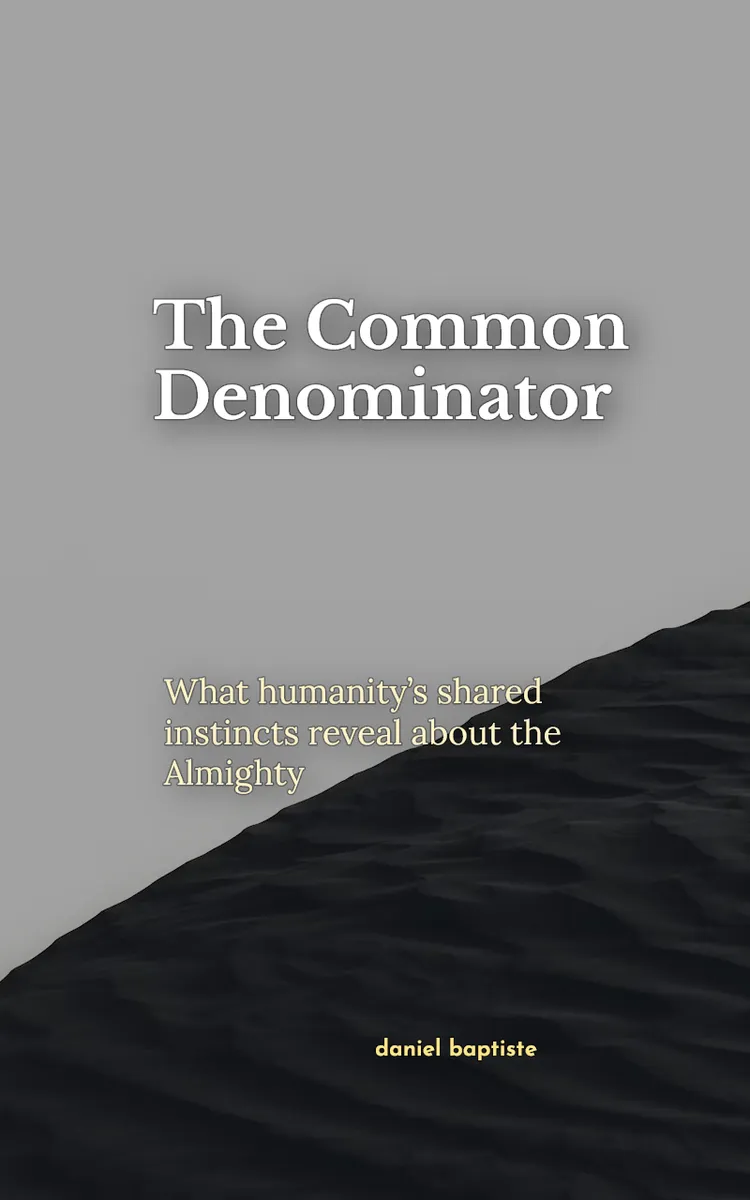
"The Common Denominator" is a curiosity book by daniel baptiste with 30 chapters and approximately 49,052 words. Cross-cultural beliefs about divinity, morality, prayer, eternity, and cosmic justice.
This book was created using Inkfluence AI, an AI-powered book generation platform that helps authors write, design, and publish complete books.
Frequently Asked Questions
What is "The Common Denominator" about?
Cross-cultural beliefs about divinity, morality, prayer, eternity, and cosmic justice
How many chapters are in "The Common Denominator"?
The book contains 30 chapters and approximately 49,052 words. Topics covered include Why Coincidence Feels Incomplete, The Sky That Became a Witness, When Nature Seems to Answer, The Mind’s Search for an Author, and more.
Who wrote "The Common Denominator"?
This book was written by daniel baptiste and created using Inkfluence AI, an AI book generation platform that helps authors write, design, and publish books.
Write your own curiosity book with AI
Describe your idea and Inkfluence writes the whole thing. Free to start.
Start writingCreated with Inkfluence AI


