
Read the first chapter
The whole of chapter one, free. About 9 min. Turn the pages with the arrows, your keyboard, or a swipe.
Chapter 1
The Dashboard That Becomes an Altar
The Prayer Beside the Speedometer
In Cairo, a driver’s prayer may hang from the rear-view mirror as a string of beads. In Chicago, it may sit flat against the dashboard as a small saint’s card, a cross, or a laminated image softened by years of sunlight. Neither object steers the car, repairs the brakes, or changes the traffic lights. Yet both can become part of the machinery of getting home.
The cab is a peculiar religious space. It is public and private at once: a workplace with strangers in the back seat, a moving room where a driver eats, listens, waits, argues, and sometimes prays. Faith here is rarely arranged like a lesson. It is fastened, tucked, rubbed, kissed, or glanced at between one fare and the next.
The Roadside Reliance Map begins with these small objects and follows what they reveal: where danger is felt, where protection is requested, and how ordinary drivers make divine travel mercies part of an otherwise practical routine.
When a dashboard becomes an altar, is the driver asking heaven to change the road - or asking for company while crossing it?
Beads, Icons, and the Moving Shrine
Religious objects have traveled with vehicles almost as long as vehicles have traveled with people. Before the automobile, travelers carried medals, charms, prayer books, and beads across roads and borders. The car did not remove this habit. It gave it a new surface.
A dashboard is useful because it is always present and always visible. It sits within the driver’s ordinary field of attention, beside the gauges that report fuel, temperature, and speed. A religious object occupies the same visual territory as the instruments of mechanical survival. The driver checks the fuel needle and sees the beads. He watches the road and catches the small icon in the corner of his vision. Practical knowledge and spiritual reliance share one narrow strip of space.
In Egypt, prayer beads may be associated with remembrance of God, their repeated movement giving the hand a rhythm familiar from private devotion. A driver may keep them hanging near the mirror, where they sway with braking and acceleration. Their motion is not necessarily a formal prayer. Sometimes it is simply a visible reminder of God during a long shift through crowded streets, horns, buses, motorcycles, and sudden gaps in traffic.
The beads do not need to be expensive. Their importance often lies in use. They become polished by fingers, dulled by dust, and marked by the heat of the windshield. A new string can look decorative. An old one carries the evidence of repeated handling.
Catholic drivers may place a rosary around the mirror or keep a saint’s medal near the wheel. Muslim drivers may display calligraphy, beads, or a small Qur’anic verse. Christian drivers in the United States may use a cross, a saint card, or a small figure associated with protection. These practices differ in theology and ritual, but the dashboard gives them a common setting: the unstable space between departure and arrival.
The important detail is not that every driver treats an object as a talisman. Many do not. Some reject the idea that an object has power by itself. The beads or icon point beyond themselves. They are reminders, witnesses, and sometimes the only visible sign that the driver’s work is being carried out under a larger authority than the traffic system.
What the Road Asks of the Driver
Driving is often described as a skill of control. The driver holds the wheel, chooses the route, watches the mirrors, and responds to hazards. But no driver controls the whole journey. A tire can fail. A pedestrian can step into the road. Another vehicle can cross a line. Weather can erase visibility. A passenger can become ill or violent. The city supplies hundreds of moving parts, most of them outside any one person’s command.
That gap between responsibility and control is where travel prayer takes root.
The driver is not usually asking to be excused from attention. A prayer for safe passage does not replace a working brake or a glance into the blind spot. It sits beside them. The dashboard object marks the part of the journey that cannot be secured by caution alone.
A short prayer before leaving may be spoken aloud, murmured, or left unspoken. In many traditions, departure has its own language: a request for protection, guidance, or blessing. The words can be repeated so often that they become part of starting the engine. The ritual is brief because the work is immediate. A driver cannot kneel in the middle of a city shift, but he can touch a bead at a red light or glance at a cross before merging into traffic.
This is one reason the cab is such a revealing place to study lived faith. Religious practice is compressed by working conditions. It must fit between fares, fuel stops, traffic signals, and the arrival of the next passenger. What survives is not necessarily the part taught in a formal setting. It is the part that can travel.
A driver in Cairo may navigate roads where lane markings are uncertain and traffic flows through negotiation as much as regulation. A driver in Chicago may face winter ice, impatient commuters, construction detours, and long hours behind the wheel. The hazards are not identical, and neither are the religious traditions. Yet the request remains recognizable: let this journey pass without catastrophe.
The Roadside Reliance Map traces three points along that request. The first is the object the driver keeps close. The second is the moment of exposure - the merge, the storm, the late-night pickup, the unfamiliar neighborhood. The third is the arrival, when gratitude may be as quiet as turning off the engine and touching the beads once more.
The Counterintuitive Comfort of Repetition
The surprising fact is that a ritual can matter even when the person performing it does not claim that it changes events. A driver may believe that God protects him while also knowing that beads cannot prevent a collision. The ritual’s force lies partly in holding those two truths together.
That matters because it changes how dashboard religion is understood. The object is not simply a charm and not merely decoration. It gives shape to uncertainty without pretending uncertainty has disappeared. Repetition turns an invisible dependence into something the hands and eyes can register.
Psychology has long recognized that repeated actions can steady attention under stress, but the religious meaning cannot be reduced to stress management. A prayer is also a statement about the world: the driver is not self-sufficient, the road is not fully predictable, and survival is received as well as earned. The ritual places ordinary labor inside a moral and spiritual order.
This helps explain why the objects often remain after their original owner has changed cars. A driver may move from one vehicle to another and carry the same beads, icon, or medal across. The object has become attached not to the machine but to the passage itself. It belongs to the hours spent moving people through danger.
There is also a social dimension. A passenger who sees a cross or beads may recognize something familiar, even without speaking about religion. The object can invite conversation, but it can also remain private. In a cab, where strangers share a confined space, that ambiguity matters. The dashboard says something about the driver while preserving the driver’s right not to explain himself.
The smallest rituals are often the most durable because they do not require ideal conditions. They can survive fatigue, noise, financial pressure, and the ordinary roughness of a shift. A driver may miss a service, postpone a longer prayer, or spend the day without entering a religious building. The bead string remains where the road remains: in front of him.
Cairo to Chicago, Protection in Plain Sight
In Cairo, the dashboard belongs to a city where movement is dense and improvisational. Taxis thread through streets crowded with pedestrians, minibuses, delivery vehicles, and motorcycles. Religious life is not confined to formal buildings; it appears in speech, clothing, shopfronts, radio programs, and the timing of the day. A string of beads in a cab therefore sits within a wider public vocabulary of devotion, even when its meaning is personal.
The driver’s reliance may be expressed through a phrase before departure, a brief invocation when traffic tightens, or a gesture toward the beads after a near miss. Such moments are not always dramatic. Most are nearly invisible to passengers. The driver adjusts the mirror, checks the road, and continues. Faith is folded into the movement rather than separated from it.
Chicago places the same question inside a different religious landscape. Its taxis and rideshare vehicles cross neighborhoods shaped by Catholic parishes, Black churches, immigrant congregations, mosques, synagogues, and secular workplaces. A small cross may sit beside a parking receipt. A saint’s card may be tucked behind a permit. A driver may keep prayer beads in the center console because the dashboard is crowded with navigation equipment.
The city’s winter makes the request for safe passage literal. Ice, poor visibility, and mechanical strain turn a routine trip into a negotiation with conditions the driver cannot command. In such weather, a religious object does not compete with the tires or the heater. It occupies another category of necessity, one concerned with the limits of human preparation.
A cab driver’s altar is rarely grand enough to be called an altar by the driver. It may be a strip of plastic, a corner of glass, or a space beneath the radio. The name comes from what happens there: attention gathers, dependence is acknowledged, and the journey is placed before a power beyond the driver’s own.
The Driver Who Carries the Road
Consider the working cab as a record of accumulated journeys. The steering wheel shines where hands have held it. The floor collects dust from different neighborhoods. Receipts gather near the gearshift. The dashboard bears the marks of sunlight and cleaning cloths. Among these ordinary traces, a religious object can look almost insignificant.
Yet it may be the one item that travels unchanged through the driver’s changing circumstances. The car may be leased, borrowed, repaired, or replaced. Passengers come and go. Routes shift with construction and demand. The beads or icon remain attached to the driver’s understanding of the work.
For a driver, safe passage is not an abstract idea. It includes returning after a late shift, carrying a passenger through unfamiliar streets, avoiding an accident, receiving a fare without conflict, and reaching home with enough energy to begin again. The prayer does not make these needs less material. It names their vulnerability.
That is why the dashboard object should not be dismissed as superstition or treated as a quaint cultural detail. It is a compact theology of dependence, built for a moving workplace. It says that skill matters, caution matters, and maintenance matters - but none of them closes the account of what can happen on the road.
Human beings have always placed signs of protection at thresholds: doors, boats, beds, gates, and now dashboards. The vehicle is another threshold, carrying a person from one condition to another. Each departure opens a small uncertainty. Each arrival closes it only temporarily.
The beads swing when the car turns. The icon catches the light. The driver watches the road, and the road continues to exceed him. Somewhere between the speedometer and the next traffic signal, a working person has made room for a question that no machine can answer: who, finally, carries us through?
End of chapter one. 29 more chapters and about 48,818 words in the full book.
Swipe or use the arrows to turn the page


What's inside: 30 chapters
- 1. The Dashboard That Becomes an Altar
- 2. What “God Willing” Means in a Deal
- 3. The Prayer Before the Monitor Beeps
- 4. When the Sea Makes God Vast
- 5. The Scale That Must Not Lie
- 6. A Nurse’s Faith Between Shifts
- 7. The Blessing Hidden in the Fare
- 8. Who Gets Credit for Daily Bread?
- 9. The Family at the Bedside
- 10. Storm Warnings in a Fisherman’s Prayer
- 11. Gratitude Without an Easy Life
- 12. The God Talk That Travels
- 13. When a Customer Cannot Pay
- 14. The Silence After Bad News
- 15. Why Crews Tell the Sea Stories
- 16. The Shift Change Confessional
- 17. A Prayer for the Unfamiliar Passenger
- 18. The Market’s Unwritten Rules of Trust
- 19. When Treatment Becomes a Bargain
- 20. The Catch Nobody Can Claim
- 21. Faith When the Rent Is Due
- 22. The Small Rituals That Hold a Shift
- 23. What Workers Ask God to Forgive
- 24. The Argument Between Prayer and Proof
- 25. Who Speaks for the Working Poor?
- 26. The Cost of Calling It a Miracle
- 27. How Work Teaches People to Pray
- 28. The Theology Hidden in a Favor
- 29. What Survives When Certainty Breaks
- 30. The People’s Theology Has No Walls
About this book
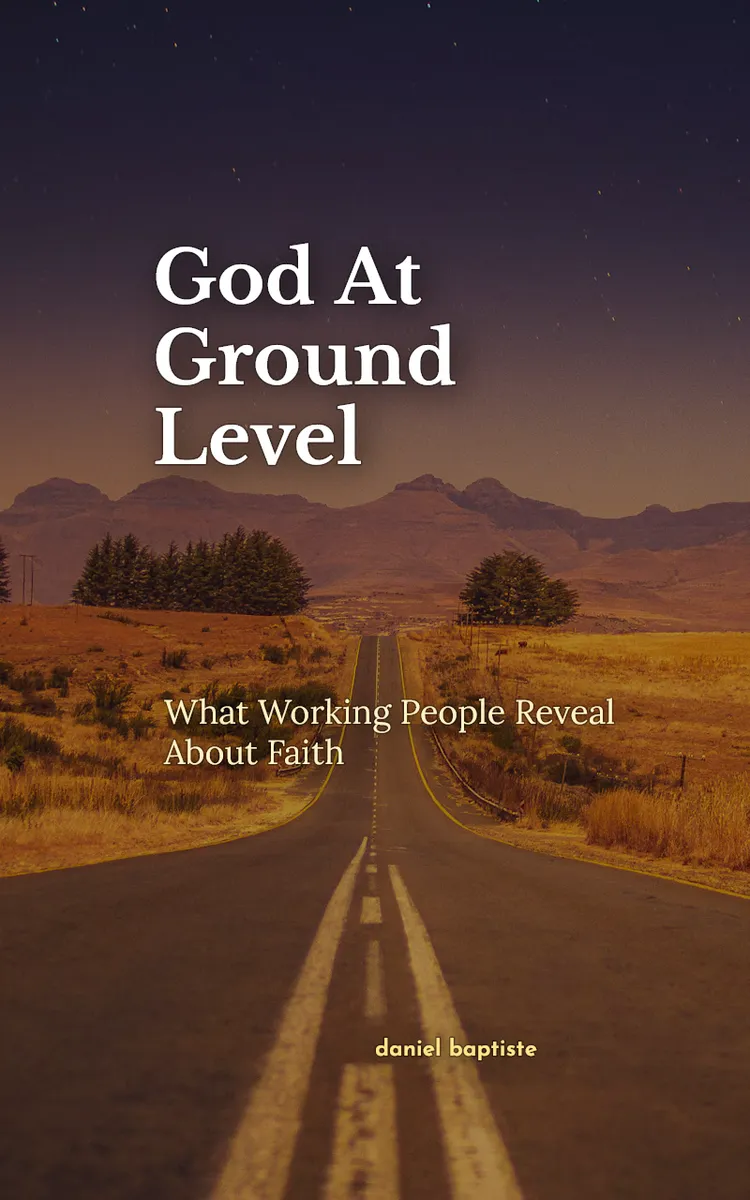
"God At Ground Level" is a curiosity book by daniel baptiste with 30 chapters and approximately 48,818 words. Lived theology and everyday faith among working-class communities worldwide.
This book was created using Inkfluence AI, an AI-powered book generation platform that helps authors write, design, and publish complete books.
Frequently Asked Questions
What is "God At Ground Level" about?
Lived theology and everyday faith among working-class communities worldwide
How many chapters are in "God At Ground Level"?
The book contains 30 chapters and approximately 48,818 words. Topics covered include The Dashboard That Becomes an Altar, What “God Willing” Means in a Deal, The Prayer Before the Monitor Beeps, When the Sea Makes God Vast, and more.
Who wrote "God At Ground Level"?
This book was written by daniel baptiste and created using Inkfluence AI, an AI book generation platform that helps authors write, design, and publish books.
Write your own curiosity book with AI
Describe your idea and Inkfluence writes the whole thing. Free to start.
Start writingCreated with Inkfluence AI


