
Read the first chapter
The whole of chapter one, free. About 7 min. Turn the pages with the arrows, your keyboard, or a swipe.
Chapter 1
The Prayer in Your Search Bar
The Search Box as a Modern Shrine
At 2:13 in the morning, someone types “God, why did this happen?” into a search bar, pauses, and deletes the sentence. The screen records nothing, yet the question belongs to a tradition older than writing itself: a private appeal directed toward an unseen power.
The modern search box is not a temple, and a search engine is not a god. Still, the act of typing a question into a blank field has an unexpected resemblance to older forms of prayer. Both begin with uncertainty, both assume that words might reach beyond the self, and both preserve a trace of a person trying to place an unmanageable experience inside language.
The difference is that ancient appeals were often pressed into clay, painted on walls, or copied onto parchment. Digital questions appear briefly, sometimes anonymously, and may vanish without a visible answer. Yet their emotional shape is familiar. Across centuries, people have asked who is listening, why suffering exists, whether the dead are safe, and whether the future can be known.
If the tools of prayer have changed, what has remained unchanged in the person who asks?
From Clay Impressions to Search Queries
The oldest written prayers do not look like modern religious devotion. They are often practical, urgent, and intensely personal. In Mesopotamia, scribes recorded appeals to gods for protection, healing, justice, or relief from misfortune. Some were written in cuneiform on clay tablets, using a reed stylus to press wedge-shaped marks into wet surfaces. The tablets were not casual notes. They were durable objects, made to survive handling, storage, and time.
One striking example is the Mesopotamian tradition of the “Prayer to Every God,” a text in which a sufferer confesses that he has offended a deity without knowing which one. The speaker does not understand the source of his punishment or even the identity of the offended god. His uncertainty is the point. The prayer gives language to a condition that remains common: something is wrong, the cause is unclear, and the person turns toward the divine because ordinary explanations have failed.
A search query such as “Why is God silent?” has a similar structure. It may contain no formal invocation, no ritual language, and no name for the deity. Yet it carries an assumption that the question belongs somewhere beyond private thought. The searcher is not merely looking for information about religion. The words may be an appeal disguised as a request for facts.
The physical form has changed from clay to glass, but the underlying movement is recognizable. A person experiences disorder, forms a question, and sends it toward a larger field of meaning.
The Private Question Finds a New Surface
Ancient prayers were not always private in the modern sense. A tablet might be commissioned by an individual but handled by a professional scribe. A written prayer could be placed in a temple, buried beneath a building, or attached to a statue representing the person who sought divine attention. In ancient Egypt, letters to the dead were written on bowls, pieces of pottery, and papyrus. These messages asked deceased relatives for help with illness, family disputes, and legal troubles.
Such objects complicate the familiar boundary between public religion and private belief. A person could address a god or ancestor in words that were intimate, but the act often depended on a social system of scribes, temples, rituals, and shared conventions. Private feeling traveled through public forms.
Online questions work in much the same way. A person may type alone, but the language available to that person comes from a vast public archive: scripture, sermons, songs, discussion boards, videos, comment sections, and inherited phrases. Even a question that feels entirely original often contains echoes of older speech. “Why have you forsaken me?” is at once a biblical phrase, a line of religious poetry, and a pattern that can reappear in an anonymous post written centuries later.
The search bar intensifies this mixture of solitude and society. It offers the privacy of a closed room while connecting the question to a shared record of human uncertainty. A query may receive an algorithmic answer, a page of scripture, a medical explanation, a stranger’s testimony, or nothing useful at all. The person asking cannot control which kind of response arrives.
That uncertainty distinguishes the search bar from a traditional prayer book. A prayer book gives the speaker an established vocabulary. A search engine gives the speaker an enormous, uneven crowd of possible vocabularies.
A single search query can function as confession, investigation, lament, and request at the same time.
The Digital Echo Map
The Digital Echo Map traces the path by which an ancient religious question reappears in modern online language. It does not claim that every search is a prayer. Instead, it follows recurring features: the direct address, the search for cause, the desire for witness, and the hope that an answer exists somewhere.
Consider the question “Why do innocent people suffer?” It appears in philosophical writing, religious commentary, courtroom speeches, private diaries, and public debates. Online, it may be entered as a short phrase with no context. The search engine strips away the questioner’s face, age, location, and history. What remains is a compact form of distress that can be matched with millions of other documents.
This is where digital language differs from a clay tablet. The tablet preserves one person’s appeal as a singular object. The search engine places one person’s words into a pattern. It does not necessarily understand sorrow, but it can identify related terms, predict completions, and return pages shaped by the behavior of other users. Private questioning is therefore pulled into a collective system.
The effect can be unsettling. A person may believe that a question belongs only to a particular night, yet the search results reveal that the same wording has been used repeatedly by people in different places and periods of life. The discovery is not proof of a shared answer. It is evidence of a shared human vocabulary.
Earlier religious cultures also gathered private appeals into recognizable forms. The Psalms, for example, preserve praise, complaint, fear, anger, and trust in a sequence that allows an individual voice to become communal speech. A lament may begin with abandonment and end without resolving the original problem. Its survival means that later readers can enter an ancient distress using their own circumstances.
Digital archives perform a rough, unstable version of this gathering. They place the isolated question beside sermons, personal essays, news reports, and other questions. The result is not a sacred book, but it can reveal the same recurring architecture: suffering becomes language, language becomes a record, and the record becomes available to strangers.
The Counterintuitive Life of an Unanswered Question
The surprising connection is that an unanswered online question may resemble an ancient prayer more closely than a religious answer does. Answers close a question into doctrine, explanation, or instruction. Questions left open preserve the original pressure of uncertainty.
This matters because the history of prayer is not only a history of beliefs. It is also a history of unresolved speech. The Mesopotamian sufferer did not know which god had been offended. The biblical lament often asks why God has hidden or remained silent. Modern online questions continue that form, even when they are addressed to no identifiable audience.
An unanswered query can therefore become a cultural artifact. It records the moment when a person reached the edge of available explanation. The words may later be deleted, buried among millions of searches, or transformed into a public post. Their value does not depend on receiving a satisfactory response. Like a prayer inscribed on a small tablet, the question testifies that someone once stood before mystery and spoke.
A Widow’s Search and the Ancient Shape of Lament
The connection becomes concrete in the online memorial culture that followed the death of Alan Kurdi, the three-year-old Syrian refugee whose body was photographed on a Turkish beach in September 2015. The image circulated globally, and alongside news reports came religious questions, private posts, and public appeals: Where was God? Why would a child die this way? What kind of world permits such suffering?
These questions were not confined to one faith or one country. They appeared in English, Arabic, Turkish, and other languages, often alongside prayers, quotations from scripture, and expressions of disbelief. Some writers addressed God directly; others questioned believers, governments, or the moral order of the world. The forms differed, but the central disturbance was shared: an innocent death had exposed the limits of ordinary explanation.
Centuries earlier, lament over the death of a child might have been written on papyrus, spoken at a grave, or preserved in a religious text. In 2015, it moved through smartphones and social platforms, where private grief could become public within minutes. The technology accelerated the circulation of the question, but it did not create the question.
The Digital Echo Map makes the continuity visible. A person sees suffering, rejects the adequacy of simple causes, and turns toward a larger moral presence - sometimes with trust, sometimes with accusation, sometimes with silence. The screen becomes the newest surface on which that appeal is made.
Human beings have never required certainty before they speak to the divine. Often, uncertainty is what produces the speech. A search bar can collect facts, but the question typed into it may be asking for something facts cannot supply: not information, but witness. Somewhere between the ancient tablet and the glowing screen, the human voice remains suspended before the same unanswered vastness.
End of chapter one. 29 more chapters and about 47,703 words in the full book.
Swipe or use the arrows to turn the page


What's inside: 30 chapters
- 1. The Prayer in Your Search Bar
- 2. Four Questions Beneath Every Age
- 3. When Disaster Changes the Prayer
- 4. Clay Tablets, Open Diaries
- 5. Why We Thank the Unseen
- 6. Bedtime Prayers Outlive Empires
- 7. The Honest Limits of Knowing
- 8. The First Gods in Written Words
- 9. When the Gods Went Silent
- 10. Greek Tragedy Puts Heaven on Trial
- 11. The Psalms Make Room for Anger
- 12. Famine Turns Bread into a Question
- 13. War Makes Every Promise Audible
- 14. Plague Prayers Name the Invisible
- 15. The Harvest Has Its Own Grammar
- 16. Confession Begins with a Pronoun
- 17. The Child Learns God’s Name
- 18. Silence Is Also a Reply
- 19. Migration Carries a Portable God
- 20. Translation Changes the Address
- 21. The Mystic’s Unspoken Question
- 22. When Doubt Joins the Conversation
- 23. The Dead Keep Asking Through Us
- 24. The End of the World, Rewritten
- 25. A Hashtag Becomes a Lament
- 26. The Algorithm Cannot Answer Why
- 27. Many Names, One Human Need
- 28. Why Answers Never Stay Final
- 29. The Whisper Becomes a Chorus
- 30. Humanity Never Ends the Conversation
About this book
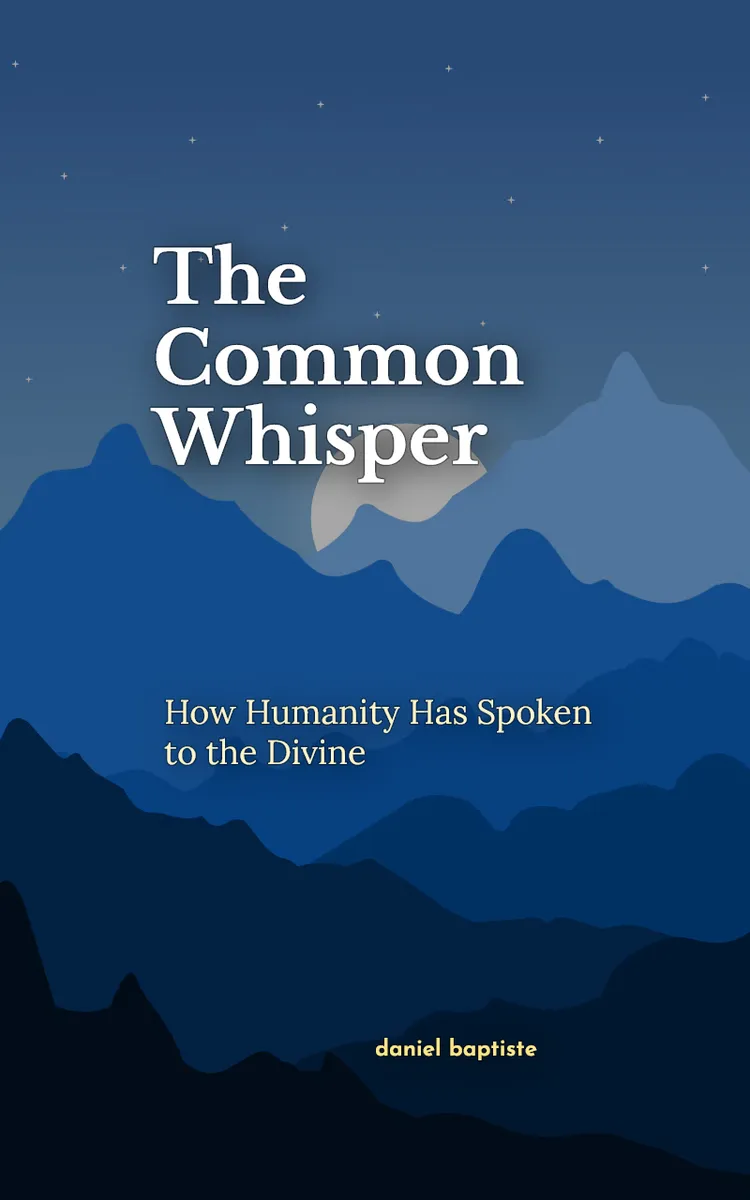
"The Common Whisper" is a curiosity book by daniel baptiste with 30 chapters and approximately 47,703 words. Recurring human questions and expressions of faith across history and cultures.
This book was created using Inkfluence AI, an AI-powered book generation platform that helps authors write, design, and publish complete books.
Frequently Asked Questions
What is "The Common Whisper" about?
Recurring human questions and expressions of faith across history and cultures
How many chapters are in "The Common Whisper"?
The book contains 30 chapters and approximately 47,703 words. Topics covered include The Prayer in Your Search Bar, Four Questions Beneath Every Age, When Disaster Changes the Prayer, Clay Tablets, Open Diaries, and more.
Who wrote "The Common Whisper"?
This book was written by daniel baptiste and created using Inkfluence AI, an AI book generation platform that helps authors write, design, and publish books.
Write your own curiosity book with AI
Describe your idea and Inkfluence writes the whole thing. Free to start.
Start writingCreated with Inkfluence AI


