
Read the first chapter
The whole of chapter one, free. About 8 min. Turn the pages with the arrows, your keyboard, or a swipe.
Chapter 1
Why a Beat Makes Strangers Move
The Moment the Room Finds One Pulse
At a concert, a crowd can begin moving together before anyone has agreed to do so. One person nods, another taps a foot, a drummer marks the beat, and within seconds hundreds of separate bodies are adjusting themselves to the same invisible grid.
The effect is so ordinary that it can seem unremarkable. Yet shared rhythm does something unusually powerful: it turns private movement into public coordination. It allows strangers to act together without exchanging instructions, and it can make cooperation feel less like a decision than a physical fact.
Rhythm is therefore more than a feature of music. It is a way bodies locate one another. It appears in rowing boats, marching grounds, work songs, religious ceremonies, hand-clapping games, and dance floors. Its force does not depend on a shared language. People may disagree about nearly everything and still recognize when a beat has begun.
The question is not simply why rhythm makes us move. It is why moving together can make other people feel, briefly, less separate.
What happens to trust when separate bodies begin keeping the same time?
The Shared Pulse Model
The Shared Pulse Model begins with a simple observation: coordinated action becomes easier when people can predict one another’s next movement. A beat supplies that prediction. It gives the body a repeating point of reference, a small promise that the next sound will arrive where expected.
This is why a steady rhythm can organize work. On a rowing boat, the stroke is not merely musical decoration; it helps several people place force into the water at the same moment. In military marching, the drum historically helped regulate pace and spacing. In factories and fields, songs have often provided a common timing for repetitive labor, especially when tools had to be lifted, pulled, struck, or turned together.
The beat does not eliminate effort. It makes effort legible. Each person can hear where their action belongs in relation to everyone else’s.
That distinction matters. A group does not become coordinated because its members have identical bodies or identical intentions. Coordination emerges because the rhythm gives difference a shared frame. A tall person and a short person, a trained dancer and an untrained one, can still clap on the same beat. Their movements remain individual, but the timing joins them.
The body is constantly making predictions about sound. When a rhythm is regular, the brain begins preparing movement before the next beat arrives. This is why listeners can tap along even when they are not consciously counting. The pulse becomes something felt in the muscles, not merely heard by the ears.
A surprising amount of social order begins this way: not with agreement, but with timing.
From Work Songs to Worship
Long before recorded music, rhythm gave communities a portable form of coordination. It required no written score, electricity, or specialized instrument. A voice, a hand, a foot, or a struck piece of wood could establish a pattern that others could join.
Work songs made this practical. In many cultures, laborers sang while rowing, harvesting, hauling, or pounding grain. The song marked the recurring shape of the task and helped distribute strain across a group. Its words might tell a story, preserve local memory, or express complaint, but its rhythm performed an immediate physical function. It told bodies when to pull.
Religious ritual added another layer. Processions, chants, clapping, drumming, and repeated phrases synchronize attention as well as movement. A congregation that sings together is not only producing a common sound; it is breathing, pausing, and beginning again in a shared pattern. The result can feel like unity even when the participants have arrived with different private concerns.
The same principle appears in secular gatherings. Stadium chants, protest songs, jump-rope rhymes, and dance music all create temporary communities through repeated timing. Their participants may never meet again. For the duration of the rhythm, however, they possess something more organized than a crowd.
A crowd is a collection of people in one place. A rhythm can make it a group.
The connection between timing and trust is partly practical. When people move together, each person receives evidence that others are attending to the same pattern. That attention is reassuring. It reduces uncertainty about what will happen next and makes cooperation less costly.
The effect can be seen in children’s games. A clapping pattern is easy to learn but difficult to perform alone as a social activity; its pleasure comes from keeping time with another person. The game teaches a small lesson in mutual expectation. My movement works because yours arrives when it should.
The Strange Social Power of Synchrony
Here is the counterintuitive finding: people can feel more connected to strangers after moving in time with them, even when the movement is simple and the interaction is brief. No deep conversation is required. Shared timing can create a sense of affiliation before anyone knows anyone’s name.
That matters because it changes where we look for the roots of social feeling. Trust is often described as something built through information - learning that another person is reliable, familiar, or similar. Rhythm suggests that trust can also begin below language, through the repeated experience of bodies matching one another.
The mechanism is not magic. Synchrony makes other people’s actions easier to predict, and predictability supports cooperation. It may also soften the boundary between self and group: when my hand rises at the same moment as yours, the event is both mine and ours.
Yet synchrony is not automatically peaceful. Marching bands, military formations, and political rallies demonstrate that coordinated movement can strengthen solidarity around exclusion as well as inclusion. The same pulse that welcomes participants can separate them from those outside it.
Digital music complicates this further. A recorded beat can synchronize thousands of listeners who occupy different rooms and time zones. Streaming platforms, headphones, and social media have made private listening feel collective without placing bodies in the same physical space. The listener may be alone, but the rhythm carries traces of a larger audience: dancers, fans, worshippers, commuters, and strangers who have all heard the same pattern.
Electronic dance music makes this division especially clear. Its bass may be generated by machines, its timing corrected by software, and its sound reproduced through speakers far from the original performance. Still, when a room responds together, the shared pulse is bodily rather than merely technical. The machine supplies regularity; people supply the collective meaning.
A Village That Keeps Time Together
One of the clearest examples comes from the Ewe communities of southeastern Ghana and nearby parts of Togo, where music and dance traditions use interlocking rhythms. In an ensemble, different players may repeat distinct patterns rather than playing the same beat. A bell marks a timeline, drums answer one another, and dancers connect the sound to specific movements.
To an outsider, the texture can seem densely layered. To participants who know the tradition, the patterns provide a map of communal timing. No single instrument contains the whole rhythm. The music exists in the relationship among parts.
That structure makes cooperation audible. Each player must maintain an individual pattern while listening for the larger cycle. The dancers do the same with their bodies, responding not only to the drum nearest them but to the ensemble’s combined pulse. The community is not represented by one voice replacing all others. It is built from separate contributions that remain distinct while fitting together.
This is a useful correction to the idea that unity means sameness. In the Ewe ensemble, coordination depends on difference. If every instrument played the same pattern, much of the music’s character would disappear. The shared pulse holds the parts together without flattening them.
Other traditions make similar principles visible in different forms. In Japanese taiko ensembles, powerful drum strokes require disciplined group timing. In West African sabar performance, rhythmic conversation allows dancers and drummers to respond to one another in real time. In Brazilian samba schools, large groups move through streets with layered percussion and choreographed motion, turning neighborhood participation into a traveling rhythmic body.
The specific sounds vary, but the social fact remains: people become a community not by erasing individual action, but by making individual action answerable to a common beat.
When the Beat Becomes Memory
Shared rhythm can also persist after the gathering ends. A song learned in childhood may return decades later with its timing intact. The words may be forgotten, yet the body remembers when to clap, pause, or enter.
This is one reason communal music can be so durable. Rhythm stores relationships in the form of expectation. A person remembers not only the melody but the moment when others joined in, the delay before a chorus, the collective breath before a final line. The memory is social because its structure was social.
In old age, familiar songs sometimes remain accessible even when other forms of recall have become difficult. Music is not a cure for memory loss, and its effects differ from person to person. But a well-known rhythm can provide a route into participation that does not depend entirely on retrieving facts or names. The body may recognize the pattern before the conscious mind can explain it.
That possibility reveals something important about music’s place in human life. A beat is not stored as sound alone. It can be tied to movement, place, faces, and shared expectation. When it returns, it may bring a group back with it.
The earliest social music may have worked in much the same way. Before instruments could be tuned or songs recorded, rhythm could still coordinate attention and action. A repeated pattern could gather a group around a task, a ritual, or a night of dancing. The technology was simple, but the social result was not.
The Community Inside the Beat
Rhythm binds people because it gives them a common future, however small. The next beat is about to arrive, and everyone listening has a chance to meet it together.
That meeting does not solve disagreement, and it does not guarantee kindness. But it creates a temporary condition in which separate bodies become mutually predictable. Music begins there: not only in sound, but in the strange discovery that another person’s timing can become part of one’s own.
A community may be held together by laws, stories, and shared places. It may also be held, for a few minutes, by the interval between two beats. And when that interval is produced by a machine, a crowd, or a human hand, the question remains open: how much of our feeling of togetherness lives in the sound, and how much waits inside the bodies answering it?
End of chapter one. 7 more chapters and about 13,435 words in the full book.
Swipe or use the arrows to turn the page


What's inside: 8 chapters
- 1. Why a Beat Makes Strangers Move
- 2. The Tune That Teaches Us to Listen
- 3. Why Teenagers Need Their Own Soundtrack
- 4. When a Song Says What Lovers Cannot
- 5. Singing Toward the Unseen
- 6. The Chorus That Makes Protest Public
- 7. How Music Carries Memory Through Loss
- 8. Can Artificial Music Make Us Feel Together?
About this book
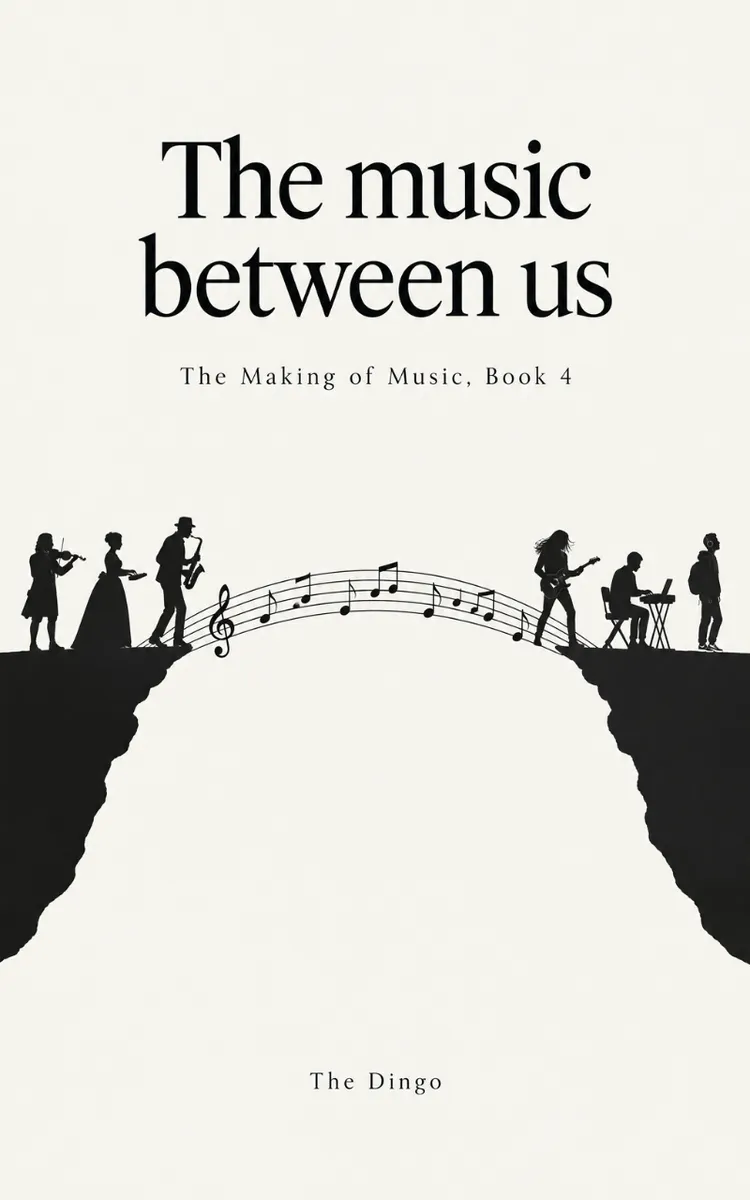
"The Music Between Us" is a curiosity book by The Dingo with 8 chapters and approximately 13,435 words. An exploration of music as communication, prayer, memory, and a force that shapes the mind from childhood through old age..
This book was created using Inkfluence AI, an AI-powered book generation platform that helps authors write, design, and publish complete books.
Frequently Asked Questions
What is "The Music Between Us" about?
An exploration of music as communication, prayer, memory, and a force that shapes the mind from childhood through old age.
How many chapters are in "The Music Between Us"?
The book contains 8 chapters and approximately 13,435 words. Topics covered include Why a Beat Makes Strangers Move, The Tune That Teaches Us to Listen, Why Teenagers Need Their Own Soundtrack, When a Song Says What Lovers Cannot, and more.
Who wrote "The Music Between Us"?
This book was written by The Dingo and created using Inkfluence AI, an AI book generation platform that helps authors write, design, and publish books.
Write your own curiosity book with AI
Describe your idea and Inkfluence writes the whole thing. Free to start.
Start writingCreated with Inkfluence AI


