
Read the first chapter
The whole of chapter one, free. About 8 min. Turn the pages with the arrows, your keyboard, or a swipe.
Chapter 1
How Birds Taught Humans to Sing
The First Borrowed Song
In the forests of Southeast Asia, male greater racket-tailed drongos imitate the calls of other birds, squirrels, and even predators. Their performances can be so convincing that other animals respond as though the original caller were nearby. Long before humans built instruments or recorded sound, nature already contained imitation precise enough to deceive an ear.
Human music began with a less exacting kind of imitation. A person heard a bird’s rising whistle, an animal’s warning cry, or the repeated pulse of feet on earth and reproduced part of it - not as a perfect copy, but as a sound selected, shortened, repeated, and remembered. Somewhere between copying and changing, a call became a phrase.
That movement is the Echo-to-Melody Path: sound is noticed, echoed by the body, shaped by memory, and eventually organized for other listeners. It does not describe a single invention or a universal timeline. It describes a pressure found wherever humans listened closely enough to turn the surrounding world into material for expression.
At what point does an imitation stop being a copy and become music?
The Ear Before the Instrument
Birdsong offered early listeners an unusually clear model because it occupied the same acoustic world as the human voice. A bird could produce a high note, hold it, bend it, repeat it, and answer another bird across distance. These qualities were available to human attention before anyone had a flute, drum, or string under deliberate control.
The resemblance between birdsong and human melody is not simply poetic. Both depend on changes in pitch, timing, loudness, and repetition. A blackbird’s phrase may rise and fall through several notes; a human voice can trace a similar contour even without matching the exact frequencies. The important feature is often the shape: upward movement, a pause, a return, a rapid cluster, or a long held tone.
Human hearing is especially alert to such patterns. The brain does not receive sound as an undivided stream. It separates events, detects repetition, and links sounds that seem to belong together. This is why a sequence of unrelated noises can become recognizable once rhythm or pitch gives it form. A bird does not need to sing a human scale for a listener to hear musical possibility in its call.
The body supplied the first copying device. Breath could lengthen a tone or break it into pulses. The tongue could interrupt airflow. The lips could narrow the opening and raise the pitch. The hands could mark a repeated beat, while the feet could reproduce the timing of a call through stamping or walking. Before sound could be stored in wood or bone, it was stored briefly in muscle and memory.
Animal calls added another lesson: sound could carry information over distance. A deer’s alarm, a wolf’s howl, or a primate’s warning call did not merely possess an appealing pitch. It indicated danger, location, invitation, or separation. When humans echoed such sounds, they may have been copying meaning as much as tone. A call could summon attention before it was detached from its original purpose and placed inside a patterned performance.
One distinction matters. There is no evidence that the earliest humans consciously thought, “This is music.” The category itself came later. What existed first were acts of listening and repetition - vocal experiments that could serve hunting, courtship, ritual, play, or social recognition. Musical intention may have emerged gradually from sounds that were useful for other reasons.
From Call to Phrase
The Echo-to-Melody Path becomes visible when a natural sound is no longer reproduced only once. Repetition changes its status. A single imitation may signal a bird or animal; a repeated imitation can become a recognizable unit, especially when its timing is altered or placed beside another sound.
A human copying a cuckoo does not need to reproduce every acoustic detail. The familiar two-note contour is enough. In many musical traditions, short phrases built from a few contrasting pitches remain powerful precisely because they are easy to remember and repeat. The sound becomes portable. It can be carried from one person to another without the original bird being present.
This portability may have mattered more than accuracy. A perfect imitation is tied to its source. A simplified one can be taught. Once a call is reduced to a manageable pattern, a group can perform it together, answer it, or attach words to it. The original sound has become a social object.
The same process appears in the imitation of animal movement. A bird’s call may be answered by a whistle; a hoofbeat may be echoed by alternating steps; the irregular bursts of a flock may be rendered through handclaps. Rhythm does not require a drum. Bodies already contain several: the heartbeat, the pace of walking, the repeated strike of work, the breath that divides a phrase.
A brief anecdote from ethnomusicology illustrates the difficulty of separating “natural” sound from “musical” sound. Among the Mbuti of the Ituri Forest, vocal music includes the dense, interwoven polyphonic singing often associated with forest life. The music does not imitate one particular bird in a simple one-to-one copy. Instead, its overlapping lines can be heard as a human response to an environment filled with layered calls, echoes, and shifting distances. The forest is not merely a subject; it is part of the listening system that makes the music intelligible.
A call becomes musical not when it loses its meaning, but when it gains additional uses. The same contour might warn of danger in one setting, identify a person in another, and serve as a ceremonial phrase somewhere else.
That extra use is the crucial turn. Music begins to separate from the immediate event while remaining grounded in it.
The Science of Borrowed Pitch
Human imitation is constrained by anatomy. A person cannot reproduce the full frequency range of a songbird, nor can the vocal folds execute every rapid change made by an animal’s larynx or syrinx. Yet listeners usually recognize a melody through relationships between notes rather than through exact acoustic duplication.
The syrinx, the sound-producing organ of birds, is unlike the human larynx. Some birds can control the two sides of it independently, producing overlapping tones that a human voice cannot match. The human advantage lies elsewhere: breath can be shaped into sustained tones, speech can attach meaning to patterns, and memory can preserve a phrase long after the source has disappeared.
Pitch itself is a physical phenomenon, but musical pitch is also a comparison. A note sounds high or low because the ear places it in relation to other notes. This helps explain why an imitation can remain recognizable after being moved into a different vocal range. A child, an adult, and a bird may produce acoustically different versions of the same contour, yet the listener hears a common design.
The surprise is that early musical imitation may have depended less on copying sounds than on copying relationships. Humans did not need to reproduce a bird’s exact frequency, volume, or speed. They needed to preserve the rise, fall, spacing, and return that made the call distinct.
This changes the story of musical origins. The first melody was not necessarily a failed attempt at natural accuracy. It may have been an intelligent abstraction: a way of extracting structure from the world and making that structure usable by human bodies. Music, in this sense, began not with a perfect echo but with selective listening.
Such selection also explains why animal calls continue to appear in human musical traditions. The imitation may be literal - a whistle shaped like a bird - or transformed into a scale, a phrase, or a rhythmic figure. What survives is often not the source’s identity but its behavior: a leap, a tremble, a repeated answer, a sudden silence.
A Community That Sings the Forest
The Mbuti provide one of the clearest real-world settings for considering how environment and imitation meet. Their traditional life in the Ituri Forest of the Democratic Republic of the Congo has long involved movement through dense vegetation, where sound can travel farther and reveal more than sight. Voices locate people across thick growth, coordinate activity, and sustain social connection when bodies are out of view.
Mbuti vocal music is frequently described through its interlocking lines, in which singers enter at different moments and create a continuously shifting texture. The effect is not a soloist reproducing a bird while others remain silent. It is collective sound shaped by a place where calls overlap, bounce, and disappear. Each singer contributes a small pattern, and the forest-like whole depends on their timing.
That distinction matters. Imitation is often imagined as an individual standing apart from nature and copying it. In this setting, the boundary is less firm. The community’s music reflects a world in which listening is shared, distance is audible, and a voice is meaningful partly because other voices answer it. The human phrase does not replace the forest’s soundscape; it joins an existing field of calls.
Birdsong also demonstrates that repetition need not mean sameness. Many birds vary their phrases according to context, season, age, and neighboring singers. Human music behaves similarly. A melody can remain identifiable while performers alter its speed, ornament, emphasis, or ending. Variation is not a defect in transmission. It is one of the ways a remembered sound stays alive.
The first instruments extended this capacity, but they did not create it from nothing. A hollow reed could preserve a pitch more reliably than the throat. A stretched hide could make a louder pulse than the hand. Bone, wood, stone, and metal gave sound a physical home. Yet the organizing intelligence had already appeared in the act of hearing a pattern, echoing it, and deciding which parts were worth keeping.
The Shape Left by an Echo
Natural sound did not hand humans finished songs. It offered models: the bird’s contour, the animal’s warning, the repeated pace of movement, the distance carried by a call. Human beings converted those models into phrases that could be remembered, shared, and changed.
The deepest surprise is that music may have begun not as an escape from nature but as a method of staying attentive to it. A melody is a controlled echo, but control does not erase the world that supplied the first shape. It preserves an impression of listening.
Every instrument that followed - whether a whistle, drum, flute, or string - continued this old exchange between body and environment. The machine-made voices of the present can generate sound without lungs, but the question they inherit is ancient: which features of a living sound make it recognizable, and which can be altered without losing its presence?
Human music began when an ear found structure in a call and a body returned it differently. The returned sound carried less of the bird than the listener’s attention - and perhaps that is why it could travel so far.
End of chapter one. 7 more chapters and about 13,286 words in the full book.
Swipe or use the arrows to turn the page


What's inside: 8 chapters
- 1. How Birds Taught Humans to Sing
- 2. Finding Rhythm in Wind and Water
- 3. Footsteps Become a Shared Beat
- 4. Breath Turns Voice into Music
- 5. Skin, Wood, and Stone Hold Rhythm
- 6. Bone and Metal Change the Sound
- 7. When Objects Became Instruments
- 8. Ritual Made Music Rememberable
About this book
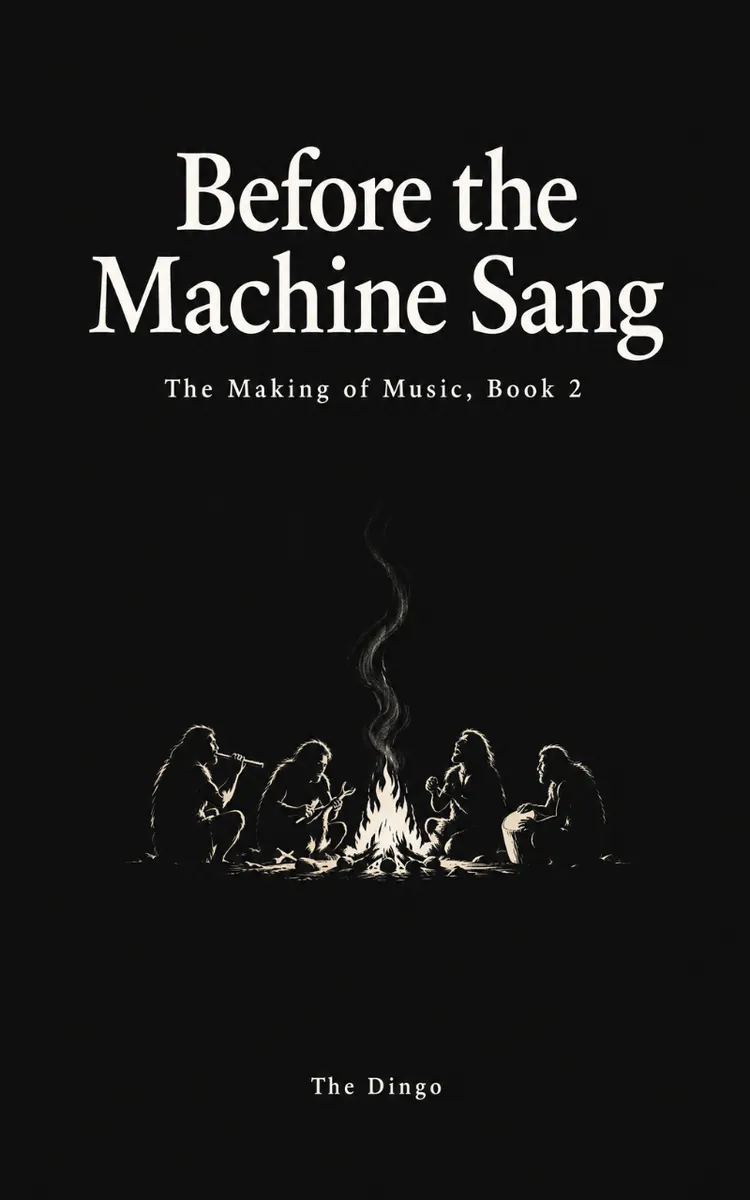
"Before the Machine Sang" is a curiosity book by The Dingo with 8 chapters and approximately 13,286 words. A journey from natural sound and early human imitation to the first instruments that gave music a physical home..
This book was created using Inkfluence AI, an AI-powered book generation platform that helps authors write, design, and publish complete books.
Frequently Asked Questions
What is "Before the Machine Sang" about?
A journey from natural sound and early human imitation to the first instruments that gave music a physical home.
How many chapters are in "Before the Machine Sang"?
The book contains 8 chapters and approximately 13,286 words. Topics covered include How Birds Taught Humans to Sing, Finding Rhythm in Wind and Water, Footsteps Become a Shared Beat, Breath Turns Voice into Music, and more.
Who wrote "Before the Machine Sang"?
This book was written by The Dingo and created using Inkfluence AI, an AI book generation platform that helps authors write, design, and publish books.
Write your own curiosity book with AI
Describe your idea and Inkfluence writes the whole thing. Free to start.
Start writingCreated with Inkfluence AI


