
Read the first chapter
The whole of chapter one, free. About 8 min. Turn the pages with the arrows, your keyboard, or a swipe.
Chapter 1
Why Old Songs Sound New Again
The Record That Refused to Stay in the Past
In 1989, a young producer named Marley Marl discovered that a tiny fragment of a drum recording could be lifted from one song and made to behave like a new instrument. The original drummer had played one performance; the sampler could repeat, cut, stretch, and rearrange it indefinitely. A recorded moment had become raw material.
That transformation changed the meaning of musical memory. A familiar bass line could return in a rap song decades later, not as a quotation in the old-fashioned sense, but as architecture. A melody could be sung again with new words, a new rhythm, and a new emotional setting. Sometimes the result sounded like conversation with the past. Sometimes it sounded like the past had been stripped for parts.
Sampling and interpolation sit at the center of that uncertainty. Both bring older music into new recordings, but they do so differently, and listeners often hear the difference before they can name it. The question is not simply whether modern music borrows. All music borrows. The more revealing question is what happens to a borrowed idea after it crosses into another song.
When does an echo become an invention, and when is it only recycling?
How a Recording Became Material
Before digital samplers, musicians borrowed from earlier music through performance. A guitarist might copy a chord progression, a singer might reshape a melody, or a band might play a familiar rhythm with different instruments. The older idea passed through human hands and changed along the way.
Sampling made the borrowing literal. A sampler could capture a short piece of recorded sound and store it as data. Producers could trigger that fragment from a keyboard, repeat it, reverse it, filter it, or place it against entirely different drums. The sound was no longer merely remembered; it was physically present inside the new track.
Hip-hop developed this practice into a musical language. Producers such as Grandmaster Flash, Afrika Bambaataa, and Marley Marl helped establish the importance of breaks: short sections of funk, soul, and jazz records that contained especially powerful drum patterns. The break from “Amen, Brother,” recorded by the Winstons in 1969, became one of the most reused drum passages in recorded music. A few seconds of performance traveled through hip-hop, jungle, drum and bass, pop, and electronic music.
The strange part is that the original performance does not become less specific when it is sampled. Its timing, room sound, imperfections, and physical force remain embedded in the fragment. Yet repetition can make it feel abstract, almost like a symbol for “drum break” rather than a performance by particular musicians in a particular studio.
A sampler therefore does two things at once. It preserves history with unusual accuracy, and it removes history from its original setting. The same snare hit can carry the warmth of an old recording while functioning inside a beat that could not have existed when the drummer played it.
Interpolation and the Borrowed Melody
Sampling uses the original recording. Interpolation borrows the underlying musical idea but records it again. A new singer may perform the melody, or a new instrumentalist may replay the bass line. The listener hears a resemblance without hearing the original tape.
The distinction matters legally, technically, and artistically. A sample usually involves permission to use the sound recording itself. An interpolation concerns the composition: the melody, harmony, or lyrics. The new performance may sound cleaner, brighter, or more contemporary, but the older structure remains underneath.
The rise of interpolation became especially visible in pop and hip-hop, where a recognizable chorus could be rebuilt inside a new song. The Verve’s “Bitter Sweet Symphony” used a newly recorded orchestral performance based on a passage associated with the Rolling Stones’ “The Last Time.” The dispute surrounding the song demonstrated how complicated musical ownership can become when a new recording resembles an older arrangement without simply copying the original master.
Another example is “Ice Ice Baby,” which used the bass-line pattern associated with Queen and David Bowie’s “Under Pressure.” The controversy was not resolved by the fact that the newer recording presented the line with a different performance. A musical pattern can be recognizable even when the sound itself has been replaced.
Interpolation can make borrowing less obvious and more intimate. A sampled voice carries the grain of the earlier singer’s throat; a replayed melody carries only the shape of the phrase. The result may feel less like a ghost in the room and more like a musician remembering something accurately enough to sing it again.
A melody is not a photograph. It is closer to a path through a landscape: the route can be retraced by someone else, but the weather, pace, and purpose may change.
The Echo-to-Invention Test
The useful distinction between homage and recycling is not whether a song contains an old idea. It is whether the new recording gives that idea a new role. The Echo-to-Invention Test asks what has changed beyond the surface: the emotional meaning, the rhythmic function, the surrounding harmony, the cultural setting, or the point of view.
An homage keeps the earlier work audible as a source while adding a clear reason for its return. Kanye West’s “Through the Wire,” built around Chaka Khan’s “Through the Fire,” is a direct example of borrowed musical material being redirected. The sped-up vocal sample creates a bright, almost weightless texture, while West’s lyrics describe his recovery after a serious car accident. The old recording is not merely decoration. Its altered pitch and speed become part of the song’s emotional tension.
Recycling works differently. It may preserve the most recognizable part of an earlier song while changing little else. The borrowed hook arrives already carrying much of its appeal. The new production can make it louder, faster, or more polished, but the listener is mainly being asked to recognize what is already familiar.
That does not make recycling automatically worthless. Popular music has always valued repetition, and recognition can be pleasurable in itself. A chorus returning from another era may connect listeners who know the source with listeners encountering it for the first time. But recognition and invention are not the same experience.
The test becomes harder when the borrowed fragment is so short that its origin is almost hidden. A producer may isolate a single vocal syllable, a guitar texture, or a fraction of a drum hit. At that scale, the source can become impossible to identify while still shaping the new track’s character. The listener hears an effect, not a quotation.
The counterintuitive point is this: the more completely a sample is transformed, the less likely it may be to sound borrowed, even though the new song still depends on the old recording. Transformation can conceal ancestry rather than erase it. What sounds original may be built from a dense archive of other people’s performances.
That changes how originality should be understood. A song need not be untouched by the past to be inventive; it must reorganize what it inherits. The important creative act may occur not in producing sound from nothing, but in deciding which old sound deserves a different future.
The Human Voice Inside the Machine
The clearest evidence of this tension appears in songs built around voices. When a producer samples James Brown, Aretha Franklin, or a gospel choir, the recording preserves more than pitch. It preserves breath, accent, timing, and the physical evidence of a body making sound. Even when chopped into syllables, a human voice can retain the pressure of the original performance.
Digital tools make those fragments unusually flexible. Pitch correction can move a note. Time-stretching can lengthen a phrase without changing its apparent tempo. Audio editors can separate consonants from vowels, place a single word on different beats, or turn a sung note into a repeating texture. The voice begins as language and ends as musical material.
This process does not necessarily diminish the singer. In some cases, it draws attention to qualities that a conventional performance would leave hidden. A breath may become percussion. A cracked note may become the emotional center of a chorus. A fragment that once passed quickly can be held in place long enough for listeners to hear its texture.
Yet the same tools can flatten a performance into a surface. When every note is corrected, aligned, and polished, the singer’s individual timing may disappear. The result can be accurate without being expressive, and clean without feeling alive.
The difference is not simply between analog warmth and digital coldness. Old recordings were edited, compressed, overdubbed, and manipulated too. The deeper issue is whether technology reveals a performance’s character or replaces character with a convenient sound.
The Bronx, the Break, and the New Song
The story of sampling becomes concrete in the South Bronx during the 1970s, where DJs developed techniques for extending the instrumental breaks in funk and soul records. At parties, DJ Kool Herc used two copies of the same record to move between identical break sections, keeping dancers inside the most energetic part of the song. The break was no longer a brief passage between verses. It became the event.
That practice helped create the conditions for hip-hop. Later DJs and producers isolated breaks, layered them, and gave them to MCs as musical ground. The songs did not simply replay older records for nostalgia. They used fragments of existing recordings to build a new social form, one shaped by turntables, neighborhood parties, competition, and the need to make limited equipment do more than it was designed to do.
The technology was modest compared with modern production software, but the underlying idea was radical: a record could be treated as a collection of usable moments rather than a fixed, complete object. Its drum break, bass line, vocal exclamation, or orchestral swell could leave the original song and enter another musical world.
That history complicates the claim that sampling is inherently parasitic. In the Bronx, borrowing was partly a response to access. New producers did not need a full band, expensive studio time, or permission from musical institutions to begin constructing something. They could work with what records already contained.
The legal and commercial systems eventually caught up. As sampling became central to successful recordings, copyright owners demanded clearance, and the cost of using recognizable material rose. Producers began replaying samples, using obscure fragments, or creating sounds that suggested older records without directly copying them. The musical practice changed because the rules around it changed.
What began as a way to extend a break became a way to rethink authorship. The person who played the original drum pattern, the DJ who isolated it, the producer who rearranged it, and the rapper who gave it new meaning all became part of the song’s history. A modern hit could therefore contain several moments of creation layered across decades.
Music has always been a conversation with the dead, but recording technology lets the dead answer back in their own voices. The question is not whether the past will return; it is how much of the present can still be heard inside the echo.
End of chapter one. 7 more chapters and about 14,893 words in the full book.
Swipe or use the arrows to turn the page


What's inside: 8 chapters
- 1. Why Old Songs Sound New Again
- 2. The Sample That Changed the Song
- 3. What Autotune Makes Us Hear
- 4. Inside the Synthetic Singer
- 5. Who Owns an AI Voice?
- 6. How Streaming Rewards Familiarity
- 7. The Human Work Machines Miss
- 8. When Music Becomes Something Else
About this book
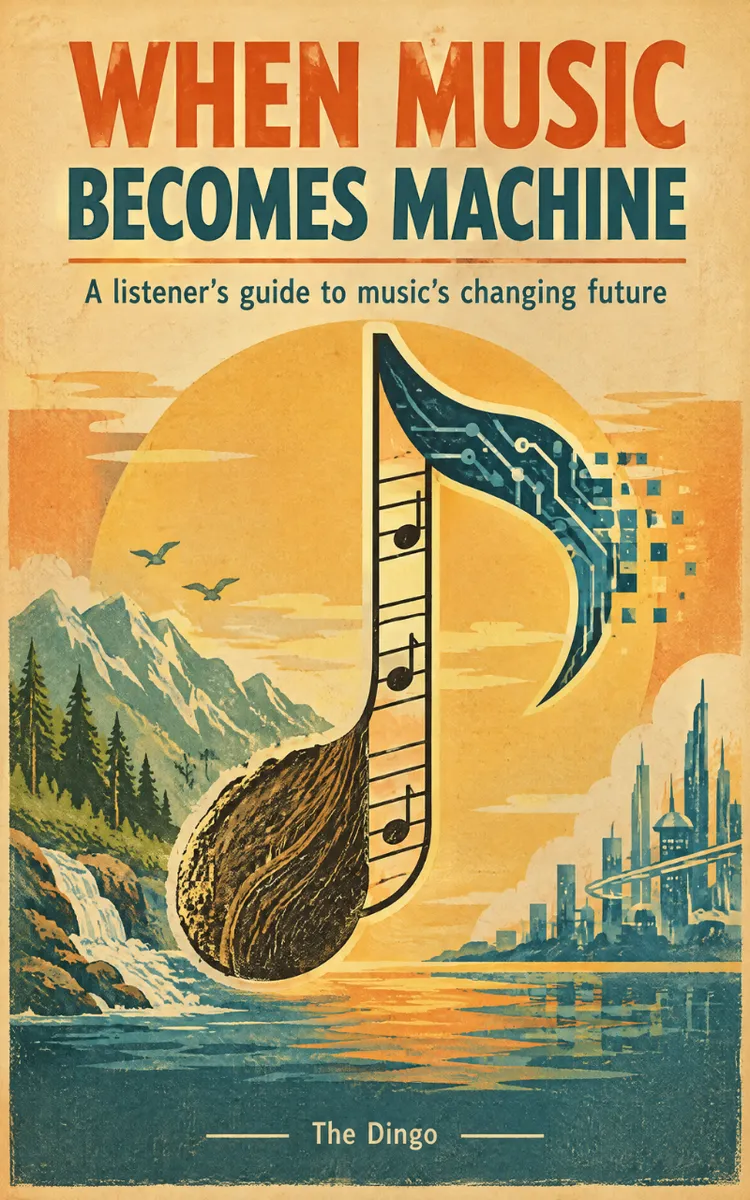
"When Music Becomes Machine" is a curiosity book by The Dingo with 8 chapters and approximately 14,893 words. How sampling, digital production, and synthetic voices are reshaping music.
This book was created using Inkfluence AI, an AI-powered book generation platform that helps authors write, design, and publish complete books.
Frequently Asked Questions
What is "When Music Becomes Machine" about?
How sampling, digital production, and synthetic voices are reshaping music
How many chapters are in "When Music Becomes Machine"?
The book contains 8 chapters and approximately 14,893 words. Topics covered include Why Old Songs Sound New Again, The Sample That Changed the Song, What Autotune Makes Us Hear, Inside the Synthetic Singer, and more.
Who wrote "When Music Becomes Machine"?
This book was written by The Dingo and created using Inkfluence AI, an AI book generation platform that helps authors write, design, and publish books.
Write your own curiosity book with AI
Describe your idea and Inkfluence writes the whole thing. Free to start.
Start writingCreated with Inkfluence AI


