
Read the first chapter
The whole of chapter one, free. About 9 min. Turn the pages with the arrows, your keyboard, or a swipe.
Chapter 1
From Clocking In to Logging On
When Being There Stopped Being the Point
At 8:57 on a Monday morning, one employee is unlocking a shop door while another is answering a customer message from a kitchen table two time zones away. Both may be working precisely when needed. Only one, however, is visibly present in the old-fashioned sense.
For much of the industrial era, punctuality and attendance were the clearest evidence of a worker’s value. The clock, the time card, and the supervisor’s glance turned effort into something that could be seen and counted. Today, a growing share of work happens through messages, shared documents, video calls, and software systems that record outcomes rather than footsteps. The question has shifted from “Were you here?” to “What moved because you were here?”
That change is not simply a story about technology. It is also a story about trust, control, and the human habit of using visible signals when the thing we really care about - useful work - is harder to observe.
When presence can be measured in minutes but contribution cannot, what exactly is the clock proving?
The Clock as a Management Tool
The modern workday was built around coordination. In a factory, a late arrival could interrupt an entire production line. In a shop, opening time mattered because customers were already waiting outside. In an office, the shared schedule made it possible for supervisors, clerks, and managers to work through the same sequence of tasks. Punctuality was not merely a personal virtue. It was part of the machinery.
The time clock made this arrangement visible. Workers punched in, punched out, and converted attendance into a record. Employers did not need to understand every movement on a factory floor to know whether someone had arrived for the shift. The record was simple, legible, and defensible. A person was present or absent; early or late; on the premises or elsewhere.
This helped create the image of the ideal employee that dominated much of the twentieth century: dependable, punctual, obedient to the schedule, and physically available when management expected. The employee who arrived ten minutes early signaled seriousness. The employee who stayed late signaled commitment. Neither signal necessarily proved that the work was good, but both were easy to see.
That distinction mattered because many jobs produced results slowly or collectively. A machinist’s contribution might become visible only after a batch was completed. An administrator might spend hours preventing a problem that never appeared. A receptionist’s value could lie in keeping a day from becoming chaotic. When output was difficult to isolate, attendance became a convenient substitute for proof.
The office inherited this logic even when the work no longer required a factory floor. Desks, fluorescent lights, and fixed hours created a shared visual field. Managers could look up and see who was working. Employees could see one another working, too. The office did not eliminate uncertainty, but it made uncertainty feel smaller.
From Desks to Devices
The first major break came when information work began to separate from a particular place. Personal computers moved tasks from filing cabinets to screens. Email replaced many paper memos. Laptops made it possible to carry documents beyond the office. Then broadband connections and cloud software allowed people to work on the same files without occupying the same room.
The change was gradual, but its consequences were not. A worker could now be physically absent while remaining connected to the work itself. A message could arrive at 6:12 in the morning, a spreadsheet could be edited from a train, and a customer issue could be resolved without anyone seeing the person who resolved it.
The COVID-19 pandemic made this arrangement impossible to ignore. Offices closed, meetings moved to video platforms, and millions of workers performed jobs from homes, spare rooms, and improvised desks. The old visual proof of work disappeared almost overnight. A manager could no longer rely on a passing glance across a room. A colleague’s availability might be represented by a green dot, a calendar status, or a reply sent from a phone.
Yet digital availability introduced its own form of attendance. The workplace did not become free of clocks; it acquired more of them. People watched inboxes, chat notifications, meeting calendars, and response times. A worker might be away from the office but never entirely away from work. The time card gave way to a trail of digital signals.
A single message can now function as both a work product and a sign of presence.
That is why flexibility has never meant simply working whenever one feels like it. In most workplaces, it means that the location and timing of work can vary while obligations remain fixed. A plumber may spend the morning moving between jobs rather than sitting in a shop, but customers still expect appointments to be kept. A gym owner may handle bookings from a phone rather than a front desk, but members still expect the doors, classes, and equipment to be ready. Flexibility changes the shape of attendance; it does not remove the need for reliability.
The Presence-to-Impact Shift
The deeper change can be understood as the Presence-to-Impact Shift. Under the older model, presence was treated as evidence of contribution. Under the newer model, contribution is increasingly judged through completed work, solved problems, satisfied customers, and decisions that move projects forward.
This shift is clearest when work is distributed. A software developer may spend a quiet morning writing code that nobody else sees until it is merged. A designer may revise one screen repeatedly before sharing it. A customer-support worker may resolve dozens of cases without speaking to a supervisor. Their work leaves traces, but not necessarily the traces managers once trusted: a full desk, a visible keyboard, or a person remaining in the building after five o’clock.
The science of attention complicates the old belief that longer visible hours mean better work. Human concentration is not a continuous beam. It rises and falls, and frequent interruptions carry a cost. The employee who appears available all day may be answering messages, switching between meetings, and losing time to the very signals that make availability visible. Meanwhile, someone working in a protected block may produce more while appearing less active.
This does not make measurement easy. Results can be delayed, shared, or difficult to assign to one person. A team may deliver a successful project because several people made small decisions at the right time. A manager who judges only what can be counted may reward speed over care, responsiveness over judgment, and constant communication over useful silence.
The most surprising part is that remote work did not eliminate surveillance; it often relocated it. Software can record login times, cursor activity, message frequency, document edits, and meeting attendance. A person may escape the supervisor’s line of sight only to enter a more detailed digital record.
That is the counterintuitive finding: the workplace that promises freedom from visible attendance can become more attentive to traces of activity than the old office ever was. The time clock has not vanished so much as multiplied into notifications, dashboards, status indicators, and activity logs.
This matters because activity and impact are not the same thing. Digital traces show that something happened, but they do not automatically show that it mattered. A fast response may be careless. A quiet afternoon may contain the decision that prevents a week of rework. Once employers treat every trace as evidence, workers learn to produce traces - messages, updates, meetings, and visible busyness - even when those signals compete with the work itself.
A City Rehearses a New Workday
The London Underground offers a clear physical record of changing work habits. For generations, rush hour concentrated office workers into trains arriving in the city at roughly the same time. The daily crowd was a public expression of the fixed workday: thousands of people moving toward desks before morning meetings and away from them after the closing hours.
During the pandemic, that pattern broke. Offices emptied, commuting collapsed, and work moved into homes. As restrictions eased, many employees did not return to the old five-day rhythm. They came in for particular meetings, collaborative work, or days chosen by their teams. The city still filled, but less predictably. The familiar peak became more uneven, with Tuesdays and Wednesdays often carrying more office traffic than the edges of the week.
The change was visible beyond the trains. Office towers had to reconsider space designed for permanent individual desks. Cafés near business districts faced quieter Mondays and Fridays. Managers had to coordinate people who might be in the same organization but not in the same place. A commuter’s absence no longer necessarily meant a day off; it could mean a full day of work performed elsewhere.
The London example shows why flexibility is not only an employee preference. It alters transport systems, commercial districts, building design, and the rhythm of cities. It also exposes the weakness of using physical presence as a universal measure. The trains could count bodies. They could not count completed reports, repaired systems, answered customers, or decisions made from home.
For a small business, the picture is more mixed. A restaurant, repair shop, salon, or gym still depends heavily on people being physically present. The customer cannot receive a haircut, a workout, or a repaired boiler through a shared document. But even these businesses increasingly combine physical service with digital work: online booking, remote scheduling, customer messages, stock systems, and payment platforms. Presence remains essential in one part of the job while becoming flexible in another.
The modern ideal employee therefore cannot be defined simply as remote or office-based. The stronger expectation is situational reliability: being physically present where the work requires it, digitally available where that is useful, and judged ultimately by whether the promised result appears.
Trust After the Time Card
The old workplace made trust visible by narrowing choice. Everyone followed the same hours, used the same entrance, and occupied the same general space. The arrangement suggested that people could be trusted because they were being observed. Modern work asks for a different kind of confidence. Employers must often trust people they cannot see, while employees must trust that their work will be recognized even when it is not performed in public.
This creates a tension that technology cannot settle. A camera can show that someone is sitting at a desk, but not whether the hour was productive. A status icon can show that a person is online, but not whether they are solving the right problem. A completed result offers stronger evidence, but it may arrive too late to reassure an anxious manager.
The ideal employee has changed because the evidence of effort has changed. Punctuality still matters, especially where customers, coworkers, or machinery depend on it. Availability still matters when a decision is urgent. But neither is sufficient on its own. The central measure is increasingly the connection between time, judgment, and consequence: what was handled, what improved, and what no longer required attention because someone dealt with it properly.
Human beings have always used visible behavior to infer invisible qualities. We see a uniform and infer professionalism; a full waiting room and infer demand; a worker at a desk and infer commitment. The strange new workplace does not remove that instinct. It gives us new objects to watch - green dots, reply times, calendar blocks - while leaving the old uncertainty intact.
Perhaps the real transformation is not from attendance to flexibility, but from one kind of visibility to another. The employee once proved reliability by appearing at the right place at the right time. Increasingly, reliability is proved by making the right thing happen, even when nobody sees the moment it happens.
A clock can tell us when someone arrived. It cannot tell us what their arrival changed. That gap between being present and having an impact is where the future of work continues to unfold, quietly, across desks, phones, workshops, trains, and the small glowing indicators that suggest someone is there.
End of chapter one. 7 more chapters and about 14,219 words in the full book.
Swipe or use the arrows to turn the page


What's inside: 8 chapters
- 1. From Clocking In to Logging On
- 2. The New Currency of Loyalty
- 3. When Obedience Stopped Looking Like Merit
- 4. The Employee Who Never Stops Learning
- 5. Team Player, Even Through a Screen
- 6. Emotional Labor Becomes Job Skill
- 7. Boundaries Are Part of Performance
- 8. Who Gets to Define Good Work?
About this book
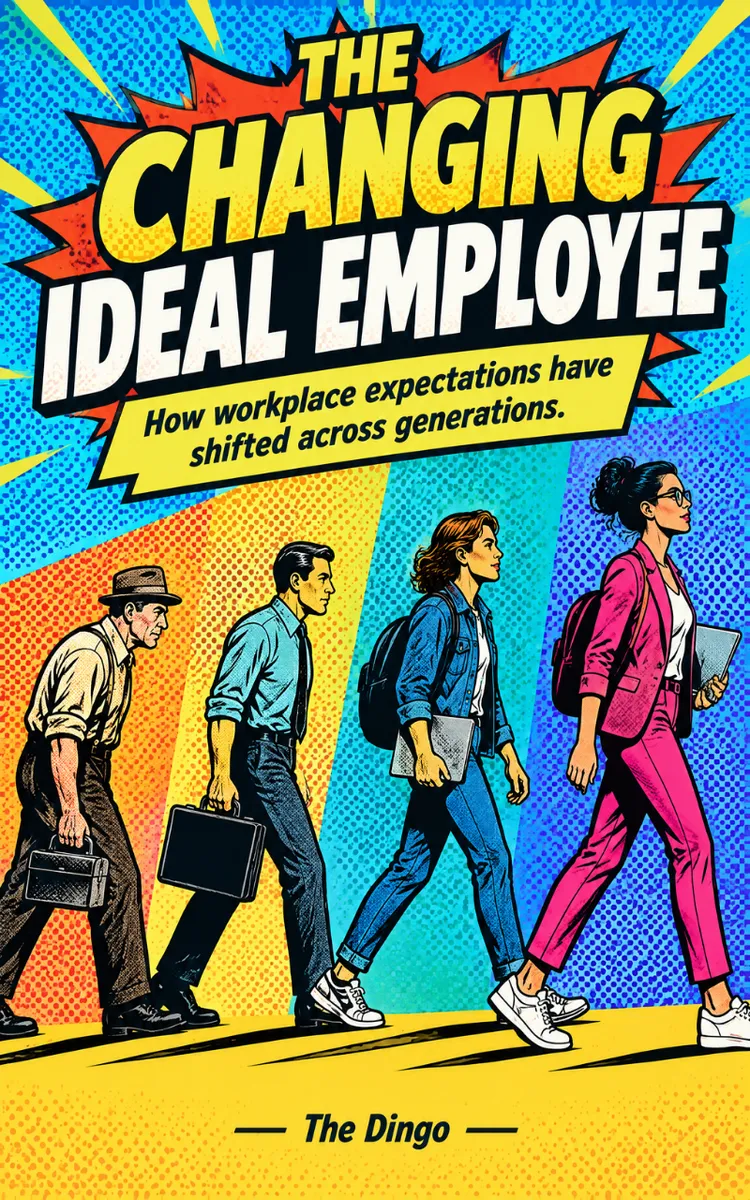
"The Changing Ideal Employee" is a curiosity book by The Dingo with 8 chapters and approximately 14,219 words. How employers’ expectations of good employees have changed over fifty years.
This book was created using Inkfluence AI, an AI-powered book generation platform that helps authors write, design, and publish complete books.
Frequently Asked Questions
What is "The Changing Ideal Employee" about?
How employers’ expectations of good employees have changed over fifty years
How many chapters are in "The Changing Ideal Employee"?
The book contains 8 chapters and approximately 14,219 words. Topics covered include From Clocking In to Logging On, The New Currency of Loyalty, When Obedience Stopped Looking Like Merit, The Employee Who Never Stops Learning, and more.
Who wrote "The Changing Ideal Employee"?
This book was written by The Dingo and created using Inkfluence AI, an AI book generation platform that helps authors write, design, and publish books.
Write your own curiosity book with AI
Describe your idea and Inkfluence writes the whole thing. Free to start.
Start writingCreated with Inkfluence AI


