

Read the first chapter
The whole of chapter one, free. About 15 min. Turn the pages with the arrows, your keyboard, or a swipe.
Chapter 1
The Double Initials
Rochester in the early 1970s was a city that made things. Kodak cameras, Xerox copiers, Bausch and Lomb lenses. Men went to work in the plants and came home at the same time every night. Kids walked to school, walked to the shops, walked to the corner store with a few coins and a list from their mothers. Nobody thought twice about it. That was what childhood looked like.
On the afternoon of Tuesday 16 November 1971, a ten-year-old girl named Carmen Colón walked into a pharmacy on West Main Street. Her grandmother had sent her to collect a prescription. Most times her grandfather, Felix, went with her, but that day Carmen had pleaded to be allowed to go on her own, and her grandparents had let her.
The prescription wasn't ready. Carmen told the owner, Jack Corbin, "I got to go. I got to go," and she left. Witnesses saw her get into a car parked close to the shop.
That was around twenty past four. Carmen was never seen alive in Rochester again.
Over the next two years, three little girls from poor families in this ordinary working city would be taken off the street, raped and strangled, and left beside country roads. Each girl's first and last names started with the same letter. Each was found in or near a town that started with that same letter. Carmen Colón in Churchville. Wanda Walkowicz in Webster. Michelle Maenza in Macedon.
The newspapers called them the Double Initial Murders. Most of the world knows them as the Alphabet Murders. More than fifty years later, nobody has ever been charged with any of them.
THE GIRL ON THE INTERSTATE
About fifty minutes after Carmen left the pharmacy, it was rush hour on Interstate 490, the expressway running west out of Rochester. Cars were nose to tail, people heading home for tea.
And there, on the side of the road, was a little girl.
Carmen was naked from the waist down. She was running away from a car that was reversing along the shoulder towards her. She was waving her arms and screaming, trying to flag somebody, anybody, down.
Scores of motorists saw her. Some later said hundreds. Not one of them stopped.
At least one driver watched as a man caught up with her and led her back to the car by the arm, and she went quietly. Then the car was gone, back into the traffic, and so was Carmen.
Witnesses couldn't even agree on what the car was. Police would end up with six different descriptions of it. One person thought it was a dark Ford Pinto hatchback. Others described something bigger and flashier. What they could agree on was the child.
Carmen's family reported her missing to the Rochester Police at ten to eight that night.
Two days later, on 18 November, two teenage boys found her body in a gully beside a quiet road in the town of Riga, close to the village of Churchville. It was about twelve miles from where she had last been seen. Her coat was lying in a culvert about three hundred feet away. Her trousers turned up nearly two weeks later, on 30 November, close to the service road where all those drivers had watched her run for her life.
The autopsy was brutal. Carmen had been raped. Her skull was fractured, and so was one of the bones in her spine. Her body was covered in scratches made by fingernails. She had been strangled by hand.
She was ten years old.
WHY DIDN'T ANYONE STOP?
Rochester was furious, and a lot of that fury landed on the drivers. How could a whole motorway full of grown adults watch a half-naked child screaming for help and keep going? It made newspapers right across America. People asked themselves what they would have done, and a lot of them didn't like the answer.
Two newspapers, the Times Union and the Democrat and Chronicle, put up a reward of $2,500 between them. Local businesses and ordinary families chipped in until it passed $6,000. A telephone hotline was set up and a postal address for anyone who wanted to send in a tip without giving their name.
Carmen was buried on 22 November 1971, after a funeral Mass attended by around two hundred people. She was laid to rest in Holy Sepulchre Cemetery.
It was the first murder in Monroe County in more than five years that police couldn't solve, and they didn't give up easily. Early in 1972, five huge billboards went up beside the city's main expressways. Each one was thirty feet wide and twelve feet high, with an eight-foot picture of Carmen's face and five words under it: Do You Know Who Killed Carmen Colón? The advertising company gave the space for free for a month.
The billboards brought in new calls. None of them went anywhere. By 21 December 1971, only a month after the murder, the number of detectives working Carmen's case full-time had already dropped to three.
THE UNCLE
There was one man police kept coming back to, and he was family.
Miguel Colón was Carmen's uncle, her father's brother. After Carmen's parents separated, Miguel had formed a relationship with her mother, Guillermina.
Just weeks before Carmen was taken, Miguel had bought a car that closely matched the one witnesses saw reversing along Interstate 490. When detectives searched it after the murder, they found it had been scrubbed inside and out. The boot had been washed with a strong cleaning solution. The dealer who sold it to him told police it hadn't been cleaned like that before he bought it.
A doll belonging to Carmen was found in the car. Her relatives said that on its own meant nothing, as she often rode in her uncle's car and could easily have left it there.
A friend of Miguel's later told investigators that, two days after Carmen died, Miguel said he was leaving the country because he had "done something wrong in Rochester." Four days after the murder, he was gone, on his way to Puerto Rico.
Detectives flew to San Juan in March 1972 to question him. But the local papers printed stories saying the Rochester police were coming, and Miguel ran. He handed himself in on 26 March and agreed to go back to Rochester to be questioned.
He couldn't give police an alibi that stood up. Nobody could be found to back up his story of where he'd been. But there was no physical evidence. Nothing at the scene tied him to it, and nothing in his car did either. He was never charged.
Miguel Colón died in 1991, aged forty-four. He shot and wounded his wife and his brother, and then he turned the gun on himself. Whatever he knew about his niece's death went with him.
Some investigators believe Carmen was killed by someone who knew her, and possibly by someone related to her. It would explain why she got into that car outside the pharmacy, and why she let herself be walked back to it on the side of the motorway. It would also mean her death might have nothing to do with what came after.
Because something did come after.
WANDA
Seventeen months later, on Monday 2 April 1973, eleven-year-old Wanda Walkowicz's mother, Joyce, sent her to the corner deli for groceries.
Wanda lived on Avenue D, on the east side of Rochester. She was a responsible girl who helped a lot at home with her younger brothers and sisters. She was also tiny for her age, just four foot seven and seventy-seven pounds.
The deli owner said Wanda bought everything on her list at about quarter past five, then set off walking home alone down Conkey Avenue. It was a big bag for a small girl. Neighbours saw her struggling with it just north of Avenue B. Three of her classmates watched her stop and lean the bag against a fence to get a better grip on it, while a brown car drove slowly past.
A man told police he saw Wanda standing at the passenger door of a large brown car, talking to the driver. He couldn't see who was behind the wheel. That spot was just two-tenths of a mile from Wanda's front door.
A woman who rang the hotline later said that sometime between half past five and six o'clock, she saw a man forcing a red-haired girl who looked like Wanda into a light-coloured Dodge Dart on Conkey Avenue.
Wanda never got home with the groceries. Joyce reported her missing at eight o'clock that night.
This time the police moved fast. Almost fifty detectives combed several square miles around the Walkowicz home, the deli and the banks of the Genesee River, where Wanda had been known to play. They found nothing.
At a quarter past ten the next morning, a police officer found her. She was lying at the bottom of a hillside beside an access road off State Route 104, near a rest area in Webster, about seven miles from Rochester. The way her body lay suggested she had been thrown from a moving car and rolled down the bank.
Wanda was fully clothed. But the autopsy showed that she had been dressed again after she died. She had been sexually assaulted and then strangled from behind with a ligature, most likely a belt. There were defensive wounds on her body. She had fought.
The medical examiner, Dr John Edland, wrote in his report: "She was such a tiny child. I don't think she was capable of putting up much of a struggle."
Her stomach held food that she wasn't known to have eaten before she disappeared. Semen was found on her body. And on her clothes there were strands of white cat hair. The Walkowicz family didn't own a white cat.
Wanda was buried on 6 April 1973, in a small white and gold casket, at Holy Sepulchre Cemetery, the same cemetery as Carmen.
A $10,000 reward was offered, and another hotline set up. In October, a local television station, WOKR, screened a thirty-minute reconstruction of Wanda's last walk home. More than two hundred people rang in afterwards. None of them led anywhere.
Remarkably, the Rochester Police Department publicly dismissed any link between Wanda and Carmen. Quietly, though, a sheriff's sergeant who had worked on Carmen's case was moved onto the Walkowicz task force.
MICHELLE
Seven months after that, on Monday 26 November 1973, eleven-year-old Michelle Maenza didn't come home from school.
Her mother, Carolyn, had left her purse in a shop at a plaza near Michelle's school earlier that day. After school, Michelle set off on her own to fetch it. Her classmates saw her walking alone towards the plaza at about twenty past three.
On the way, her uncle drove past and offered her a lift. Michelle said no thanks. Her brother Steve said years later that his uncle never forgave himself for not insisting.
About ten minutes after her classmates last saw her, a witness saw Michelle in the passenger seat of a beige or tan car, going fast along Ackerman Street before it turned onto Webster Avenue. The witness said she was crying.
At around half past four, a girl who looked like Michelle was seen at a fast-food restaurant in the town of Penfield, with a white man with dark hair. He was described as between twenty-five and thirty-five, about six foot tall and around 165 pounds.
An hour later, at half past five, a motorist on Route 350 in the town of Walworth saw a big beige or tan car pulled over on the side of the road with a flat tyre. A man was standing beside it, holding a young girl by the wrist. The motorist was certain it was Michelle. He slowed down to offer help. The man grabbed the girl, pushed her behind his back, and moved to block the number plate. Then he stared at the driver with a look so menacing that the driver put his foot down and left.
Two days later, at half past ten on the morning of 28 November, Michelle's body was found face down in a ditch beside a country road in Macedon, about fifteen miles from Rochester.
Like Wanda, she was fully clothed, and like Wanda, she had been dressed again after death. She had been beaten, raped, and strangled from behind with a ligature, possibly a thin rope. Her hand was clenched around leaves that matched the plants where she lay. That told investigators she had most likely been killed right there, in that ditch.
Once again, there were strands of white cat hair on her clothes.
The pathologist found hamburger and onions in her stomach, eaten about an hour before she died. It fitted the sighting at the fast-food restaurant. Investigators lifted a partial palm print from Michelle's neck, and semen from her body and her underwear, which came from one man.
One of the officers at the scene told reporters it was "an exact duplicate" of the place where Wanda had been found.
Michelle's funeral was held at Corpus Christi Church on 1 December 1973, with an open casket and a church full of mourners. Afterwards her father, Christopher, said to the people around him: "She was a sweet little girl. She didn't fight much."
She was buried at Holy Sepulchre too. Three girls in one cemetery, in the space of two years.
A CITY IN FEAR
By now nobody in Rochester believed in coincidence any more, least of all the police. They released a composite drawing of the man seen with Michelle, set up another dedicated hotline, offered another reward and promised anonymity to anyone who rang. The calls poured in. None of them produced a credible suspect.
Parents across upstate New York kept their daughters indoors. Families whose little girls happened to have double initials were terrified.
And when detectives laid the three cases side by side, the similarities were hard to ignore.
All three girls came from poor Catholic families. All three were small for their age. All three were described as lonely, with few friends, and had been having a hard time at school, whether through bullying or poor marks. All three disappeared on days of rain, light or heavy. All three were found close to main roads, in places a car could reach easily, and all three had been thrown or carried from a vehicle. All three had been raped and strangled.
Wanda and Michelle had both eaten food nobody could account for. Both had been dressed again after death. Both had white cat hair on their clothes.
Because the girls shared so much, investigators wondered whether the killer might have worked for, or known how things worked at, a social welfare agency. Someone like that could have found out about vulnerable children and won their trust.
Over the years, investigators questioned more than eight hundred people. Three of them stand out in the record.
THE FIREFIGHTER
Dennis Termini was a twenty-five-year-old Rochester firefighter. He was also a serial rapist. Known as the "Garage Rapist," he attacked at least fourteen teenage girls and young women between 1971 and 1973, the same years as the murders.
He drove a beige car like the one witnesses described. He lived on Bock Street, close to where Michelle Maenza was last seen.
On New Year's Day 1974, just five weeks after Michelle died, Termini tried to snatch a teenage girl at gunpoint. She wouldn't stop screaming, and he ran. Soon afterwards he grabbed another girl. This time police chased him, and when they closed in, he shot himself in the head.
When investigators went over his car, they found white cat hair on the upholstery.
For more than thirty years, many people in Rochester believed they knew who the Double Initial Killer was. Then, in January 2007, Termini's body was dug up so his DNA could be compared with the semen found on Wanda Walkowicz.
It didn't match. Dennis Termini did not kill Wanda.
Whether he killed Carmen or Michelle, nobody can say, because there is nothing left to test. Every piece of physical evidence from Carmen's and Michelle's cases has been lost or destroyed over the years. Only Wanda's evidence survives.
THE HILLSIDE STRANGLER
Kenneth Bianchi lived in Rochester when the girls were killed. At the time he worked selling ice cream, and he worked at spots close to where the first two girls were found. He drove a car of the same colour and model as one seen near one of the abductions.
In January 1976, Bianchi moved to Los Angeles. There, with his cousin Angelo Buono, he went on to commit the Hillside Strangler murders of ten girls and young women.
Bianchi has never been charged with any of the Rochester murders. He has always denied any part in them and has tried many times to have investigators formally clear him. There has never been enough evidence to charge him.
THE OTHER ALPHABET KILLER
Then, in April 2011, came a headline that sent a chill right through Rochester.
A seventy-seven-year-old man named Joseph Naso was arrested in Reno, Nevada, for murdering four women in California between 1977 and 1994. Each woman's first and last names started with the same letter. One of them was even called Carmen Colón.
Naso was a New Yorker who had lived in Rochester in the early 1970s and travelled back and forth between New York and California. For a while, authorities called him a person of interest.
But once again, the DNA didn't match what was found on Wanda. Naso was convicted of the California murders in August 2013 and sentenced to death that November. He has never been linked to the girls from Rochester.
WHERE THE CASE STANDS NOW
Fifty years on, the Double Initial Murders are still open. New York State Police still put out appeals, most often for Wanda, whose case is theirs. Rochester Police have said they remain committed to solving it.
In 2009, the Democrat and Chronicle ran a series of articles on the case. About twenty new leads came in. Every one of them was chased up. None led to an arrest.
The investigators who know the case best now believe the matching initials are almost certainly a coincidence. To pick victims by their names, a killer would have had to stalk each girl for a long time, which would make him far more likely to be seen. The FBI profiler Roy Hazelwood, who drew up a profile for the investigation, pointed to the likelihood of two separate offenders.
Many investigators think the same man probably killed Wanda and Michelle, both lured, both fed, both dressed again, both covered in white cat hair. Carmen's murder was different. She was beaten far more savagely, and she was seen running from her attacker, then walking back to him. Some believe she knew him.
If that's right, there may be two killers who got away with murdering little girls in Rochester, not one.
The best hope left is sitting in an evidence store. The semen taken from Wanda Walkowicz in 1973 still exists. So far it hasn't matched anyone. But DNA has cracked cold cases older than this one in recent years, and every time a new name is added to a database, it's one more chance.
In 1995, Carmen's mother, Guillermina, spoke publicly about her daughter's murder for the first time. She told a reporter that she had lived her whole life in poverty, but if she could have one thing before she died, it wouldn't be money.
"If I could die knowing who killed my Carmencita," she said, "I could die more peacefully than I have lived."
Rochester never forgot those three little girls. For a whole generation of parents there, the Double Initial Murders marked the end of letting children run to the shops on their own. And for everyone who ever drives past someone who needs help, the story of Carmen Colón on Interstate 490 is a hard lesson about what happens when everyone assumes someone else will stop.
Carmen, Wanda and Michelle lie in the same cemetery in Rochester. Whoever put them there was never brought to justice.
If you know anything about the murders of Carmen Colón, Wanda Walkowicz or Michelle Maenza, New York State Police can be reached on (585) 398-4100.
End of chapter one. 9 more chapters in the full book.
Swipe or use the arrows to turn the page

THE KILLER WHO TURNED CABIN 28 INTO A SLAUGHTERHOUSE

THE KILLER WHO WORE A WHITE MASK

Color My Little Pooch
What's inside: 10 chapters
- 1. The Double Initials
- 2. The Milk on the Table
- 3. Two Days Before Christmas
- 4. The Same Man
- 5. Hands Up
- 6. The Open Door
- 7. The Ring in the Rubbish Bin
- 8. Forty Minutes from the Bus
- 9. The Note in the Doughnut Box
- 10. The Boys
About this book
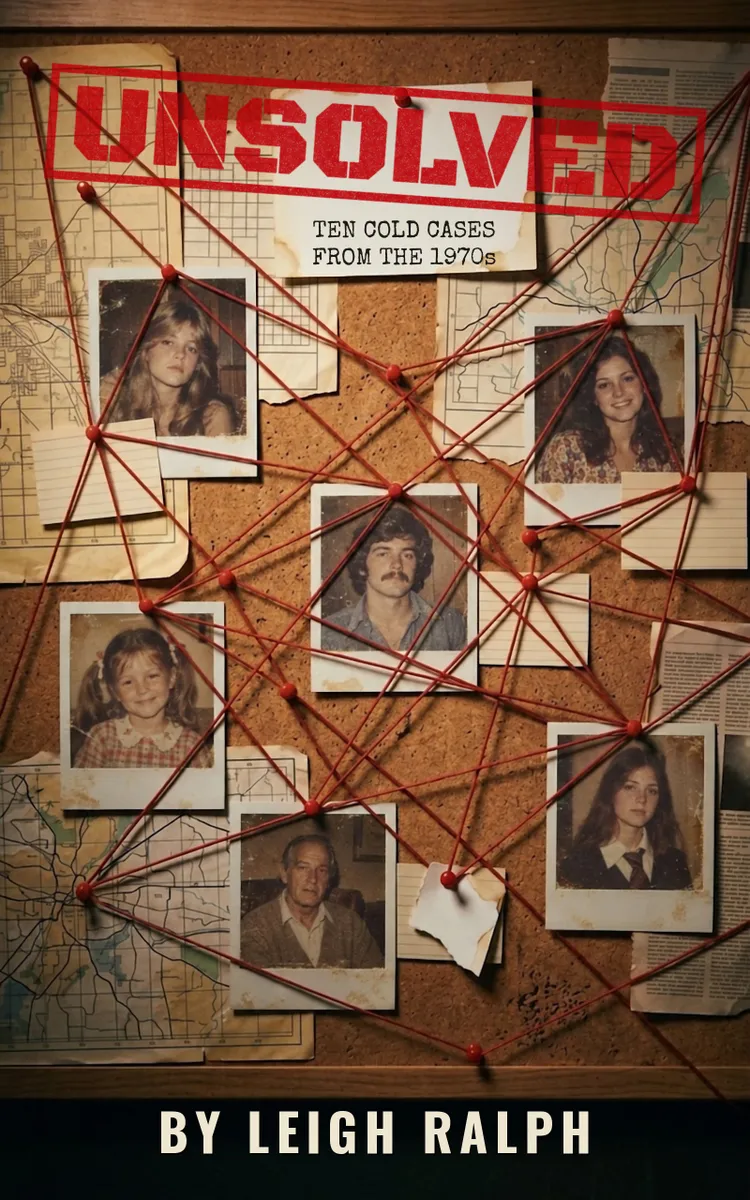
"UNSOLVED: No One Was Ever Brought to Justice" is a true crime book by Leigh Ralph with 10 chapters and approximately 19,697 words. It covers key insights and practical takeaways on the topic.
This book was created using Inkfluence AI, an AI-powered book generation platform that helps authors write, design, and publish complete books. It was made with the AI True Crime Book Writer.
Frequently Asked Questions
What is "UNSOLVED: No One Was Ever Brought to Justice" about?
"UNSOLVED: No One Was Ever Brought to Justice" is a true crime book by Leigh Ralph covering key insights and practical takeaways on the topic.
How many chapters are in "UNSOLVED: No One Was Ever Brought to Justice"?
The book contains 10 chapters and approximately 19,697 words. Topics covered include The Double Initials, The Milk on the Table, Two Days Before Christmas, The Same Man, and more.
Who wrote "UNSOLVED: No One Was Ever Brought to Justice"?
This book was written by Leigh Ralph and created using Inkfluence AI, an AI book generation platform that helps authors write, design, and publish books.
How can I create a similar true crime book?
You can create your own true crime book using Inkfluence AI. Describe your idea, choose your style, and the AI writes the full book for you. It's free to start.
Write your own true crime book with AI
Describe your idea and Inkfluence writes the whole thing. Free to start.
Start writingCreated with Inkfluence AI


