
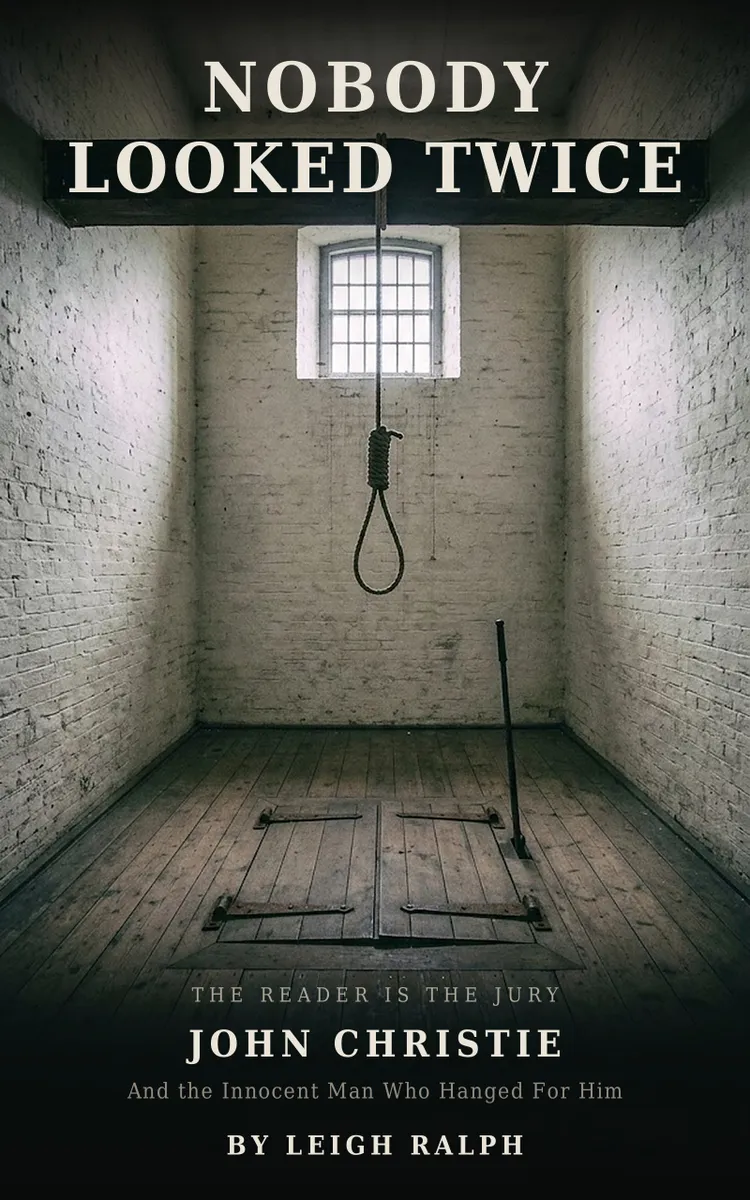

Read the first chapter
The whole of chapter one, free. About 12 min. Turn the pages with the arrows, your keyboard, or a swipe.
Chapter 1
THE LAST MORNING
They hanged him at nine o’clock in the morning on Wednesday the fifteenth of July, 1953.
By then a crowd had gathered outside the gates of Pentonville Prison in north London. Around two hundred people, waiting in the street for the notice to be posted. That was the custom. When it was done, a prison officer would come out and fix a printed sheet to the gate confirming that the sentence had been carried out, and the people who had waited would file past and read it and go home. Some of them had come for the spectacle. Some had come because of what he had done. A few, though it is impossible now to say how many, had come because of what had been done three years earlier to a man named Timothy Evans, in the same prison, on the same gallows, by the same hangman.
Inside, John Reginald Halliday Christie was fifty-four years old and had a little under an hour to live.
He had been in the condemned cell at Pentonville since the twenty-fifth of June. Three weeks, near enough. The condemned cell in an English prison of that period was not a cell in the ordinary sense. It was a room, larger than a normal cell, with two officers in it at all times, day and night, in shifts. They played cards with him. They talked to him. They watched him eat and watched him sleep and were never once out of the room, because the state had determined that a man sentenced to hang must be kept alive and in good health until the morning appointed for killing him, and that meant he could not be left alone for a minute.
The room had a door in one wall that the condemned man was not told about. It looked like a cupboard. Behind it was the execution chamber, and the drop, and the beam. The distance from the condemned cell to the noose at Pentonville was a matter of a few paces. This was considered a mercy, and by the standards of what had gone before it was one. In the previous century a man might be walked across a prison yard in front of an audience. By 1953 the whole thing took less than a minute from the moment the door opened.
Christie had been convicted of one murder.
His trial had opened at the Old Bailey on the twenty-second of June, in the same courtroom where Timothy Evans had been tried and convicted three and a half years earlier. He was charged with the murder of his wife, Ethel. That was the only charge. The bodies of six other women had by then been found at or around the house where he lived, and he had admitted killing them, but the law did not require the Crown to prove them all. One murder carried the same sentence as seven. So they tried him for Ethel and left the rest.
He pleaded not guilty by reason of insanity. His counsel was Derek Curtis-Bennett, a King’s Counsel who had defended some of the most notorious men in the country, and who found himself in the difficult position of arguing that his client was mad while his client kept calmly adding to the number of women he had killed. The Attorney-General, Sir Lionel Heald, led for the Crown. The judge was Mr Justice Finnemore.
The jury heard four days of evidence. Then they went out and came back, and the record puts the time they were absent at a little over twenty minutes. They rejected the insanity plea and found him guilty. He was sentenced to death on the twenty-fifth of June.
Four days later he let it be known that he would not appeal.
That is worth pausing on, because it is unusual and because it shaped everything that followed. A man under sentence of death in England in 1953 had a right of appeal, and beyond that a right to petition the Home Secretary for mercy. Christie used neither. He did not want to be saved. Whether that was despair, or exhaustion, or vanity, or the simple recognition that no jury on earth was going to let him live, the record does not say and he never explained it.
The Home Secretary was Sir David Maxwell Fyfe. On the thirteenth of July, two days before the date fixed for the execution, he announced that there would be no reprieve, and gave as his reason that there were no physical or psychological grounds for granting one.
There was, however, one last attempt to stop it, and it came from an unexpected direction.
A number of Members of Parliament wanted the execution postponed. Not because they thought Christie deserved to live. Because of Timothy Evans.
Three years earlier, in the same house, two people had been strangled: Beryl Evans, who was twenty, and her daughter Geraldine, who was thirteen months old. Beryl’s husband Timothy had been charged with both murders, tried for the child’s, convicted, and hanged at Pentonville on the ninth of March 1950. The principal witness against him had been his neighbour from the ground floor flat, a quiet, softly spoken, respectable-seeming man who had served in the war and who had spent four years in the uniform of the War Reserve Police. That witness was John Christie.
Now, in the summer of 1953, six more bodies had been found in and around the same address, all of them women, all of them strangled, and the quiet neighbour had admitted to killing them.
The MPs who wanted the execution delayed wanted it delayed for one reason. They wanted more time to ask Christie about Beryl and Geraldine Evans. They believed, not unreasonably, that once he was dead nobody would ever be able to ask him again.
Maxwell Fyfe refused. The execution would go ahead as scheduled.
And Christie, for his part, refused to see them. In his last days in the condemned cell he would not meet the MPs who wanted to question him. Whatever he knew about what had happened on the floor above him in November 1949, he took a good deal of it with him.
That is the shape of the thing, and it is worth being plain about it before going any further, because it is the reason this book exists.
The state of England hanged Timothy Evans in March 1950 for a murder committed at 10 Rillington Place. The state of England hanged John Christie in July 1953 for murders committed at 10 Rillington Place. Both men were hanged in the same prison. Both were hanged by the same executioner, a man named Albert Pierrepoint. It is not possible for both convictions to have been entirely sound.
Something worth knowing about Pierrepoint.
He was a Yorkshireman, as Christie was, and he was the most experienced executioner in the country. He had carried out his first hanging as principal executioner in October 1941, at Pentonville, and over the course of his career he put to death 433 men and seventeen women. He took a professional pride in speed. He believed that the humane thing was to make the whole procedure as quick as it could possibly be made, and by every account he was extraordinarily good at it. The interval between a condemned man first seeing the hangman and the drop opening beneath him could be a matter of seconds.
He had hanged Timothy Evans. Now he was to hang the man who had given evidence against him.
The mechanics were as follows, and they had been refined over the better part of a century.
The day before, the executioner would observe the condemned man without the man knowing, in order to judge his build. The drop was then calculated from his weight and physique, using a table. This mattered a great deal. The purpose of a judicial hanging as practised in England by 1953 was not strangulation but the dislocation of the neck, and the length of the fall was the whole of it. Too short a drop and the man choked slowly. Too long and he was decapitated. Both had happened in the past, and the tables and the calculations existed because of it.
The night before the execution, while the prisoner was out of the room, the gallows was tested with a sack of sand of roughly his weight, and the sack was left hanging on the rope overnight to take the stretch out of it. In the morning the trapdoors were reset and the drop adjusted a final time. The rope was coiled and secured with a piece of thread so that the noose hung at chest height and the man could not stumble into it.
The prisoner was given his own clothes to wear. This is a detail people are often surprised by, and it is true. He did not go to the gallows in prison uniform. He went in a suit.
A few seconds before nine, the executioner and his assistant came into the condemned cell. The man’s arms were pinned behind him with a leather strap. He was walked through the door in the wall, the one that had looked like a cupboard, into the chamber. He was positioned on the trapdoors. A white hood went over his head, then the noose tightened with the eyelet under the angle of the jaw. His ankles were strapped. The executioner stepped aside and pushed the lever.
It was arranged this way so that a man had almost no time in which to be frightened.
There is a story about Christie’s last minutes, and it has been repeated for seventy years, and this book will tell you exactly what it is and exactly what it is worth.
The story is that as he stood with his arms pinned, waiting, Christie complained that his nose was itching. And that Pierrepoint replied that it would not bother him for long.
It appears in a great many accounts. It is the sort of thing people remember about the case, and it has the ring of the gallows humour that grew up around the trade. But it is an anecdote that surfaced afterwards rather than anything recorded at the time, and no witness statement establishes it. It may have happened. It may have been improved in the telling, or invented outright. Where a thing cannot be shown to be true, this book will say so, and so it is said here.
What is certain is that at nine o’clock the lever was pushed, the trapdoors opened, and John Christie fell through them and died at the end of a rope in a room he had walked into a few seconds earlier.
Under the law of the time the body was left hanging for an hour. Then it was taken down, and there was an inquest, and he was buried in an unmarked grave inside the walls of Pentonville Prison, which is where the law required executed prisoners to be buried and where he remains.
Outside, they posted the notice on the gate, and the crowd of two hundred read it and dispersed.
There was very little grief. It is doubtful that anyone in England mourned him, and there is no reason why they should have. In the ten years before that morning he had killed at least eight people. He strangled every one of them. Most of them he gassed first. Several of them he interfered with while they were dying or after they were dead. He put two of them under the floorboards of his own garden and used a thigh bone to prop up a fence. He put three more in a papered-over alcove in his kitchen, sitting a few feet away from them while he ate his meals. He put his wife under the floorboards of the front room and slept above her for three months, telling the neighbours she had gone to Birmingham.
Nothing in this book will ask you to feel sorry for him.
But there is a difficulty, and it will not go away, and it is the reason the crowd outside the gates that morning was not entirely made up of people who had come to enjoy themselves.
Two weeks before Christie was hanged, the House of Commons had held a free vote on capital punishment. The chamber was crowded. The question of whether England should go on hanging people was live, and had been growing more live for some years, and the thing that was driving it was not sympathy for murderers. It was the fear of hanging the wrong man.
That fear had a name and the name was Timothy Evans. He was twenty-five years old when he died. He could barely read. Under questioning he had given the police several different accounts of what had happened to his wife and daughter, contradicting himself repeatedly, and at his trial he said plainly that Christie had done it. The prosecution invited the jury to consider how absurd it was to accuse this perfectly innocent man, meaning Christie, and the jury agreed, and Evans was convicted in a little over half an hour, and hanged.
Three years later the perfectly innocent man was found to have been strangling women in that house for a decade, including two he had put in the garden before Evans ever moved in.
The arguments about Evans went on for years afterwards. There were two official inquiries. The first, held within weeks of Christie’s arrest and reported before he was even hanged, concluded that Evans had been rightly convicted. The second, thirteen years later, reached a more complicated view: that on the balance of probability Evans had killed his wife but had not killed his daughter, which mattered enormously, because it was for the murder of his daughter that he was hanged. In October 1966 Timothy Evans was granted a posthumous free pardon.
A pardon is not the same as an acquittal, and it does not undo a hanging, and the argument about what really happened in that house in November 1949 has never been fully settled. This book will set out what is on the record and let you weigh it.
But the fact that could not be argued away, in 1953 or since, was the fact that made two hundred people stand in the street outside Pentonville that morning and made Members of Parliament try to hold up an execution nobody wanted stopped on its merits.
The state had already hanged one man over 10 Rillington Place. Now it was hanging another, and the second one had been the chief witness against the first.
Eleven years after Christie went through the trapdoors, England hanged for the last time. The following year Parliament suspended capital punishment for murder, and a few years after that abolished it outright. A good many things brought that about, and it would be too neat to lay it all at the door of one house in Notting Hill. But the Evans case was in the middle of the argument from beginning to end, and it is still cited today, and it began with a man who nobody looked at twice.
That is who this book is about.
He was, to everyone who met him, unremarkable. Balding, bespectacled, quietly spoken, thin. He suffered from an assortment of ailments and complained about them. He had been a clerk. He had worked for the Post Office. He had, for four years of the war, walked the streets of west London as a police reserve constable in uniform, with the authority of the state on his shoulder, at the very time he was strangling and burying two young women in the garden of the house he was living in.
He was a man people asked for help. That is the part that is hardest to hold on to. Women came to him because he told them he had medical knowledge and could treat their complaints, and he sat them down in his kitchen, and he was gentle with them, and they trusted him enough to let him put a mask over their faces.
Nobody looked twice at John Christie for ten years.
By the time they did, at least eight people were dead, and one more had been hanged for it.
End of chapter one. 14 more chapters in the full book.
Swipe or use the arrows to turn the page

THE KILLER WHO TURNED CABIN 28 INTO A SLAUGHTERHOUSE

THE KILLER WHO WORE A WHITE MASK

Color My Little Pooch
What's inside: 15 chapters
- 1. THE LAST MORNING
- 2. THE QUIET MAN
- 3. THE WOMEN IN THE GARDEN
- 4. THE FAMILY ABOVE THE KILLER
- 5. WHAT HE TOLD BERYL EVANS
- 6. THE WASHHOUSE
- 7. THE MAN WHO KEPT CONFESSING
- 8. THE STAR WITNESS
- 9. THEY HANGED THE WRONG MAN
- 10. UNDER THE FLOORBOARDS
- 11. THREE WOMEN BEHIND THE WALLPAPER
- 12. THE SHELF
- 13. SEVEN DAYS
- 14. EVERYTHING HE SAID
- 15. SIXTEEN YEARS TOO LATE
About this book
"NOBODY LOOKED TWICE" is a true crime book by Leigh Ralph with 15 chapters and approximately 26,830 words. It covers key insights and practical takeaways on the topic.
This book was created using Inkfluence AI, an AI-powered book generation platform that helps authors write, design, and publish complete books. It was made with the AI True Crime Book Writer.
Frequently Asked Questions
What is "NOBODY LOOKED TWICE" about?
"NOBODY LOOKED TWICE" is a true crime book by Leigh Ralph covering key insights and practical takeaways on the topic.
How many chapters are in "NOBODY LOOKED TWICE"?
The book contains 15 chapters and approximately 26,830 words. Topics covered include THE LAST MORNING, THE QUIET MAN, THE WOMEN IN THE GARDEN, THE FAMILY ABOVE THE KILLER, and more.
Who wrote "NOBODY LOOKED TWICE"?
This book was written by Leigh Ralph and created using Inkfluence AI, an AI book generation platform that helps authors write, design, and publish books.
How can I create a similar true crime book?
You can create your own true crime book using Inkfluence AI. Describe your idea, choose your style, and the AI writes the full book for you. It's free to start.
Write your own true crime book with AI
Describe your idea and Inkfluence writes the whole thing. Free to start.
Start writingCreated with Inkfluence AI


