

Read the first chapter
The whole of chapter one, free. About 18 min. Turn the pages with the arrows, your keyboard, or a swipe.
Chapter 1
God’s Design for Christian Parenting
Chapter 1
God’s Design for Christian Parenting
1) HOOK — When the House Feels Like a Battlefield
There are moments in parenting when the floor tells the whole story.
A cereal bowl tipped over. A sock stuck to something mysterious. A child crying because the blue cup is “wrong.” Another child standing there with the exact face that says, I heard you, but I’m not doing it. And you — Bible -believing, church-attending, trying-to-be-faithful you — are standing in the middle of the room wondering how something so small can expose so much in your own heart.
Not the child. You.
That’s the part nobody puts on the baby shower card.
You love your children. You would protect them with your life. You pray for them, feed them, drive them, correct them, lose sleep over them, and think about their future while folding laundry at 11:37 p.m. But then real life hits. Disrespect. Tantrums. Backtalk. Sibling conflict. Screens. Attitudes. Exhaustion. The same instruction repeated four times and still ignored.
And somewhere between “Please put your shoes on” and “I said put your shoes on,” something happens inside a parent.
The voice rises.
The jaw tightens.
The heart starts reaching for control.
I mean, let’s just be honest: most parents don’t wake up planning to parent in frustration. Nobody says, “Today I’d like to disciple my child through sarcasm and panic.” But pressure reveals patterns. The home becomes the place where our theology gets tested before breakfast.
That’s why we have to start here.
Not with techniques first.
Not with behavior charts first.
Not with a frantic search for the perfect consequence.
We start with God’s design.
Because if we get the design wrong, we’ll use authority wrongly. If we see children as interruptions, we’ll resent them. If we see them as trophies, we’ll perform through them. If we see them as projects, we’ll control them. If we see them as burdens, we’ll parent with bitterness.
But Scripture gives us a better word.
A stronger word.
A steadier word.
Children are not accidents in your house. They are not obstacles to your calling. They are not raw material for your ego.
They are a heritage from the Lord.
And that changes everything.
2) TEXT + THESIS — Scripture Before Opinion
Bible translation: NIV
Psalm 127:3 says:
“Children are a heritage from the LORD, offspring a reward from him.”
Here is the thesis for this chapter:
Christian parenting begins when we receive our children as God’s gift and raise them as God’s entrusted stewardship, discipling their hearts under His authority instead of parenting from control, fear, or drift.
That sentence matters. You may want to read it again.
Children are God’s gift.
Parenting is God’s stewardship.
Authority is God’s assignment.
Discipleship is the goal.
That is the foundation. Not your mood. Not culture’s latest advice. Not grandma’s harshest memory. Not the internet’s loudest parenting account. The Word of God stands over our opinions, our exhaustion, our family patterns, and our reactions.
Psalm 127 is not sentimental fluff. It is not a decorative verse for nursery walls. It is a theological claim about the home: children come from the Lord, belong under the Lord, and must be raised in the fear and instruction of the Lord.
So the question is not merely, “How do I get my child to behave?”
That question has a place, sure. Behavior matters. Obedience matters. Boundaries matter.
But the deeper question is this:
What has God entrusted to me, and how does He command me to steward it?
Because parenting is not ownership.
Parenting is stewardship.
You don’t own your child like property. You shepherd your child as one who will answer to God.
That’s sobering. Actually, it’s more than sobering — it’s clarifying.
You are not God in your home.
You are not powerless in your home.
You are an entrusted parent under Scripture, called to train, correct, love, model repentance, establish order, and point your child to Christ.
Not perfectly.
Faithfully.
There’s a difference.
3) STEELMAN — The Best Version of the Opposing View
Now, let’s be fair. Because sloppy Christians sometimes attack caricatures, and that helps nobody.
The common cultural view says something like this:
“Children need love, safety, emotional support, autonomy, and space to become themselves. Parents should avoid harsh authority because controlling homes can damage kids. Discipline should focus less on obedience and more on connection, emotional regulation, and self-expression. If parents are too strict, children may obey outwardly but become fearful, resentful, or dishonest inwardly.”
That is the better version of the opposing view.
And honestly? There are real concerns inside it.
Some parents have used “biblical authority” as a cover for anger. Some homes have treated obedience as silence, not heart formation. Some children have been crushed by constant criticism, shamed for normal immaturity, or disciplined in ways that had more to do with parental embarrassment than righteousness.
We should say that plainly.
Harshness is not holiness.
Control is not discipleship.
Fear is not faith.
A child who is trained only to avoid punishment may learn how to hide, not how to love what is good.
So yes, the cultural critique has a point when it warns against authoritarian parenting — the kind that says, “Do it because I said so, and don’t ask questions, and your feelings don’t matter.” That kind of parenting may produce compliance for a season, but it often misses the heart.
And soft-church culture has its own version of the problem. It reacts against harshness by drifting into passivity. It says, “Just love them,” but never defines love biblically. It says, “Give grace,” but treats grace like the absence of correction. It says, “Don’t be legalistic,” but sometimes uses that phrase to avoid training, boundaries, and repentance.
So we have two ditches.
One ditch is control without tenderness.
The other ditch is tenderness without authority.
One crushes.
The other neglects.
Neither is God’s design.
The biblical path is different: warm authority under God.
A parent is not a tyrant.
A parent is not a roommate.
A parent is a steward.
And stewardship means love with a spine.
4) RECEIPTS — Evidence, Distinctions, and Plain Logic
Let’s slow down and bring receipts — not bluster, not fear tactics, not “the world is ending because kids these days.” Just plain reasoning under Scripture.
Claim: Children must be received as gifts and raised through faithful stewardship.
That claim rests first on Scripture, but it also makes sense when you look carefully at how children are formed.
Why culture often says something different
Modern parenting advice often begins with the child’s self-expression or emotional experience as the highest priority. The mainstream assumption is that authority is dangerous unless heavily softened, negotiated, or therapeutic in tone. The soft-church version often baptizes this with language about grace and compassion, but sometimes forgets that biblical grace trains us.
Titus 2:11–12 says grace teaches us to say “No” to ungodliness. So grace is not a fog machine. Grace is a teacher.
Now, to be precise, not every secular parenting insight is wrong. That would be lazy. Many researchers and counselors have observed something Christians should already know from Scripture: children need warmth, consistency, attachment, instruction, and correction that does not humiliate them.
That’s not the enemy.
The hidden assumption we should challenge is this: that a child’s desires are self-authorizing and parental authority is mainly a threat to authenticity.
Wait, let me say that more plainly.
Our culture often assumes that if a child feels something strongly, that feeling deserves to lead. But Scripture says the heart must be shepherded, guarded, and trained. Feelings matter, but they are not king. Desires are real, but they are not Lord.
That distinction changes parenting.
Steelman reminder
Again, the strongest secular concern is legitimate: harsh, unpredictable, angry parenting can harm trust and train fear. A Christian parent should not dismiss that. In fact, Scripture got there first.
Ephesians 6:4 says:
“Fathers, do not exasperate your children; instead, bring them up in the training and instruction of the Lord.”
Colossians 3:21 says:
“Fathers, do not embitter your children, or they will become discouraged.”
So the Bible does not give parents permission to provoke, humiliate, or dominate.
But it also does not remove parental authority.
It reforms it.
Counter-evidence and logic
Here’s what is worth noticing.
Across parenting research, one of the most commonly discussed patterns is the difference between parenting that is harsh and controlling, parenting that is permissive and inconsistent, and parenting that combines warmth with clear expectations. Researchers often call that last pattern “authoritative” parenting — high warmth and clear boundaries.
I’m not saying a research category is equal to Scripture. It isn’t. Scripture is the authority. Research is limited, sometimes debated, and often shaped by worldview assumptions. But in this case, it is interesting — actually, it’s more than interesting — that careful observation often confirms what biblical wisdom already teaches.
Children generally do better with loving structure than with chaos.
They generally need both affection and boundaries.
They need to know they are loved, and they need to know someone steady is guiding the home.
Does this even make sense in daily life? Of course it does.
A child who never knows whether “no” means no will keep testing. Not because they are a monster, but because inconsistency trains testing.
A child whose parent explodes over small things learns to scan the room for danger instead of learning righteousness.
A child whose parent refuses to correct may feel temporarily free but is being abandoned to their own immaturity.
A child whose parent corrects calmly, consistently, and lovingly learns something deeper than rule-keeping: There is order. There is truth. There is forgiveness. There is a way back.
That is discipleship in miniature.
Or rather, it’s not miniature at all. It is the front line.
Important distinction: gift does not mean idol
Psalm 127:3 says children are a heritage and reward. That means we receive them with gratitude. But gift does not mean idol.
This is where some Christian parenting goes sideways. We say “children are a blessing,” then build the entire home around the child’s preferences, schedule, moods, and demands. That is not biblical parenting. That is child-centered disorder with religious language sprinkled on top.
A gift must be cherished.
A steward must be faithful.
A child must be loved.
A child must also be trained.
Those truths are not enemies.
If your child is a gift, you don’t despise them.
If your child is a stewardship, you don’t neglect discipline.
If your child belongs to the Lord, you don’t raise them as though their heart is morally neutral and their desires need no shepherding.
Proverbs 22:6 says:
“Start children off on the way they should go, and even when they are old they will not turn from it.”
That is wisdom literature, not a mechanical guarantee that removes your child’s responsibility before God. Important nuance. Parents are called to be faithful, but they cannot regenerate a child’s heart. Salvation belongs to the Lord. Still, the command stands: train them in the way.
Not the way of your ego.
Not the way of family image.
Not the way of cultural success.
The way of the Lord.
Another distinction: authority does not mean anger
Some parents hear “authority” and picture a raised voice. But volume is not authority. Anger is not authority. Intimidation is not authority.
In fact, anger often reveals that we feel our authority slipping.
Biblical authority can speak softly and still mean every word.
It can kneel beside a child and say, “I love you too much to let you hit your sister.”
It can remove the toy without a twenty-minute sermon.
It can require an apology without shaming the child’s soul.
It can say, “We obey God in this house,” and then model repentance when the parent sins too.
That last part matters. A lot.
A Christian parent does not disciple by pretending to be sinless. A Christian parent disciples by living under the same Lord they preach to their children.
So when you snap, you repent.
When you overcorrect, you repair.
When you are inconsistent, you own it.
That doesn’t weaken authority. It purifies it.
Your child needs to see that everyone in the house — parent and child — stands under God’s Word.
Not just the little people.
Everyone.
Plain logic: every home disciples
Here’s the receipt that may sting a little: every home is already discipling.
The only question is into what.
Your routines disciple.
Your tone disciples.
Your conflict style disciples.
Your screen habits disciple.
Your church attendance disciples.
Your apologies — or lack of apologies — disciple.
Your marriage patterns, your spending habits, your prayer life, your reactions to inconvenience, your comments about other people when they leave the room — all of it teaches.
There is no neutral home.
A home either drifts or trains.
A home either reacts or disciples.
A home either enthrones the mood of the moment or submits the moment to Christ.
That’s why “I’m just trying to survive” can’t become the long-term operating system. Some seasons really are survival seasons, and God gives grace there. Newborn exhaustion, grief, illness, deployment, job loss, special needs, major transitions — those are real. This is not a guilt trip for tired parents.
But even in survival seasons, the home is being shaped.
Maybe not by elaborate family devotions. Maybe not by perfect routines. Maybe only by one prayer, one apology, one consistent boundary, one Scripture spoken at bedtime.
Good.
Start there.
Faithfulness does not have to be flashy to be real.
Receipts over bluster: children are formed by repetition, relationship, correction, modeling, and worship. Scripture says it. Life confirms it. Your home proves it every week.
5) IMPLICATION — The Fork in the Road
So now we come to the fork.
And there is only one fork in this chapter.
You can receive your children as God’s gift and steward them under God’s authority.
Or you can treat them as interruptions, idols, or projects and parent from control, fear, or drift.
That is the decision.
Not perfection or failure.
Not “super spiritual parent” or “hopeless mess.”
No. That’s not the fork.
The fork is this: Will God’s Word define your parenting, or will pressure define it?
Because pressure will preach if you let it.
Exhaustion will preach.
Fear will preach.
Culture will preach.
Your childhood wounds may preach.
Your child’s attitude may preach.
But none of them gets the final word.
Scripture does.
Psalm 127:3 declares that your child is a heritage from the Lord. That means gratitude must replace resentment. Stewardship must replace control. Discipleship must replace drift.
This does not mean every moment feels sweet. Let’s not be fake. Some moments are loud. Some are embarrassing. Some leave you sitting in the driveway for thirty seconds because you need to gather yourself before walking inside.
But conviction gives you a path.
When your child disobeys, you don’t ask only, “How do I stop this behavior?”
You ask:
“What heart is being revealed?”
“What truth needs to be taught?”
“What boundary must be held?”
“What does love require right now?”
“What does God’s Word say about my response?”
That last question is where Christian parenting begins to breathe again.
Because the goal is not to raise children who merely behave when watched.
The goal is to raise children who learn to live before God.
The goal is not a quiet house at any cost.
The goal is a faithful house under Christ.
The goal is not parental control.
The goal is Spirit-shaped discipleship.
Now, will your children always respond the way you hope? No. They are moral agents. They will make choices. Some will resist. Some seasons will be harder than others. The Bible does not give parents a prosperity-style contract that says, “Do these five steps and your child will never rebel.” That is not Christianity. That is vending-machine religion.
But God does call you to faithfulness.
He calls you to plant.
To water.
To correct.
To pray.
To model.
To repent.
To keep going.
Aha — that’s the mercy here. You are not responsible to be the Messiah of your home. Christ already is.
You are responsible to be faithful under Him.
That means when the house feels like a battlefield, you don’t throw away your authority and you don’t weaponize it. You bring it under the Lord.
Firm hands.
Soft heart.
Clear words.
Quick repentance.
Steady love.
That is not weakness. That is Christian strength.
6) IDENTITY + ACTION — Who You Are in Christ and What You Do Next
Let’s speak identity carefully, biblically, and without hype.
If you are in Christ, you are not a doomed parent.
You are not disqualified because yesterday got messy.
You are not the sum of your sharpest moment.
You are not powerless against generational patterns.
You are not called to perform perfection.
You are a parent under grace.
You are a steward under Scripture.
You are a disciple raising disciples.
You are entrusted, not abandoned.
You are corrected by God because you are loved by God.
You are invited to repent quickly and lead steadily.
You are not parenting for applause.
You are parenting before the Lord.
That identity matters on Monday morning.
Not just during a conference. Not just during a Sunday sermon. Monday morning, when somebody refuses breakfast, somebody can’t find shoes, and your coffee has become a cold witness against you.
In practice, here is your action.
Your Monday Morning Stewardship Routine
Before your child wakes up — or if that ship has sailed, before the first correction of the day — take five minutes.
Set a timer if you need to. Don’t overcomplicate it.
Minute 1: Receive
Pray Psalm 127:3 back to God:
“Lord, my child is a heritage from You. Help me receive them with gratitude today.”
Name your child or children out loud.
Not as problems.
As gifts.
Minute 2: Surrender
Say:
“Father, they belong to You before they belong to me. My authority is under Your authority.”
This protects you from control. Actually, it protects the whole house from control.
Minute 3: Prepare
Ask:
“What is the most likely pressure point today?”
Bedtime? Screens? Sibling conflict? Morning routine? Homework? Attitude?
Name one.
Just one.
Minute 4: Plan one sentence
Write or speak one calm correction sentence before the moment comes.
Examples:
• “You may be upset, but you may not speak disrespectfully.”
• “We obey the first time because God calls us to honor authority.”
• “I love you, and I will help you do what is right.”
• “That choice has a consequence, and restoration is still available.”
• “We are going to pause, pray, and try again.”
The point is not to sound impressive. The point is to be ready.
Prepared parents are usually calmer parents.
Minute 5: Ask for wisdom
Pray James 1:5 in plain language:
“God, You give wisdom generously. Give me wisdom for the next hard moment.”
Then move into the day.
Not as a vibe merchant.
As a courier of the Word.
Not as a perfect parent.
As a faithful steward.
And if the morning falls apart anyway? Well, welcome to actual parenting. Return to the routine at lunch. Or in the car. Or outside the bedroom door before bedtime.
The goal is not never falling short.
The goal is returning to the Lord faster.
7) INVITATION — Decide With Hope, Not Shame
So here is the invitation.
Receive your child again.
Not as an inconvenience.
Not as a trophy.
Not as a report card on your worth.
Receive your child as a heritage from the Lord.
And receive your assignment again.
Not as a crushing burden.
Not as a demand to control outcomes.
Not as a perfectionism trap dressed up like holiness.
Receive parenting as stewardship under grace.
Maybe you need to repent today. Not dramatically. Not with self-hatred. Just honestly.
“Lord, I’ve treated my child like an interruption.”
“Lord, I’ve used anger and called it authority.”
“Lord, I’ve avoided correction and called it grace.”
“Lord, I’ve parented from fear instead of faith.”
That prayer is not the end of your authority. It may be the beginning of clean authority.
Because the gospel does not shame weary parents away from God. The gospel brings weary parents back to God.
Christ is not standing over repentant parents with contempt. He is Lord, and He is merciful. He tells the truth about sin, and He gives grace for obedience.
So choose the better road.
Gift, not resentment.
Stewardship, not control.
Discipleship, not drift.
Scripture, not pressure.
You don’t have to fix the next eighteen years today.
You have to obey God in the next moment.
That’s where faithfulness starts.
At the sink.
In the hallway.
Beside the crib.
At the bedroom door.
In the minivan.
At the table with the spilled cereal and the child who still needs your steady love.
Lift your eyes. God has not made a mistake in entrusting this child to your care. And He has not left you to do it alone.
Parent under His Word.
Walk in His grace.
Begin again today.
Pulpit clarity in the argument. Fellow-traveler warmth in the invitation.
Champion cadence. Courier of the Word. No prosperity receipt required.
Challenge the priesthood of the textbook. Bring receipts or don’t swing.
Practice for Today
• Gift and Stewardship Sentence Write one sentence with two parts: “My child is a gift from the Lord, and I am responsible to steward their heart under His authority.”
• Five-Minute Prayer Reset Set a timer for five minutes. Pray Psalm 127:3 back to God. Name your child. Thank God for them. Ask for wisdom for one specific pressure point.
• One Prepared Correction Choose one recurring struggle — bedtime, screens, disrespect, lying, whining, sibling conflict. Write one calm, biblical correction sentence you will use the next time it happens.
• Parent Heart Check Ask yourself: “Am I more tempted toward control or drift?” Write one honest answer. No shame. Just truth.
Closing Prayer
Father, thank You for the children You have entrusted to me. Your Word says they are a heritage from You, and I receive them again with gratitude. Forgive me for the times I have parented from anger, fear, control, or passivity. Teach me to steward their hearts under Your authority.
Give me wisdom for the next hard moment. Make my correction steady, my words truthful, my tone loving, and my repentance quick. Help my home become a place where Your Word is honored, obedience is taught, grace is practiced, and Christ is seen in ordinary moments.
I cannot parent faithfully without You. Lead me today. In Jesus ’ name, amen.
Dig Deeper — Receipts for the Road
• Psalm 127:3 teaches that children are a gift from the Lord, not possessions or interruptions. Begin with gratitude.
• Ephesians 6:4 shows that biblical authority must not provoke or crush children. Discipline must be shaped by the Lord’s instruction.
• Colossians 3:21 warns parents against embittering children. Harshness can discourage the heart you are called to shepherd.
• Proverbs 22:6 supports intentional training, while reminding us that parenting is wisdom-shaped faithfulness, not a mechanical guarantee.
• Parenting observation and research often distinguish harsh control, permissive drift, and warm structured authority. Scripture remains the authority, but this pattern confirms a plain truth: children need love, consistency, correction, and a steady model to follow.
End of chapter one. 14 more chapters in the full book.
Swipe or use the arrows to turn the page

Christian Faith Healing And The Power Of Miracles

The Overthinker’s 90-Day Prayer Journal

The Empty Nester's Next-Chapter Devotional
What's inside: 15 chapters
- 1. God’s Design for Christian Parenting
- 2. Building Your Home on God’s Word
- 3. Becoming the Parent God Is Forming You to Be
- 4. Discipline with Love, Wisdom, and Consistency
- 5. Reaching the Heart of a Misbehaving Child
- 6. Teaching Obedience Without Crushing the Spirit
- 7. Prayer Strategies for Parents
- 8. Raising Children with Faith, Courage, and Character
- 9. Handling Anger, Tantrums, Defiance, and Strong Emotions
- 10. Screens, Culture, Friends, and Worldly Influence
- 11. Speaking Life Over Your Child
- 12. Family Worship, Devotions, and Spiritual Habits
- 13. Parenting Through Hard Seasons
- 14. Preparing Children to Follow Christ for Life
- 15. A 365-Day Christian Parenting Devotional Journey
About this book
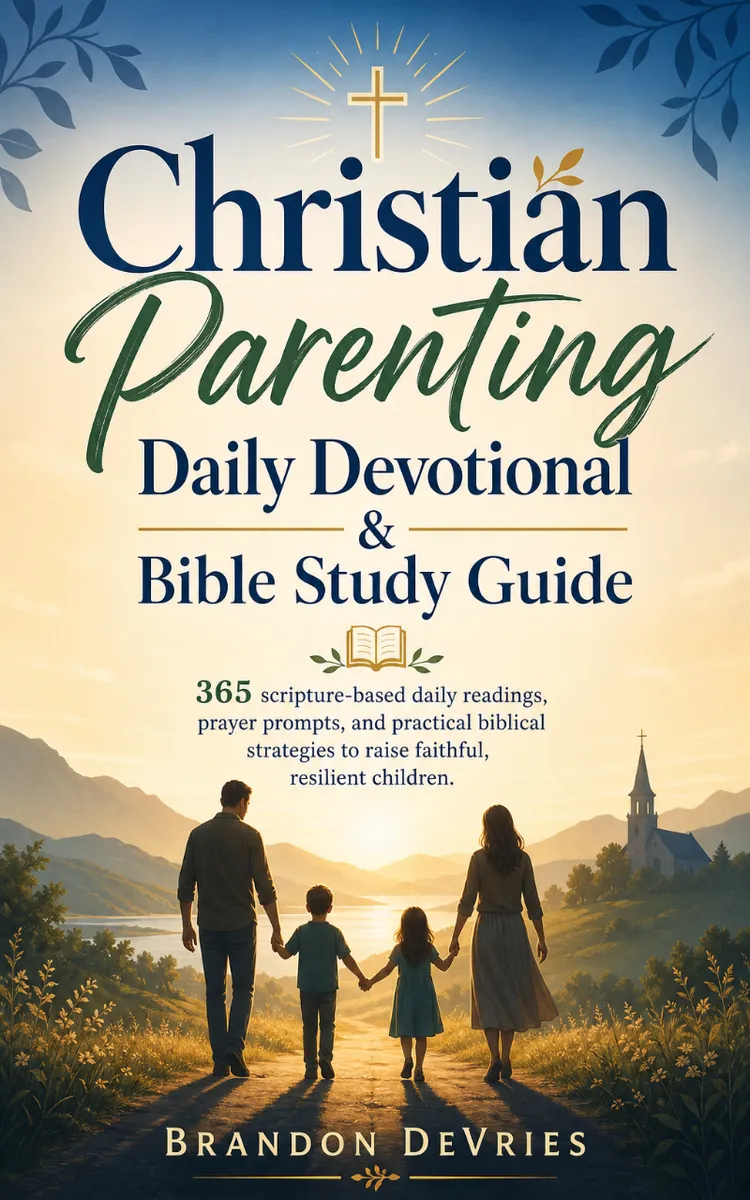
"Christian Parenting Daily Devotional & Bible Study Guide" is a religious devotional book by Brandon DeVries with 15 chapters and approximately 53,171 words. Christian parenting devotional and Bible study for discipling children.
This book was created using Inkfluence AI, an AI-powered book generation platform that helps authors write, design, and publish complete books.
Frequently Asked Questions
What is "Christian Parenting Daily Devotional & Bible Study Guide" about?
Christian parenting devotional and Bible study for discipling children
How many chapters are in "Christian Parenting Daily Devotional & Bible Study Guide"?
The book contains 15 chapters and approximately 53,171 words. Topics covered include God’s Design for Christian Parenting, Building Your Home on God’s Word, Becoming the Parent God Is Forming You to Be, Discipline with Love, Wisdom, and Consistency, and more.
Who wrote "Christian Parenting Daily Devotional & Bible Study Guide"?
This book was written by Brandon DeVries and created using Inkfluence AI, an AI book generation platform that helps authors write, design, and publish books.
Write your own religious devotional book with AI
Describe your idea and Inkfluence writes the whole thing. Free to start.
Start writingCreated with Inkfluence AI


