
Read the first chapter
The whole of chapter one, free. About 9 min. Turn the pages with the arrows, your keyboard, or a swipe.
Chapter 1
Diagnosing Burnout’s Three-Part Pattern
Burnout doesn’t usually announce itself with a dramatic explosion - it creeps in through the same daily cracks you’ve learned to ignore.
Picture Tanya, a 7th-grade ELA teacher, walking in with her usual “I’ve got this” face. She’s graded enough to feel responsible, planned enough to feel safe, and smiled enough to keep the peace. But by third period, her brain feels like it’s wading through wet cement. She snaps at a student over something small, then spends the rest of the day pretending she didn’t. At home, she doesn’t even relax - she just replays her worst moments like a highlight reel she never asked for.
Then the weekend hits. She tells herself she’ll catch up. She opens her laptop, sees the same pile - essays, missing work, parent emails - and her stomach tightens like she’s about to get graded, too. She can’t tell if she’s tired, overwhelmed, or just… done. And because she still shows up, she starts blaming herself: If I were stronger, I wouldn’t feel this way. Sound familiar?
• Key idea 1: Burnout has a repeatable pattern, not just “stress.” - Key idea 2: Normal fatigue recovers; burnout tends to harden. - Key idea 3: You can name what’s happening with a simple self-administered screen. - Key idea 4: Once you see the pattern, you can stop treating the symptoms like the problem.
The Pattern: The Triad Lens Burnout Screen in Real Life
Tanya’s week doesn’t just feel busy - it feels personal. Emotional exhaustion shows up first, not as vague “I’m tired,” but as this specific drain: she can’t summon the same patience during hallway transitions, and conversations that used to feel energizing now feel like work she can’t set down. She’s physically present, but mentally she’s shrinking. The weird part is how quickly it happens. Give her a full day of instruction and she’s spent. Give her one extra task - one - like a last-minute grade update or a parent follow-up, and she feels like she’s drowning in a bathtub.
Then comes depersonalization, which is the burnout piece people hate admitting. It looks like “I don’t care,” but it’s usually more like “I’m done trying.” Tanya starts thinking in blunt shortcuts: They’ll never turn it in anyway. He’s just going to argue. She’s not becoming a villain overnight - she’s protecting herself by emotionally checking out. And under that, reduced personal accomplishment quietly rots her confidence. She grades, she teaches, she tries - and still, she can’t feel proud. Progress feels invisible, even when students improve. She leaves school with the sense that nothing she does truly lands.
So… do you recognize that shift - from tired to numb, from caring to bracing, from “I’m making a difference” to “it’s not working” - in yourself?
A New Perspective: What if your “bad attitude” is your burnout’s job description?
Here’s the provocative question most teachers never ask: What if the way you’re thinking is not a character flaw, but burnout doing its pattern-matching work? Not “you’re failing.” Not “you need a mindset reset.” Just… what if your brain is trying to survive a load that’s too heavy for too long?
When burnout is active, the Triad Lens Burnout Screen has a rhythm. Emotional exhaustion is your system running low and still getting asked to perform. Depersonalization is your mind putting distance between you and the emotional demands, because closeness hurts. Reduced personal accomplishment is the part that steals meaning, so even effort doesn’t feel effective. Together, they make teaching feel like you’re functioning instead of connecting - and that’s why it’s so hard to explain to anyone who hasn’t lived it.
Let’s use Tanya’s before-and-after to make it concrete. Before, she would say, “I’m just overwhelmed. I need to work smarter.” She’d try to push harder: plan longer, grade faster, answer more emails. But the more she pushed, the more she snapped and the more she felt numb. After she finally named the triad pattern, her language changed. She didn’t say, “I’m a bad teacher.” She said, “My exhaustion is spiking, my patience is shutting down, and I can’t feel impact right now.” That one shift didn’t magically erase her workload - but it stopped her from treating burnout like a personal defect. It became something she could diagnose and respond to.
Because here’s the truth: fatigue can be fixed by rest. Burnout is a pattern that keeps intensifying unless you change something essential about how you carry the load.
Breaking It Down: The Cause-Effect Chains (and the Better One)
Your burnout pattern isn’t random. It moves like this - especially on the weeks when you feel “fine” until you’re not.
1. When you hit repeated emotional demands (constant redirections, tense conversations, daily stress with no real decompression) 2. You feel emotional exhaustion first - your patience gets thinner, your mind stops cooperating, and your body feels heavy. 3. So you start guarding yourself: shorter responses, less engagement, fewer attempts to reach students. 4. Which leads to depersonalization - your thoughts get sharper, colder, or flat (“I can’t do this again,” “they don’t care,” “whatever”).
Then the last piece joins in:
• When depersonalization becomes your default coping, you stop seeing yourself as effective. - You feel reduced personal accomplishment - effort doesn’t translate into pride. - So you keep working while believing it won’t matter. - Which leads to even more exhaustion and a tighter grip on the triad.
Now here’s the alternative chain - starting with diagnosis, not punishment:
1. When you notice the early warning signs (“I’m running out of patience,” “I’m getting snappy,” “I can’t feel impact after I teach”) 2. You pause long enough to name the triad using the Triad Lens Burnout Screen (exhaustion → depersonalization → reduced accomplishment) instead of labeling yourself. 3. So you choose one small recovery move that matches the part that’s flaring (not a random “be positive” fix). 4. Which leads to the pattern loosening - your brain stops escalating and you regain a little sense of control and meaning.
Burnout is not just stress - it’s a triad pattern you can diagnose.
Check In With Yourself: Rate the Triad Lens Burnout Screen
This is your self-administered stress audit. No clinical jargon needed - just honest answers that tell you what’s driving your week. Rate each item from 1 to 10, where 1 = not happening and 10 = happening a lot.
1. Emotional exhaustion: How often this week did you feel emotionally drained by the end of the day, like you had nothing left for students, colleagues, or even your own thoughts? - If you’re scoring high here, your system is running low - rest alone may not fix it if the load stays the same. If it’s low, your burnout may be driven more by meaning or distance.
2. Depersonalization: How often did you catch yourself mentally distancing from students (less empathy, more irritation, “whatever” thoughts, emotionally flat responses)? - High scores here usually mean your mind is protecting you by disconnecting. That’s not “you being mean” - it’s your brain trying to reduce emotional input. Low scores suggest you may be suffering without the distancing piece.
3. Reduced personal accomplishment: How often did you finish the day thinking, “Nothing I did mattered,” or “I’m not making a difference,” even when you know you worked hard? - High scores here point to meaning collapse. Even good effort won’t feel rewarding, which keeps burnout fed. Lower scores suggest you’re still landing some impact.
4. Pattern intensity check: If you had to name the dominant feeling right now - exhaustion, numb distance, or meaning loss - which one is loudest? (Choose one.) - If you can clearly pick one, you’ll know what to target first. If it’s a blend, it usually means the triad is already interacting, so you’ll want to diagnose quickly and act immediately rather than “wait it out.”
Interpretation guide (quick and real): - If exhaustion is your highest score, you’re likely in the early triad stage - your body is protesting before your heart fully checks out. - If depersonalization is highest, your burnout is already using emotional shutdown as a tool. - If reduced accomplishment is highest, your biggest problem isn’t effort - it’s meaning, and that requires different attention than “work harder” does.
And if two categories are high, that’s your signal: this isn’t just a bad week. It’s the triad pattern setting a rhythm.
Take Action: The 3-Step Triad Lens Burnout Screen Challenge (15 minutes)
You don’t need a perfect plan. You need a clear name and one small response that matches the name. Try this today - no cost, no equipment, no dramatic life overhaul.
Triad Lens Burnout Screen Reset
1. Set a 5-minute timer and write your “dominant triad” sentence. - Example format: “Right now, my burnout is mostly showing up as, because.” - Difficulty: Easy - You’ll know it’s working when: your sentence feels specific enough that you could explain it to someone without defending yourself.
2. Do a 7-minute “evidence dump” for that triad piece. - List 3 moments from the last 5 school days that match your dominant triad (one sentence each). - Difficulty: Easy - You’ll know it’s working when: you stop arguing with your feelings and start recognizing the pattern in real moments.
3. Choose ONE micro-recovery move that targets the matching triad part - do it within 3 minutes. - If it’s exhaustion: drink water and eat something with protein (even a yogurt or nuts), then do 60 seconds of slow breathing. - If it’s depersonalization: write one student-specific “human fact” (a short detail you actually know) and let yourself remember it for 30 seconds. - If it’s reduced accomplishment: pick one concrete win from the evidence dump and phrase it as impact (“I helped _ by _”). - Difficulty: Medium - You’ll know it’s working when: your body eases even slightly and you can feel a tiny shift from “I’m failing” to “I’m diagnosing.”
If you do these steps and nothing changes at school tomorrow, that’s okay. The point is to stop treating burnout like a mystery you have to survive. You’re learning to name it - and naming is how you start taking the power back.
What You Now Know: Your burnout has a map, not a moral
You’re not broken - you’re pattern-informed. Once you learn the Triad Lens Burnout Screen, the chaos starts to organize itself. You stop asking, “What’s wrong with me?” and start asking, “Which part of the triad is driving this week?”
Here’s the core you should leave with:
• Emotional exhaustion is your system running low and still being asked to perform. - Depersonalization is your mind creating distance to reduce emotional pain. - Reduced personal accomplishment is where meaning collapses, so effort stops feeling effective. - Normal fatigue feels temporary; the triad feels like it keeps tightening unless you diagnose and respond.
So the next time you feel yourself getting colder, flatter, or more hopeless - before you blame your character - can you pause and ask which triad piece is speaking the loudest? That question is the bridge to the next chapter, where we’ll turn this diagnosis into a baseline you can track, so you can see recovery happening instead of hoping it will.
End of chapter one. 6 more chapters in the full book.
Swipe or use the arrows to turn the page


What's inside: 7 chapters
- 1. Diagnosing Burnout’s Three-Part Pattern
- 2. Mapping Your Stress Triggers and Drains
- 3. Breaking the Good-Teacher Martyr Loop
- 4. Batch Grading and Template Planning System
- 5. Saying No With Bulletproof Scripts
- 6. Nervous-System Reset for Standing Teachers
- 7. Your Five-Year Career Joy Sustainability Plan
About this book
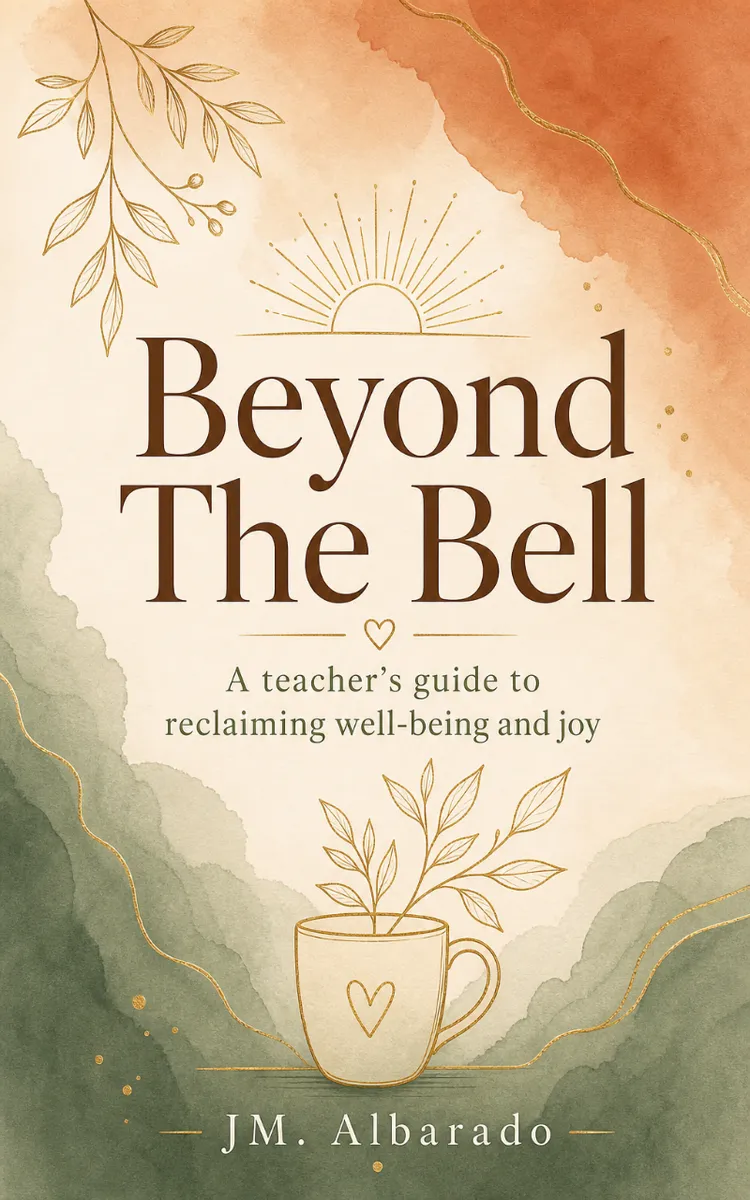
"Beyond The Bell" is a self-help book by JM. Albarado with 7 chapters and approximately 11,261 words. Teacher burnout recovery, boundaries, and time systems for K-12 educators.
This book was created using Inkfluence AI, an AI-powered book generation platform that helps authors write, design, and publish complete books. It was made with the AI Self-Help Book Writer.
Frequently Asked Questions
What is "Beyond The Bell" about?
Teacher burnout recovery, boundaries, and time systems for K-12 educators
How many chapters are in "Beyond The Bell"?
The book contains 7 chapters and approximately 11,261 words. Topics covered include Diagnosing Burnout’s Three-Part Pattern, Mapping Your Stress Triggers and Drains, Breaking the Good-Teacher Martyr Loop, Batch Grading and Template Planning System, and more.
Who wrote "Beyond The Bell"?
This book was written by JM. Albarado and created using Inkfluence AI, an AI book generation platform that helps authors write, design, and publish books.
How can I create a similar self-help book?
You can create your own self-help book using Inkfluence AI. Describe your idea, choose your style, and the AI writes the full book for you. It's free to start.
Write your own self-help book with AI
Describe your idea and Inkfluence writes the whole thing. Free to start.
Start writingCreated with Inkfluence AI


