
Read the first chapter
The whole of chapter one, free. About 3 min. Turn the pages with the arrows, your keyboard, or a swipe.
Chapter 1
Days 1-2: Corporate High-Cortisol Trap
Work stress doesn’t end when you close your laptop. Research consistently links chronic workplace stress with disrupted sleep, muscle tension, anxious thoughts, and a body that stays on alert long after the “urgent” message is handled. Days 1 and 2 begin with noticing that pattern through the Cortisol Loop Map: trigger, body signal, automatic response, and what happens next.
You won’t fix the whole workday in five minutes. You will start catching the moment your body says, This is too much, before the next notification pulls you deeper into the loop.
---
Day 1: Catch the Loop
Tip of the Day:
At 9:07 a.m., Priya, a 32-year-old product manager working hybrid, opens her laptop and sees three Slack messages, a calendar change, and an email marked “quick question.” Nothing is technically on fire. Her shoulders are already lifted, her jaw is tight, and she’s holding her breath while reading.
That’s the corporate high-cortisol trap: the body reacts to constant signals of demand before your mind has time to decide whether something is actually urgent. The Cortisol Loop Map helps you spot four parts:
• Trigger: the notification, deadline, meeting, or difficult message - Body signal: tight chest, shallow breathing, clenched jaw, buzzing hands, hot face - Automatic response: rushing, refreshing, overexplaining, people-pleasing, or freezing - After-effect: exhaustion, irritability, poor focus, or carrying work tension into the evening
You don’t need to judge the response. Your body is trying to protect you. Today, you’re simply gathering information.
Today's Action:
Open a note on your phone or computer and write down one stress moment using this sentence:
“The trigger was __. My body signaled. I automatically. Afterward, I felt __.”
Choose a moment from today, even if it seems small. Maybe your manager added a meeting. Maybe your inbox went from twelve messages to forty. Maybe you reread one sentence five times because your brain felt foggy.
Then place both feet on the floor. Let your shoulders drop on one slow exhale. Look around and name three neutral things you can see: a window, a mug, a blue folder. This tells your attention, gently, that you’re here - not inside every possible problem at once.
---
Day 2: Answer the Body Signal
Tip of the Day:
Yesterday, you noticed the loop. Today, you’ll interrupt it before it gathers speed.
Your body often signals overload before your thoughts catch up. A tight throat may show up before, I don’t want to have this conversation. A restless leg may appear before, I’ve been sitting in this meeting for an hour. A heavy chest may arrive before, I’m treating this email like an emergency.
Priya notices her own signal during a video call: her fingers press hard into the edge of her desk, and her breath becomes barely there. Her instinct is to keep listening, nodding, and pretending she’s fine. Instead, she gives her body a small, clear response. She uncurls her fingers, presses her feet into the floor, and makes her exhale slightly longer than her inhale. The meeting continues. She doesn’t need to announce a nervous system reset to the room.
Use the same approach today. Don’t wait until you feel calm enough to regulate. Start with one physical message of safety while the stress is still present.
Today's Action:
Set one discreet reminder for the busiest part of your workday. When it appears, pause for 60 seconds and complete this desk-friendly reset:
1. Put both feet flat on the floor. 2. Press your heels down gently for five seconds, then release. Repeat three times. 3. Unclench your jaw and let your tongue rest away from the roof of your mouth. 4. Breathe in comfortably. Exhale slowly, as if cooling a spoonful of hot tea. Repeat five times. 5. Write one sentence: “My body is signaling __. The support I can offer right now is __.”
Keep the support small and real. It might be lowering your screen, drinking water, postponing a nonessential reply, or taking the next call standing up.
At the end of the day, complete this quick Cortisol-Check Log:
• Before the reset: Stress level from 0-10: __ - Body signal I noticed: - After the reset: Stress level from 0-10: - What changed, even slightly? - What did I need but not give myself? __
Your body isn’t a distraction from your work. It’s the first place the overload becomes visible. The more clearly you can read its signals, the sooner you can respond - before one notification turns into an entire day spent bracing.
End of chapter one. 6 more chapters and about 5,369 words in the full book.
Swipe or use the arrows to turn the page

Glucose Spike Hacks For Energy

30-Day Anti-Inflammatory Meal Prep Guide

Homeschooling Made Simple For Working Parents
What's inside: 7 chapters
- 1. Days 1-2: Corporate High-Cortisol Trap
- 2. Days 3-4: Somatic Advantage Over Thinking
- 3. Days 5-6: 5-Minute Desk Cortisol Reset
- 4. Days 7-8: Morning & Evening Micro-Routines
- 5. Days 9-10: Vagus Nerve High-Pressure Calm
- 6. Days 11-12: Boundaries Through Somatic Resilience
- 7. Days 13-14: The 14-Day Somatic Reset Plan
About this book
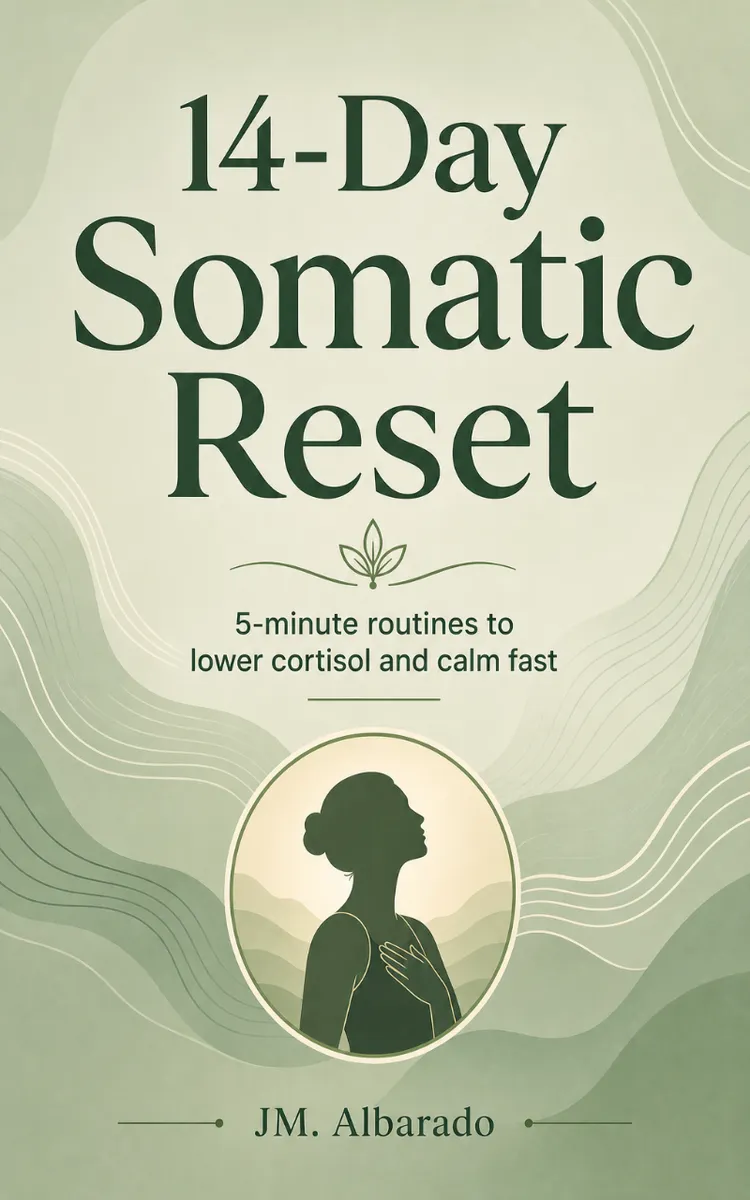
"14-Day Somatic Reset" is a day challenge book by JM. Albarado with 7 chapters and approximately 5,369 words. 14-day somatic exercises for nervous system regulation and cortisol reduction.
This book was created using Inkfluence AI, an AI-powered book generation platform that helps authors write, design, and publish complete books.
Frequently Asked Questions
What is "14-Day Somatic Reset" about?
14-day somatic exercises for nervous system regulation and cortisol reduction
How many chapters are in "14-Day Somatic Reset"?
The book contains 7 chapters and approximately 5,369 words. Topics covered include Days 1-2: Corporate High-Cortisol Trap, Days 3-4: Somatic Advantage Over Thinking, Days 5-6: 5-Minute Desk Cortisol Reset, Days 7-8: Morning & Evening Micro-Routines, and more.
Who wrote "14-Day Somatic Reset"?
This book was written by JM. Albarado and created using Inkfluence AI, an AI book generation platform that helps authors write, design, and publish books.
Write your own day challenge book with AI
Describe your idea and Inkfluence writes the whole thing. Free to start.
Start writingCreated with Inkfluence AI


