
Read the first chapter
The whole of chapter one, free. About 6 min. Turn the pages with the arrows, your keyboard, or a swipe.
Chapter 1
The Modern Homeschool Mindset
Overcoming Parent Guilt
The hardest part of homeschooling often begins before the first lesson: the belief that a good parent must recreate school at home. If your workday includes client calls, deadlines, deliveries, patient appointments, or a full inbox, that belief can make every interruption feel like failure. It is not failure. It is a sign that your family needs a workable system instead of a school-shaped schedule.
Parent guilt usually comes from comparing two different jobs. A classroom teacher manages a room of students whose day centers on instruction. A working parent manages education alongside income, household tasks, and family care. Your goal is not to copy a classroom. Your goal is to help your child make steady progress with focused teaching, useful practice, and enough rest to stay engaged.
Start by replacing the question “Did we do enough today?” with three practical questions: What skill did my child practice? What evidence shows progress? What adjustment will make the next session easier? These questions move your attention from hours spent to learning completed. A short reading discussion, a math explanation, or a written response can tell you more than a long block of distracted seatwork.
Create a simple guilt check for the end of each week. Write down one thing your child learned, one task your child completed with less help, and one part of your routine that caused unnecessary stress. Keep the list factual. Do not label yourself as organized or disorganized; record what happened. This practice helps you improve the system rather than criticize the person running it.
Your child also benefits when you stop treating every missed task as an emergency. Work can run late. A child can wake up tired. A family appointment can change the day. When that happens, move the lesson to the next available learning window instead of trying to squeeze it into an already overloaded evening. The practical takeaway is simple: measure your homeschool by clear progress and repeatable habits, not by how closely it resembles a school building.
Rethinking Traditional Classroom Hours
The familiar school day can create a misleading picture of learning. Children may spend hours moving between subjects, waiting for directions, changing materials, lining up, completing transitions, and working at different speeds. At home, you can remove much of that overhead. A focused explanation followed by purposeful practice can accomplish the central work without filling an entire day.
This is why homeschooling does not require six to eight hours of daily instruction. A realistic, stress-free guide can help a working family deliver a complete, rich education in just four hyper-efficient hours per week when those hours receive careful attention. The four hours refer to direct, high-value teaching and review. They do not limit reading, conversation, play, chores, projects, or curiosity-driven learning that naturally happens throughout the week.
Protect the difference between instruction and exposure. Instruction means you deliberately teach or check a skill. Exposure means your child encounters ideas through books, conversation, cooking, building, music, errands, or questions. Both matter, but they do not require the same schedule. If you explain how to compare fractions during a focused session, your child can later notice fractions while measuring ingredients without needing another formal lesson.
Use a “minimum effective lesson” test before adding time. Ask yourself: What must my child understand by the end? What example will make the idea clear? What short task will show whether the child can use it? Remove activities that do not support those answers. For example, if the goal involves identifying the main idea, a brief passage and a spoken explanation may provide better practice than several pages of repetitive questions.
Keep lessons short enough for attention but complete enough to produce evidence. A session might include a quick review, one explanation, guided practice, and a final check. Stop when your child demonstrates the target skill or when the session stops producing useful attention. Continuing after that point can turn a successful lesson into a daily struggle.
Ask yourself whether your current schedule rewards learning or simply rewards time logged. If your child can explain a concept, apply it, and correct a mistake, the lesson has done its job. The practical takeaway is to plan around outcomes and attention, not the clock. The next step is to place those focused sessions where your job and family can support them.
Designing an Education System That Fits Around Your Job
Begin with your real week, not an ideal week. Look at the times when your work requires full attention, the periods when you can answer a question, and the windows when your child can work without direct help. Mark fixed commitments first. Then choose four weekly teaching hours that you can protect most weeks. A remote professional might use two early mornings and two lunch-adjacent sessions; a small-business owner might choose quieter periods before opening and after closing. The exact clock time matters less than consistency.
Build each learning window around your work demands. During a meeting-heavy morning, place a task your child already knows how to complete rather than a new concept that requires repeated help. Before a quieter work block, teach the new idea and confirm the first example. On a day with unpredictable demands, keep a short fallback session available. The fallback should review a known skill, read together, or complete one meaningful written response. This prevents one disrupted day from breaking the entire week.
Separate “must happen” work from “helpful if available” work. Must-happen work covers the skill you intend to teach or check. Helpful work includes extra practice, enrichment, or a longer project. This distinction reduces pressure because a late client call does not force you to choose between a complete education and an impossible checklist. You can protect the essential lesson and move the optional activity without treating the change as a crisis.
Give your child clear signals for independent work. Set out the materials before your work block, write the task in one sentence, and define what “finished” looks like. For example, “Read the passage, write three sentences about the main idea, and place the page in the review folder” gives a child a clear endpoint. A vague instruction such as “work on reading” invites interruptions because your child cannot tell what to do next.
Create a communication rule for your work periods. Your child should know which questions can wait, which problems require immediate help, and where to record a question. A sticky note, shared document, or question notebook can collect issues for your next teaching window. This protects your concentration while showing your child that questions still receive attention. Explain the rule before the work block begins; do not invent it during a stressful call.
Review the system once a week for ten minutes. Check whether the chosen hours worked, whether your child handled independent tasks, and whether any lesson created avoidable friction. Change one part at a time. If mornings fail because everyone starts rushed, move one session later before redesigning the entire week. Small adjustments make the routine easier to trust and easier to maintain.
Your job does not need to disappear for homeschooling to work. Your homeschool needs clear priorities, protected teaching time, realistic backup options, and a schedule that respects the demands of earning a living. When you design around the week you actually have, education stops competing with your work at every turn. It becomes a dependable part of family life - focused when it needs your attention, flexible when life changes, and calm enough to continue.
End of chapter one. 7 more chapters and about 12,202 words in the full book.
Swipe or use the arrows to turn the page


What's inside: 8 chapters
- 1. The Modern Homeschool Mindset
- 2. The 4-Hour Micro-Learning Principle
- 3. Time-Blocking for Busy Parents
- 4. The 4-Hour Weekly Curriculum Framework
- 5. Leveraging Tech & AI Tools
- 6. Stress-Free Progress & Compliance
- 7. The 14-Day Family Launch Plan
- 8. Special Features & Practical Templates
About this book
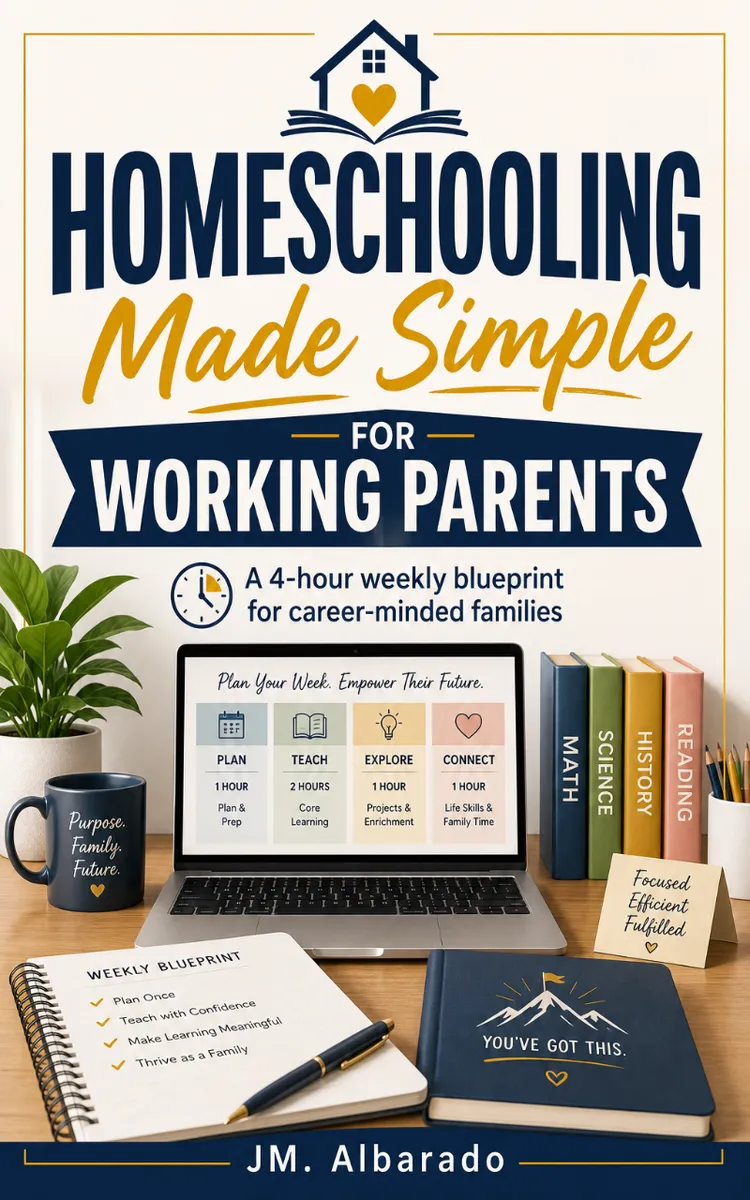
"Homeschooling Made Simple For Working Parents" is a how-to guide book by JM. Albarado with 8 chapters and approximately 12,202 words. A practical homeschooling system for working parents using micro-learning.
This book was created using Inkfluence AI, an AI-powered book generation platform that helps authors write, design, and publish complete books. It was made with the AI Ebook Generator.
Frequently Asked Questions
What is "Homeschooling Made Simple For Working Parents" about?
A practical homeschooling system for working parents using micro-learning
How many chapters are in "Homeschooling Made Simple For Working Parents"?
The book contains 8 chapters and approximately 12,202 words. Topics covered include The Modern Homeschool Mindset, The 4-Hour Micro-Learning Principle, Time-Blocking for Busy Parents, The 4-Hour Weekly Curriculum Framework, and more.
Who wrote "Homeschooling Made Simple For Working Parents"?
This book was written by JM. Albarado and created using Inkfluence AI, an AI book generation platform that helps authors write, design, and publish books.
How can I create a similar how-to guide book?
You can create your own how-to guide book using Inkfluence AI. Describe your idea, choose your style, and the AI writes the full book for you. It's free to start.
Write your own how-to guide book with AI
Describe your idea and Inkfluence writes the whole thing. Free to start.
Start writingCreated with Inkfluence AI


