

Read the first chapter
The whole of chapter one, free. About 8 min. Turn the pages with the arrows, your keyboard, or a swipe.
Chapter 1
Grounding Groups in Biblical Mission
Scripture’s Mission Becomes the Group’s Assignment
“Every Christian community must answer one question: What is God sending us to do together?” That question keeps a small group from becoming only a weekly discussion circle. Scripture answers it by showing one mission unfolding from Genesis to Revelation: God forms a people who know him, display his holiness, welcome the nations, and make disciples through Jesus Christ.
God called Abraham so that “all peoples on earth will be blessed through you” (Genesis 12:3). Israel received that calling as a kingdom of priests (Exodus 19:5-6), but Israel’s failure exposed the need for a faithful representative. Jesus fulfills that calling and sends his disciples to make disciples of all nations (Matthew 28:18-20). The church now carries that witness through the power of the Holy Spirit (Acts 1:8). Small groups do not create a separate mission. They provide one practical setting where the church obeys Christ’s mission together.
This matters because groups can drift toward three narrow goals: private fellowship, Bible information, or member care disconnected from the wider church. Each has value, but none captures the whole assignment. By grounding your group in Scripture, you can explain how your meetings serve your church’s pastoral vision, help people follow Jesus, and open a trustworthy path into the church community. Ask yourself: Can every member explain how this group helps make disciples and welcome people into Christ’s body?
The Mission-to-Community Map gives you a simple way to answer that question. It traces four movements: God’s mission, the church’s witness, the group’s practice, and the newcomer’s next step. The map keeps your group connected to biblical theology and to the local church led by its pastors.
The Mission-to-Community Map
Begin with God’s mission. The Bible presents mission as God’s work before it presents mission as our activity. The Father sends the Son (John 3:16-17), the Father and Son send the Spirit (John 15:26), and the risen Christ sends his church (John 20:21-22). God gathers people into a covenant family, reconciles them to himself through Christ, and sends them to bear witness. Therefore, your group should ask more than, “What topic will we discuss?” Ask, “How will this gathering help people know Christ, obey Christ, and represent Christ?”
Move next to the church’s witness. Acts 2:42-47 shows a church devoted to apostolic teaching, fellowship, shared meals, prayer, generosity, worship, and public witness. The believers did not separate spiritual growth from community life. Their shared life helped outsiders see the gospel in action, and “the Lord added to their number daily those who were being saved” (Acts 2:47). A small group serves the church when it strengthens these same patterns and directs people toward the gathered worship, teaching, ordinances, care, and leadership of the local congregation.
Then define the group’s practice. A group makes disciples when members move from hearing Scripture to obeying Scripture. Jesus said that disciples must be taught to obey everything he commanded (Matthew 28:20). Your meeting should therefore include Bible understanding, honest response, prayer, mutual care, and a clear action. For example, after studying Luke 10:25-37, members might identify one neighbor who needs practical help, plan a specific act of mercy, and pray for an opportunity to explain why they serve. The group turns interpretation into obedience without reducing discipleship to a project.
Finally, identify the newcomer’s next step. Welcoming people into Christ’s community requires more than offering a seat and a snack. A guest needs a clear path from first contact to belonging, spiritual care, and participation in the church. Scripture calls believers to welcome one another as Christ welcomed them (Romans 15:7), practice hospitality (1 Peter 4:9), and use their gifts for the body (1 Corinthians 12:4-7). Your group can introduce a newcomer to the church’s worship, explain the gospel plainly, connect the person with pastoral care when needed, and invite appropriate participation over time.
Use the map through these four questions:
1. What has God sent us to do? Write a one-sentence answer from Scripture and your church’s stated mission. This prevents the group from inventing its own purpose. 2. How does our church express that mission? Name the church’s preaching, worship, outreach, care, and discipleship pathways. This keeps the group under pastoral leadership rather than beside it. 3. What will we practice in our meetings? Choose repeatable actions such as prayer for neighbors, Scripture obedience, shared care, and invitations. This turns theology into a group rhythm. 4. What next step will we offer? Decide how a guest can meet the group, attend worship, ask questions, join a class, receive care, and eventually serve. This makes welcome intentional and safe.
Keep the map visible in your leader notes. At the end of each meeting, ask, “Which movement did we practice tonight, and what remains unfinished?” If the group studies mission but never welcomes people, the map exposes the gap. If the group welcomes guests but never directs them toward Christ and his church, the map exposes that gap as well.
Applying the Map to a Newcomer Path
Consider a group of twelve adults that meets on Thursday evenings in a church member’s home. The church’s senior pastor has asked every group to help people connect with Sunday worship and the church’s newcomer class. The group wants to obey that direction without treating guests as attendance numbers.
Use this sequence:
1. Write the mission sentence. Before the next meeting, the leader writes: “We help people follow Jesus through Scripture, shared obedience, prayer, and connection to the local church.” The leader checks the wording with the small-groups pastor or assigned elder. The expected outcome is a purpose the whole group can repeat. 2. Prepare a four-week study. Choose passages from Matthew 28:18-20, Acts 2:42-47, Romans 12:3-8, and 1 Peter 4:7-11. Each meeting includes twenty-five minutes of Bible teaching, twenty minutes of discussion, fifteen minutes of prayer, and ten minutes for a concrete response. The expected outcome is a balanced gathering rather than a lecture or social event. 3. Assign a welcome role. One member contacts guests before the meeting, gives clear directions, explains the meeting length, and asks about food or accessibility needs. Another member greets guests at the door and introduces them to two people. The expected outcome is personal care without placing pressure on the guest. 4. Connect the group to Sunday worship. During the first meeting, the leader explains the church’s worship time, children’s arrangements, parking, and newcomer class. The leader offers to sit with the guest on Sunday but does not demand a decision. The expected outcome is a clear next step that removes practical uncertainty. 5. Practice one mission action. After the Acts 2 study, the group prepares a meal for a family connected to the church’s care ministry. The leader confirms the need with the ministry leader before making promises. The expected outcome is service that supports the church’s existing care rather than competing with it. 6. Follow up within forty-eight hours. The host sends a brief message thanking the guest and asking whether the person has questions. If the guest requests prayer, the leader records the request securely and follows the church’s pastoral-care process. The expected outcome is continued relationship without intrusive contact. 7. Review after four weeks. The leader asks three questions: Did members practice obedience? Did guests receive a clear welcome? Did the group connect people to the church’s next step? The leader shares the answers with the assigned pastor or group coordinator. The expected outcome is correction while the group remains small enough to adjust.
The group should not measure success only by whether a guest returns. Some people need time, and some will choose another church. The group can still evaluate faithful actions: members opened Scripture, practiced hospitality, explained the gospel, honored pastoral direction, and offered a clear path into church life.
Quick checklist
• Confirm the church’s mission and pastoral priorities. - Write one sentence that connects the group to that mission. - Choose biblical passages that support discipleship and community. - Give every meeting a Scripture response and a prayer response. - Assign a host before guests arrive. - Explain worship, children’s care, and newcomer pathways clearly. - Contact guests within forty-eight hours. - Protect confidential information and follow pastoral-care procedures. - Review the group’s practice after four weeks. - Report needs, opportunities, and concerns to church leadership.
The practical takeaway is simple: map every gathering from God’s purpose to a person’s next step. That connection helps the group serve the church instead of becoming an isolated ministry.
Correcting Mission Drift
Mistake: Treating the group as a private club
A group may develop strong friendships while rarely inviting others or connecting members to the church. Closed routines often form quietly: the same people sit together, share personal updates, and make decisions without considering guests.
Do this: Reserve one meeting each month for a deliberate welcome practice. Review the church’s newcomer pathway, pray for specific people, and ask members whom they can invite or serve.
Not this: Assume that a friendly atmosphere automatically fulfills the church’s mission.
Mistake: Confusing Bible discussion with disciple-making
A group can answer every study question and still avoid obedience. Members may explain what a passage means but never change their schedules, relationships, spending, speech, or service.
Do this: End each study with one obedience question: “What will you do before we meet again, and who can help you follow through?” Choose actions that fit the passage. After studying Ephesians 4:25-32, members might reconcile with someone, stop harmful speech, or seek forgiveness.
Not this: Accept “That was interesting” as the group’s only response.
Mistake: Acting independently of pastoral leadership
A group may see a genuine need and launch a ministry without checking with church leaders. Good intentions can create duplicated work, unsafe care, confused communication, or promises the church cannot keep.
Do this: Bring significant needs, doctrinal questions, crisis situations, and outreach plans to the assigned pastor or ministry leader. Let leaders connect the group with existing church resources and clarify boundaries.
Not this: Present the group’s plan as a finished decision and ask the church to support it afterward.
The Mission-to-Community Map keeps these problems visible. God’s mission gives the group its purpose, the church gives it direction, the group gives the mission a weekly practice, and the newcomer receives a trustworthy next step. When those four movements stay connected, a small gathering becomes more than a meeting: it becomes one local expression of Christ’s disciple-making, reconciling, welcoming church.
End of chapter one. 7 more chapters and about 14,880 words in the full book.
Swipe or use the arrows to turn the page

Church History Beginning to 1516 Study Guide

Church History 1600 2000 Study Guide

The Skillful Sanctuary
What's inside: 8 chapters
- 1. Grounding Groups in Biblical Mission
- 2. Interpreting the Senior Pastor’s Vision
- 3. Practicing Spiritual Alignment
- 4. Designing Groups for Discipleship
- 5. Leading with Christian Psychological Insight
- 6. Welcoming Seekers into Church Life
- 7. Connecting Groups to Church Ministries
- 8. Multiplying Leaders with Accountability
About this book
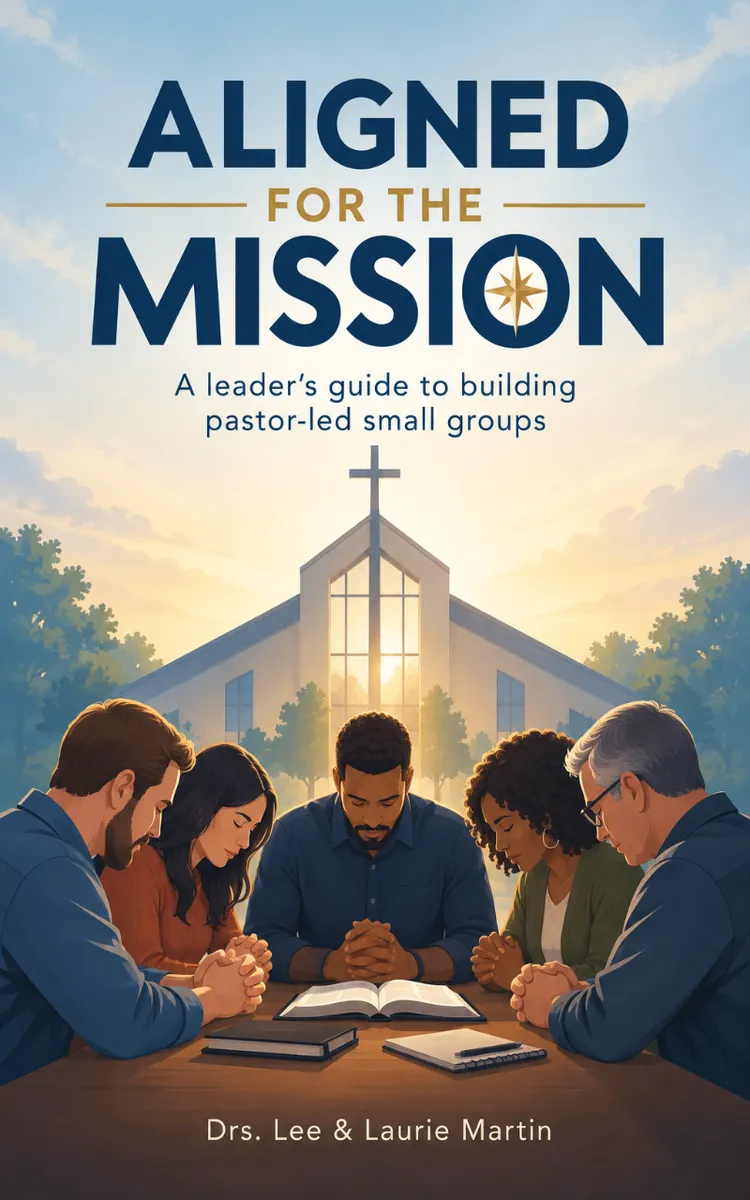
"Aligned For The Mission" is a how-to guide book by Drs. Lee & Laurie Martin with 8 chapters and approximately 14,880 words. Biblical small-group leadership aligned with pastoral vision and church growth.
This book was created using Inkfluence AI, an AI-powered book generation platform that helps authors write, design, and publish complete books. It was made with the AI Ebook Generator.
Frequently Asked Questions
What is "Aligned For The Mission" about?
Biblical small-group leadership aligned with pastoral vision and church growth
How many chapters are in "Aligned For The Mission"?
The book contains 8 chapters and approximately 14,880 words. Topics covered include Grounding Groups in Biblical Mission, Interpreting the Senior Pastor’s Vision, Practicing Spiritual Alignment, Designing Groups for Discipleship, and more.
Who wrote "Aligned For The Mission"?
This book was written by Drs. Lee & Laurie Martin and created using Inkfluence AI, an AI book generation platform that helps authors write, design, and publish books.
How can I create a similar how-to guide book?
You can create your own how-to guide book using Inkfluence AI. Describe your idea, choose your style, and the AI writes the full book for you. It's free to start.
Write your own how-to guide book with AI
Describe your idea and Inkfluence writes the whole thing. Free to start.
Start writingCreated with Inkfluence AI


