

Read the first chapter
The whole of chapter one, free. About 4 min. Turn the pages with the arrows, your keyboard, or a swipe.
Chapter 1
A SURVEY OF CHURCH HISTORY 1648 A.D. to 2000 A.D.
INTRODUCTION
Compiled by Dr. LyVenda Reckner Taught by Dr. Lee Martin
An understanding of world events and the circumstances faced by Christians throughout the ages is needed in order to gain a perspective of the current age in which we are living. Church history is part of world history. The events of earth’s history have influenced the Church and the Church has influenced the world. Therefore, it is impossible to discuss the history of the Church intelligently without including the happenings of world governments and societies. This study will highlight certain historical events in order to bring understanding to circumstances taking place with the Church during that period of time. Numerous events of equal or even greater importance are not discussed simply for the sake of time. Further study and research is encouraged in order to broaden the scope of understanding concerning the Church of our Lord Jesus Christ.
The hindsight of history provides us with an understanding of our roots, and where we come from and will hopefully provide wisdom and insight concerning our future. Like many who came before us, we must learn from the mistakes of the past and move forward into the future with greater wisdom to win the world for Christ.
The spirit of reform had broken out with intensity during the 16th century. The Age of Reformation gave birth to Protestantism and shattered the papal leadership of Western Christendom. Four major traditions marked early Protestantism: Lutheran, Reformed, Anabaptist and Anglican. After a generation, the Church of Rome itself, led by the Jesuits, recovered its moral fervor. Bloody struggles between Catholics and Protestants followed and Europe was ravaged by war before it became obvious that Western Christendom was permanently divided. A few pioneers pointed toward a new way: the denominational concept of the Church.
The denominational theory of the Church implies that a Christian group called by a particular name is but one member of a larger group – the Church – to which all denominations belong. It insists that the true Church cannot be identified with any single ecclesiastical structure. No denomination claims to represent the whole Church of Christ. Each simply constitutes a different form – in worship and organization – of the larger life of the Church.
The Reformers had planted the seeds of denominational theory of the Church when they insisted that the true Church can never be identified in any exclusive sense with a particular institution. The true succession is not of bishops but of believers. Martin Luther believed that the outward forms of the Church ought to give the Word of God free course in the world, not block its power to save.
During the 17th century, Independents became aware of the dangers of “dividing the godly Protestant party” and looked for some way to express Christian unity even when Christians did not agree. These “Dissenting Brethren of Westminster”, who represented the minority voice at the Westminster Assembly in 1642, held that several fundamental truths must be recognized:
• First, considering man’s inability to always see the truth clearly, differences of opinion about the outward form of the Church are inevitable.
• Second, even though these differences do not involve fundamentals of the faith, they are not matters of indifference. Every Christian is obligated to practice what he believes the Bible teaches.
• Third, since no church has a final and full grasp of divine truth, the true Church of Christ can never be fully represented by any single ecclesiastical structure.
• Finally, the mere fact of separation does not of itself constitute schism. It is possible to be divided at many points and still be united in Christ.
Thus, the denominational theory of the Church looked for Christian unity in some inward religious experience – and allowed diversity in the outward expressions of personal faith.
The identity of the “one true Church” was restricted to those who shared a common understanding of the core of the Christian faith. This denominational view of the Church found only limited acceptance in England, but gained increasing acceptance in the English colonies of America. It seemed to be God’s answer for the multiplying faiths in the New World.
Advocates of the denominational view had no intention of reducing the basic beliefs of Christianity to a general feeling of religious sincerity but they could not control the future. They simply knew that the traditional bigotry and bloodshed in the name of Christ was not the way forward.
In the end, then, the denominational form of the Church has marked the recent centuries of Christian history, not because it is ideal, but because it is better than any alternative the years have offered.
End of chapter one. 15 more chapters and about 34,890 words in the full book.
Swipe or use the arrows to turn the page


What's inside: 16 chapters
- 1. A SURVEY OF CHURCH HISTORY 1648 A.D. to 2000 A.D.
- 2. SECTION ONE THE AGE OF REVIVAL AND REASON 1648 A.D. - 1789 A.D.
- 3. III. THE EVANGELICAL AWAKENING:
- 4. IV. A NEW ORDER OF THE AGES:
- 5. THE AGE OF PROGRESS
- 6. II. A NEW SOCIAL FRONTIER:
- 7. III. TO EARTH’S REMOTEST PEOPLE:
- 8. IV. THE DESTINY OF A NATION:
- 9. V. A BRIDGE FOR INTELLIGENT MODERNS:
- 10. VI. NOTHING TO LOSE BUT CHAINS:
- 11. SECTION THREE THE AGE OF IDEOLOGIES 1914-1996
- 12. III. NEW CREEDS FOR BREAKFAST:
- 13. IV. THE MEDICINE OF MERCY:
- 14. V. TIME FOR A REVERSE FLOW:
- 15. VI. POLITICS AS A NOBLE CALLING:
- 16. VII. THE GLOBAL VILLAGE:
About this book
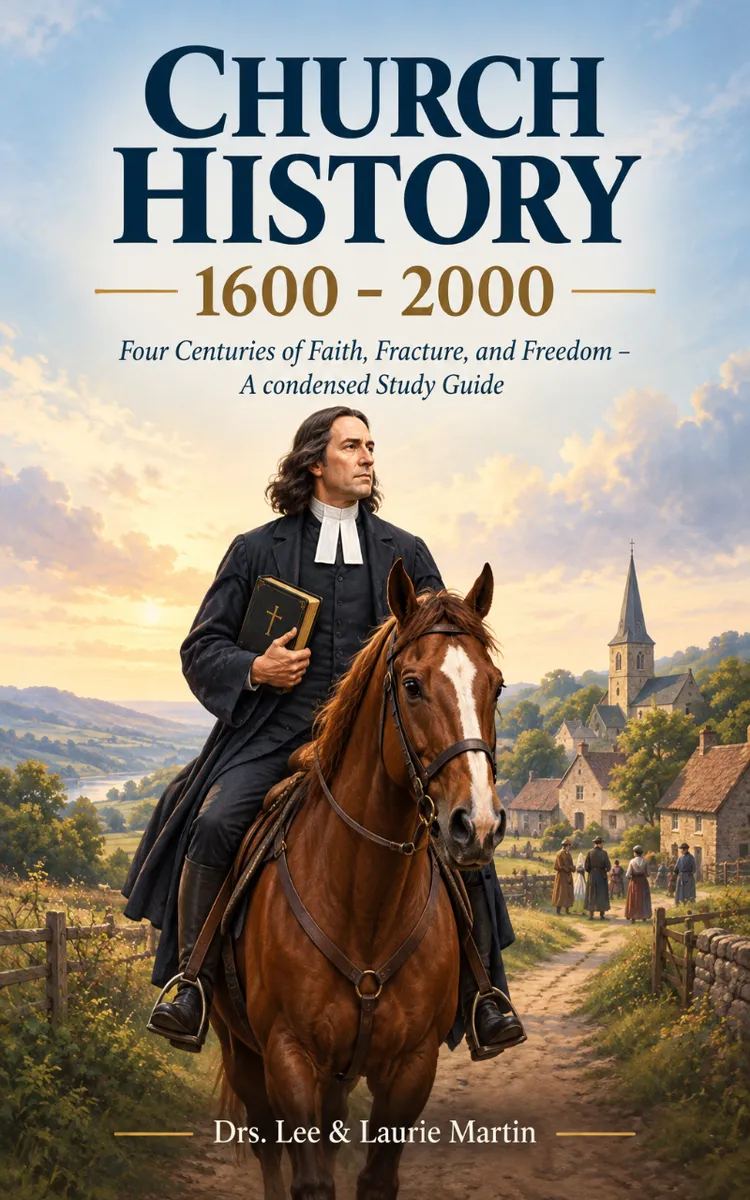
"Church History 1600 2000 Study Guide" is a general book by Drs. Lee & Laurie Martin with 16 chapters and approximately 34,890 words. It covers key insights and practical takeaways on the topic.
This book was created using Inkfluence AI, an AI-powered book generation platform that helps authors write, design, and publish complete books.
Frequently Asked Questions
What is "Church History 1600 2000 Study Guide" about?
"Church History 1600 2000 Study Guide" is a general book by Drs. Lee & Laurie Martin covering key insights and practical takeaways on the topic.
How many chapters are in "Church History 1600 2000 Study Guide"?
The book contains 16 chapters and approximately 34,890 words. Topics covered include A SURVEY OF CHURCH HISTORY 1648 A.D. to 2000 A.D., SECTION ONE THE AGE OF REVIVAL AND REASON 1648 A.D. - 1789 A.D., III. THE EVANGELICAL AWAKENING:, IV. A NEW ORDER OF THE AGES:, and more.
Who wrote "Church History 1600 2000 Study Guide"?
This book was written by Drs. Lee & Laurie Martin and created using Inkfluence AI, an AI book generation platform that helps authors write, design, and publish books.
Write your own book with AI
Describe your idea and Inkfluence writes the whole thing. Free to start.
Start writingCreated with Inkfluence AI


