
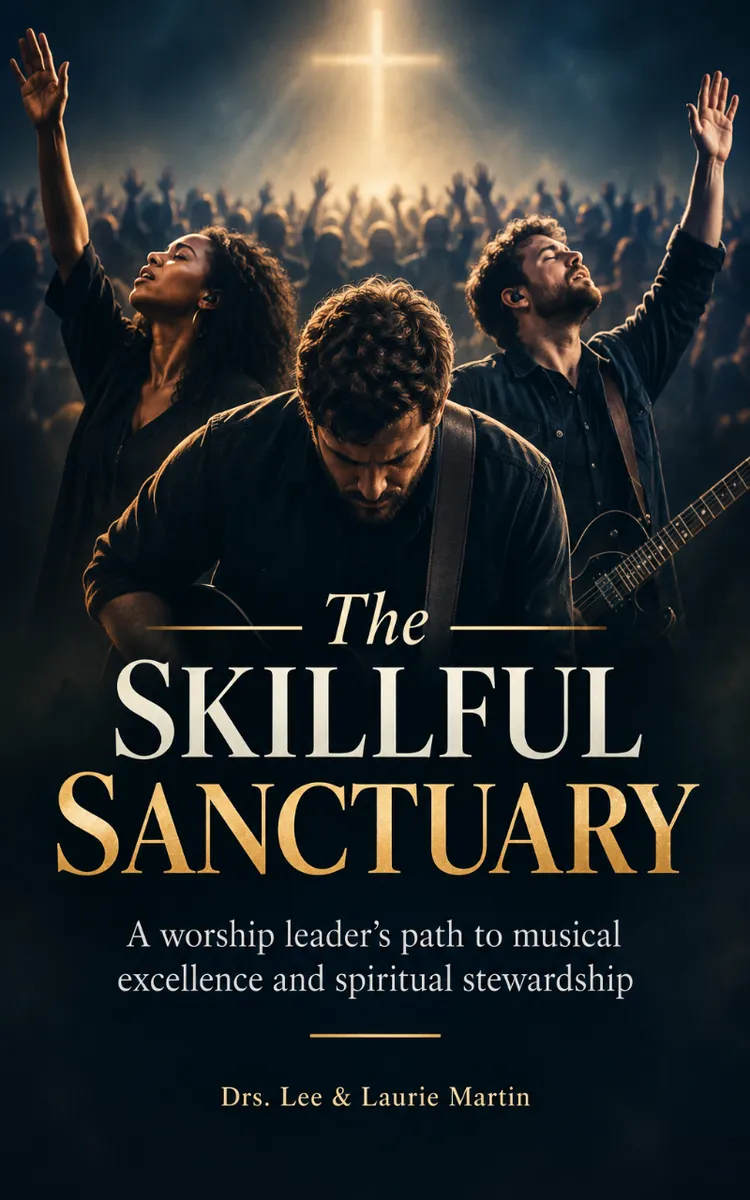

Read the first chapter
The whole of chapter one, free. About 5 min. Turn the pages with the arrows, your keyboard, or a swipe.
Chapter 1
The Call to Skillful Worship
Scripture Focus
1 Chronicles 25:7
> So the number of them, with their brethren that were instructed in the song of the LORD, even all that were cunning, was two hundred fourscore and eight.
A worship team is called to bring both a trained offering and a Spirit-shaped heart before the Lord.
The worship ministry of Israel was not built around whoever happened to be available with an instrument. David, the leaders of the army, and the Levites appointed the sons of Asaph, Heman, and Jeduthun for musical service. These musicians were “instructed in the song of the LORD,” and they were skilled - “cunning,” or capable, in the language of older English translations. Their work included singing, playing instruments, teaching, and leading the congregation in praise.
That detail matters. Scripture does not treat musical preparation as a distraction from spiritual life. It places skill inside the life of worship. The musicians were not merely talented performers hired to decorate a religious gathering. They were servants set apart to help God’s people remember His character, proclaim His works, and respond to His presence. Their training had a spiritual purpose.
Psalm 33:3 gives the same direction: “Sing unto him a new song; play skilfully with a loud noise.” The command joins expression and competence. We’re told to sing, but also to play skillfully. Psalm 47:7 says, “Sing ye praises with understanding.” Biblical worship includes both the heart’s affection and the mind’s attention. It isn’t careless noise, and it isn’t cold precision. It is truth carried faithfully through sound.
This is why musical excellence and spiritual anointing belong together. Skill cannot replace the work of the Holy Spirit. A polished arrangement cannot produce repentance, faith, or awe. At the same time, spiritual sincerity is not an excuse for neglecting pitch, rhythm, preparation, tone, lyrics, or arrangement. If a congregation is struggling to follow because the team has not rehearsed, sincerity alone hasn’t solved the problem.
The sons of Asaph give us a healthy picture. Their ministry involved instruction, discipline, and service. First Chronicles 25:6 says they served “under the hands of their father” in the house of the Lord. They learned within relationship and accountability. They didn’t simply collect songs; they developed musicianship under guidance. First Chronicles 25:8 adds that they cast lots for their duties, “the small as well as the great, the teacher as well as the scholar.” The ministry made room for growth, but it still honored preparation.
The goal isn’t performance instead of worship; it’s skill placed under worship. A vocalist who practices breath control is caring for the words being sung. A drummer who works with a metronome is protecting the congregation from distraction. A guitarist who learns the arrangement thoroughly is making space to listen, respond, and serve rather than scramble through the song. A worship leader who studies the lyrics is better prepared to guide people toward the truth those lyrics declare.
This also helps us understand anointing more carefully. Anointing is not a substitute for practice, and practice is not a way to manufacture anointing. We prepare faithfully, then depend on God completely. Paul’s instruction to Timothy captures this balance: “Exercise thyself rather unto godliness” (1 Timothy 4:7), and “Neglect not the gift that is in thee” (1 Timothy 4:14). Timothy’s gift required stewardship. So does yours.
Daily ministry brings real pressures. A team may have only one rehearsal before Sunday. A singer may be learning harmony while carrying a demanding work schedule. An instrumentalist may feel embarrassed by a weak area and avoid practicing it. A leader may be tempted to settle for “good enough” because the church is small or because nobody has complained. Yet the size of the room doesn’t change the worth of the offering. God sees the hidden preparation that happens when nobody applauds.
Practice, then, becomes an act of love. It says, “I want to remove avoidable obstacles so that people can hear and respond to God.” That doesn’t mean chasing flawless production or copying the latest worship sound. It means bringing your actual ability to the Lord, then developing it with patience. The Levites were instructed. They learned their craft. They served in a structure that valued both spiritual responsibility and musical competence.
A useful test is simple: after rehearsal, are you more available to God and more helpful to the congregation? If you’re still counting bars, guessing lyrics, or worrying about a chord progression during worship, focused preparation can free your attention. Excellence is not about impressing people. It’s about making the message clear and the team dependable.
Try holding this phrase in front of your practice: Prepare like the song matters, and minister like God is present. Those two convictions belong in the same room.
Practice for Today
1. Set a focused twenty-minute practice block. Choose one part of a current worship song that needs attention: the chorus harmony, the bass transition, the drum groove, the opening cue, or the final ending. Spend five minutes identifying the problem, ten minutes practicing it slowly with a metronome or reference track, and five minutes playing or singing it in context. End by thanking God for the ability to grow. The point isn’t to conquer the entire song today. It’s to offer careful attention to one part of your service.
2. Journal with 1 Chronicles 25 in front of you. Write about this question: Where have I separated spiritual sincerity from musical responsibility? Be specific. You might write, “I pray for the congregation, but I rarely review the lyrics,” or, “I care about excellence, but I become impatient with team members who are still learning.” Then write one balanced response that honors both sides: This week I will pray for the ministry and prepare the transition between verses two and three before rehearsal.
3. Pray for five minutes before your next rehearsal. For the first minute, become quiet before God. For the next two minutes, name the people you’ll serve and the specific musical tasks in front of you. Use the final two minutes to surrender both pride and insecurity. Ask the Lord to make your skill useful, your listening attentive, and your leadership gentle. Then carry one practical decision into rehearsal: arrive ten minutes early, mark your chart, tune carefully, or listen before offering a correction.
As you work, notice what changes when practice is no longer treated as a private hobby or a technical chore. A repeated vocal line becomes an act of stewardship. A corrected rhythm becomes a gift to the drummer beside you. Learning the song’s biblical message changes how you sing it. The work remains work, but its purpose becomes clearer.
Closing Prayer
Lord, thank You for the gifts You have placed in my hands and voice. Teach me to develop them faithfully without pride or fear. Join my preparation to dependence on Your Spirit, so that my skill serves the truth and helps Your people worship with understanding. Make me attentive, teachable, and ready to offer my best for Your glory. Amen.
End of chapter one. 8 more chapters and about 10,238 words in the full book.
Swipe or use the arrows to turn the page

Church History Beginning to 1516 Study Guide

Church History 1600 2000 Study Guide

Aligned For The Mission
What's inside: 9 chapters
- 1. The Call to Skillful Worship
- 2. The Heart Before the Instrument
- 3. Trusting the Giver of Gifts
- 4. The Discipline of Individual Practice
- 5. Rehearsing in Unity
- 6. Offering the Whole Body
- 7. Leading Through Prayer and Discernment
- 8. Serving the Congregation with Hope
- 9. A Lifelong Offering of Craftsmanship
About this book
"The Skillful Sanctuary" is a religious devotional book by Drs. Lee & Laurie Martin with 9 chapters and approximately 10,238 words. Biblical worship leadership, musical excellence, spiritual anointing, and disciplined team practice.
This book was created using Inkfluence AI, an AI-powered book generation platform that helps authors write, design, and publish complete books.
Frequently Asked Questions
What is "The Skillful Sanctuary" about?
Biblical worship leadership, musical excellence, spiritual anointing, and disciplined team practice
How many chapters are in "The Skillful Sanctuary"?
The book contains 9 chapters and approximately 10,238 words. Topics covered include The Call to Skillful Worship, The Heart Before the Instrument, Trusting the Giver of Gifts, The Discipline of Individual Practice, and more.
Who wrote "The Skillful Sanctuary"?
This book was written by Drs. Lee & Laurie Martin and created using Inkfluence AI, an AI book generation platform that helps authors write, design, and publish books.
Write your own religious devotional book with AI
Describe your idea and Inkfluence writes the whole thing. Free to start.
Start writingCreated with Inkfluence AI


