

Read the first chapter
The whole of chapter one, free. About 3 min. Turn the pages with the arrows, your keyboard, or a swipe.
Chapter 1
Chapter 1 The Psychology of Home
Think about the homes you've lived in throughout your life.
Not the addresses.
Not the square footage.
Not the market values.
The homes themselves.
What comes to mind?
For most people, it isn't the number of bedrooms or the type of flooring.
It's the memories.
It's the Christmas tree in the corner of the living room.
It's the smell of dinner coming from the kitchen.
It's sitting on the front porch on a summer evening.
It's a child's first bedroom.
It's family photographs hanging on the wall.
It's the feeling of safety after a difficult day.
When we look back on our lives, we rarely remember the house itself.
We remember the life we lived inside it.
That's because a home is never just a building.
A home becomes the backdrop of our lives.
It's where ordinary moments become meaningful memories.
And yet, when it comes time to buy a home, many of us focus almost entirely on the building.
We compare prices.
We study neighborhoods.
We evaluate school districts.
We review inspection reports.
All of those things are important.
But there's another question that often gets overlooked.
A question that may matter even more.
Will this home support the life I want to live?
That question sits at the heart of everything in this book.
The Day I Started Thinking Differently
Over the years, I've watched people fall in love with homes for reasons they could never fully explain.
Two buyers would walk into the same house.
One would be excited.
The other would seem completely unimpressed.
One would immediately begin imagining a future there.
The other would be ready to leave within five minutes.
The interesting part was that neither person was wrong.
They were responding to different needs.
One buyer might see a peaceful retreat.
Another might see isolation.
One person might see an energetic neighborhood.
Another might see noise and stress.
The house didn't change.
The people did.
That's when I began realizing that home buying isn't just about finding the right property.
It's about finding the right fit.
Why Bigger Isn't Always Better
Our culture tends to suggest that happiness comes from getting more.
More square footage.
More upgrades.
More luxury.
More amenities.
Yet many people discover that bigger doesn't automatically mean better.
A large home can feel empty.
A dream neighborhood can feel uncomfortable.
A beautiful property can create daily frustrations.
At the same time, a modest home can bring tremendous contentment.
A smaller space can feel warm and welcoming.
A simple property can become the setting for a wonderful life.
The difference often has very little to do with the house itself.
The difference is compatibility.
The home fits the person.
Every Home Makes a Promise
I've come to believe that every home makes a promise.
A quiet home promises peace.
A downtown condo promises convenience and activity.
A family neighborhood promises connection.
A country property promises freedom and space.
A waterfront home promises beauty and escape.
The challenge is that different promises appeal to different people.
What feels like freedom to one person may feel lonely to another.
What feels exciting to one person may feel exhausting to another.
What feels comfortable to one person may feel confining to someone else.
That's why no home is universally perfect.
Homes only fit particular people particularly well.
Understanding Yourself Changes Everything
Most buyers begin by asking:
"What kind of house do I want?"
That's a reasonable question.
But I believe there's a better place to start.
Ask:
"What kind of life do I want?"
The answer changes everything.
Because once you understand the life you're trying to create, the right home becomes much easier to recognize.
You stop chasing features simply because they're popular.
You stop comparing your choices to everyone else's.
You become less interested in impressing others and more interested in creating a life that genuinely makes you happy.
And that's exactly what the Home Personality framework is designed to help you do.
Over the next few chapters, you'll discover that your housing preferences are not random.
They're connected to deeper patterns in how you think, live, recharge, connect with others, and define happiness.
Those patterns create what I call your Home Personality.
And once you understand your Home Personality, you'll begin to see homes differently.
Not simply as properties.
But as places where your future life can unfold.
End of chapter one. 20 more chapters and about 25,224 words in the full book.
Swipe or use the arrows to turn the page

The 16 Baseball Minds: How Personality Shapes High School & College Players

Retirement by Personality: 16 Paths to a Fulfilling Life

Grief Through the Lens of Personality
What's inside: 21 chapters
- 1. Chapter 1 The Psychology of Home
- 2. Chapter 2 The Four Hidden Drivers Behind Every Home Decision
- 3. Chapter 3 The Homes That Shaped You
- 4. Chapter 4 The Home Personality Assessment
- 5. Chapter 5 Understanding Your Home Personality
- 6. Chapter 6 The Retreat Seeker
- 7. Chapter 7 The Family Anchor
- 8. Chapter 8 The Urban Explorer
- 9. Chapter 9 The Creator
- 10. Chapter 10 The Homesteader
- 11. Chapter 11 The Freedom Seeker
- 12. Chapter 12 The Luxury Curator
- 13. Chapter 13 The Balanced Hybrid
- 14. Chapter 14 Finding Your Home Personality Match
- 15. Chapter 15 Property Evaluations by Home Personality Type
- 16. Chapter 16 The Neighborhood Personality Match
- 17. Chapter 17 Couples and Family Personality Conflicts
- 18. Chapter 18 How Your Home Personality Changes Through Life
- 19. Chapter 19 Creating Your Personal Home Blueprint
- 20. Chapter 20 Coming Home to Yourself
- 21. Chapter 21 Author's Note
About this book
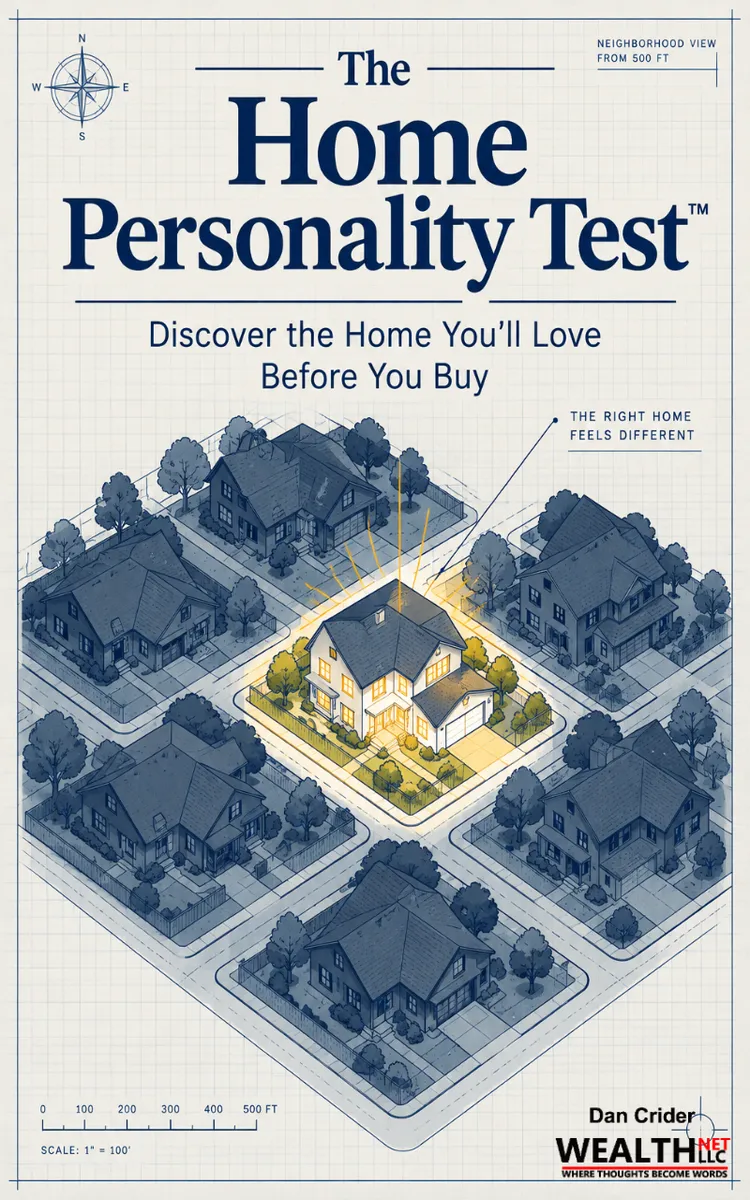
"The Home Personality Test™" is a general book by Dan Crider with 21 chapters and approximately 25,224 words. It covers key insights and practical takeaways on the topic.
This book was created using Inkfluence AI, an AI-powered book generation platform that helps authors write, design, and publish complete books.
Frequently Asked Questions
What is "The Home Personality Test™" about?
"The Home Personality Test™" is a general book by Dan Crider covering key insights and practical takeaways on the topic.
How many chapters are in "The Home Personality Test™"?
The book contains 21 chapters and approximately 25,224 words. Topics covered include Chapter 1 The Psychology of Home, Chapter 2 The Four Hidden Drivers Behind Every Home Decision, Chapter 3 The Homes That Shaped You, Chapter 4 The Home Personality Assessment, and more.
Who wrote "The Home Personality Test™"?
This book was written by Dan Crider and created using Inkfluence AI, an AI book generation platform that helps authors write, design, and publish books.
Write your own book with AI
Describe your idea and Inkfluence writes the whole thing. Free to start.
Start writingCreated with Inkfluence AI


