

Read the first chapter
The whole of chapter one, free. About 5 min. Turn the pages with the arrows, your keyboard, or a swipe.
Chapter 1
Spot Your Procrastination Triggers
See the Loop Before You Try to Change It
Procrastination usually starts before you notice yourself avoiding the task. A situation appears, a feeling rises, and a quick thought gives you a reason to delay. Then the delay brings short-term relief, which teaches your brain to repeat the pattern.
Your job here isn’t to judge the delay or force yourself to “try harder.” It’s to spot the sequence clearly. Look for these three parts:
1. Situation: What was happening just before you delayed? 2. Feeling: What emotion or body sensation showed up? 3. Thought: What did you tell yourself in that moment?
For example, opening a tax folder might create tension. The thought may be, “I need a clear hour before I can start.” You check your phone instead. The phone gives you a quick break, but the tax folder remains threatening. That’s a procrastination loop.
Key takeaway: Your most useful trigger map is specific enough to describe one real moment, not a general label such as “I procrastinate when I’m busy.”
A trigger can be obvious, like an unpleasant phone call, or quiet, like seeing a blank document. It can also be a positive feeling. Boredom, uncertainty, resentment, embarrassment, and even excitement can all lead to delay. The goal is to notice what reliably comes first.
Map One Recent Procrastination Loop
Materials needed: This workbook, a pen, and one recent example of something you delayed. Time required: 15-20 minutes.
Choose a delay from the past seven days. Pick something small enough to remember clearly, such as sending an invoice, booking an appointment, replying to a message, cleaning equipment, or starting a report. Don’t choose your biggest lifelong struggle. We’re looking for a clear snapshot.
Your Turn
1. Write the task you delayed in one sentence. Use a verb. Task: I delayed _______________________________________________
2. Write when you first intended to begin. Then write when you actually began, if you did. Planned start: __________________ Actual start: __________________
3. Reconstruct the five minutes before you delayed. Record the setting, people nearby, device in your hand, and what you had just finished doing. Situation: I was _____________________________________________ Location: ________________________________________________ What happened immediately before: ____________________________
4. Name the strongest feeling that showed up. Choose one or write your own: tension, boredom, confusion, dread, resentment, embarrassment, tiredness, fear, restlessness, or pressure. Add a number from 0 to 10. Feeling: __________________ Intensity: __ / 10
5. Notice your body. Write one physical sign, such as tight shoulders, a heavy chest, a clenched jaw, or the urge to move. Body signal: __________________________________________________
6. Capture the thought that made delay seem reasonable. Write it as close to the original wording as you can. Thought: “____________________________________________________”
7. Record what you did instead. Be concrete. “I avoided it” isn’t enough. Write “watched three short videos,” “reorganized the toolbox,” or “answered easier messages.” Replacement action: ____________________________________________
8. Record the immediate payoff. What did the replacement action give you for the next few minutes? Short-term payoff: ______________________________________________
9. Complete this loop sentence: When ________________________________ happened, I felt __________________________. I thought “______________________________________________,” so I __________________________. That gave me ______________________________________________.
10. Repeat steps 1-9 for two more recent delays. Use different tasks if possible. Then compare the three maps. Circle any repeated situation, feeling, thought, or replacement action.
Here’s a completed example:
> Task: Send a price estimate to a customer > Planned start: 9:00 a.m. > Actual start: 2:30 p.m. > Situation: I opened the estimate template after finishing a job > Feeling: Pressure, 7/10 > Body signal: Tight chest and restless hands > Thought: “If I send the wrong number, I’ll look careless.” > Replacement action: Checked email, then cleaned the van shelves > Short-term payoff: I felt useful and avoided the risk of being judged > Loop: When I had to send an estimate with uncertain pricing, I felt pressure. I thought, “If I send the wrong number, I’ll look careless,” so I cleaned the van instead. That gave me a sense of control.
Now mark each mapped loop with a simple frequency score:
• 1: This happened once. - 2: This happened twice. - 3: This happened three or more times.
Write the highest score beside each repeated trigger. You’re finished when you have three completed loop maps and at least one repeated pattern marked.
Use Trigger Clues in Everyday Situations
Once you can name the loop, watch for its first visible clue. The first clue is often easier to catch than the full delay. A blank screen may signal uncertainty. A customer message may signal fear of conflict. A pile of receipts may signal shame or overwhelm. The task isn’t always the true trigger; the meaning you attach to the task may be.
Suppose you run a small business and notice that you delay calling overdue customers. Your situation is “I see the unpaid invoice.” Your feeling is discomfort at 6/10. Your thought is, “They’ll be angry, and I’ll make things worse.” Your replacement action is checking stock levels. The useful discovery isn’t simply “phone calls are hard.” It’s that possible conflict starts the loop.
Use that information in the moment. When the first clue appears, pause for ten seconds and name the three parts silently: “Situation, feeling, thought.” You don’t need to solve the whole task yet. Naming the pattern creates a small gap between the trigger and the usual escape.
Try the same approach with a household task. You might see laundry waiting, feel irritation, and think, “I’ll never catch up.” Instead of treating the whole pile as the job, record the loop and identify the smallest honest starting point: sort five items. The expected outcome isn’t a perfectly finished room. It’s learning whether “too much to finish” is the thought that starts your delay.
For the next three days, keep a short trigger log. Each time you notice a delay lasting at least five minutes, write:
Time: ________ Task: __________________________ Situation: ______________________ Feeling and intensity: ___________ Thought: “______________________” What I did instead: _________________
Complete at least three entries. If the same thought appears twice, put a star beside it. That starred thought is a strong candidate for your main trigger this week. Don’t argue with it yet. First, learn when it shows up.
Turn Your Patterns Into a Clear Next Step
Which part of your loop appeared most often: the situation, the feeling, or the thought? Give one specific example from your maps rather than a general answer.
__________________________________________________________________
__________________________________________________________________
__________________________________________________________________
What replacement action gives you the biggest short-term relief - your phone, easier work, cleaning, food, planning, or something else? What feeling does that action help you avoid for a few minutes?
__________________________________________________________________
__________________________________________________________________
__________________________________________________________________
What early clue will you watch for over the next three days, and where will you record it? Write the exact clue, such as “I reread the same email twice” or “I open a new browser tab.”
__________________________________________________________________
__________________________________________________________________
__________________________________________________________________
Your pattern doesn’t need to be perfectly explained before it becomes useful. A clear moment, feeling, and thought are enough to show you where the loop begins. Once you can spot the beginning, delay is no longer invisible - and that gives you something real to work with.
End of chapter one. 6 more chapters in the full book.
Swipe or use the arrows to turn the page


What's inside: 7 chapters
- 1. Spot Your Procrastination Triggers
- 2. Build a 10-Minute Starting Plan
- 3. Use the Two-List Decision System
- 4. Time-Block with the Focus Sprint Timer
- 5. Defuse Perfectionism with the Draft-First Rule
- 6. Handle Setbacks with the Reset Ritual
- 7. Create Your Personal Accountability Loop
About this book
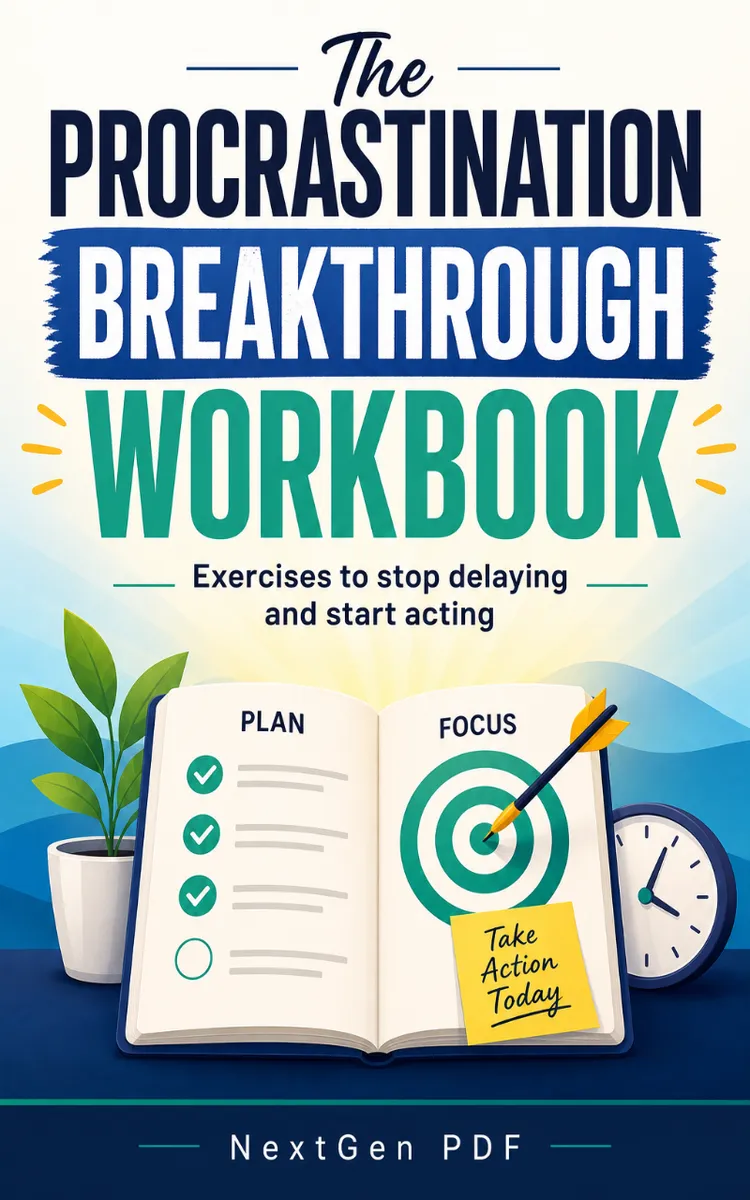
"The Procrastination Breakthrough Workbook" is a workbook by NextGen PDF with 7 chapters and approximately 9,934 words. Turn procrastination into a visible pattern, then break it with guided exercises. Spot your triggers, map the loop, build a 10-minute starting plan, and use a two-list system to choose what matters next.
This book was created using Inkfluence AI, an AI-powered book generation platform that helps authors write, design, and publish complete books. It was made with the Workbook Generator.
Frequently Asked Questions
What is "The Procrastination Breakthrough Workbook" about?
Turn procrastination into a visible pattern, then break it with guided exercises. Spot your triggers, map the loop, build a 10-minute starting plan, and use a two-list system to choose what matters next. Start today, finish the first step, and keep going.
How many chapters are in "The Procrastination Breakthrough Workbook"?
The book contains 7 chapters and approximately 9,934 words. Topics covered include Spot Your Procrastination Triggers, Build a 10-Minute Starting Plan, Use the Two-List Decision System, Time-Block with the Focus Sprint Timer, and more.
Who wrote "The Procrastination Breakthrough Workbook"?
This book was written by NextGen PDF and created using Inkfluence AI, an AI book generation platform that helps authors write, design, and publish books.
How can I create a similar workbook?
You can create your own workbook using Inkfluence AI. Describe your idea, choose your style, and the AI writes the full book for you. It's free to start.
Write your own workbook with AI
Describe your idea and Inkfluence writes the whole thing. Free to start.
Start writingCreated with Inkfluence AI


