

Read the first chapter
The whole of chapter one, free. About 13 min. Turn the pages with the arrows, your keyboard, or a swipe.
Chapter 1
Day 1-6: Waiting Without Withering-God’s Presence in the In-Between
CHAPTER 1
Day 1–6: Waiting Without Withering—God’s Presence in the In-Between
1) HOOK — When Waiting Starts Feeling Like a Verdict
There’s a particular kind of quiet that settles over a person after another wedding invitation arrives.
You smile. You mean it. You love them. You’re happy for them—actually happy, not fake happy. But later, when the room gets quiet and the phone is face down, something in your chest asks the question you didn’t want to ask:
What about me?
Not in a selfish way. Not in a bitter way, at least not always. More like a tired way. A human way.
You’ve prayed. You’ve tried to be faithful. You’ve gone to church, served, waited, forgiven, grown, started over, maybe even deleted and re-downloaded the dating app more times than you want to admit. And still, the timeline hasn’t moved the way you thought it would.
That’s when waiting can start to feel less like a season and more like a report card.
Single at this age? Still no answer? Still no person? Still no clear direction?
The world has its own scoreboard. The church, if we’re honest, sometimes borrows it without meaning to. Marriage can get treated like the finish line of maturity, and singleness can get treated like an awkward waiting room where everyone keeps asking, “So… any updates?”
That question can wear on a soul.
But here’s where we need to slow down. Your longing is not proof that God is late. Your singleness is not proof that you are lacking. Your waiting is not a divine rejection letter.
I know that sounds simple. Maybe too simple. But simple truth is often what we need when the mind starts building a courtroom.
Waiting can either become a place where your heart withers under accusation, or it can become a place where God trains trust, steadies identity, and meets you in the in-between.
That is the fork in the road.
Not later. Not once the relationship begins. Not once the loneliness gets quiet.
Now.
2) TEXT + THESIS — Scripture Before the Scoreboard
Bible translation: New International Version (NIV).
“Wait for the LORD; be strong and take heart and wait for the LORD.” — Psalm 27:14, NIV
Here is the thesis for this chapter:
Waiting does not define your worth; in Christ, waiting becomes a place to receive God’s presence, practice trust, and obey faithfully without letting delay become a verdict.
That sentence matters. Read it again if you need to.
Waiting does not define your worth.
The Word of God does.
Psalm 27 does not say, “Wait for the Lord because your life is on pause.” It does not say, “Wait for the Lord because you are behind.” It does not say, “Wait for the Lord because God is withholding love until you become more impressive.”
It says, “Wait for the LORD; be strong and take heart.”
Strength is needed because waiting is not easy. Courage is needed because delay can shake the inner life. And the command to wait is repeated because God knows our hearts tend to run when we cannot control the outcome.
Wait for the Lord.
Not wait for the ring as your savior. Not wait for another person to become your identity. Not wait for marriage to finally validate your life.
Wait for the Lord.
That is not a consolation prize. That is the center.
And yes, I know—if you desire marriage, that desire is not automatically unspiritual. Scripture honors marriage. God created marriage. Wanting covenant love is not a defect in your discipleship.
But the desire for marriage was never meant to carry the full weight of your identity. It cannot. It will collapse under that kind of pressure.
Only Christ can hold that weight.
3) STEELMAN — The Best Version of the Opposing View
Let’s name the opposing view fairly before we challenge it.
The mainstream cultural view says something like this:
“Waiting is mostly wasted time. If you want something, you should optimize yourself, market yourself, take control, and measure progress by results. If you are still single, maybe you have not tried hard enough, healed enough, improved enough, or positioned yourself well enough. Your timeline is your responsibility, so take charge.”
Now, to be fair, there is some truth hiding inside that view.
Personal responsibility matters. Wisdom matters. Growth matters. If you desire marriage, it is not wrong to develop maturity, communicate better, build community, make wise dating choices, and deal honestly with patterns that need sanctification. Passivity is not holiness. Avoidance is not trust.
So yes, we should reject the lazy version of waiting that says, “I’ll do nothing and call it faith.”
But there’s also a soft-church version of the problem. It sounds more spiritual, but it can still harm the heart:
“Just be content. Stop wanting marriage so much. Maybe when you’re finally satisfied enough, God will bring someone.”
That one is sneaky.
It turns contentment into a contract. It makes peace a bargaining chip. It implies that God is waiting for you to reach some emotional score before He blesses you.
And honestly? That can crush people.
Because then every lonely moment becomes evidence against you. Every tear becomes proof you are not content enough. Every desire becomes suspicious.
That is not biblical contentment. That is spiritual pressure wearing church clothes.
So here is the third path: not secular control, not spiritualized shame.
Faithful waiting.
Faithful waiting says: “I will take wise responsibility, but I will not worship control.” “I will desire marriage honestly, but I will not let desire define my worth.” “I will practice contentment, but not as a bribe to get God to move faster.” “I will wait for the Lord, because He is present now—not only at the outcome.”
That’s the better road.
Harder, maybe. But better.
4) RECEIPTS — What Scripture, Logic, and Lived Reality Actually Show
Let’s bring receipts without pretending we can prove every detail of God’s timing like a lab result. We cannot.
We are not making a scientific claim here like, “Waiting produces X measurable outcome in every Christian single.” That would be overreach. People’s stories differ. Some marry young. Some marry later. Some remain single longer than expected. Some experience deep grief around this topic.
So we need to argue at the right level: biblical worldview, spiritual formation, and plain logic about the human heart.
Claim 1: Scripture does not treat waiting as wasted time.
The Bible is full of waiting people.
Abraham waited for the promised son. Joseph waited through betrayal, slavery, and prison. David was anointed king and still spent years running from Saul. Israel waited in exile. Simeon waited to see the consolation of Israel. The early believers waited for the promised Spirit.
Now, not every biblical waiting story maps directly onto singleness. We should be careful there. You are not Abraham. Your dating life is not Joseph’s prison. Let’s not flatten Scripture into motivational slogans.
But the pattern is still clear: God often forms His people in seasons where the outcome is not immediate.
Waiting, in Scripture, is not empty space. It is often the place where trust is exposed and rebuilt.
Psalm 27:14 does not mock the waiting person. It strengthens them.
Isaiah says it this way:
“But those who hope in the LORD will renew their strength. They will soar on wings like eagles; they will run and not grow weary, they will walk and not be faint.” — Isaiah 40:31, NIV
Notice the promise is not, “Those who hope in the Lord will immediately get the exact timeline they prefer.”
The promise is renewed strength.
That matters. God may not answer every “when” on your schedule, but He does not abandon His people in the waiting.
Claim 2: Culture often assumes visible progress equals personal worth.
This is one of the hidden assumptions we need to challenge.
Modern culture loves metrics. Followers. Promotions. Relationship status. Engagement photos. House keys. Baby announcements. Progress is often public, visible, and easy to compare.
So when your life does not show the same visible milestone, the culture quietly suggests you are behind.
But that assumption needs to be cross-examined.
Does public progress equal spiritual maturity? No. Does marriage automatically prove someone is more loved by God? No. Does singleness automatically prove someone is immature, unwanted, or forgotten? Absolutely not.
That logic is false.
Marriage is a good gift, but it is not proof of superior worth. Singleness can be painful, but it is not proof of inferior worth.
The gospel destroys that scoreboard.
In Christ, your worth is not measured by whether someone chose you romantically. Your worth is anchored in the fact that God chose to set His covenant love on you through Jesus Christ.
Paul writes:
“For he chose us in him before the creation of the world to be holy and blameless in his sight.” — Ephesians 1:4, NIV
Chosen in Christ.
Not chosen only once you are married. Not chosen once your life looks socially impressive. Not chosen when your timeline becomes easier to explain.
Chosen in Him.
That is identity heat with biblical roots. Not self-deification. Not “I am enough” in a vague motivational sense. No, stronger than that:
You are not your delay. You are not your relationship status. You are not a failed timeline. You are chosen in Christ. You are seen by the Father. You are being formed by the Spirit. You are not waiting outside the love of God.
That’s not hype. That’s doctrine with shoes on.
Claim 3: The soft-church “contentment contract” distorts grace.
Let’s talk about this carefully.
Some Christian singles have been told—directly or indirectly—that if they become content enough, then God will finally bring a spouse. The idea sounds encouraging at first. It tries to say, “Trust God.” But if we’re not careful, it becomes a formula:
Contentment + patience + purity + prayer = marriage.
That is not Christianity. That is a vending machine.
God is not a vending machine.
Faithfulness matters. Obedience matters. Sexual holiness matters. Prayer matters. But they are not coins you insert into heaven to purchase an outcome.
Grace is not a transaction. God’s love is not a contract you activate by becoming emotionally impressive.
To be precise, Scripture does call believers to contentment. Paul says:
“I have learned to be content whatever the circumstances.” — Philippians 4:11, NIV
But Paul’s contentment was not a manipulation tool to get a better life outcome. It was a learned stability in Christ whether circumstances improved or not.
That is different.
Biblical contentment does not mean you stop desiring good things. It means your desire is no longer allowed to overthrow your trust in God.
Or rather—let me say that cleaner: contentment does not kill longing. It submits longing to the Lordship of Christ.
That’s the line.
Claim 4: Waiting reveals what has been carrying your identity.
This is where it gets personal.
Waiting has a way of showing us what we have asked marriage to do.
Sometimes we ask marriage to prove we are lovable. Sometimes we ask marriage to silence family pressure. Sometimes we ask marriage to give us a future we can finally explain. Sometimes we ask marriage to heal loneliness that only God can fully meet.
Does this even make sense? I think it does, because many of us do this without realizing it. We don’t wake up and say, “I would like to make marriage my functional savior today.” Nobody talks like that.
But the heart can drift there.
And waiting exposes it.
That exposure is not condemnation. It is mercy. God reveals false foundations so He can replace them with something stronger.
Jesus said:
“But seek first his kingdom and his righteousness, and all these things will be given to you as well.” — Matthew 6:33, NIV
The order matters. Seek first His kingdom.
Not because your desires are meaningless. Not because marriage is bad. But because every good gift becomes dangerous when it becomes ultimate.
Marriage is a gift. Christ is Lord.
Keep those in the right order, and your heart can breathe.
5) IMPLICATION — The Fork in the Road
So here is the fork.
You can treat waiting like a verdict, or you can receive it as a place where God is present.
One road says:
“My delay defines me.” “My singleness proves something is wrong.” “My worth rises and falls with romantic progress.” “I must either control the outcome or collapse under disappointment.”
That road withers the heart.
The other road says:
“My delay is real, but it is not my identity.” “My desire is honest, but it is not my master.” “My worth is rooted in Christ, not my timeline.” “I will wait for the Lord with courage, because He is with me in the in-between.”
That road forms the heart.
Not instantly. Not dramatically every day. But truly.
And let’s be honest: choosing the second road does not mean you will never cry again. It does not mean wedding photos will never sting. It does not mean loneliness will magically stop knocking at the door.
Faith is not emotional numbness.
Faith is returning to God when your emotions are loud.
The question is not, “Will I ever feel weary?” You probably will.
The question is, “Will I let weariness become the final authority?”
Scripture says no.
Wait for the Lord. Be strong. Take heart. Wait for the Lord.
There’s the command. There’s the comfort. There’s the road.
6) IDENTITY + ACTION — Who You Are While You Wait
You need lines you can underline when the day gets heavy.
You are in Christ before you are in a relationship. You are loved before you are chosen by a person. You are seen before your life is understood by others. You are being formed before your future is visible. You are not benched. You are not behind in the kingdom of God. You are not a problem to be solved. You are a disciple being shepherded.
That does not remove responsibility. It gives responsibility a better root.
Because you are in Christ, you can act from peace instead of panic. Because you are under Scripture, you do not have to obey every anxious thought. Because you belong to the Father, you can bring Him your longing without pretending it is smaller than it is.
Now let’s make this practical.
Not someday. Not “when life calms down.”
Monday morning.
Monday Morning Action: The Three-Minute Return
Set a timer for three minutes before your day gets loud.
Minute 1 — Tell the truth. Say or write: “Father, I feel ______ about waiting today.”
No polishing. No spiritual performance. Just truth.
Minute 2 — Read Psalm 27:14 slowly. “Wait for the LORD; be strong and take heart and wait for the LORD.”
Read it like it is addressed to a real person with a real ache. Because it is.
Minute 3 — Choose one faithful step. Ask: “What is one obedient thing I can do today without controlling the outcome?”
Examples:
• Put the phone down when comparison starts pulling you under.
• Send the message you need to send with clarity and kindness.
• Take a walk and pray honestly instead of spiraling.
• Serve someone without turning service into a bargain with God.
• Write one sentence of gratitude for evidence of God’s care.
One step. That’s it.
Real faith doesn’t have to float above ordinary life. It moves through it.
7) INVITATION — Grace for the In-Between
If you have been treating waiting like a report card, you can lay that down today.
Not because your desire no longer matters. It does matter.
But because your desire was never meant to be your judge.
God is not standing over you with a clipboard, grading your singleness. He is not waiting for you to become impressive enough to receive His care. He is not embarrassed by your longing, your tears, your questions, or your tired prayers.
In Christ, the door is open.
So come honestly.
Come with the ache. Come with the questions. Come with the hope that feels stretched thin. Come with the part of you that still wants marriage and the part of you that is afraid to want it too much.
The Father can handle all of it.
Today, you have agency. You can decide what story will interpret your waiting.
Will delay become your verdict?
Or will God’s Word become your anchor?
Choose the anchor.
Wait for the Lord—not as someone forgotten, but as someone held. Be strong—not because you feel strong, but because His grace can carry what your emotions cannot. Take heart—not because the timeline is clear, but because God’s character is.
Waiting without withering is possible.
Not because you become numb. Not because marriage stops mattering. Not because every question gets answered.
But because God is present in the in-between.
And His presence is not a small thing.
It is enough for today.
OPTIONAL DIG DEEPER — Receipts for the Waiting Heart
• Psalm 27:14 — Waiting is paired with courage, not passivity. God strengthens His people while they wait.
• Isaiah 40:31 — The promise attached to hope in the Lord is renewed strength, not instant timeline control.
• Philippians 4:11–13 — Contentment is learned stability in Christ, not a contract to force outcomes.
• Ephesians 1:4 — Identity begins with being chosen in Christ, not being chosen romantically.
• Matthew 6:33 — The kingdom comes first. Good gifts must stay beneath the lordship of God.
End of chapter one. 9 more chapters in the full book.
Swipe or use the arrows to turn the page

Christian Faith Healing And The Power Of Miracles

The Overthinker’s 90-Day Prayer Journal

The Empty Nester's Next-Chapter Devotional
What's inside: 10 chapters
- 1. Day 1-6: Waiting Without Withering-God’s Presence in the In-Between
- 2. Day 7-12: Prayer That Doesn’t Perform-Talking to God Like a Father
- 3. Day 13-18: Contentment Over Comparison-Guarding Your Heart in a Loud World
- 4. Day 19-24: Surrender the Timeline-Letting God Be God in Your Waiting
- 5. Day 25-30: Rest in Grace-Healing Burnout Without Earning Love
- 6. Day 31-36: Hope That Holds-Trusting God’s Character When You Can’t See the Plan
- 7. Day 37-42: Renewed Identity-Becoming the Person God Is Forming While You Wait
- 8. Day 43-48: Healthy Boundaries and Wise Choices-Love Without Letting Life Collapse
- 9. Day 49-54: Faithful Community-Serving, Belonging, and Not Waiting Alone
- 10. Day 55-60: Peace for the Next Step-Living Ready, Not Anxious
About this book
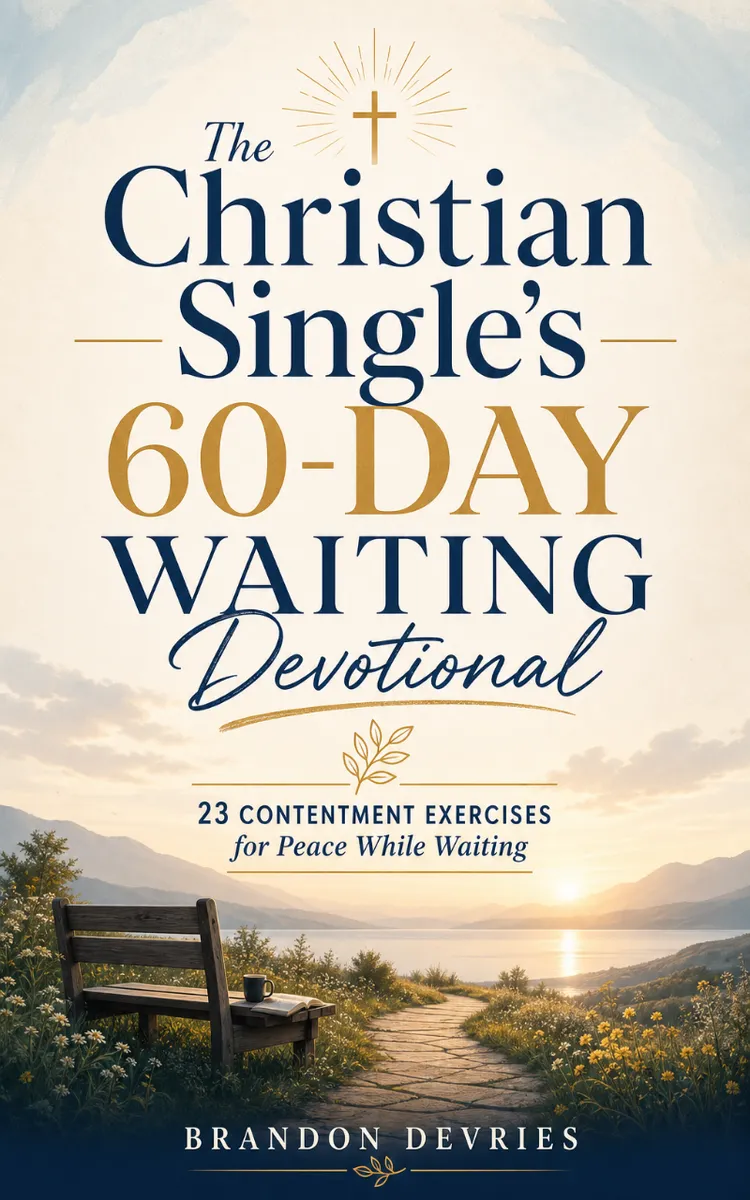
"The Christian Single’s 60-Day Waiting Devotional" is a religious devotional book by Brandon DeVries with 10 chapters and approximately 36,094 words. Daily Christian devotional for singles waiting for marriage.
This book was created using Inkfluence AI, an AI-powered book generation platform that helps authors write, design, and publish complete books.
Frequently Asked Questions
What is "The Christian Single’s 60-Day Waiting Devotional" about?
Daily Christian devotional for singles waiting for marriage
How many chapters are in "The Christian Single’s 60-Day Waiting Devotional"?
The book contains 10 chapters and approximately 36,094 words. Topics covered include Day 1-6: Waiting Without Withering-God’s Presence in the In-Between, Day 7-12: Prayer That Doesn’t Perform-Talking to God Like a Father, Day 13-18: Contentment Over Comparison-Guarding Your Heart in a Loud World, Day 19-24: Surrender the Timeline-Letting God Be God in Your Waiting, and more.
Who wrote "The Christian Single’s 60-Day Waiting Devotional"?
This book was written by Brandon DeVries and created using Inkfluence AI, an AI book generation platform that helps authors write, design, and publish books.
Write your own religious devotional book with AI
Describe your idea and Inkfluence writes the whole thing. Free to start.
Start writingCreated with Inkfluence AI


