

Read the first chapter
The whole of chapter one, free. About 12 min. Turn the pages with the arrows, your keyboard, or a swipe.
Chapter 1
Day 1: When the Valley Feels Too Heavy
CHAPTER 1
Day 1: When the Valley Feels Too Heavy
“How long, Lord? Will you forget me forever? How long will you hide your face from me? How long must I wrestle with my thoughts and day after day have sorrow in my heart?” — Psalm 13:1–2 (NIV)
The Weight of the First Silence
Grief has a distinct, suffocating weight. It is not an abstract concept or a soft emotional background note; it is a physical, psychological, and spiritual force that alters the air in the room.
If you are currently walking through the dark lower elevations of a deep loss, you already know that ordinary life changes overnight. The world outside your window continues its rapid, unbothered movement, while inside your home, the quiet feels deafening and small daily tasks feel like climbing a mountain with lead in your shoes.
You wake up, and for a fraction of a second, your mind rests in the familiar reality of yesterday. Then, the weight hits your chest. You remember.
• The funeral is over, but the silence in the hallway remains.
• The test results came back, and the future you planned was erased in a single phone call.
• The pregnancy test is negative, or the room that was supposed to hold a cradle is now an empty space behind a closed door.
• The divorce papers are signed, and the home you built feels like an unfamiliar museum of broken promises.
• The trauma occurred, and your nervous system refuses to believe the danger has passed.
In those first heavy hours, well-meaning people often bring food, advice, or quick theological aphorisms designed to make them feel more comfortable with your pain. They tell you to look for the silver lining. They remind you that God works all things together for good. They encourage you to stay strong, to keep your chin up, or to remember that your loved one is in a better place.
While those words may stem from genuine affection, they frequently land like gravel on an open wound. They create an unspoken expectation that a faithful Christian ought to handle catastrophic loss with composed dignity, quiet resignation, and immediate spiritual victory.
So you sit on the edge of the bed and wonder why you can’t pray properly. You wonder why your throat tightens when you try to sing a hymn at church. You wonder if the numbness, the sudden anger, or the relentless cycle of “what-ifs” running through your head means your faith is secretly failing.
Here is the truth you need to hear before you take another step today: God does not require you to edit your pain before you enter His presence.
He is not standing at the edge of your valley waiting for you to pull yourself together, dry your tears, and present a composed face. He does not treat your grief as an embarrassment, nor does He view your exhaustion as a lack of trust. The valley is heavy, but you are allowed to tell the truth about how hard it is to carry.
The Lie of the Polished Faith
For centuries, a subtle, dangerous assumption has circulated within church culture—the quiet belief that sorrow and spiritual maturity are fundamentally incompatible.
We don't always say it aloud, but we live as though it were true. We reward performance-based optimism. We celebrate testimonies that skip rapidly from the onset of tragedy to the triumph of deliverance, treating the painful middle section as something to be endured quickly and forgotten.
When someone asks how we are doing in the lobby after a service, the default Christian response is almost reflexively engineered: “I'm blessed,” or “God is good,” spoken through clenched teeth while the heart inside is splintering into a thousand pieces.
This impulse to cover our grief with spiritual language is not faith; it is fear. It is the fear that if we admit how much we hurt—if we admit that we feel abandoned, confused, or physically overwhelmed—we are somehow failing God or dishonoring His name.
We treat God like an fragile earthly ruler who can only tolerate praise, assuming He will turn away if our first words to Him are marked by raw protest or heavy silence.
Scripture shatters this false paradigm entirely.
When you open the Bible, you do not find a manual for toxic positivity. You find a rugged, honest record of real human beings suffering real, unvarnished pain in a fallen world. More than one-third of the Psalms are psalms of lament—cries of distress, sorrow, and disorientation preserved by the Holy Spirit for the corporate worship of God’s people.
Consider David in Psalm 13. He does not begin with an altar call or a victory shout. He opens his prayer with a raw, relentless question:
“How long, Lord? Will you forget me forever? How long will you hide your face from me?”
Look closely at those words. David does not say, “Lord, I know You are near, so I will pretend I don't feel forgotten.” He explicitly names the sensation of abandonment. He admits that he is wrestling with his thoughts daily, carrying sorrow in his heart hour after hour.
God did not strike David down for asking “How long?” He did not edit those lines out of the holy canon to preserve His public image. God inspired those words. He preserved them. He bound them into the holy Book so that when your world collapses, you will know that the path of raw, unvarnished honesty has already been walked by the saints before you.
Lament is not the opposite of faith. Lament is faith turned toward God in the middle of the dark.
The person who stops praying entirely because of suffering has given up on the relationship. But the person who comes to God and cries, “Where are You? Why does this hurt so much?” is still actively engaging the Almighty. They are bringing their absolute worst moments to the only One who holds the power to save.
God is not threatened by your questions. He is not offended by your tears. He can receive your sorrow in all its messy, unresolved complexity without asking you to fix it first.
Receipts from the Valley: Why Pain Takes Time
To understand why grief feels so disorienting, we have to look at how God designed the human soul and body.
We live in a culture obsessed with efficiency. We expect instantaneous digital communication, fast recovery times, and four-step solutions to complex emotional problems. When grief strikes, we naturally apply that same mechanical mindset to our internal lives. We treat sorrow like a technical glitch in our software—something to be diagnosed, repaired, and erased as quickly as possible so we can resume normal operations.
Biologically and spiritually, however, human grief does not operate on a digital timetable.
When you suffer a major personal loss, your entire being undergoes a profound shock. Neurologically, your brain is forced to rewrite its internal map of reality. The physical body carries the stress of loss in measurable ways:
• Muscle tension and persistent physical fatigue
• Disrupted sleep cycles and altered brain chemistry
• Short-term memory lapses and cognitive fog
• A persistent feeling of physical heaviness in the chest or stomach
This is not a sign of spiritual weakness; it is the physical cost of loving deeply in a world broken by sin and death. Your body and mind are processing a severe tear in the fabric of your life.
When the Bible speaks of grief, it routinely acknowledges the deep physical toll of suffering. In Psalm 6:6, David writes, “I am worn out from my groaning; all night long I flood my bed with weeping and drench my couch with tears.” In Psalm 31:9, he writes, “My eyes grow weak with sorrow, my soul and body with grief.”
Scripture never treats human beings as disembodied spirits who can simply snap their fingers and ignore physical and emotional exhaustion.
Notice the structure of Psalm 13. The psalm eventually ends with a declaration of trust in God’s unfailing love, but it does not rush there. David spends the first four verses pouring out his ache, his fear, and his exhaustion before he takes his single step toward confidence.
┌────────────────────────────────────────────────────────────────────────┐ │ THE ARCH OF SCRIPTURAL LAMENT │ │ │ │ 1. HONEST CRY 2. PERSISTENT PETITION 3. ANCHORED TRUST │ │ "How long, Lord?" ➔ "Look on me and answer" ➔ "I trust in Your │ │ (Naming the pain) (Asking for help) unfailing love" │ │ │ └────────────────────────────────────────────────────────────────────────┘ If you try to jump straight to step three without passing through steps one and two, your trust will be a brittle, manufactured performance rather than a genuine anchor for your soul.
Healing is an organic process, not a mechanical achievement. God works through time, through truth, through community, and through His quiet presence to stitch broken lives back together.
If someone demands that you move past your grief before your heart has had time to process the loss, you have full permission under God's Word to step back from that demand. You are not on a deadline. You are on a journey through a valley, and the Good Shepherd walks at a human pace.
The Decision Before You
Grief will inevitably push you toward a fork in the road. When the valley feels impossibly heavy, you will be tempted to choose one of two dangerous paths:
• The Path of Fake Strength: You decide to lock your emotions away, put on a stoic face for your family or church, and act as though your faith makes you immune to pain. You suppress your tears, refuse help, and exhaust yourself trying to preserve an image of spiritual invincibility.
• The Path of Bitter Isolation: You conclude that because God did not prevent your loss, He must be cruel, indifferent, or absent. You close your heart, retreat from God and safe people, and allow your sorrow to curdle into cynical resentment.
There is a third path—the biblical path of Grace-Anchored Honesty.
This path requires you to drop the mask without letting go of God's hand. It allows you to sit on the floor and weep while still directing those tears toward your Heavenly Father. It lets you say, “Lord, I don't understand what You are doing, I don’t feel Your presence right now, but I am choosing to stay right here with You until the light breaks.”
/─► FAKE STRENGTH (Suppression & Masking) │ THE FORK IN THE ROAD ───┼─► BITTER ISOLATION (Resentment & Withdrawal) │ \─► GRACE-ANCHORED HONESTY (Honest Cry + Reaching Out) Choosing this path does not mean you will magically feel better by tonight. It simply means you stop wasting your limited physical energy on pretending. It means you allow your identity in Christ to be your bottom line, even when your emotions are in turmoil.
You are not defined by the speed of your recovery. You are defined by the God who purchased you with His own Son's blood, who counts every tear that falls from your eyes, and who has promised that the valley—no matter how dark—is never the final destination of your story.
Your Daily Groundwork
You do not need to rewrite your entire life today. You only need enough grace for the next step. Here are three simple, low-barrier practices to help you bring your grief into the light of God's grace today:
1. Write the Unedited Sentence
Set a timer for five minutes. Take a plain piece of paper and finish this phrase with complete, unedited honesty:
“Today, I am grieving...”
Do not edit your sentence to make it sound spiritual. Do not add a pious disclaimer at the end. If you are grieving the loss of your morning routine with a spouse, write that down. If you are grieving the financial stability that evaporated with a diagnosis, write that down. If you are angry, terrified, or simply exhausted, name it clearly.
When you finish, leave the page open before the Lord. Consider it an act of worship—a physical presentation of your raw reality to the One who sees all things.
2. Establish a Gentle Limit
Grief consumes an immense amount of physical energy. If you are trying to maintain your baseline level of productivity, social engagement, or church service while your heart is broken, you will burn out.
Identify one nonessential demand on your calendar today and step away from it. Say to yourself—or to someone else—without guilt:
“I don't have the capacity for that today, but I am caring for my heart as I navigate this season.”
Protecting your capacity is not selfish; it is wise stewardship of a bruised soul.
3. Practice the Two-Sentence Breath Prayer
When your thoughts begin to spin out of control, find a quiet chair. Place both feet flat on the floor, rest your hands on your laps, and breathe slowly.
• As you inhale, pray in your mind: “Lord, I am heavy...”
• As you exhale, pray: “...hold me right here.”
Repeat this three times. You don’t need an elaborate sermon. A single sentence of honest turning is enough to keep your anchor set.
A Grace-Anchored Invitation
If your faith feels shaky today, remember that your security does not depend on the strength of your grip on God; it depends entirely on His unbreakable grip on you.
Jesus Christ did not stay far away from human suffering. He entered it. He was named a “man of sorrows, and acquainted with grief” (Isaiah 53:3). He wept openly at the tomb of His friend Lazarus, even knowing He was about to raise him from the dead. He knelt in the dark dirt of Gethsemane, sweating drops like blood, crying out to His Father under the weight of an agonizing load.
When you sit in the dark of your own valley, you are sitting with a Savior who knows the exact terrain of human heartbreak. He does not view you from a safe, academic distance. He stands beside you in the debris of your broken plans, offering not a harsh reprimand, but His gentle, enduring presence.
You do not have to finish the journey today. You do not have to solve tomorrow's problems tonight.
Take a breath. Give your sorrow a name. Let God sit with you in the quiet. The valley may feel too heavy for your arms, but it is not too heavy for His.
Closing Prayer
Lord God, here I am.
I bring You my broken words, my exhausted body, and the sorrow I cannot fix. Thank You that I do not have to pretend to be strong when I feel completely undone.
You see the loss I carry—the empty space, the terrifying diagnosis, the shattered relationship, the quiet rooms, and the unanswered questions that return in the night. Forgive me for the times I have tried to hide my pain behind fake strength or pull away from You in bitterness.
Give me grace for this exact hour. Give me the courage to tell You the truth without fear. When my faith feels small and my thoughts are spinning, remind me that Your love is not measured by my calm, but anchored in Your character.
Hold me when I cannot hold myself. Surround me with safe people who offer comfort without pressure. Step into my valley today, Lord, and let Your presence be enough for the next step.
In Jesus' name, Amen.
Dig Deeper
Use these prompts for personal journal entry, quiet meditation, or discussion with a trusted friend or counselor this week:
• Scripture Focus: Read Psalm 13:1–6 and Psalm 34:17–19. Highlight every word that describes God’s proximity to people who are hurting.
• Self-Examination: What is one emotion (anger, fear, confusion, numbness) you have been trying to hide from God because you thought it was “unspiritual”? What changes when you realize He can handle that emotion?
• Practical Care: What is one physical need your body has right now (water, sleep, nutritious food, a walk, professional medical or counseling support) that you have been neglecting while carrying this grief? How can you address it today?
End of chapter one. 9 more chapters in the full book.
Swipe or use the arrows to turn the page

Christian Faith Healing And The Power Of Miracles

The Overthinker’s 90-Day Prayer Journal

The Empty Nester's Next-Chapter Devotional
What's inside: 10 chapters
- 1. Day 1: When the Valley Feels Too Heavy
- 2. Day 2: God Hears Your Lament
- 3. Day 3: Comfort That Doesn’t Require Pretending
- 4. Day 4: When the Loss Is Personal (Death, Miscarriage, Diagnosis)
- 5. Day 5: Trust When Your Heart Feels Unsteady
- 6. Day 6: Grace for the Broken Places (Divorce, Trauma, Exhaustion)
- 7. Day 7: God Restores What the Valley Took
- 8. Day 8: Returning to God After the Valley (A Gentle Reset)
- 9. Day 9: Comfort for Caregivers, Pastors, and Ministry Leaders
- 10. Day 10: A Pocket Prayer Plan for the Weeks Ahead
About this book
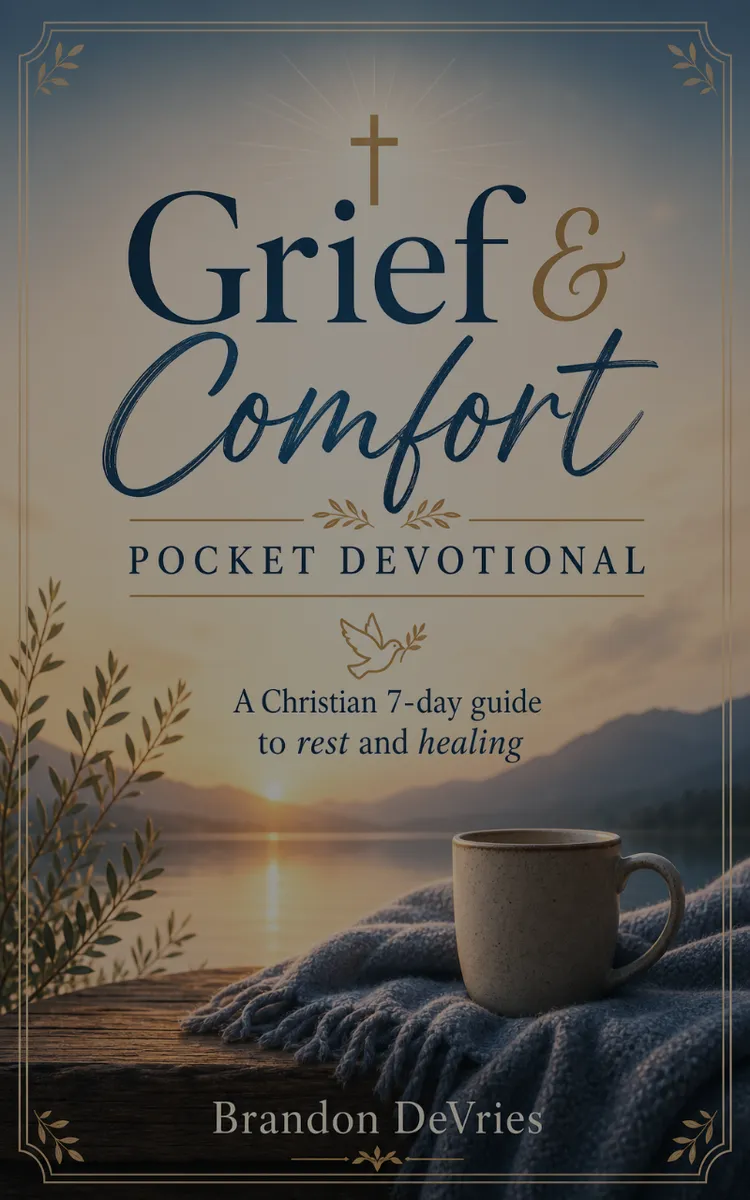
"Grief & Comfort Pocket Devotional" is a religious devotional book by Brandon DeVries with 10 chapters and approximately 31,442 words. Christian devotional for grief, loss, and healing with prayers.
This book was created using Inkfluence AI, an AI-powered book generation platform that helps authors write, design, and publish complete books.
Frequently Asked Questions
What is "Grief & Comfort Pocket Devotional" about?
Christian devotional for grief, loss, and healing with prayers
How many chapters are in "Grief & Comfort Pocket Devotional"?
The book contains 10 chapters and approximately 31,442 words. Topics covered include Day 1: When the Valley Feels Too Heavy, Day 2: God Hears Your Lament, Day 3: Comfort That Doesn’t Require Pretending, Day 4: When the Loss Is Personal (Death, Miscarriage, Diagnosis), and more.
Who wrote "Grief & Comfort Pocket Devotional"?
This book was written by Brandon DeVries and created using Inkfluence AI, an AI book generation platform that helps authors write, design, and publish books.
Write your own religious devotional book with AI
Describe your idea and Inkfluence writes the whole thing. Free to start.
Start writingCreated with Inkfluence AI


