

Read the first chapter
The whole of chapter one, free. About 9 min. Turn the pages with the arrows, your keyboard, or a swipe.
Chapter 1
Biblical Foundations of Education
Scripture Sets the Purpose of Education
A child learning Deuteronomy 6 is not merely memorizing religious information. The child is being taught how to love God, interpret life, make decisions, and live faithfully in ordinary places: at home, on the road, when lying down, and when rising. That picture gives Christian education its first legal and ethical question: What is education for? Scripture answers before an institution writes a curriculum or adopts a policy.
These passages also establish the proper order of authority. Deuteronomy 6:4-9 places parents and the covenant community under God’s command. Proverbs 1:7 identifies the fear of the Lord as the beginning of knowledge. Second Timothy 3:14-17 shows Scripture forming the servant of God for faithful living and good work. Together, these texts help educators distinguish divine purposes from institutional aims. A seminary may schedule courses, issue certificates, and maintain records, but it does not create the authority or purpose of Christian formation.
The earlier foundations of this book have addressed why independent Christian education requires careful attention to both Scripture and law. The present discussion supplies the biblical terms that should guide that work. It also gives leaders a way to test whether a policy serves education as Scripture understands it or merely serves institutional convenience.
Learning Objectives
• Define education, authority, vocation, and formation from Deuteronomy 6:4-9, Proverbs 1:7, and 2 Timothy 3:14-17. - Distinguish God’s purposes for education from the limited aims of a school or seminary. - Apply these definitions to curriculum, policy, and student formation in an independent Christian institution.
The practical takeaway is simple: before asking whether a program is legally independent, ask whether its educational purpose is biblically ordered.
Education, Authority, Vocation, and Formation
Education - the intentional passing on of truth, wisdom, skills, and habits so that a person can live faithfully before God and serve others well.
This definition is broader than classroom instruction. Deuteronomy 6:4-9 describes education as a continuous pattern of hearing, loving, remembering, speaking, and practicing. “Hear, O Israel: The Lord our God is one Lord” comes first. The learner receives truth about God before receiving a method for handling information. The command to love God with heart, soul, and might then joins knowledge to loyalty. Education is therefore not complete when a student can repeat a doctrine. It aims at a life shaped by that doctrine.
The passage also gives a setting for education. Parents teach children through repeated conversation and daily practice. The command is not limited to a religious building. A seminary may extend and strengthen this work, especially by preparing ministers and teachers, but it cannot replace the household, the church, or the believer’s personal obedience. Institutional education is a servant of God’s larger educational purpose.
Authority - the rightful power to teach, command, judge, or govern, received from a legitimate source and exercised within proper limits.
Proverbs 1:7 begins, “The fear of the Lord is the beginning of knowledge.” This statement places God above every educational authority. A teacher may possess expertise. A board may possess delegated responsibility. A state may regulate certain public interests. An accrediting body may set standards for recognition. None of these authorities is ultimate. God’s authority is foundational because truth and moral obligation do not originate with the institution.
The fear of the Lord is not panic. It is reverent submission to God’s judgment and rule. It corrects two errors. First, it prevents educators from treating their own opinions as unquestionable. Second, it prevents students from treating academic success as a substitute for wisdom. Proverbs immediately contrasts this fear with the rejection of instruction. The problem is not lack of data but refusal to be corrected.
A Christian school therefore needs policies that reflect accountable authority. A faculty member should have real responsibility for teaching, but not unlimited power over students. A governing board should protect the institution’s mission, but not rewrite Scripture to preserve enrollment. A student should receive fair treatment, but freedom does not mean freedom from truth or moral responsibility.
Vocation - a God-directed calling to faithful work and service, expressed through particular gifts, responsibilities, and relationships.
Second Timothy 3:16-17 says that Scripture equips “the man of God” for every good work. The phrase does not limit vocation to ordained ministry. Scripture equips believers to serve God in homes, churches, professions, communities, and public responsibilities. A seminary may train pastors, missionaries, chaplains, teachers, and other Christian workers, but its deeper task is to prepare people for faithful obedience wherever God places them.
A course in biblical interpretation, for example, should not aim only at producing a passing grade. It should help a future pastor handle Scripture honestly, help a teacher explain it accurately, and help every student obey it in real decisions. The institutional aim may be “completion of three credit hours.” The divine purpose is the formation of a servant who can do good work under God’s Word.
Formation - the gradual shaping of a person’s beliefs, desires, character, judgment, and conduct.
Formation explains why Christian education cannot be reduced to information transfer. Deuteronomy 6 joins teaching to love. Proverbs joins knowledge to reverence and teachability. Second Timothy joins Scripture to correction, training, righteousness, and readiness for good work. The learner is being shaped from the inside out.
A syllabus can measure attendance, reading, and written work. It cannot by itself measure humility, honesty, courage, or love. Yet those qualities remain central to Christian formation. An independent seminary should therefore ask whether its practices reinforce what it teaches. A school that teaches servant leadership while rewarding manipulation has created a contradiction between curriculum and formation.
The distinction between divine purpose and institutional aim can be stated clearly:
| Divine purpose | Institutional aim | |---|---| | Love God and obey his Word | Complete a course or program | | Grow in wisdom and holiness | Meet academic requirements | | Serve others through a vocation | Prepare for employment or ministry placement | | Become equipped for good work | Issue a transcript, certificate, or degree |
Institutional aims are not automatically wrong. A transcript can document study. A certificate can recognize completion. A schedule can make learning possible. The danger comes when these tools become the final purpose. The seminary exists to serve truth, holiness, and vocation; those purposes do not exist merely to sustain the seminary.
Ask yourself: If the institution achieved its enrollment target but produced graduates who could not handle Scripture faithfully, would it have succeeded? The biblical answer is no. The measure of success must include whether education produces people increasingly prepared for faithful obedience.
A Worked Example: Evaluating a Seminary Ministry Course
Consider an independent seminary planning a twelve-week course titled “Ministry Leadership.” The proposed institutional requirements are twelve weekly meetings, ten reading responses, one final paper, and a passing grade of 70 percent. Those details are useful, but they do not yet show whether the course is Christian education.
1. Identify the divine purpose. Begin with 2 Timothy 3:16-17. The course should use Scripture for teaching, correction, reproof, and training in righteousness, with the goal of equipping students for good work. The outcome is not simply knowledge of leadership theories. It is faithful service.
2. Identify the governing authority. Proverbs 1:7 requires reverence for the Lord and willingness to receive instruction. The instructor may select readings and establish assignments, but Scripture remains the highest teaching authority. A popular leadership model may be discussed, yet it cannot overrule Christ’s commands concerning humility, truth, sacrifice, and care for the weak.
3. Define the vocation served. Students may enter pastoral ministry, Christian education, missions, or nonprofit work. The course should therefore connect leadership principles to actual responsibilities: teaching a congregation, correcting error, handling money, resolving conflict, and protecting vulnerable people.
4. Name the formation being sought. Deuteronomy 6:4-9 requires more than public performance. The course should cultivate love for God, truthful speech, teachability, patience, and consistent conduct. A student who can describe servant leadership but uses intimidation has not reached the course’s biblical goal.
5. Test the assignments. The ten reading responses may measure comprehension, but at least some work should require application. One assignment might ask students to examine a church policy for evidence of biblical authority, proper limits, and care for people. Another might require a plan for teaching one biblical principle in a congregation or classroom.
6. Set a fair institutional standard. The 70 percent passing mark can remain as an administrative measure. However, a serious ethical failure cannot be hidden by a high average. If a student falsifies ministry records, the institution must address the conduct through a clear process. Academic achievement does not cancel the call to truthfulness.
7. Review the final result. At the end of twelve weeks, the school should ask two questions: Did the student meet the stated academic requirements? Did the course provide meaningful evidence of growth toward faithful service? The first question protects educational clarity. The second protects the biblical purpose.
Final result: the course is properly designed only when its academic requirements serve biblical formation and preparation for good work, rather than replacing them.
This example shows how the four definitions work together. Education supplies the purpose of teaching. Authority identifies the source and limits of instruction. Vocation gives direction to the learning. Formation examines the kind of person the process is shaping. A policy-driven institution can use these four questions when reviewing admissions, faculty expectations, discipline, assessment, and graduation standards.
The practical reflection is to take one existing course and write its divine purpose in one sentence. If the sentence describes only credits, contact hours, or institutional recognition, the course needs a deeper biblical statement.
Guided Practice and Answer Key
1. A seminary requires students to memorize a doctrinal statement but never asks them to apply it in ministry or daily conduct. Which biblical category is most clearly missing? Hint: Consider the difference between repeating information and being shaped for good work.
2. A board claims that its policy is automatically right because the board approved it. How would Proverbs 1:7 correct that claim? Hint: Ask what authority stands above the board and what posture leaders must maintain.
3. Deuteronomy 6:4-9 describes teaching at home, on the road, at bedtime, and in the morning. What does this suggest about the relationship between institutional education and Christian formation? Hint: Consider whether formation can be confined to scheduled classes.
4. A student earns 95 percent in a ministry course but repeatedly deceives people in practical service. Should the institution treat the grade as conclusive evidence of success? Hint: Compare institutional measurement with the biblical purpose of equipping someone for good work.
5. Write one divine purpose and one institutional aim for a course in biblical counseling. Hint: The divine purpose should describe faithful service or formation; the institutional aim may describe a measurable course requirement.
Answer Key: Question 1: Formation and vocation are missing; memorization alone does not establish faithful service. Question 2: God’s authority stands above the board, and leaders must remain teachable before the Lord. Question 3: Institutions support formation but do not contain it; Christian teaching belongs within the whole pattern of life. Question 4: No. The grade measures academic work, while deception contradicts the formation required for good work. Question 5: A divine purpose might be “to prepare students to counsel truthfully and compassionately under Scripture.” An institutional aim might be “to complete a twelve-week course with a supervised counseling case study.”
The biblical foundation is therefore both simple and demanding: education must begin with God, remain accountable to God, and lead toward service under God. When independent Christian educators preserve that order, policies become servants of truth rather than substitutes for it.
End of chapter one. 7 more chapters and about 15,599 words in the full book.
Swipe or use the arrows to turn the page


What's inside: 8 chapters
- 1. Biblical Foundations of Education
- 2. Christian Anthropology and Learning
- 3. Scripture, Interpretation, and Curriculum
- 4. American Christian Education History
- 5. Constitutional Rights and State Authority
- 6. Religious Exemptions and Seminary Compliance
- 7. Governance, Ethics, and Institutional Policy
- 8. Autonomous Seminary Leadership and Review
About this book
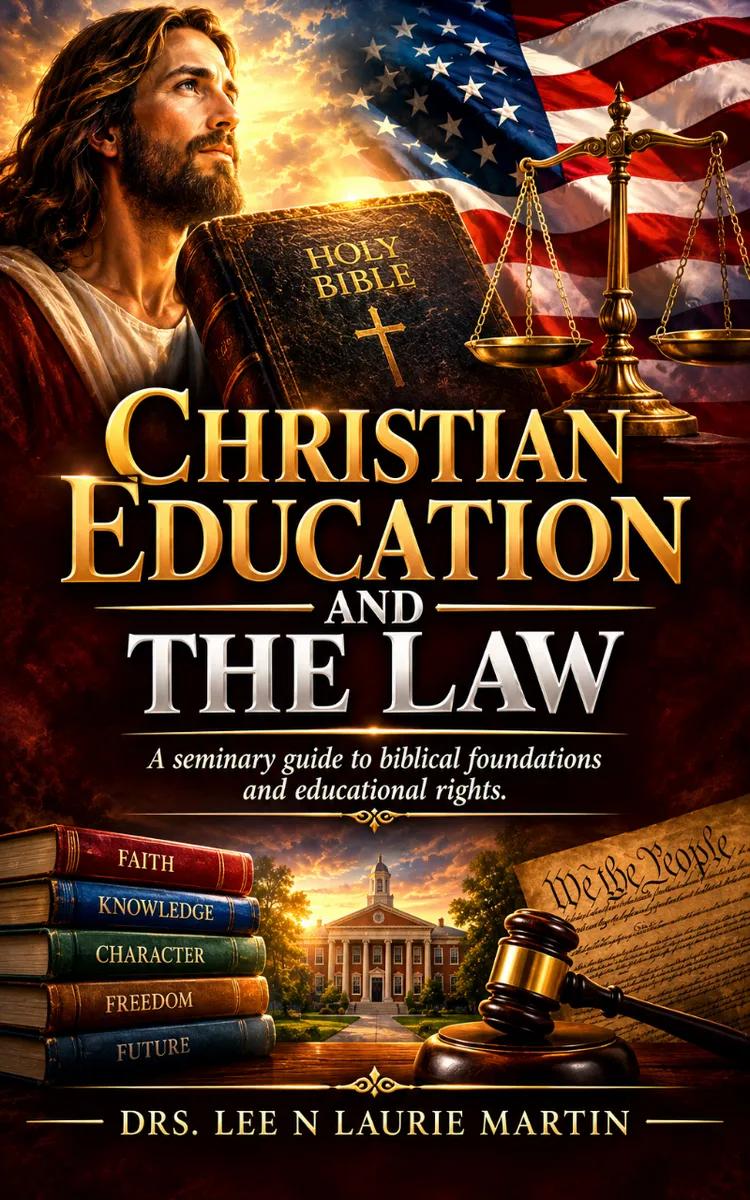
"Christian Education And The Law" is a education book by Drs. Lee & Laurie Martin with 8 chapters and approximately 15,599 words. Biblical, theological, historical, and legal foundations of independent Christian seminaries.
This book was created using Inkfluence AI, an AI-powered book generation platform that helps authors write, design, and publish complete books. It was made with the AI Lesson Plan Generator.
Frequently Asked Questions
What is "Christian Education And The Law" about?
Biblical, theological, historical, and legal foundations of independent Christian seminaries
How many chapters are in "Christian Education And The Law"?
The book contains 8 chapters and approximately 15,599 words. Topics covered include Biblical Foundations of Education, Christian Anthropology and Learning, Scripture, Interpretation, and Curriculum, American Christian Education History, and more.
Who wrote "Christian Education And The Law"?
This book was written by Drs. Lee & Laurie Martin and created using Inkfluence AI, an AI book generation platform that helps authors write, design, and publish books.
How can I create a similar education book?
You can create your own education book using Inkfluence AI. Describe your idea, choose your style, and the AI writes the full book for you. It's free to start.
Write your own education book with AI
Describe your idea and Inkfluence writes the whole thing. Free to start.
Start writingCreated with Inkfluence AI


