

Read the first chapter
The whole of chapter one, free. About 4 min. Turn the pages with the arrows, your keyboard, or a swipe.
Chapter 1
Day 1: A Fresh Start-Welcome to Mindful Self-Care
Scripture Focus
1 Corinthians 6:19-20 (NIV)
> “Do you not know that your bodies are temples of the Holy Spirit, who is in you, whom you have received from God? You are not your own; you were bought at a price. Therefore honor God with your bodies.”
Today’s invitation is to care for your body, mind, and spirit as gifts entrusted to you - not as projects you must perfect.
The alarm rings, your phone is already buzzing, and your mind starts listing everything that needs attention. Before the day has properly begun, you may already feel behind. In that moment, self-care can sound like one more demand: eat better, sleep longer, exercise, pray more, worry less. Even good advice can become heavy when it feels like another scorecard.
Christian self-care begins somewhere gentler. It begins with receiving your life as a gift from God and caring for that gift with wisdom. Paul’s words to the Corinthians remind us that our bodies matter to God. They aren’t disposable containers for our “real” spiritual lives. Our bodies, thoughts, emotions, and spiritual needs are all part of how we live before God.
Stewardship means caring faithfully for what has been placed in our hands. A plumber checks the tools that make the work possible. A small-business owner watches equipment, supplies, and time because neglect eventually affects the whole operation. In a similar way, your body and mind need attention. Rest isn’t laziness. Nourishing food isn’t vanity. A quiet moment with God isn’t wasted time. These practices can help you serve, work, love, and respond with greater steadiness.
Still, stewardship isn’t the same as control. You can’t force your body never to tire or make every anxious thought disappear. You can’t measure your spiritual life by how perfectly you complete a routine. Self-care is not a way to earn God’s love; it is a response to the love you have already received. That distinction matters. Guilt says, “I’ve failed again.” Grace asks, “What care would honor God and support faithful living today?”
Perhaps your first act of care is noticing that you’re exhausted instead of pushing past it automatically. Maybe it’s drinking a glass of water before reaching for a second cup of coffee. Maybe it’s admitting in prayer that you feel scattered, rather than trying to sound composed. These choices may seem small, but mindful faith is often practiced in small moments. You pause. You notice. You invite God into what is actually happening.
Prayerful awareness doesn’t require a silent house, a perfect schedule, or a particular personality. It can happen while washing dishes, sitting in the truck before work, or standing in the kitchen as the kettle heats. You might breathe in slowly and pray, “God, help me receive this day with care.” Then breathe out and release the pressure to handle everything at once.
Gentleness is not an excuse to avoid responsibility. It’s a Christ-shaped way of accepting responsibility without treating yourself harshly. When you care for your body, mind, and spirit, you’re not turning inward in selfishness. You’re making room to love God and neighbor with the strength and attention you actually have.
The foundation for today is simple: your worth does not rise and fall with your productivity. You are God’s beloved before you finish the list, solve the problem, or improve the habit. From that secure place, you can make one faithful choice at a time.
Practice for Today
1. Take a three-minute stewardship pause. Set a timer for three minutes. Sit or stand comfortably, place both feet on the floor, and notice your breathing without trying to change it. Ask God to help you pay attention to your body, mind, and spirit. Then quietly name what you notice: “My shoulders feel tight.” “My thoughts are racing.” “My heart feels thankful.” Don’t criticize what you find. Simply bring it honestly before God.
2. Choose one gentle act of care. Select one action that supports the part of you most in need today. If your body is depleted, drink water, eat a nourishing meal, or go to bed thirty minutes earlier. If your mind is crowded, silence nonessential notifications for one hour. If your spirit feels dry, read a short Gospel passage or sit quietly with God for five minutes. Keep the action realistic. The goal isn’t to redesign your life before dinner. It’s to practice faithful attention.
3. Journal with honesty and grace. Write for five minutes in response to this prompt: Where have I been treating my body, mind, or spirit as something to use rather than something to steward? What would a gentle, God-honoring response look like today? Be specific. You might write, “I keep skipping lunch and then becoming impatient with people. Today I’ll prepare something simple before noon.” Or, “I’ve been carrying worry without naming it. I’ll bring it to God and speak with someone I trust.” End your entry with one sentence of thanks for the care God has already provided.
As you practice, resist the urge to turn these steps into another test. If you miss the timer, forget the journal, or discover that your chosen action wasn’t possible, begin again without scolding yourself. Starting over is part of faithful growth. A fresh start doesn’t need dramatic proof. Sometimes it looks like noticing your limits and choosing the next wise step.
Closing Prayer
God, thank You for giving me a body, a mind, and a spirit to steward. Help me notice my needs without shame and respond with wisdom instead of guilt. Teach me to rest when I need rest, to seek help when I need help, and to receive ordinary moments as places where You are present. Guide my choices today so that caring for myself helps me love You and serve others with a steadier heart. Amen.
End of chapter one. 19 more chapters in the full book.
Swipe or use the arrows to turn the page


What's inside: 20 chapters
- 1. Day 1: A Fresh Start-Welcome to Mindful Self-Care
- 2. Days 2-3: Noticing Without Judgment-Awareness as Worship
- 3. Days 4-5: Prayer Before Panic-Breathing in God’s Presence
- 4. Days 6-7: Trusting the Good Shepherd-Safety for Your Soul
- 5. Days 8-9: Deepening Trust-Letting God Lead Your Attention
- 6. Days 10-11: Hope in Small Steps-Grace for the In-Between
- 7. Days 12-13: Surrender Your Schedule-Rest That Honors God
- 8. Day 14: The Gentle Reset-Confession, Release, and Renewal
- 9. Days 15-16: The Prayer of Presence-Listening for God’s Quiet Guidance
- 10. Days 17-18: Care for the Mind-Renewal Through Truth
- 11. Day 19: Care for the Body-Stewardship, Not Performance
- 12. Days 20-21: Care for Relationships-Love Without Self-Abandonment
- 13. Days 22-23: Surrender Your Control-God’s Peace Over Your Plans
- 14. Day 24: The Work of Forgiveness-Healing That Doesn’t Excuse Harm
- 15. Days 25-26: Hope for Hard Days-God’s Presence in the Valley
- 16. Days 27-28: Spiritual Disciplines for Self-Care-Rhythms That Form You
- 17. Days 29-30: Living From Abundance-Gratitude, Contentment, and Joy
- 18. Day 31: A Letter to Your Future Self-Commit to Ongoing Mindful Care
- 19. Day 32: When You Fall Back-How to Return to Prayer and Peace
- 20. Day 33: The Ongoing Journey-Self-Care as a Life of Surrender
About this book
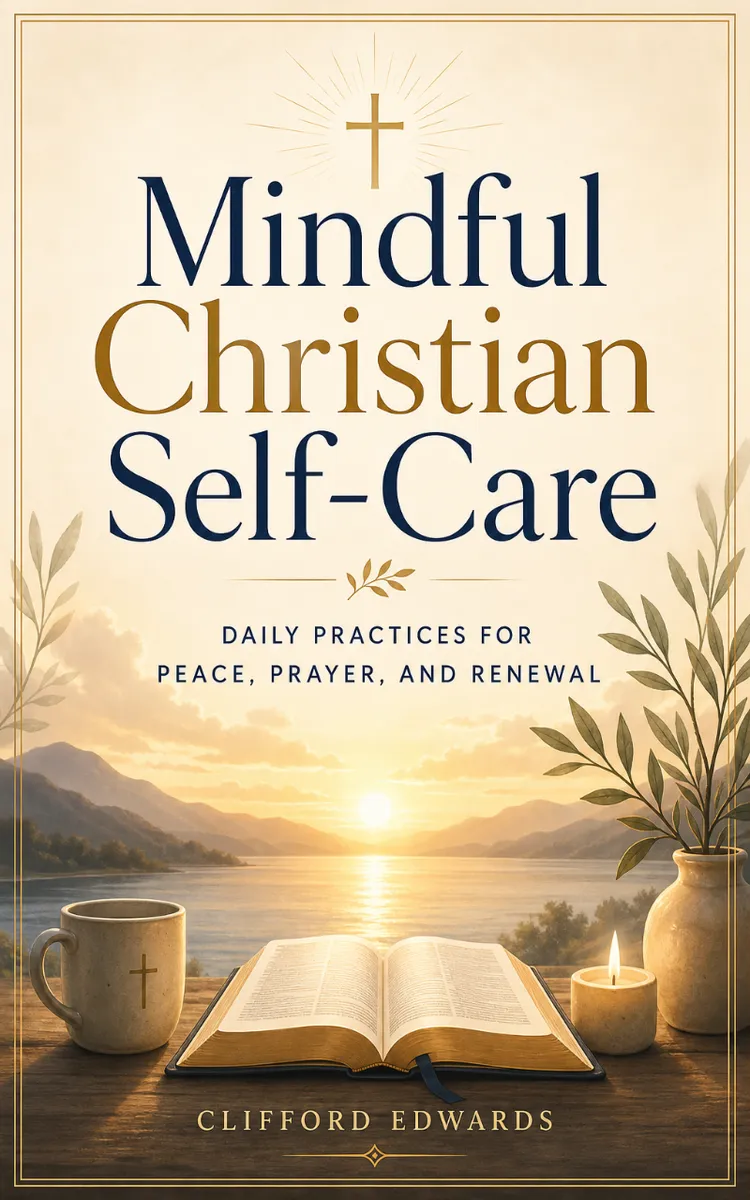
"Mindful Christian Self-Care" is a religious devotional book by Clifford Edwards with 20 chapters and approximately 19,553 words. Christian self-care through mindful daily spiritual practices.
This book was created using Inkfluence AI, an AI-powered book generation platform that helps authors write, design, and publish complete books.
Frequently Asked Questions
What is "Mindful Christian Self-Care" about?
Christian self-care through mindful daily spiritual practices
How many chapters are in "Mindful Christian Self-Care"?
The book contains 20 chapters and approximately 19,553 words. Topics covered include Day 1: A Fresh Start-Welcome to Mindful Self-Care, Days 2-3: Noticing Without Judgment-Awareness as Worship, Days 4-5: Prayer Before Panic-Breathing in God’s Presence, Days 6-7: Trusting the Good Shepherd-Safety for Your Soul, and more.
Who wrote "Mindful Christian Self-Care"?
This book was written by Clifford Edwards and created using Inkfluence AI, an AI book generation platform that helps authors write, design, and publish books.
Write your own religious devotional book with AI
Describe your idea and Inkfluence writes the whole thing. Free to start.
Start writingCreated with Inkfluence AI


