
Read the first chapter
The whole of chapter one, free. About 9 min. Turn the pages with the arrows, your keyboard, or a swipe.
Chapter 1
Why Hamlet Delays the Revenge
The Question Behind the Delay
What if Hamlet’s famous delay is not a failure to act, but the most accurate response to a command that cannot be proved? Shakespeare gives his prince a clear task - kill the man who murdered his father - then surrounds that task with uncertainty, surveillance, religious fear, political danger, and the possibility that the messenger itself is corrupt.
The play begins after the crime has already happened. King Hamlet is dead, Claudius has taken the throne and married Gertrude, and the court at Elsinore has settled into a new order. Hamlet alone remains fixed on the old one. When the Ghost appears, it does not simply reveal information; it creates an obligation. Hamlet must decide whether the figure speaks for justice, hell, or something more deceptive.
The Revenge Delay Map follows the choices that grow from that uncertainty: the Ghost’s demand, Hamlet’s testing of its story, the performance of madness, the play staged as evidence, and the final movement toward action. The important question is not merely why Hamlet waits. It is what waiting allows him to discover - and what it destroys while he discovers it.
When the truth arrives in the shape of a ghost, how certain can revenge ever become?
The Ghost’s Demand and the World of Revenge
The Ghost appears during the night watch at Elsinore, a castle associated with military readiness and political authority. The guards have seen the figure twice before Hamlet is brought to it. Its armor resembles that worn by the dead king, making the apparition immediately political as well as supernatural. This is not an abstract spirit floating through the darkness. It looks like a ruler prepared for war.
When the Ghost finally speaks to Hamlet, it gives a precise account of the crime. Claudius, it says, poured poison into the sleeping king’s ear, killing him and taking both his crown and his queen. The image of poison entering through the ear matters because the murder begins as hidden speech: a secret act, unheard by the court, that changes the entire kingdom. Claudius has not defeated the king in battle or challenged him openly. He has entered the private space of sleep.
The Ghost’s command is equally precise: Hamlet must avenge the murder, but must not harm Gertrude. That limit distinguishes the request from blind violence. The Ghost wants punishment for Claudius and restraint toward the queen, whose marriage is presented as morally corrupt but not as a crime requiring physical revenge. Hamlet accepts the task almost immediately. His words promise memory, even reducing the contents of his mind to a single purpose: remembering the Ghost and obeying its demand.
Yet the culture of revenge made such a command complicated. In early modern England, revenge tragedy drew on older Roman and medieval traditions in which a murdered person’s spirit returned because ordinary justice had failed. The dead could expose hidden crimes, but an apparition was never automatically trustworthy. Christian teaching also warned that demons might imitate the dead in order to mislead the living. Hamlet therefore receives the Ghost within two competing systems: a culture that expects revenge and a religion that questions supernatural instruction.
The result is the first mark on the Revenge Delay Map. Hamlet has a charge, but not certainty. He knows what the Ghost claims. He does not yet know what the claim means.
Doubt as a Method of Investigation
Hamlet’s hesitation is often treated as a private weakness, as if he simply thinks too much. The play presents something more exact. He tests evidence because the cost of acting on false evidence is enormous. If Claudius is innocent, Hamlet would become a murderer. If the Ghost is evil, obedience would mean serving the very corruption he believes he is fighting.
That uncertainty explains Hamlet’s decision to adopt an “antic disposition,” or an appearance of madness. The disguise gives him freedom to observe the court while making his strange behavior harder to interpret. It also creates a controlled distance between what he knows and what others think he knows. Hamlet can speak dangerous truths in forms that may be dismissed as nonsense.
The performance, however, does not remain under perfect control. Ophelia sees a version of Hamlet that is alarming rather than strategic. Polonius interprets his behavior as lovesickness. Claudius suspects a deeper cause and summons Rosencrantz and Guildenstern to investigate. The court answers Hamlet’s uncertainty with its own surveillance. Everyone watches, and no one trusts what is seen.
A brief exchange with Polonius captures the problem. Hamlet calls him a “fishmonger,” a word that may mean fish seller but could also suggest a dealer in women. Polonius hears madness; the audience hears a mind using ambiguity as cover. Hamlet’s language becomes an instrument that can conceal an accusation inside a joke. The more carefully he investigates, the more difficult it becomes for anyone - including the audience - to separate his strategy from genuine disorder.
The delay also has a bodily dimension. Hamlet is not considering a harmless intellectual puzzle. Renaissance beliefs about the afterlife, confession, damnation, and purgatory made the condition of the dead morally significant. The Ghost says it is condemned to wander at night and suffer by day, unable to rest until its earthly crime is addressed. If that account is true, revenge may restore a broken moral order. If it is false, Hamlet risks condemning himself.
The Play Within the Play
The decisive test arrives through theater. Hamlet asks a visiting troupe of actors to perform a version of a murder resembling the Ghost’s story. He revises the script, adds lines, and watches Claudius during the performance. This is not simply an artistic diversion. It is an experiment designed to provoke a visible response.
The plan depends on a practical observation about human behavior: people may control their words, but they often struggle to control their bodies when confronted with a concealed truth. Hamlet hopes that Claudius’s reaction will reveal guilt more reliably than a confession. The stage becomes a laboratory, and the king becomes an unwilling subject.
The experiment appears to work. During the performance, Claudius rises and stops the play. He then leaves to pray. Hamlet treats this response as confirmation, though it still does not give him the absolute certainty he wants. The Ghost’s accusation has been strengthened by human behavior, but the evidence remains indirect.
The prayer scene creates Hamlet’s clearest opportunity to act. He finds Claudius alone and apparently vulnerable. Yet Hamlet delays again because Claudius is praying. Killing him at that moment, Hamlet reasons, might send his soul to heaven, whereas killing him in sin would provide a more fitting revenge. The logic is disturbing, but it shows that Hamlet’s hesitation is not empty indecision. He is trying to control not only Claudius’s death but its spiritual meaning.
The opportunity passes. Claudius’s prayer, meanwhile, is itself incomplete. He wants forgiveness but cannot surrender the rewards of the crime: his crown, his power, and his marriage. Hamlet does not know that the king’s repentance is blocked from within. The audience does. Shakespeare therefore creates a painful gap between what Hamlet sees and what the audience understands.
The Counterintuitive Shape of Hesitation
The surprising fact is that Hamlet’s delay repeatedly produces action. He stages a play, questions an apparition, performs madness, confronts his mother, kills Polonius, and sends Rosencrantz and Guildenstern to their deaths. The man who cannot immediately kill Claudius is not inactive; he is active in ways that multiply the consequences.
This changes the usual picture of Hamlet as a passive thinker. His problem is not that thought replaces action. Thought redirects action into testing, performance, spying, verbal attack, and indirect violence. The delay protects him from one kind of error while exposing others. By refusing to strike at once, Hamlet gains evidence about Claudius - but he also creates the conditions for Ophelia’s collapse, Polonius’s death, and the hostility that drives Claudius toward a final plot.
The distinction matters because revenge is not a single choice. It is a chain of choices, each altering the circumstances of the next. Hamlet’s hesitation does not freeze the plot. It changes its temperature. The revenge becomes less like a straight line from accusation to punishment and more like an investigation conducted inside a court where every participant is already moving.
Elsinore and the Cost of Waiting
The human cost becomes clearest in the rooms around Elsinore, where private grief is repeatedly exposed to political control. Hamlet’s mother, Gertrude, is caught between her son’s accusation and Claudius’s authority. During the closet scene, Hamlet confronts her about the speed and nature of her remarriage. The Ghost has instructed him not to harm her, and the scene confirms that limit: his violence is verbal and emotional, not physical.
Polonius hides behind the arras while Hamlet speaks with Gertrude. Hearing movement, Hamlet assumes Claudius may be there and thrusts his sword through the hanging. Instead, he kills Polonius. The act is sudden, but it grows directly from the conditions created by delay: secrecy, surveillance, suspicion, and the habit of interpreting every hidden movement as part of the conspiracy.
Polonius’s death transforms Claudius’s problem. Before it, the king is trying to discover the cause of Hamlet’s behavior. After it, Hamlet is a public danger. Claudius sends him to England with Rosencrantz and Guildenstern, carrying secret orders for Hamlet’s execution. Hamlet discovers the letter, changes it, and returns to Denmark after pirates intervene. His delay has now produced a new kind of decisiveness: he acts quickly when his own life is immediately threatened.
At the same time, Ophelia’s grief becomes visible in fragments. Her father is dead, Hamlet has rejected or tormented her, and the court offers no stable place for her sorrow. Her songs about death, betrayal, and burial are not merely signs of madness; they are the scattered language of a person whose social world has been dismantled. Laertes returns to Denmark demanding revenge for Polonius, creating a mirror image of Hamlet. Both sons receive a father’s death as a command. Laertes acts faster, but his speed makes him easier for Claudius to manipulate.
The final duel is therefore not a simple resolution to the original demand. Claudius arranges poisoned weapons and a poisoned cup, while Laertes agrees to the plot. Hamlet enters the encounter with a changed relation to uncertainty. He does not possess complete knowledge, but he has learned that action cannot wait for perfect conditions. Once the poisoned plan is exposed through Gertrude’s death, Laertes’s confession, and Claudius’s own treachery, Hamlet kills the king.
The revenge is fulfilled, but it does not restore the old order. Hamlet, Laertes, Gertrude, and Claudius die; Ophelia and Polonius are already gone. Fortinbras arrives to inherit a court emptied by its secrets. Justice has occurred, yet it resembles a collapse more than a repair.
Hamlet’s delay reveals a difficult truth about human judgment: uncertainty rarely keeps us still. It sends us sideways, into tests, disguises, arguments, and half-measures that carry their own dangers. At Elsinore, the question is never only whether revenge should happen, but how much damage is created while a person tries to become certain enough to deliver it. The Ghost asks for a death; Hamlet’s hesitation turns that demand into a world of evidence, performance, and consequence - and leaves us wondering whether any act of justice can remain untouched by the doubts that precede it.
End of chapter one. 7 more chapters and about 13,704 words in the full book.
Swipe or use the arrows to turn the page


What's inside: 8 chapters
- 1. Why Hamlet Delays the Revenge
- 2. The Ghost’s Dangerous Testimony
- 3. Claudius’s Crown of Guilt
- 4. Ophelia Trapped by Obedience
- 5. The Play That Exposes a King
- 6. A Curtain, a Killing, a Crisis
- 7. The Duel Claudius Designs
- 8. When Denmark’s Revenge Ends
About this book
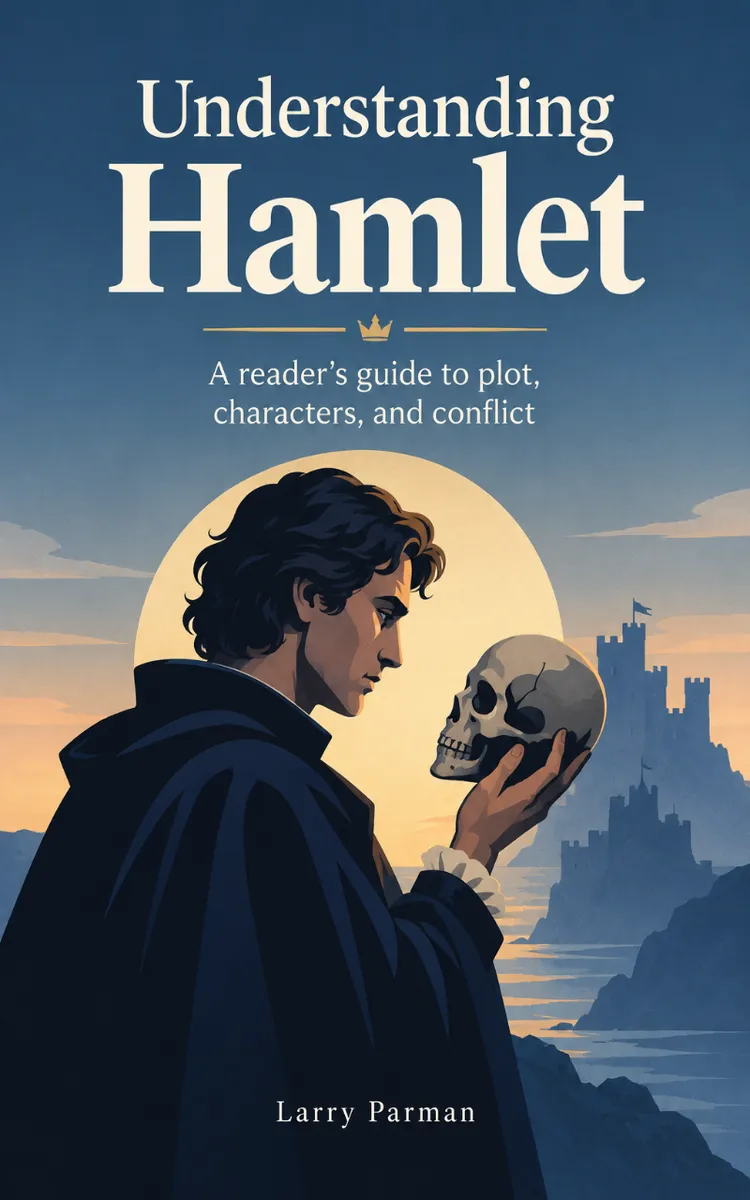
"Understanding Hamlet" is a curiosity book by Larry Parman with 8 chapters and approximately 13,704 words. Hamlet’s plot, characters, motivations, conflicts, and resolutions.
This book was created using Inkfluence AI, an AI-powered book generation platform that helps authors write, design, and publish complete books.
Frequently Asked Questions
What is "Understanding Hamlet" about?
Hamlet’s plot, characters, motivations, conflicts, and resolutions
How many chapters are in "Understanding Hamlet"?
The book contains 8 chapters and approximately 13,704 words. Topics covered include Why Hamlet Delays the Revenge, The Ghost’s Dangerous Testimony, Claudius’s Crown of Guilt, Ophelia Trapped by Obedience, and more.
Who wrote "Understanding Hamlet"?
This book was written by Larry Parman and created using Inkfluence AI, an AI book generation platform that helps authors write, design, and publish books.
Write your own curiosity book with AI
Describe your idea and Inkfluence writes the whole thing. Free to start.
Start writingCreated with Inkfluence AI


