
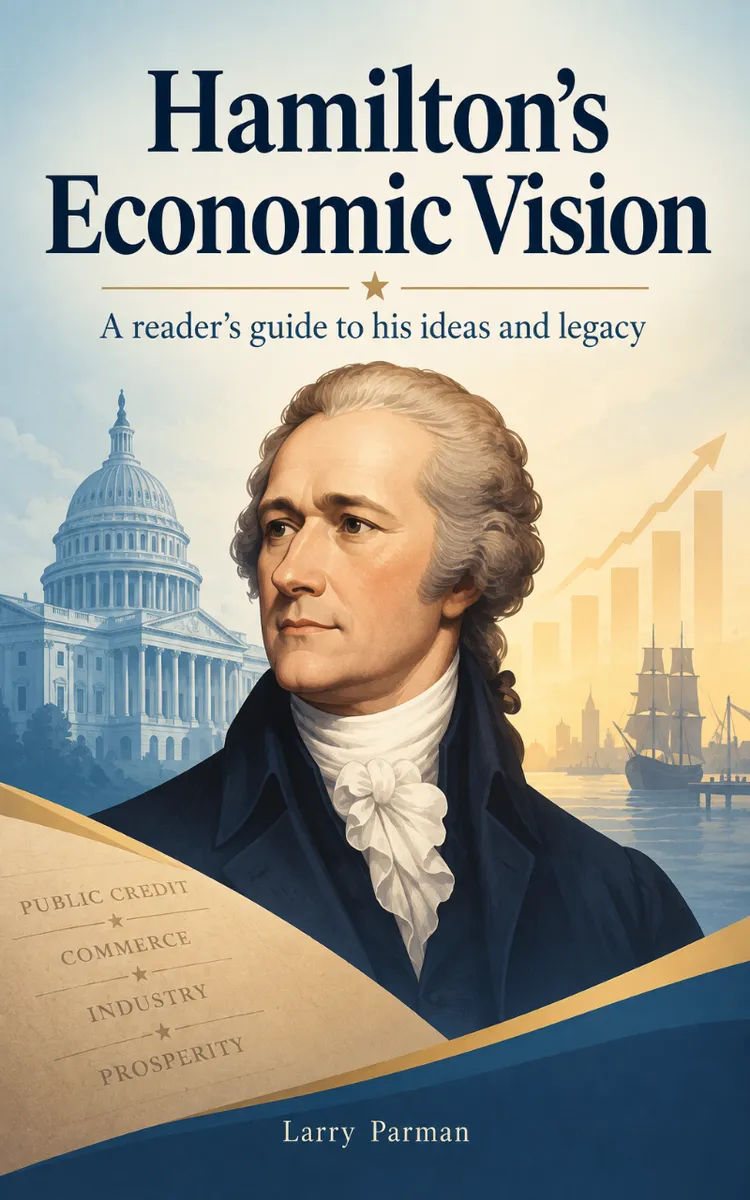
Read the first chapter
The whole of chapter one, free. About 9 min. Turn the pages with the arrows, your keyboard, or a swipe.
Chapter 1
Why Hamilton Wanted a National Bank
The Bank That Was Meant to Hold a Nation Together
What would a new country do if its government could promise payment but had no reliable way to make that promise believable? In the 1790s, the United States had won independence, yet its finances still carried the marks of war: unpaid obligations, scattered currencies, uncertain tax collections, and creditors who had learned to distrust official promises.
Alexander Hamilton’s answer was not simply to create another place where people could deposit money. He wanted a national bank to serve as a financial instrument of the federal government and as a visible sign that the Union possessed enough authority to honor its debts. The bank would gather scattered resources, make payments more orderly, and help government credit become something more substantial than words printed on paper.
Hamilton’s plan rested on what might be called the Credit Anchor Model. Public credit needed an anchor: a stable institution tied to the federal government, connected to commercial life, and capable of moving money where it was needed. The bank was designed to perform that work, but its deeper purpose was political. It would make the new federal government present in the daily business of the nation.
Could a bank do more than lend money - could it make a country feel real?
A Republic Built on Unpaid Promises
The financial problem began during the Revolution. Congress had needed money to supply armies and purchase materials, but the Continental Congress lacked the power to tax directly. It issued paper currency known as Continental dollars, borrowed from foreign lenders, and appealed to the states for funds. The paper money lost value so rapidly that “not worth a Continental” became a lasting expression for something nearly worthless.
Peace did not erase the debt. The federal government inherited obligations to soldiers, suppliers, foreign lenders, and domestic creditors. Some debts had been sold at reduced prices to speculators because their original holders doubted that the government would ever pay. A certificate issued by Congress could be traded in a tavern or market, but its value depended on a question that no piece of paper could answer by itself: would the government ultimately honor it?
Hamilton, appointed the first secretary of the treasury in 1789, treated that question as central to the survival of the republic. Public credit was not merely a matter of reputation. It determined whether the government could borrow in an emergency, whether merchants would accept government obligations, and whether citizens would regard federal authority as dependable.
His first major reports proposed funding the national debt at full value, assuming certain state debts, and establishing regular federal revenue. These measures were intended to convert the government’s scattered promises into obligations backed by an organized financial system. The bank belonged to the same design. It would not cure every weakness in American finance, but it could give the government a dependable place to deposit revenue, issue payments, and obtain short-term loans.
The need was especially clear because money in the early United States did not flow through one national channel. States chartered their own banks, merchants relied on foreign coins, and local communities often conducted business through private notes and credit arrangements. A farmer might sell produce for banknotes issued far from home, while a merchant might accept a note only after judging the reputation of the issuing bank. Money circulated, but not always smoothly. Its value could change with distance, confidence, and local circumstances.
Hamilton’s proposed Bank of the United States, chartered in 1791, was meant to steady that uneven system. Congress authorized a twenty-year charter and allowed the bank to operate with private investment alongside federal participation. The arrangement reflected Hamilton’s belief that public authority and private capital could reinforce one another rather than exist in separate worlds.
The Credit Anchor Model
The Credit Anchor Model explains why Hamilton considered the bank more than a government cashier. An anchor does not move a ship forward, but it gives the ship a fixed point in uncertain water. Hamilton wanted the bank to give the federal government a fixed financial point from which it could borrow, pay, and regulate the movement of funds.
The bank received federal deposits and transferred money between distant locations. It could collect revenue in one place and make government payments in another without forcing officials to move chests of coin across the countryside. It could also issue banknotes, which entered circulation as a form of usable money. Those notes were not national currency in the modern sense, but the bank’s size and federal connection could make them more widely trusted than many local notes.
A central feature of the system was the bank’s ability to redeem its notes in specie - gold or silver coin. If too many notes entered circulation, customers might demand payment in metal. That possibility placed pressure on the bank to avoid issuing notes without sufficient backing. The process was not mechanical or perfectly stable, but it created a relationship between paper credit and tangible reserves.
The bank also gave the Treasury a financial partner. When the government received tax revenue, it could deposit the funds. When it needed to pay contractors or soldiers, the bank could transfer money through its branches. In a country where roads were poor and communication slow, such a network reduced the friction of federal finance.
A banknote was therefore more than a substitute for coins. It was a claim resting on a chain of confidence: confidence in the bank, in its reserves, in the government’s legal authority, and in the willingness of others to accept the note. Hamilton understood that economic activity depended on these invisible judgments. A note circulated because people believed someone else would take it later.
The bank’s usefulness also extended to private commerce. By discounting commercial bills - purchasing them before their full payment date - the bank could provide merchants with funds before a transaction was complete. That helped turn future payment into present purchasing power. Credit, in this sense, was not simply debt. It was a bridge between goods already moving through the economy and money not yet collected.
The surprising fact is that Hamilton’s national bank was designed to make government debt more useful, not merely to make government debt disappear. Public obligations could become financial assets that supported borrowing, trade, and confidence. That changed the meaning of debt: properly managed, it could serve as part of the nation’s economic machinery.
The Unexpected Connection: Debt as a Bond of Union
Hamilton’s opponents saw the bank as a dangerous concentration of power. Thomas Jefferson and James Madison questioned whether the Constitution authorized Congress to create such an institution. They also feared that the bank would favor merchants, financiers, and coastal cities over farmers and state governments. The constitutional dispute was real, but beneath it lay a broader disagreement about what kind of republic the United States should become.
Hamilton’s unexpected connection was between public credit and national identity. A government that borrowed from citizens, paid them reliably, and used a common financial institution could create relationships that crossed state lines. Credit became a quiet form of federalism. A creditor in one state might hold an obligation backed by the same government that collected revenue in another.
This mattered because the United States was still more a collection of communities than a single economic space. State boundaries shaped law, taxation, banking, and trade. The bank could not eliminate those differences, but it could connect them through a common institution. Its branches and transactions gave the federal government a practical presence beyond the capital.
The connection also changed how people understood political authority. The Constitution had created a federal government on paper; the bank helped make that government visible in ledgers, payments, notes, and contracts. A nation was not held together only by speeches or symbols. It was also held together by the expectation that a promise made in Philadelphia would be recognized in Charleston, Boston, or the western settlements.
This is why the bank provoked such intense opposition. It was not merely a financial tool. It proposed a different relationship between citizens and the federal government - one in which national authority entered commercial life and became responsible for maintaining a shared system of credit.
A Bank in Philadelphia, a Network Across the Republic
The first Bank of the United States was headquartered in Philadelphia, then the nation’s capital. Its building, completed in the early 1790s, stood among the offices, warehouses, and wharves of a city already accustomed to international trade. From that setting, the bank’s operations reached outward through branches in places including Boston, New York, Baltimore, Charleston, and Norfolk.
Those locations mattered because the young republic’s economy was not concentrated in one place. New England merchants traded across the Atlantic. Southern exporters shipped tobacco and rice. Middle Atlantic businesses handled flour, shipping, and manufactured goods. Money had to travel between these regions, and the bank’s branches helped move funds without requiring every transaction to be settled in coin.
The bank’s relationship with the Treasury made the arrangement concrete. Federal customs duties, collected at major ports, formed an important source of national revenue. Instead of leaving those receipts scattered among local offices, the Treasury could place them within a system that made them available for government payments elsewhere. A customs payment in New York could become part of a financial operation serving the federal government in another city.
For merchants, the bank’s notes and discounts could reduce the uncertainty of long-distance trade. For the Treasury, the institution offered order and reach. For critics, however, the same network looked like a source of concentrated influence. A bank capable of directing credit could also decide which forms of commerce received easier access to funds. The very feature that made the institution useful - its capacity to connect distant places - made it politically powerful.
Hamilton did not imagine a neutral machine untouched by human judgment. Banks depended on assessments of borrowers, reserves, law, and reputation. Their decisions could assist commerce, but they could also expose inequalities and create resentment. The national bank’s promise was therefore inseparable from its risk: it could bind the country through common credit, yet the terms of that credit would never feel equally fair to everyone.
What the Bank Revealed About the New Nation
The argument over the bank exposed a basic tension in American political life. The republic needed institutions strong enough to manage national problems, but many Americans feared that strength would become domination. Hamilton’s plan addressed a genuine weakness in public finance, yet it also raised a question that would remain unresolved: how much economic coordination could a free society accept before coordination began to look like control?
The bank’s supporters saw stability in its notes, branches, and connection to the Treasury. Its opponents saw privilege and an unconstitutional enlargement of federal power. Both sides understood something important. Money was not only a medium of exchange. It was a measure of trust, and whoever organized that trust gained influence over the shape of national life.
Hamilton wanted public credit to become dependable enough that the United States could act as a government rather than merely claim to be one. The bank was his anchor in that effort, fixed between the federal treasury and the commercial world. Yet an anchor also reveals what a vessel is attached to - and what it may be unable to leave behind. The young nation had begun to discover that unity could be built through financial promises, but it had not yet discovered who would control the chain.
End of chapter one. 7 more chapters and about 13,727 words in the full book.
Swipe or use the arrows to turn the page


What's inside: 8 chapters
- 1. Why Hamilton Wanted a National Bank
- 2. Turning Revolutionary Debt into Credit
- 3. The Tariff That Built Industry
- 4. Taxing Whiskey, Testing Federal Power
- 5. Commerce as a National Strategy
- 6. Speculation, Securities, and Public Trust
- 7. Hamilton Versus Jefferson’s Agrarian Republic
- 8. The Hamiltonian System Still at Work
About this book
"Hamilton’s Economic Vision" is a curiosity book by Larry Parman with 8 chapters and approximately 13,727 words. Alexander Hamilton’s economic theories, principles, and influence.
This book was created using Inkfluence AI, an AI-powered book generation platform that helps authors write, design, and publish complete books.
Frequently Asked Questions
What is "Hamilton’s Economic Vision" about?
Alexander Hamilton’s economic theories, principles, and influence
How many chapters are in "Hamilton’s Economic Vision"?
The book contains 8 chapters and approximately 13,727 words. Topics covered include Why Hamilton Wanted a National Bank, Turning Revolutionary Debt into Credit, The Tariff That Built Industry, Taxing Whiskey, Testing Federal Power, and more.
Who wrote "Hamilton’s Economic Vision"?
This book was written by Larry Parman and created using Inkfluence AI, an AI book generation platform that helps authors write, design, and publish books.
Write your own curiosity book with AI
Describe your idea and Inkfluence writes the whole thing. Free to start.
Start writingCreated with Inkfluence AI


