
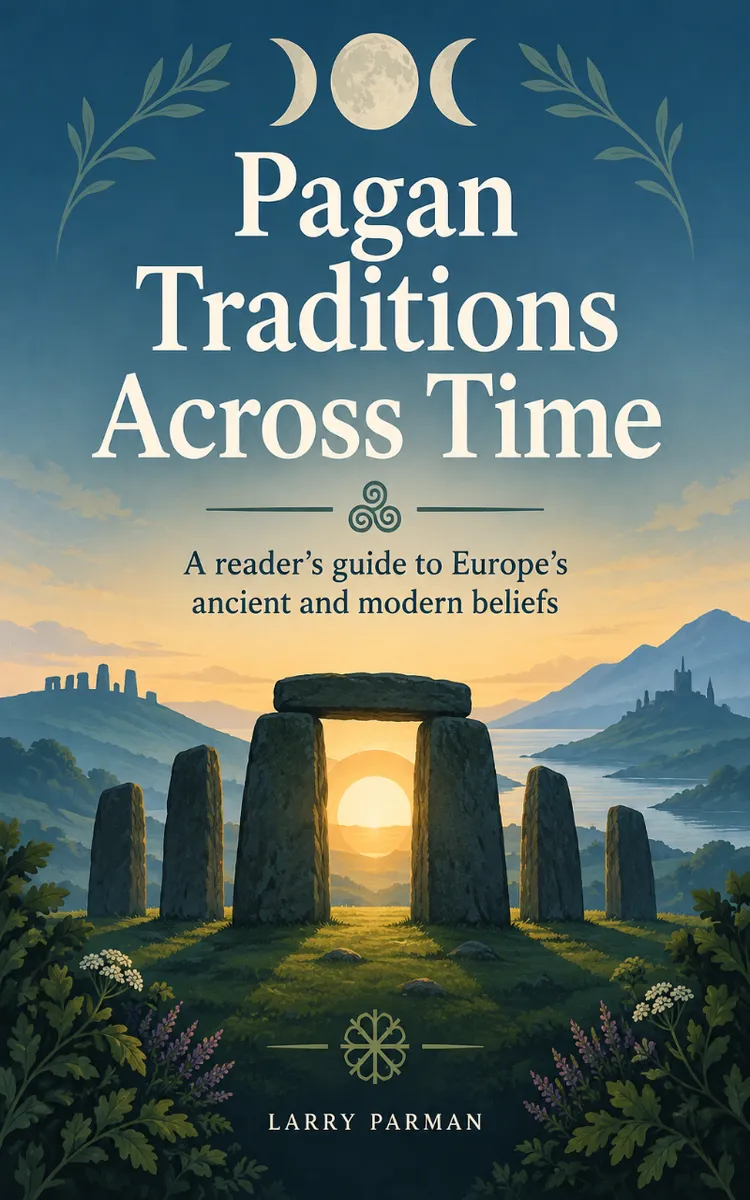
Read the first chapter
The whole of chapter one, free. About 9 min. Turn the pages with the arrows, your keyboard, or a swipe.
Chapter 1
Why Paganism Returned to Europe
A Doorway Back to the Sacred
A person can leave a church, stop believing in its doctrines, and still find themselves marking the solstice, lighting a candle for the dead, or speaking of a river as if it were more than water. Modern paganism began, in part, inside that apparent contradiction: a movement born in a secular age that nevertheless refused to treat the world as spiritually empty.
Its revival was not a simple return to an intact ancient religion. No uninterrupted European pagan institution survived from the Roman Empire into the modern era. What returned was a mixture of archaeological fragments, medieval folklore, Romantic poetry, occult experiments, ecological concern, feminist ritual, and a desire for religious practice that could be felt in the body rather than merely affirmed in the mind.
The Revival-to-Roots Map follows that movement from modern invention toward older sources, while keeping both directions visible. It asks what modern pagans recovered, what they reconstructed, what they borrowed from elsewhere, and why these traditions became compelling when inherited religious authority was weakening.
When a religion returns after centuries of silence, is it being rediscovered - or newly made?
The Revival Begins in Books, Ruins, and Imagination
The first modern revival did not begin with peasants secretly preserving a complete pre-Christian faith. It began among writers, antiquarians, poets, and political thinkers who looked at Europe’s ruins and saw more than a vanished past. During the eighteenth and nineteenth centuries, scholars collected folk songs, seasonal customs, charms, and local legends. Romantic writers treated forests, mountains, and ancient monuments as sources of national and spiritual meaning.
The word pagan, originally a Christian term for those outside the church, acquired new uses. It could mean devotion to pre-Christian gods, admiration for nature, opposition to Christian authority, or simply a cultural identity rooted in Europe’s older past. That elasticity helped the revival spread, but it also created confusion. A person celebrating the winter solstice, a ceremonial magician invoking Greek deities, and a reconstructionist honoring Norse gods might all be described as pagan while practicing very different religions.
Archaeology supplied powerful images but incomplete instructions. Stone circles, burial mounds, Roman temples, and carved figures revealed that ancient Europeans had worshipped many gods and marked the agricultural year with ceremonies. They rarely explained exactly how a ritual was performed, what words were spoken, or how ordinary people understood the divine. The gaps invited interpretation. Modern paganism developed partly in those spaces between evidence and imagination.
The nineteenth-century occult revival added another layer. Groups such as the Hermetic Order of the Golden Dawn, founded in Britain in 1887, drew on astrology, Egyptian symbolism, Jewish mysticism, Renaissance magic, and Christian esotericism. This was not a direct survival of ancient European religion, but it helped establish a modern habit: assembling spiritual systems from historical materials that had once belonged to separate cultures.
The result was less like reopening an abandoned temple than restoring a building from scattered stones. Some stones were ancient. Others came from neighboring structures. The finished building could be meaningful without being identical to what had stood there before.
From Witchcraft to Many Pagan Paths
Modern paganism became more recognisable in the twentieth century, especially through Wicca, a religion publicly associated with Gerald Gardner in Britain from the 1950s onward. Gardner presented witchcraft as an old surviving religion, but historians have found that Wicca also drew on ceremonial magic, folklore, Freemasonry, Margaret Murray’s now-discredited theories about a continuous witch-cult, and contemporary ideas about gender and nature.
Wicca’s influence came partly from its practicality. It offered a ritual calendar, seasonal festivals, consecrated tools, initiatory groups, spells, and a theology centered on a Goddess and God. Its ceremonies could take place in a living room, a garden, or a woodland clearing. Religious authority moved away from a central church and toward covens, teachers, books, and personal experience.
Other movements followed different routes. Druidry developed around the imagined memory of ancient Celtic religious specialists, though modern Druid groups are largely products of the eighteenth century onward rather than continuous survivals from Iron Age Britain. Heathenry turned toward the pre-Christian religions of northern Europe, using Icelandic sagas, the Poetic Edda, archaeology, and historical linguistics to reconstruct worship of gods such as Odin, Thor, and Freyja. Hellenic polytheism focused on the gods of ancient Greece, while Roman, Baltic, Slavic, and Gaulish reconstructionists sought more specific regional roots.
Some practitioners call themselves eclectic pagans, combining deities, rituals, and symbols from several traditions. Others reject that approach, arguing that religious practices should remain within their historical and cultural settings. This disagreement is not a minor technical dispute. It reveals two competing ideas of authenticity: one based on historical continuity and another based on the ability of a practice to create a living relationship with the sacred.
A surprising fact sits at the center of the revival: much of modern paganism became visible through print culture before it became visible through temples. Books, newsletters, correspondence courses, and later websites allowed isolated practitioners to form communities before they had shared institutions. The religion spread through pages and screens, even while many of its rituals emphasized soil, fire, moonlight, and the human body.
That reversal matters. Modern paganism is often described as a return to nature, but its early expansion depended heavily on modern communication. The same society that produced industrial cities, mass printing, and electronic networks also made it possible to recover and reinvent local gods. Paganism did not simply oppose modernity; it used modernity to search for alternatives to it.
The Secular World and the Need for Practice
The revival also belongs to a broader change in European religious life. As churches lost social authority in many countries, religion became less compulsory and more individual. People could choose among denominations, borrow from several traditions, or describe themselves as spiritual without belonging to an institution. Modern paganism flourished within this environment because it offered a form of religion that was participatory and seasonal rather than primarily confessional.
Its rituals often organize time through the Wheel of the Year: solstices, equinoxes, and the cross-quarter festivals associated with older Celtic and Germanic calendars. The historical links between these modern festivals and ancient ceremonies vary, sometimes strongly and sometimes only loosely. Yet the calendar gives practitioners a repeated structure for noticing change. The first frost, the lengthening evening, the harvest, and the return of birds become religious occasions rather than background events.
Here the contrast with Christianity is revealing. Christianity places central weight on scripture, sacraments, salvation history, and the life, death, and resurrection of Jesus. Pagan traditions generally have no single scripture or universally binding creed. Their authority may come from myth, place, ritual experience, ancestral practice, or the perceived character of a deity. The difference is not that one side has belief and the other has practice. Christian life is also embodied in worship and festivals, while paganism also involves interpretation and belief. The difference lies in where religious truth is located and who has the power to define it.
Pagan practice can also be compared with Asian and African traditions, though broad comparisons require care. Shinto, for example, treats particular places, objects, and natural forces as capable of expressing sacred presence, a resemblance to some pagan approaches to landscape. Many African religious traditions likewise maintain relationships with ancestors, spirits, and local powers rather than separating religion from ordinary social life. Yet these traditions have their own histories, institutions, and concepts; they are not interchangeable examples of “nature religion.” Modern European pagans sometimes borrow Asian or African practices, but such borrowing can raise serious questions about context, authority, and cultural ownership.
The most important shift may be from religion as inherited membership to religion as repeated encounter. A ritual does not merely state that the world is sacred; it asks participants to attend to a particular place, season, body, or relationship. In a secular society, that attention can feel unfamiliar precisely because so much daily life is organized around efficiency and abstraction.
Rebuilding Ancient Europe Without Pretending It Survived
The Revival-to-Roots Map becomes most useful when it distinguishes recovery from reconstruction. Ancient European religions were local, varied, and historically changing. A Roman household shrine, a Viking-age burial, and a Celtic sanctuary did not belong to one unified pagan system. Their gods, customs, and social structures differed across time and place.
Modern practitioners therefore face a problem that ancient worshippers did not: they must decide what counts as evidence. Some turn to inscriptions, ritual remains, classical descriptions, and medieval texts. Others use comparative mythology, folklore, or personal religious experience. Few can reproduce the social world in which ancient rites once operated, where religion was woven into farming, kinship, law, warfare, and political authority.
This reconstruction has produced careful scholarship as well as imaginative excess. Some older claims - such as the idea that a single prehistoric Goddess religion once covered Europe - remain influential in popular culture but are not supported by clear evidence. Likewise, the image of an unbroken witch religion surviving secretly through the Christian centuries has proved historically unreliable. Yet rejecting these claims does not make modern pagan practice meaningless. It clarifies what kind of meaning is being created.
Christianity itself absorbed and reinterpreted elements of earlier European religious culture. Midwinter celebrations became associated with Christmas, while local holy wells, sacred springs, pilgrimage sites, and seasonal customs often continued under Christian names. Saints sometimes took on roles once associated with local divine or heroic figures. The church did not simply erase every older practice; in many places it redirected existing habits toward Christian stories and authorities.
This history complicates the idea of a clean boundary between pagan and Christian Europe. A decorated evergreen, a procession to a spring, or a festival timed near the turning of the seasons may carry several layers of history at once. Modern paganism often makes those layers visible again, though not always in the exact form they originally had.
The movement’s central question is therefore not whether modern pagans have reproduced ancient religion perfectly. They have not, and usually cannot. The more revealing question is what happens when people use fragments of an older religious landscape to build practices suited to a world of cities, environmental crisis, religious pluralism, and individual choice.
A Living Tradition in the Present
In the late twentieth and early twenty-first centuries, pagan communities became increasingly public. Festivals, open rituals, online forums, interfaith gatherings, and published liturgies connected people who might otherwise have practiced alone. In Britain, the United States, Scandinavia, and elsewhere, groups formed around particular gods, landscapes, historical cultures, or ritual styles.
One visible example is the Stonehenge Free Festival and the wider role of Stonehenge in modern pagan and alternative spiritual culture. The monument is prehistoric, its original ceremonies uncertain, and its meaning contested. Yet modern gatherings there have made the stones a meeting point for Druids, witches, musicians, tourists, and people seeking a direct encounter with an ancient landscape. The site demonstrates how sacred meaning can be layered rather than singular. Archaeological evidence tells one story; modern ritual adds another without erasing the first.
A different kind of community appears in Ásatrú and other forms of Heathenry, where practitioners use Old Norse myths and archaeological research to honor gods such as Thor and Freyja. Some groups emphasize historical reconstruction and inclusive community. Others have been entangled with ethnic nationalism and white supremacist symbolism, despite the fact that ancient northern societies were themselves connected through trade, migration, slavery, and cultural exchange. The struggle over who may claim a tradition shows that pagan revival is never only about the past. It is also about identity in the present.
For many practitioners, the most convincing evidence of a living religion is not an ancient pedigree but a durable relationship: returning each year to the same festival, maintaining a household shrine, honoring ancestors, or treating a local landscape as a participant in communal life. Such practices do not prove that ancient gods have returned in any scientific sense. They show that religious worlds can be rebuilt through attention, repetition, and shared interpretation.
Modern European paganism emerged from fragments, but fragments are not necessarily weak. A broken inscription, a surviving custom, or a name preserved in a place can become the beginning of a new conversation between past and present. The unanswered question is whether that conversation creates continuity, invention, or something less tidy and more interesting: a tradition whose roots are historical but whose life is unmistakably modern.
End of chapter one. 7 more chapters and about 13,695 words in the full book.
Swipe or use the arrows to turn the page


What's inside: 8 chapters
- 1. Why Paganism Returned to Europe
- 2. Rebuilding Ritual Without Ancient Manuals
- 3. What Ancient Europeans Actually Worshipped
- 4. The Gods Were Never One Pantheon
- 5. Asia’s Sacred Cycles, Europe’s Local Gods
- 6. African Traditions Beyond the Label
- 7. Pagan Customs Inside Christian Calendars
- 8. What Survives When Beliefs Change
About this book
"Pagan Traditions Across Time" is a curiosity book by Larry Parman with 8 chapters and approximately 13,695 words. Modern and ancient European paganism compared with Asian and African traditions and Christianity.
This book was created using Inkfluence AI, an AI-powered book generation platform that helps authors write, design, and publish complete books.
Frequently Asked Questions
What is "Pagan Traditions Across Time" about?
Modern and ancient European paganism compared with Asian and African traditions and Christianity
How many chapters are in "Pagan Traditions Across Time"?
The book contains 8 chapters and approximately 13,695 words. Topics covered include Why Paganism Returned to Europe, Rebuilding Ritual Without Ancient Manuals, What Ancient Europeans Actually Worshipped, The Gods Were Never One Pantheon, and more.
Who wrote "Pagan Traditions Across Time"?
This book was written by Larry Parman and created using Inkfluence AI, an AI book generation platform that helps authors write, design, and publish books.
Write your own curiosity book with AI
Describe your idea and Inkfluence writes the whole thing. Free to start.
Start writingCreated with Inkfluence AI


