
Read the first chapter
The whole of chapter one, free. About 8 min. Turn the pages with the arrows, your keyboard, or a swipe.
Chapter 1
Why Psychedelics Feel Like Other Worlds
The Room That Became Larger Than the World
In 1955, the British writer Aldous Huxley took mescaline in a quiet Los Angeles house and later described an altered attention in which ordinary objects seemed to possess an intensity beyond their practical use. The remarkable part was not that the room changed shape. It was that the familiar world appeared to contain more reality than waking consciousness usually permits.
That tension sits at the center of Terence McKenna’s account of psychedelics. He was less interested in treating these substances as unusual decorations added to ordinary life than in asking whether ordinary life itself might be a narrowed condition. Psychedelic experience, in his telling, could reveal consciousness as something less like a private spotlight and more like an opening onto a much larger field.
McKenna’s language was often extravagant, but the question beneath it was precise: why can a chemical change in the brain produce the sense of entering another world? The Boundary Dissolution Lens approaches that question by examining what happens when the borders between self and surroundings, memory and perception, symbol and object, begin to loosen.
When the mind’s boundaries fade, is the world becoming stranger - or is more of it becoming visible?
The Mind as a Filter, Not a Window
Ordinary perception feels complete because it is efficient. At any moment, the eyes receive changing patterns of light, the ears register pressure waves, and the brain selects a manageable portion of this incoming information. Most of what reaches the senses never becomes conscious. The mind does not present the world in its entirety; it builds a usable version.
This basic point gives McKenna’s ideas a scientific foothold. The brain is not a passive camera. It predicts, sorts, ignores, and stabilizes. It helps a person recognize a chair before examining every angle of its surface, follow a conversation despite background noise, and cross a street without becoming overwhelmed by every moving object. Consciousness is useful partly because it leaves so much out.
Psychedelics can disturb this editing system. Substances such as psilocybin, mescaline, and LSD act on serotonin systems involved in perception, mood, attention, and the sense of self. Their effects vary with the substance, dose, setting, and person, but a common feature is the weakening of familiar mental organization. Colors may seem unusually vivid. Music can acquire spatial depth. Thoughts may appear less like a private stream and more like events occurring in a vast surrounding space.
The result is not simply “seeing more.” It is a change in the rules by which experience is assembled. A wall may remain physically still while seeming alive with pattern. A memory may arrive with the force of a present event. The distinction between inner image and outer scene may become difficult to maintain. McKenna regarded this disruption as an encounter with the mind’s hidden architecture.
His point was not that every psychedelic perception reveals an external fact. Rather, the experience demonstrates how much of what feels like reality depends on mental boundaries that usually remain invisible. Once those boundaries become noticeable, waking consciousness no longer seems like the only possible arrangement.
The Boundary Dissolution Lens
The Boundary Dissolution Lens names the central shift: psychedelic states can make the dividing lines that organize ordinary awareness feel temporary rather than permanent. The boundary between “me” and “the world” may soften. So may the boundary between the present and the remembered past, the meaningful and the meaningless, the natural and the artificial.
Anthropologists have long recorded cultures in which plants and fungi are treated not merely as intoxicants but as teachers, medicines, or mediators between human beings and a larger living order. In Indigenous traditions of the Americas, ceremonial use of peyote and psilocybin mushrooms developed within systems of song, kinship, ritual, and responsibility. These settings differ sharply from the solitary or recreational use common in modern Western accounts. They also show that the feeling of entering another world is never produced by chemistry alone. Cultural expectations help determine what the experience means.
McKenna drew heavily on this contrast. He saw modern society as unusually committed to a narrow definition of reality: measurable, productive, and publicly verifiable. Psychedelics appeared to him as a pressure against that narrowness. They returned attention to image, myth, language, and the possibility that meaning might be sensed before it can be explained.
A useful comparison is dreaming. During a dream, the mind can construct places, characters, and emotional situations without the dreamer asking how they were made. Psychedelic experience differs because the person is often awake, remembers the ordinary world, and may retain a critical awareness that something extraordinary is happening. Yet both states reveal that consciousness can generate a world-like environment from shifting patterns of memory, expectation, sensation, and emotion.
The difference between hallucination and revelation, then, cannot be settled simply by asking whether an experience felt real. Dreams feel real while they last. So do grief, religious visions, and certain forms of artistic absorption. McKenna’s contribution was to take this problem seriously without reducing it to either a supernatural certainty or a dismissive “it was only chemicals.”
The Scientific Puzzle of Vastness
The counterintuitive finding is that a feeling of boundless consciousness may arise when the brain’s organizing activity becomes less tightly coordinated. The experience feels like expansion, but one possible description is reduced control: familiar predictions lose their authority, and signals that are normally held apart begin influencing one another.
This matters because it changes the meaning of psychedelic “worlds.” They need not be regarded as literal planets hidden behind ordinary reality to be psychologically and philosophically important. They may instead reveal how the brain constructs separation, identity, and significance - and how strange experience becomes when those constructions loosen.
Research using brain imaging has explored changes in networks associated with self-focused thought, attention, and communication between brain regions during psychedelic states. The language of networks can sound distant from the vivid reports of people who describe meeting entities or dissolving into the universe, but the two descriptions address different levels of the same event. Brain activity describes the machinery; experience describes what the machinery feels like from within.
McKenna was especially interested in the way these states alter language. Under psychedelics, words can become unusually charged. A phrase may unfold into several meanings at once, or a sound may seem to carry a physical texture. He believed this linguistic intensification pointed toward a deeper relationship between consciousness and symbol-making. Human beings do not merely inhabit a physical environment; they inhabit a world shaped by names, stories, categories, and metaphors.
One sentence captures the strangeness of the problem: the experience of leaving the world may be produced by a change in the way the brain represents the world.
That possibility does not make the experience trivial. A map is not the territory, but changes in a map can alter where a person believes the borders lie. Psychedelics may expose the map-making process itself, leaving the traveler uncertain whether the newly visible patterns belong to the landscape, the cartographer, or both.
Huxley, McKenna, and the Modern Psychedelic World
Huxley’s mescaline experience became one of the defining literary accounts of psychedelic perception because it treated altered consciousness as an epistemological event - a change in what can be known. In The Doors of Perception, he described furniture, flowers, and fabric as if their existence had become more immediate than their ordinary names allowed. The objects were not useful, symbolic, or familiar first. They were simply present with an overwhelming density.
McKenna inherited this concern but pushed it toward a more cosmic register. Where Huxley often described attention opening onto the “isness” of things, McKenna spoke of contact with intelligence, other dimensions, and a reality that seemed to exceed the human. His claims about machine elves and alien presence were not scientific conclusions, and they should not be treated as established facts. They were reports of how certain experiences presented themselves to him and a wider culture.
The late twentieth century provided fertile ground for such accounts. Psychedelics moved from Indigenous ceremonial contexts into Western laboratories, literary circles, counterculture, psychotherapy research, and criminalized underground markets. The same substances were described as psychiatric tools, dangerous drugs, spiritual sacraments, artistic catalysts, and threats to social order. Each description captured something, but none exhausted the experience.
The setting mattered enormously. A person taking a psychedelic in a carefully prepared clinical room, surrounded by trained guides and familiar music, encounters a different interpretive world from someone using it at a crowded festival or alone in an unfamiliar place. The substance may be the same, but the boundaries available to consciousness are not. Expectations, fear, trust, memory, and social meaning become part of the event.
Ram Dass and the Human Face of Expanded Consciousness
A concrete example appears in the life of Richard Alpert, the Harvard psychologist who later became known as Ram Dass. In the early 1960s, Alpert worked with Timothy Leary on psychedelic research at Harvard, where the drugs were examined as tools for studying consciousness and personal transformation. After his dismissal from the university, Alpert traveled to India, met the teacher Neem Karoli Baba, and adopted the name Ram Dass.
The importance of this story is not whether one accepts every spiritual interpretation attached to it. It shows how a psychedelic experience can become part of a larger search for a framework capable of holding it. Alpert’s encounters with altered states did not remain isolated episodes of unusual perception. They raised questions about identity, authority, discipline, compassion, and the limits of academic psychology.
His later life also illustrates a boundary McKenna repeatedly examined: the difference between opening consciousness and learning how to live with what has been opened. A person may experience the self as fluid, connected, or strangely transparent, then return to ordinary habits, social roles, and bodily limits. The world has not disappeared, but its usual arrangement may no longer seem final.
For McKenna, this was one reason psychedelic experience could feel like contact with another world. The “other” world was not necessarily located somewhere in space. It could be a mode of attention in which the categories supporting everyday identity - worker, citizen, body, individual, observer - became temporary constructions. Once seen that way, ordinary life itself acquired an unfamiliar quality.
Human beings spend much of their time mistaking the boundaries that organize experience for the limits of reality. Psychedelics do not settle what lies beyond those boundaries, but they make the question difficult to avoid. Perhaps the most unsettling possibility is that consciousness is neither a sealed room nor an open universe, but a shifting threshold whose shape we usually mistake for the world.
End of chapter one. 7 more chapters and about 13,479 words in the full book.
Swipe or use the arrows to turn the page


What's inside: 8 chapters
- 1. Why Psychedelics Feel Like Other Worlds
- 2. The Mushroom as a Messenger
- 3. Language at the Edge of Experience
- 4. Creativity as a Cosmic Force
- 5. Chaos Behind the Pattern
- 6. Time’s Arrow Toward Novelty
- 7. Consciousness Beyond the Human
- 8. The Cosmos as an Unfinished Conversation
About this book
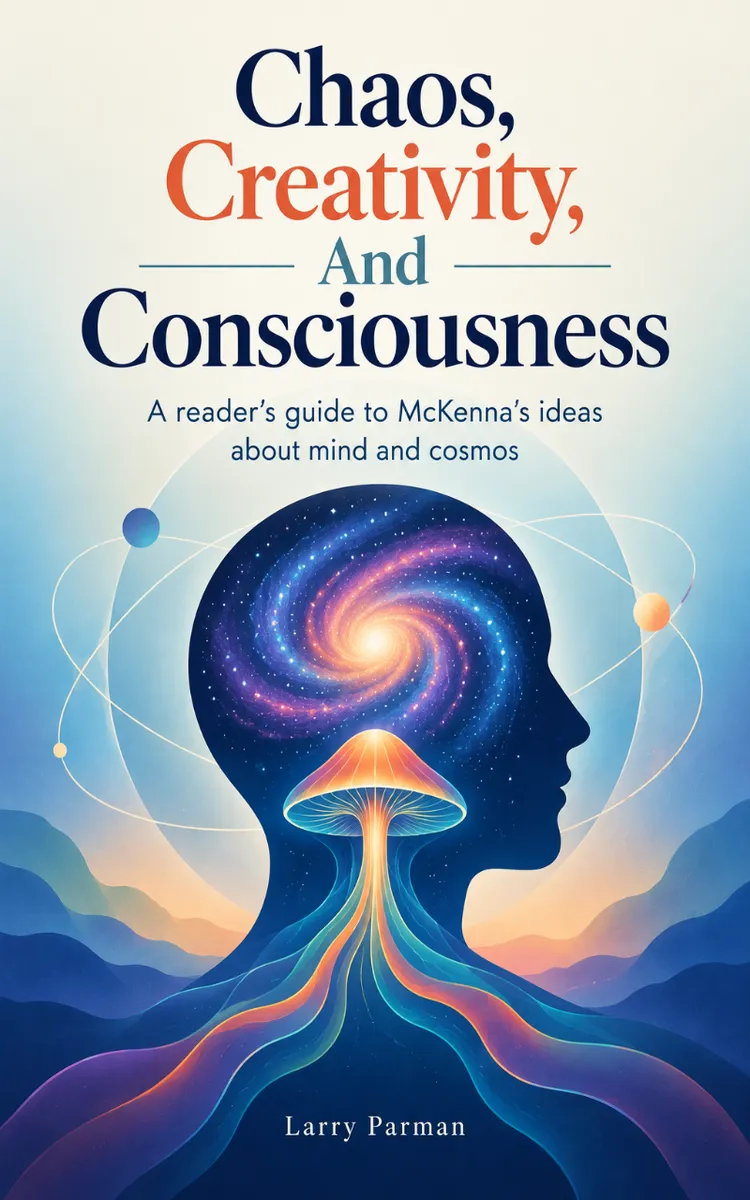
"Chaos, Creativity, And Consciousness" is a curiosity book by Larry Parman with 8 chapters and approximately 13,479 words. A summary of Terence McKenna’s ideas on chaos, creativity, and cosmic consciousness.
This book was created using Inkfluence AI, an AI-powered book generation platform that helps authors write, design, and publish complete books.
Frequently Asked Questions
What is "Chaos, Creativity, And Consciousness" about?
A summary of Terence McKenna’s ideas on chaos, creativity, and cosmic consciousness
How many chapters are in "Chaos, Creativity, And Consciousness"?
The book contains 8 chapters and approximately 13,479 words. Topics covered include Why Psychedelics Feel Like Other Worlds, The Mushroom as a Messenger, Language at the Edge of Experience, Creativity as a Cosmic Force, and more.
Who wrote "Chaos, Creativity, And Consciousness"?
This book was written by Larry Parman and created using Inkfluence AI, an AI book generation platform that helps authors write, design, and publish books.
Write your own curiosity book with AI
Describe your idea and Inkfluence writes the whole thing. Free to start.
Start writingCreated with Inkfluence AI


