
Read the first chapter
The whole of chapter one, free. About 9 min. Turn the pages with the arrows, your keyboard, or a swipe.
Chapter 1
Why Rain Gods Still Matter
When the Sky Became a Person
In the dry season of 1980, archaeologists working at Palenque, in the Mexican state of Chiapas, found evidence that Maya rulers treated rainfall as more than weather. Water, maize, kingship, and the underworld were tied together in inscriptions and ritual spaces, as if the survival of a community depended on keeping several worlds in agreement. The striking fact is that rain was both a physical event and a social relationship.
That double meaning still surrounds us. A failed harvest once threatened a village directly; today, drought, floods, crop prices, power shortages, and changing weather patterns arrive through forecasts, alerts, insurance notices, and news reports. The instruments have changed, but the underlying unease has not. Human beings remain vulnerable to forces too large to control and too important to ignore.
The Maya rain-making traditions offer a way to examine that unease without reducing ancient religion to a primitive version of modern science. Through the Weather-to-Worry Lens, weather becomes a window onto the fears that gather around survival: Will there be enough food? Will the seasons remain dependable? Can a community act together when danger is uncertain? Myth gives these questions a face, a name, and a place in a larger order.
When danger has no face, how does a society learn what it is facing?
Chaac and the Work of Rain
Across the Maya world, rain was associated with Chaac, a powerful deity whose imagery appears in temples, ceramics, and carved stone. Chaac is often shown with a long, curling nose, prominent eyes, and an axe or lightning weapon. The image is not a portrait in the modern sense. It gathers several features of the storm into one recognizable presence: thunder, lightning, wind, and the sudden arrival of water.
Maya communities depended heavily on maize, beans, squash, and other crops whose success rested on seasonal rainfall. In the lowlands of the Yucatán Peninsula, the problem was not simply whether rain existed. Water might arrive in violent bursts, disappear for weeks, or collect in places where it could not easily be used. The peninsula’s limestone ground absorbs water quickly, while natural wells and underground reservoirs provide uneven access. Rain was therefore both blessing and hazard.
Maya rain-making traditions developed within this practical landscape. Rituals connected people to Chaac and to other sacred powers associated with caves, springs, mountains, and the underworld. Caves were especially important because they could be understood as entrances to watery realms beneath the earth. A community seeking rain was not addressing an abstract atmosphere. It was engaging a living geography in which water had origins, guardians, and consequences.
The famous cenotes of Yucatán made this relationship visible. These sinkholes, formed when limestone collapsed over underground water, supplied drinking water and served as sacred places. At Chichén Itzá, the Sacred Cenote received offerings over centuries, including objects made of jade, gold, wood, and other materials. The offerings do not prove that people believed a simple transaction was taking place - one gift for one storm. They show instead that water was part of a moral and religious order, one in which humans, rulers, ancestors, and supernatural powers were connected.
Maya rulers presented themselves as mediators between these realms. Their ceremonies could include bloodletting, offerings, processions, and appeals to divine forces. Such acts were not separate from politics. A ruler’s authority depended partly on the ability to maintain order, and rainfall was among the clearest tests of whether order had been maintained.
The rain god’s importance, then, lay not only in controlling clouds. Chaac made the uncertainty of agriculture intelligible. A late storm could be described as a failure in a relationship, a disturbance in cosmic balance, or a problem requiring ritual attention. That explanation did not remove the risk. It placed the risk inside a world that people could name.
The Weather-to-Worry Lens
The Weather-to-Worry Lens begins with a simple observation: people rarely fear weather as weather. They fear what weather does to bodies, homes, food stores, debts, roads, and futures. A storm matters because it can destroy a crop, isolate a settlement, or expose the limits of political power.
This is why rain gods are not merely ancient explanations for meteorology. They are figures formed at the meeting point between natural force and human consequence. Chaac’s axe can be read as lightning, but it also expresses the sharpness of uncertainty. A storm is sudden, visible, and powerful; a drought is quieter, accumulating day after day. Both become easier to discuss when represented through an agent.
Modern societies have not eliminated this need for recognizable agents. We speak of El Niño as if it were a troublemaker moving across the Pacific, although it is a complex climate pattern involving ocean temperatures, winds, and atmospheric circulation. We name hurricanes, track their paths, and watch colored maps as though a storm’s identity helps us grasp its behavior. Scientific language gives us mechanisms; naming gives those mechanisms a shape that communities can follow.
The comparison should not be pushed too far. A weather pattern is not a deity, and a satellite image is not a ritual offering. Yet both ancient myth and modern forecasting respond to the same human difficulty: environmental danger is often too large, dispersed, or delayed to experience as a single event. A drought may begin with a small change in rainfall and become a crisis only after months. A warming climate may alter planting seasons, insect populations, water supplies, and insurance markets without producing one dramatic moment at which “the danger” appears.
A brief fact carries unusual weight here: the Maya did not need modern climate science to understand that rainfall could be seasonal, uneven, and politically consequential. Their explanations differed from ours, but their attention to patterns was not absent. Farmers observed skies, soils, plants, animals, and the timing of storms. Ritual and practical knowledge occupied the same world.
The Weather-to-Worry Lens therefore changes the question. Instead of asking whether Chaac was a correct scientific explanation, it asks what kind of human problem Chaac made visible. The answer includes drought, but also responsibility, dependence, authority, and the fear that a community might not be able to secure its own future.
Drought, Data, and the Return of the Unmanageable
The surprising connection is that modern climate anxiety often resembles ancient rain religion less in its beliefs than in its structure. Both confront a force that is partly observable, partly unpredictable, and capable of exposing failures in the human systems built around it.
This matters because scientific knowledge does not automatically make danger feel manageable. A weather model can improve forecasts while leaving farmers, cities, and governments exposed to consequences they cannot fully control. Data may tell us that rainfall is becoming less reliable; it does not by itself answer who should bear the cost, which communities deserve protection first, or how a society should interpret loss.
For Maya communities, rain rituals joined environmental observation to social coordination. Ceremonies gathered people around a shared concern and placed that concern within a common story. Modern societies have their own coordinating forms: emergency broadcasts, reservoir reports, drought declarations, evacuation maps, and international climate assessments. These are not myths in the traditional sense, but they also translate an immense system into signs that people can recognize and act upon collectively.
The difference is that modern institutions often separate facts from meaning. A rainfall chart may describe what has happened, while public argument struggles over what it means. Ancient myth fused those questions. The same sacred order that explained the storm also addressed obligations among rulers, farmers, ancestors, and divine powers.
This fusion could become oppressive. If drought was interpreted as evidence of ritual failure or moral disorder, vulnerable people might be blamed for a crisis they did not cause. Modern societies make similar errors when they treat climate disasters as individual failures rather than consequences of infrastructure, policy, inequality, and geography. The language has changed, but the temptation to turn complex danger into a judgment about particular people remains.
Myth’s strength was not that it made every natural event predictable. Its strength was that it made uncertainty socially legible. Chaac stood where weather became responsibility. The storm could be feared, negotiated with, celebrated, and woven into the identity of a place.
Palenque and the Politics of Water
At Palenque, the relationship between rain and rulership can be seen in the city’s architecture and inscriptions. The site was built in a humid region of southern Mexico, where heavy seasonal rains shaped agriculture, construction, and movement. Its rulers sponsored elaborate water systems, including channels that helped manage streams flowing through the settlement. Sacred meaning and practical engineering were not opposing activities; both expressed the importance of controlling and honoring water.
The city’s inscriptions present kings as participants in a cosmic order that included gods, ancestors, and forces of nature. In Maya royal art, rulers appear in ceremonies involving supernatural beings and agricultural symbols. Such scenes made political authority visible as a religious duty. A king was not simply a person who occupied a palace. He was expected to sustain relations between the human community and the powers on which its survival depended.
That expectation placed rulers in a difficult position. Rain could not be commanded with certainty, yet kingship implied a special capacity to preserve order. When harvests failed, the gap between authority and control became clear. A ruler might perform the right ceremonies, maintain alliances, and manage waterworks, but the sky remained beyond complete human command.
Archaeological evidence from the wider Maya region suggests that drought contributed to periods of political stress, including the disruptions associated with the decline of many Classic Maya centers between the eighth and tenth centuries. Climate was not the sole cause. Warfare, competition among states, population pressure, and political instability also mattered. The important point is that environmental strain became dangerous through institutions. A dry period could weaken food supplies, undermine confidence in rulers, intensify conflict, and encourage migration.
Modern communities face the same layered danger. A drought does not become a crisis only because rainfall decreases. It becomes a crisis when reservoirs are low, crops fail, electricity becomes expensive, food systems tighten, and political trust weakens. The weather is real, but its social meaning is built through the structures that receive it.
Palenque’s water channels and sacred imagery belong to a world very different from a contemporary drought-monitoring center. Yet both reveal a common fact: survival is never only a matter of nature. It depends on how a community organizes its knowledge, authority, labor, and hope around forces that remain partly outside human control.
The Face We Give the Storm
Rain gods still matter because danger becomes easier to live with when it can be recognized as part of a relationship rather than experienced as meaningless pressure. Chaac did not make the Maya independent of weather. He expressed their dependence in a form that could enter stories, ceremonies, buildings, and political claims.
Modern people often imagine that science has removed the need for such figures. More accurately, science has multiplied the ways we describe danger while leaving the emotional and social problem intact. A satellite can show a storm’s spiral; a climate model can trace a trend; neither image alone explains what a threatened community owes its neighbors or how loss should be remembered.
Myth gives danger a human face, but it also reveals the limits of human power. The face may be divine, monstrous, ancestral, or symbolic. Behind it stands the same unsettling recognition: the world on which life depends does not belong entirely to us. Rain falls through a culture’s stories before it reaches the ground, and in those stories we can see what each society fears losing - and what it believes might still hold the sky and the human world together.
End of chapter one. 7 more chapters and about 14,302 words in the full book.
Swipe or use the arrows to turn the page


What's inside: 8 chapters
- 1. Why Rain Gods Still Matter
- 2. Who Gets to Rule the Sky?
- 3. The Ritual That Makes a World
- 4. Desire Wears a Sacred Mask
- 5. What Death Cannot Explain
- 6. Awakening Without a Creator
- 7. Campbell’s Masks, Not One Myth
- 8. The Questions We Keep Asking
About this book
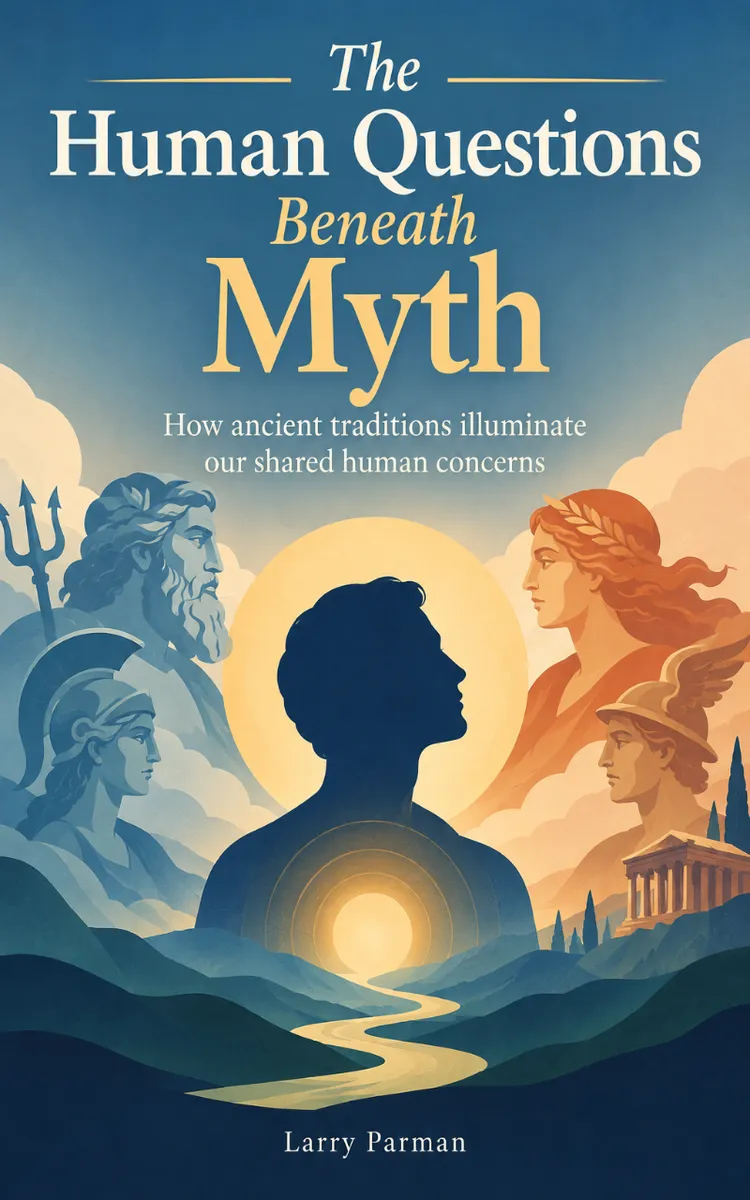
"The Human Questions Beneath Myth" is a curiosity book by Larry Parman with 8 chapters and approximately 14,302 words. Comparative mythology and recurring human concerns across religious traditions.
This book was created using Inkfluence AI, an AI-powered book generation platform that helps authors write, design, and publish complete books.
Frequently Asked Questions
What is "The Human Questions Beneath Myth" about?
Comparative mythology and recurring human concerns across religious traditions
How many chapters are in "The Human Questions Beneath Myth"?
The book contains 8 chapters and approximately 14,302 words. Topics covered include Why Rain Gods Still Matter, Who Gets to Rule the Sky?, The Ritual That Makes a World, Desire Wears a Sacred Mask, and more.
Who wrote "The Human Questions Beneath Myth"?
This book was written by Larry Parman and created using Inkfluence AI, an AI book generation platform that helps authors write, design, and publish books.
Write your own curiosity book with AI
Describe your idea and Inkfluence writes the whole thing. Free to start.
Start writingCreated with Inkfluence AI


