
Read the first chapter
The whole of chapter one, free. About 9 min. Turn the pages with the arrows, your keyboard, or a swipe.
Chapter 1
Why Myths Wear Many Masks
The Question Behind Every Mask
What if a Maya rain god, a Greek sky god, and a Buddhist image of awakening were not separate answers to separate questions, but different ways of speaking about problems human beings repeatedly face? Their names, rituals, and stories belong to particular cultures. Yet beneath those differences appear familiar concerns: birth, death, danger, desire, order, loss, and the strange fact of being conscious at all.
This is the central tension in Joseph Campbell’s The Masks of God. Myth is never simply a false story left behind by science. Nor is it a single universal code that every culture disguises in the same way. It is a symbolic language shaped by local history and landscape, expressing experiences that no society escapes.
Campbell’s Many-Masks Lens holds both facts together. It asks us to notice the recurring human concern beneath a symbol without stripping away the culture that gave the symbol its particular form. A mask conceals a face, but it also makes a face visible. What might the world’s different gods be saying about the same human condition?
One Human Problem, Many Sacred Languages
Campbell’s argument grew from a long history of comparison. European scholars had been comparing myths for centuries before he wrote The Masks of God, but earlier comparisons often ranked cultures according to European standards. Campbell worked within a different intellectual climate, shaped by anthropology, psychology, archaeology, and the study of religion. He treated myths as records of human imagination rather than as curiosities arranged on a ladder from “primitive” to “advanced.”
The four volumes of The Masks of God, published between 1959 and 1968, follow mythic traditions across broad regions and historical periods. Campbell examines primitive mythology, Oriental mythology, Occidental mythology, and creative mythology. These labels reflect the vocabulary of his era and are now dated, but his larger project remains clear: to trace both the recurring patterns and the cultural transformations through which myths take shape.
A myth about a flood, for example, is never just “the flood myth.” In the Hebrew Bible, Noah’s flood is tied to judgment, covenant, and a renewed relationship between God and humanity. In the Mesopotamian Epic of Gilgamesh, the flood story appears within a world of quarrelsome gods and fragile human life. In ancient Greece, Deucalion and Pyrrha survive a flood sent by Zeus and restore humanity by casting stones behind them. The event changes according to the moral and religious structure of each tradition.
The differences matter as much as the resemblance. If every flood story is reduced to a single formula - water destroys, survivors begin again - its cultural meaning disappears. Campbell’s comparison works in the opposite direction. Similarities invite the question of shared human concerns; differences show how communities answer those concerns according to their own histories.
A myth is therefore not a fossilized scientific explanation. It is closer to a cultural instrument, tuned to make invisible pressures audible. It gives shape to anxiety about catastrophe, to the hope of renewal, and to the problem of how a damaged world might continue.
Symbols Do More Than Stand for Ideas
The power of myth lies partly in its symbols. A symbol does not merely point to one fixed meaning, as a road sign points to a turn. It gathers several meanings at once. A serpent may represent danger, healing, renewal, sexuality, wisdom, or the power of the underworld, depending on the tradition in which it appears.
The ouroboros, the serpent biting its own tail, offers a useful example. In ancient Egyptian imagery and later alchemical traditions, the circular serpent could suggest cyclical time, self-renewal, and the unity of beginnings and endings. In the biblical story of Moses, a bronze serpent becomes an instrument associated with healing. In the Greek myth of Asclepius, a staff with a serpent becomes linked to medicine. These are not interchangeable symbols, but the serpent’s capacity to shed its skin makes it an especially durable image of transformation.
Campbell drew on the work of Carl Jung, who argued that myths and dreams often express psychological patterns through images rather than abstract propositions. Campbell did not claim that every culture tells exactly the same story because all people possess identical private thoughts. His claim was subtler: human beings share bodily conditions and recurring emotional problems, and cultures develop symbolic forms for dealing with them.
Birth and death provide the most obvious examples. Every society must interpret the arrival of new life, the loss of the dead, and the uncertain boundary between the two. The Egyptian Osiris is killed, dismembered, and restored through the devotion of Isis. Persephone descends into the underworld and returns in the Greek account of the seasons. In Christian tradition, the crucifixion and resurrection of Jesus give death and renewal a radically different historical and theological shape. The stories are not the same, but they all address the unsettling possibility that disappearance may not be the final word.
One surprising fact is that myths often preserve their force after people stop treating them as literal history.
That matters because mythic meaning does not depend entirely on factual belief. A modern reader may not accept that a god physically descended into an underworld, yet the image can still express grief, separation, return, and the hope that loss may be transformed. The story continues to work because symbols address more than the part of the mind that checks whether an event occurred exactly as described.
Culture Changes the Shape of the Sacred
Campbell’s comparisons become most revealing when geography and history enter the picture. Religious symbols are not produced in a vacuum. Herding societies, farming societies, city states, empires, and trading cultures encounter different dangers and organize life in different ways. Their myths absorb those conditions.
The ancient Near Eastern myths of dying and returning vegetation emerged in societies dependent on the rhythms of agriculture. The fate of crops could determine whether a community survived the year. In Greek myth, Demeter’s grief over the disappearance of Persephone explains the seasonal withdrawal of the earth. In Mesopotamian traditions surrounding Inanna’s descent, the underworld becomes a place of irreversible law and exchange. Each story connects personal loss with a larger order of nature, but the emotional and political meanings differ.
The same process appears in the treatment of the hero. Gilgamesh, king of Uruk, begins as a powerful ruler who must confront the death of his companion Enkidu. His search for immortality ends not with escape from mortality but with recognition of the limits of human life and the lasting work of civilization. In the Greek story of Heracles, extraordinary strength and suffering lead through labor, punishment, and eventual apotheosis. In the Buddha’s story, the central victory is not conquest of enemies but release from attachment and ignorance.
Calling these figures all “heroes” is useful only if the word remains flexible. Each one embodies a different cultural response to the question of what a human being should become. Gilgamesh learns the boundary between human and divine. Heracles proves himself through violent trials. The Buddha rejects the search for permanent satisfaction in the world of change. The recurring pattern is not a single moral lesson but the pressure of transformation.
This is where the Many-Masks Lens prevents comparison from becoming flattening. It notices the family resemblance among stories while preserving their distinct faces. A Buddhist image of liberation cannot be treated as a Greek heroic ascent with different costumes. Its purpose, vocabulary, and view of desire belong to a different religious world.
A Map of Human Experience, Not a Dictionary of Myths
Campbell’s method can be understood as a map rather than a dictionary. A dictionary assigns a meaning to a word. A map shows relationships: where one place lies in relation to another, what terrain separates them, and which routes connect them. Comparative mythology does something similar with human concerns.
The map becomes especially useful when myths change across time. Ancient symbols are often carried into new religious systems, where they acquire new meanings. The serpent, the tree, the mountain, the mother, and the sacred child appear in many traditions, but none remains untouched by historical change. A symbol can be inherited, resisted, reinterpreted, or absorbed into a new vision of the world.
Campbell saw modern art and literature as part of this continuing process. When a society’s inherited religious images lose their authority, the symbolic need does not necessarily vanish. It may reappear in novels, films, painting, poetry, or personal visions. The artist becomes a maker of new masks for old pressures: mortality, isolation, love, violence, freedom, and the search for meaning.
That claim does not mean that every modern story is secretly a religious myth. It means that human beings continue to use images and narratives to approach questions that cannot be settled by information alone. A scientific account can describe how stars form. It does not by itself tell a culture what the night sky means, how mortality should be faced, or why one life should matter.
The myths of a society reveal what that society fears, honors, and considers possible. Their masks are cultural, but the face beneath them belongs to human life.
Osiris, Isis, and the Egyptian Work of Renewal
Ancient Egypt gives Campbell’s argument a particularly clear human setting. Along the Nile, the annual flood shaped agriculture, settlement, and political power. The river’s rise and retreat made renewal visible as a natural process, but Egyptian religion connected that process to divine kingship, death, and the maintenance of cosmic order.
In the myth of Osiris, the god and king is murdered by his brother Seth, whose violence fragments the established order. Isis searches for Osiris, gathers his scattered body, and restores him sufficiently for the conception of Horus. Osiris does not simply return to ordinary earthly life. He becomes ruler of the dead, while Horus grows into the figure who confronts Seth and restores rightful kingship.
The story contains several layers at once. It explains a divine succession, gives form to the grief of a wife and the duty of a son, and links agricultural renewal with the hope of continued existence after death. Egyptian funerary practices, including mummification and the furnishing of tombs, show that these concerns were not confined to stories. They shaped objects, ceremonies, architecture, and the treatment of the dead.
Yet Osiris is not merely an Egyptian version of every dying-and-rising god. His role is bound to Egyptian ideas of kingship, family obligation, judgment, and cosmic balance. The myth’s recurring human concerns become visible through specifically Egyptian symbols and institutions. That is Campbell’s central claim in miniature: humanity supplies the questions, while culture gives them names, bodies, places, and destinies.
The Human Face Behind the Divine Forms
Myths wear many masks because no human concern appears in a purely abstract form. Fear becomes a monster, renewal becomes a returning god, wisdom becomes an old woman or a serpent, and the unknown becomes a journey into darkness. The image is not decoration added after the idea; it is the way the idea becomes thinkable.
Campbell’s work remains valuable when it holds universal experience and cultural difference in the same frame. Human beings may share mortality, but they do not mourn in one language. They may all face uncertainty, but they build different sacred worlds around it. Every mask is shaped by a particular people, yet each may catch the light of a question found far beyond its birthplace.
The world’s myths do not conceal one final answer waiting to be decoded. They offer a gallery of human attempts to speak about what exceeds ordinary speech - and the next mask may reveal as much about its makers as about the mystery they faced.
End of chapter one. 7 more chapters and about 13,839 words in the full book.
Swipe or use the arrows to turn the page


What's inside: 8 chapters
- 1. Why Myths Wear Many Masks
- 2. When Myth Becomes a Map
- 3. The Birth of the Cosmic Image
- 4. How Agriculture Rewrote the Sacred
- 5. The Hero Enters History
- 6. The East Turns Inward
- 7. When Revelation Meets Reason
- 8. Finding the Sacred Without a Script
About this book
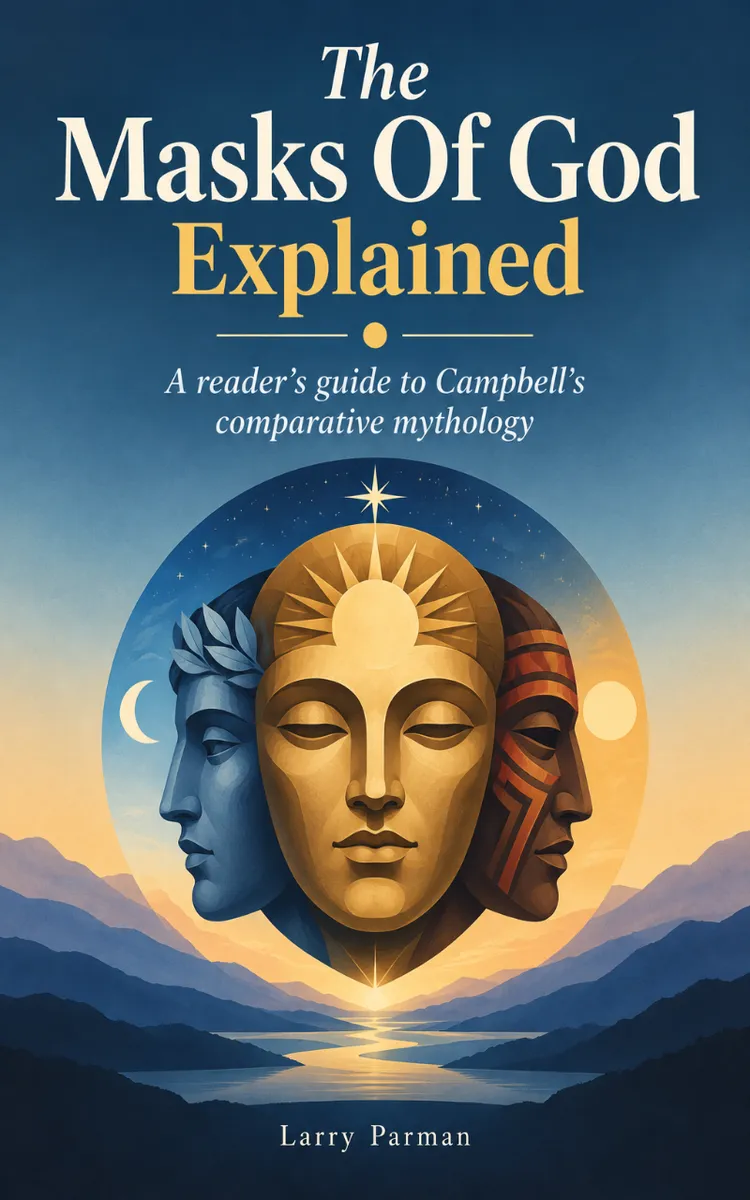
"The Masks Of God Explained" is a curiosity book by Larry Parman with 8 chapters and approximately 13,839 words. Joseph Campbell’s exploration of world mythologies and religious traditions.
This book was created using Inkfluence AI, an AI-powered book generation platform that helps authors write, design, and publish complete books.
Frequently Asked Questions
What is "The Masks Of God Explained" about?
Joseph Campbell’s exploration of world mythologies and religious traditions
How many chapters are in "The Masks Of God Explained"?
The book contains 8 chapters and approximately 13,839 words. Topics covered include Why Myths Wear Many Masks, When Myth Becomes a Map, The Birth of the Cosmic Image, How Agriculture Rewrote the Sacred, and more.
Who wrote "The Masks Of God Explained"?
This book was written by Larry Parman and created using Inkfluence AI, an AI book generation platform that helps authors write, design, and publish books.
Write your own curiosity book with AI
Describe your idea and Inkfluence writes the whole thing. Free to start.
Start writingCreated with Inkfluence AI


