
Read the first chapter
The whole of chapter one, free. About 8 min. Turn the pages with the arrows, your keyboard, or a swipe.
Chapter 1
Designing the Hero’s Ordinary World
Begin with the Life the Hero Cannot Simply Leave
At dawn, a medieval baker did not begin with a grand destiny. She checked the flour, owed rent to a miller, answered to a guild, and measured her work against the hunger of neighbors who knew her name. Those details matter more than a dramatic opening speech. They show what she values, what limits her choices, and which rules her later journey might break.
The Ordinary World means the hero’s normal life before the adventure begins. In a historical epic, that life must feel specific enough to resist easy escape. A hero who leaves “the village” has little to lose. A hero who leaves a leased farm, an aging parent, a sworn employer, and a reputation built over twelve years carries the social order into every later decision.
A strong ordinary world solves three problems at once: it grounds the period, gives the hero visible pressures, and creates the contrast that makes the Call to Adventure matter. By the end of this work, you should have a daily routine, a clear set of obligations, and a social structure that the hero may defend, endure, or disrupt. Ask yourself: what must this person do before pursuing anything extraordinary?
Build the Ordinary World Through the Living World Lens
The Living World Lens treats daily life as a working system rather than a decorative backdrop. Study four connected parts: labor, resources, relationships, and rules. Each part should affect the hero’s choices on the page.
1. Map the workday. Write the hero’s first five tasks after waking, the tools used, the people encountered, and the task that ends the day. Work reveals values because it shows what the hero protects through repeated effort. A shipwright who checks every joint twice values reliability; a court clerk who copies petitions late into the night values order or fears punishment.
2. Set the material limits. Decide what the hero can afford, obtain, repair, carry, and replace. Record food, clothing, transport, weapons, fuel, and shelter. These limits prevent convenient solutions. If a mounted messenger owns one lame horse, a broken stirrup becomes a serious problem rather than a minor inconvenience.
3. Draw the social ladder. Name the people and institutions with power over the hero: household, guild, landlord, temple, army, court, clan, or town council. Then state what each expects. Social order becomes dramatic when the reader understands the cost of disobedience. A woman who inherits a workshop may still need a male guardian to sign contracts; a minor noble may possess a title but lack money to maintain soldiers.
4. Choose the daily compromise. Give the hero one rule they obey even when it hurts and one rule they quietly bend. This contrast reveals character without explanation. A healer may refuse payment from the poor but falsify a tax record to obtain medicine. The first action shows compassion; the second shows a willingness to challenge authority.
Now test the four parts against the historical period. Do not begin with modern categories such as “career” or “personal freedom” and place old clothing around them. Ask what people in that society called work, honor, family duty, property, crime, and belonging. Check primary material when possible: household accounts, legal codes, letters, tax records, craft regulations, travel descriptions, and surviving tools. Use those sources to confirm what the hero can plausibly know and do.
Build the setting at the scale the hero experiences it. A peasant may understand a king through taxes, soldiers, sermons, and rumors rather than direct contact. A royal adviser may experience the same kingdom through schedules, petitions, seals, and rival offices. Both belong to the same historical world, but they do not possess the same map of it. The hero’s knowledge should come from daily access, not from the author’s overview.
A useful test checks whether each detail creates pressure. If you include a market, identify what the hero buys, sells, owes, or overhears there. If you include a festival, identify who may enter, who pays for it, and what behavior the event permits. If you include a household shrine, identify who maintains it and what failure would imply. Detail earns its place when it changes a choice.
Use a simple worksheet before drafting:
| Living World element | Question to answer | Example result | |---|---|---| | Labor | What must happen before noon? | Dye three wool lengths before the guild inspection | | Resources | What can fail today? | The only copper dye pot develops a crack | | Relationships | Who can demand obedience? | An older brother controls the workshop lease | | Rules | What cannot happen openly? | A married woman cannot sign the export contract | | Compromise | What does the hero risk already? | She hides a foreign buyer from the guild officer |
The ordinary world works when the reader can predict the hero’s obligations before the hero breaks them. Your practical takeaway: create a day that functions without the plot, then identify the exact pressure that makes the plot impossible to ignore.
Apply the Lens to a Working Historical Hero
Use a late medieval textile town as a test case. The hero, Mara, manages a small dye workshop in Bruges in 1468. She supports her widowed mother, owes two weeks of rent to a property owner, and must pass a guild inspection in six days. Her workshop produces blue wool for merchants who sell cloth beyond the town.
1. Set the morning routine. At 5:30 a.m., Mara unlocks the courtyard, checks three dye vats, counts 18 lengths of wool, and sends her apprentice to collect madder root. The expected outcome: the reader sees skilled labor before hearing about any quest.
2. Set the resource pressure. The workshop has one sound copper vat, 4 sacks of fuel, and enough madder for 12 lengths. A replacement vat costs more than Mara’s available cash. The expected outcome: a damaged tool threatens both income and guild standing.
3. Set the social demands. Her brother holds the lease because local custom gives him control of the family business after their father’s death. The guild permits Mara to work but requires his signature for a large export order. The expected outcome: her competence cannot erase the legal barrier.
4. Set the relationships. Her mother expects daily care, the apprentice expects instruction, and the merchant expects delivery by Saturday. Mara cannot leave without shifting the burden onto named people. The expected outcome: departure creates consequences rather than a clean break.
5. Set the compromise. Mara secretly sells two lengths to a foreign trader because the price will cover the rent. The guild forbids unregistered sales. The expected outcome: her first act of defiance already connects survival with the social order she may later challenge.
6. Connect the Call to Adventure. On the fourth morning, a sealed order arrives from a border commander requesting blue cloth and asking Mara to identify a dye mark found on captured banners. The request threatens her routine: answering may expose the illegal sale, while refusing may endanger the town’s trade. The expected outcome: the Call grows from established pressures instead of arriving as an unrelated surprise.
Check the scene against the Living World Lens. Labor gives Mara skill. Resources give her a hard limit. Relationships give her obligations. Rules give her a barrier. The compromise gives her a moral fault line. Together, these elements show why she might act and what she may lose.
Quick checklist
• List five tasks the hero performs before the day’s main meal. - Name three objects the hero depends on and the cost of replacing each. - Identify two people who can demand the hero’s labor. - Write one public rule and one private workaround. - Give the hero one deadline within the first week. - Connect the Call to Adventure to an existing duty, tool, debt, or relationship. - Remove any historical detail that creates no pressure or choice.
If the scene works, a reader should understand the hero’s normal life without an explanatory lecture. The reader should also see how the Call disturbs a system that already feels complete.
Avoid a Decorative Past
Mistake: Treating history as costume
A character may wear period clothing, use old currency, and live in a stone building while thinking and behaving like a modern person with different furniture. This weakens the social order because the reader never sees how it shapes conduct.
Do this: Tie behavior to a period rule. Show who controls property, who speaks in public, who receives education, and who carries legal responsibility.
Not this: Add a feast, sword, or church bell merely to signal the century.
Give each visible custom a consequence. If a household follows inheritance law, show who receives land and who must leave. If a guild controls trade, show how inspection affects prices, employment, and reputation.
Mistake: Giving the hero unlimited access
A hero who reads every document, travels freely, speaks every language, and obtains any tool can bypass the period’s real barriers. The journey then feels easy before it begins.
Fix access deliberately. Write three columns: what the hero knows, what the hero can reach, and what the hero only hears as rumor. A village midwife may know local plants but lack court records. A noble envoy may enter archives but misunderstand village labor. Limits create useful misunderstandings and force the hero to seek help.
Mistake: Making the ordinary world too pleasant or too bleak
A perfect home gives the hero no reason to change. A place of constant misery gives the hero no meaningful attachment. Both versions flatten the Call to Adventure.
Give the hero something worth preserving and something that must change. Mara may love the workshop’s craft, trust her apprentice, and resent the guild’s restrictions. That mixture creates conflict with direction.
Do this: Pair one genuine comfort with one daily injustice.
Not this: Label the society “good” or “bad” before showing how different people experience it.
The strongest Ordinary World does not merely hold the hero in place. It teaches the hero what counts as duty, success, shame, and belonging. When the Call arrives, the reader understands exactly which parts of life the hero risks - and which rules the journey may force the hero to question.
End of chapter one. 7 more chapters and about 15,810 words in the full book.
Swipe or use the arrows to turn the page


What's inside: 8 chapters
- 1. Designing the Hero’s Ordinary World
- 2. Creating a Historically Rooted Call
- 3. Making Refusal Cost Something
- 4. Building a Mentor from the Era
- 5. Crossing into the Special World
- 6. Staging Tests, Allies, and Enemies
- 7. Preparing the Inmost Cave Ordeal
- 8. Designing the Return with the Elixir
About this book
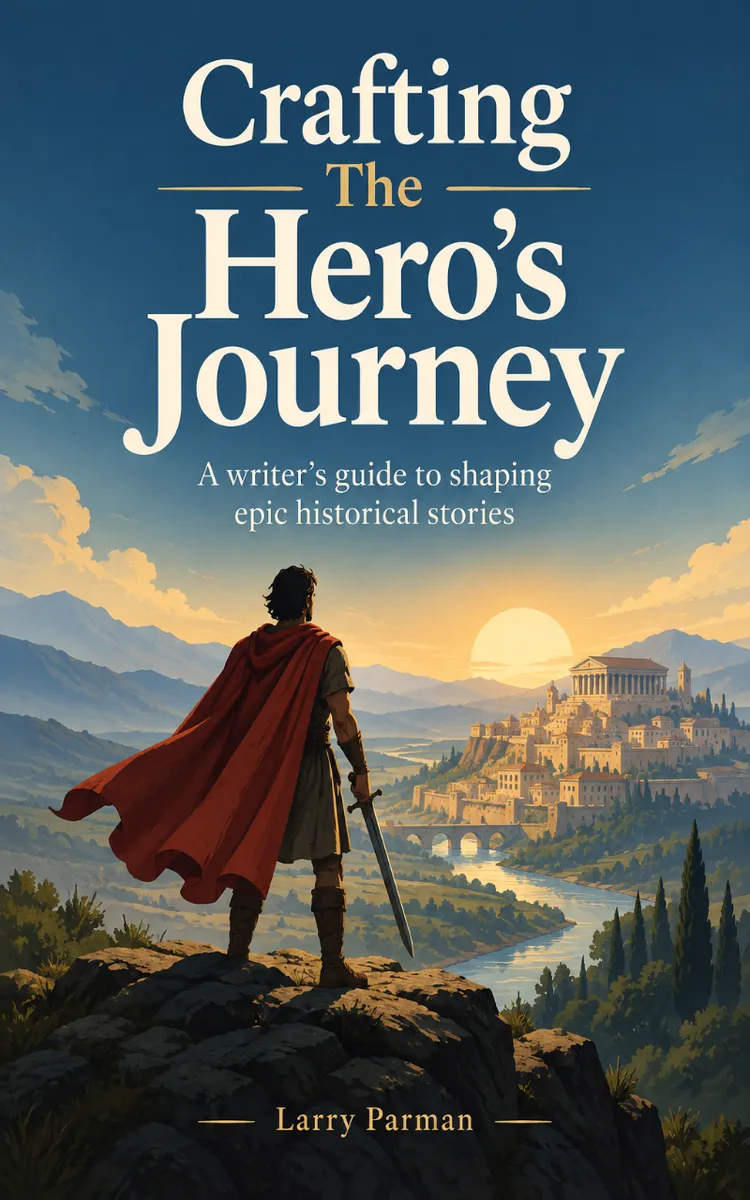
"Crafting The Hero’s Journey" is a how-to guide book by Larry Parman with 8 chapters and approximately 15,810 words. A medieval baker cannot leave for adventure without leaving flour, rent, a guild, and hungry neighbors behind. That is where a convincing historical epic begins: not with destiny, but with the obligations that make escape costly.
This book was created using Inkfluence AI, an AI-powered book generation platform that helps authors write, design, and publish complete books. It was made with the AI Ebook Generator.
Frequently Asked Questions
What is "Crafting The Hero’s Journey" about?
A medieval baker cannot leave for adventure without leaving flour, rent, a guild, and hungry neighbors behind. That is where a convincing historical epic begins: not with destiny, but with the obligations that make escape costly. Crafting The Hero’s Journey shows you how to build an Ordinary World from labor, resources, relationships, and the rules of a particular time. Then you can make the Call to Adventure collide with those pressures. Use the same framework to make hesitation matter. When a hero refuses the Call, the danger keeps moving: supplies disappear, enemies advance, and someone else pays the price. Across eight chapters, you’ll shape a hero’s choices around the historical world they must defend, endure, or disrupt. Put the hero’s daily life on the page, and the first step beyond it will carry real weight.
How many chapters are in "Crafting The Hero’s Journey"?
The book contains 8 chapters and approximately 15,810 words. Topics covered include Designing the Hero’s Ordinary World, Creating a Historically Rooted Call, Making Refusal Cost Something, Building a Mentor from the Era, and more.
Who wrote "Crafting The Hero’s Journey"?
This book was written by Larry Parman and created using Inkfluence AI, an AI book generation platform that helps authors write, design, and publish books.
How can I create a similar how-to guide book?
You can create your own how-to guide book using Inkfluence AI. Describe your idea, choose your style, and the AI writes the full book for you. It's free to start.
Write your own how-to guide book with AI
Describe your idea and Inkfluence writes the whole thing. Free to start.
Start writingCreated with Inkfluence AI


